Eight lawmakers from Iyad Allawi’s Iraqi National Movement announced their split from the list on March 7, 2011. The group consists of Minister of State for Tribal Affairs Jamal Batikh, Hassan Aliwi, Aliya Nassif, Khadim Shammari, Aziz Maahi, Qutaiba Jabouri, and Ahmed Oaibi. Together they formed the White Iraqi National Movement Party, led by Aliwi and Batikh, with Jabouri being their parliamentary head.
The new party provided several reasons for why they decided to leave the National Movement. One was that they claimed the parliament needed an opposition to keep the government honest, and represent the people. They also accused Allawi of failing to implement the National Movement’s program. They went on to say that the National Movement had not fulfilled its promises to its followers, criticized the fact that Allawi could’ve aligned with Maliki to rule the country without all the other parties but didn’t, and that the planned National Council for Strategic Policies was a failed idea.
Currently there is only one winning party that did not join the national unity government. That is the Kurdish opposition party the Change List. They won eight seats in the March 2010 election, but quit the Kurdish Coalition and a chance to join Prime Minister Nouri al-Maliki’s new administration in October 2010. They too felt there were problems with the leaders of their list, and decided to go it alone.
Together the White Iraqi National Movement Party and the Change List have 16 out of 325 seats in the new parliament. This is the first time since the first post-Saddam Hussein elections were held in January 2005 that parties have decided to not join the government. Politicians have always felt that being part of the ruling coalition, and reaping its benefits, namely gaining ministries, outweighed any other course of action. Now two small groups of parliamentarians have chosen to take the bold step of standing on their own. Whether they’re successful or not, could go a long way to convincing other parties to follow their lead, creating a real opposition in the legislature that can hold the prime minister responsible for his decisions, and monitor the actions of his ministers.
SOURCES
Alsumaria, “Eight MPs withdraw from Iraqiya, form new party,” 3/8/11
Shames, Abdullah, ”Eight al-Iraqiya deputies announce split from bloc,” AK News, 3/7/11
- “Newly-formed Iraqiya White Party says govt. needs opposition,” AK News, 3/8/11
Friday, March 11, 2011


Thursday, March 10, 2011
Iraqi Government Doesn’t Have Means To Deal With Refugee Problem Currently
In January 2011, the Ministry of Migration and Displacement announced that it had formulated a master plan to deal with Iraq’s displaced and refugees in one year. The United Nations High Commissioner for Refugees (UNHCR) praised the idea, saying that it hoped that it would be the beginning of the end of Iraq’s refugee problem. By February however, when details of the 2011 budget were published, the Ministry had to reverse course saying that it would not be receiving enough money to fully implement its program.
In February, the Deputy Minister of Migration and Displacement told the press that the 2011 budget would not provide enough money to complete its plans to deal with the country’s displaced and refugees. The Deputy Minister said that his agency needed $416-$500 million this fiscal year, but it would only be getting $250 million.
Just the month before, the same official laid out the Ministry’s plans. He stated that the government was going to solve the refugee issue within a year. The plan would include three options for the displaced. One would be to return them to their homes, another was to have them integrate into the communities they currently reside in, and the third was to relocate others to another area. The Ministry was coordinating these actions with the UNHCR. In order to implement the program, the government would secure areas where the displaced wanted to go back to, provide short-term loans for housing, give them back their old jobs, and provide services. The Ministry already created Return Assistance Centers in Baghdad, which has the largest refugee and displaced population. These facilities offer $850 for six-months for returnees to rent a new place. The government also renewed its efforts to try to get refugees to come back, by offering Iraqis in Egypt and Yemen free plane rides home, and $250 each. Because the Ministry is only getting half of what it expected, it will only be able to implement a fraction of what it wanted to do this year.
The plan might have been too ambitious to begin with. A former Minister of Migration and Displacement told Radio Free Europe/Radio Liberty that the Ministry’s plans were not coordinated with other ministries. Areas where refugees and displaced want to go back to are supposed to be secured by the Iraqi security forces for example, but this has not been discussed with the Interior Ministry. The Ministry of Migration’s program would also involve working with several other government agencies to provide housing and services, but this too has not been worked out. The problem with the Iraqi government is that the ministries are divided between the various political blocs in the ruling coalition, with many run like personal fiefs of their ministers. There is little to no dialogue between them as a result. Without an integrated plan, refugees and the displaced cannot be dealt with, and this was true even before the 2011 budget was announced.
SOURCES
Healy, Jack and Schmidt, Michael, “Iraq Tells Refugees in Egypt and Yemen: We’ll Pay You to Return,” New York Times, 2/10/11
IRIN, “IRAQ: Funding shortfall hits plans for IDPs, returnees,” 2/28/11
Radio Free Europe/Radio Liberty, “Iraq Drafts Plan To Help IDPs, Refugees,” 1/26/11
Wednesday, March 9, 2011
Why Didn’t The Iraqi Air Force Fight During The 2003 Invasion?
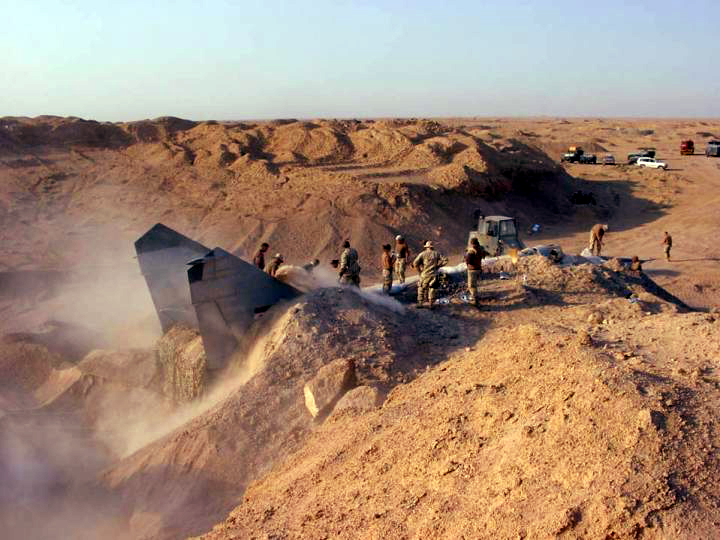
During the March 2003 U.S. invasion, the Iraqi Air Force did not show up. Saddam Hussein had 267 planes and helicopters at his disposal, but not a single one even left the ground during the war. Afterward, several dozen were found buried near air bases. The U.S. military claimed that the Iraqis were afraid to fly because of the Coalition’s air superiority. In fact, Baghdad was following a strategy shaped by the Iran-Iraq and Gulf wars.
Saddam believed that 2003 would be a limited conflict like 1991, where he would remain in power. According to captured documents found after the war, Saddam’s main priorities were: 1) a coup or a Shiite uprising, 2) regional threats from Iran and Israel, and finally 3) the Coalition in that order. He therefore wanted to preserve his forces to fight another day against the much more important internal threats and Tehran. This was the same strategy he took in previous wars.
In the Iran-Iraq War, Baghdad failed to destroy the Iranian air force on the ground in the opening attacks. Iraq then formulated a strategy of sending its air craft to friendly neighboring states where they could not be hit by Iran. That worked to preserve much of the air force during the war.
During the Gulf conflict, Iraq followed a similar plan. First, it tried to hide many of its planes by dispersing them throughout the country. When that didn’t work, it decided to send aircraft to the only nation that the Coalition would not hit, Iran. 173 fighters, bombers, and transports were flown to Iran as a result. The problem was, after the war, Tehran did not return the planes, and Iraq lost a sizeable piece of its air force.
The Gulf War shaped Saddam’s perceptions of the 2003 invasion. He believed there would be a massive air campaign, southern Iraq might be taken, but the U.S. would not enter Baghdad, and he would remain in office. Following this view, Iraq wanted to preserve its air force from what it thought would be a short conflict. That led it to hide its planes amongst trees, place destroyed aircraft on airfields as decoys, bury several dozen planes in the sand, and not fly a single sortie. After the war, U.S. forces looking for WMD dug up 24 Iraqi planes including MiG-25 fighters and Su-25 fighter-bombers in a western Baghdad air base.


Rather than being afraid to fight in 2003 as the Americans initially speculated, Iraq was simply following the same pattern it had set nearly twenty years before. Ever since the Iran-Iraq War, Baghdad had tried to protect its air force from its enemies by hiding them, either within the country, or in neighboring states during conflicts. Because Saddam did not see the U.S.-led coalition in 2003 as a real threat to his power, he did not want to waste his planes during the invasion, and chose to bury and camouflage them instead. That was the real lesson from the episode, in that it revealed Saddam’s flawed perceptions of the war that would unseat him.
SOURCES
Associated Press, “Iraqi Warplanes Found Buried in Desert,” 8/1/03
Global Security, “Iraqi Air Force Equipment – Introduction,” 1/22/05
Haulman, Daniel, “What Happened to the Iraqi Air Force?” Air Force Historical Research Agency, 11/5/09
Smith, Charles, “Iraqi ‘Mach 3’ MiG Buried in Sand,” Newsmax, 8/6/03
Woodsa, Kevin, Stout, Mark, “Saddam’s Perceptions and Misperceptions: The Case of ‘Desert Storm,’” Journal of Strategic Studies, February 2010
Saddam believed that 2003 would be a limited conflict like 1991, where he would remain in power. According to captured documents found after the war, Saddam’s main priorities were: 1) a coup or a Shiite uprising, 2) regional threats from Iran and Israel, and finally 3) the Coalition in that order. He therefore wanted to preserve his forces to fight another day against the much more important internal threats and Tehran. This was the same strategy he took in previous wars.
In the Iran-Iraq War, Baghdad failed to destroy the Iranian air force on the ground in the opening attacks. Iraq then formulated a strategy of sending its air craft to friendly neighboring states where they could not be hit by Iran. That worked to preserve much of the air force during the war.
During the Gulf conflict, Iraq followed a similar plan. First, it tried to hide many of its planes by dispersing them throughout the country. When that didn’t work, it decided to send aircraft to the only nation that the Coalition would not hit, Iran. 173 fighters, bombers, and transports were flown to Iran as a result. The problem was, after the war, Tehran did not return the planes, and Iraq lost a sizeable piece of its air force.
The Gulf War shaped Saddam’s perceptions of the 2003 invasion. He believed there would be a massive air campaign, southern Iraq might be taken, but the U.S. would not enter Baghdad, and he would remain in office. Following this view, Iraq wanted to preserve its air force from what it thought would be a short conflict. That led it to hide its planes amongst trees, place destroyed aircraft on airfields as decoys, bury several dozen planes in the sand, and not fly a single sortie. After the war, U.S. forces looking for WMD dug up 24 Iraqi planes including MiG-25 fighters and Su-25 fighter-bombers in a western Baghdad air base.
MiG-25 found July 2003 in western Baghdad (U.S. Air Force)
Rather than being afraid to fight in 2003 as the Americans initially speculated, Iraq was simply following the same pattern it had set nearly twenty years before. Ever since the Iran-Iraq War, Baghdad had tried to protect its air force from its enemies by hiding them, either within the country, or in neighboring states during conflicts. Because Saddam did not see the U.S.-led coalition in 2003 as a real threat to his power, he did not want to waste his planes during the invasion, and chose to bury and camouflage them instead. That was the real lesson from the episode, in that it revealed Saddam’s flawed perceptions of the war that would unseat him.
SOURCES
Associated Press, “Iraqi Warplanes Found Buried in Desert,” 8/1/03
Global Security, “Iraqi Air Force Equipment – Introduction,” 1/22/05
Haulman, Daniel, “What Happened to the Iraqi Air Force?” Air Force Historical Research Agency, 11/5/09
Smith, Charles, “Iraqi ‘Mach 3’ MiG Buried in Sand,” Newsmax, 8/6/03
Woodsa, Kevin, Stout, Mark, “Saddam’s Perceptions and Misperceptions: The Case of ‘Desert Storm,’” Journal of Strategic Studies, February 2010
Subscribe to:
Posts (Atom)
This Day In Iraqi History Oct 24 – Iraq said it took Khorrmanshahr major city in south Iran Was supposed to be taken in first week of war Took 1 month
1915 UK cmdr in Mesopotamia Gen Nixon told to march on Baghdad Gen Townshend said he couldn’t advance without more supplies ( Musing...

-
 Napoleoni, Loretta, Insurgent Iraq, Al Zarqawi and the New Generation , New York: Seven Stories Press, 2005 In Insurgent Iraq autho...
-
 Dr. Michael Izady of Columbia’s School of International and Public Affairs recently gave an interview to the Swiss-based International Relat...
-
 Professor Nadje Al-Ali is a professor of gender studies at SOAS, University of London. She has authored several books and articles...