Showing posts with label food. Show all posts

Tuesday, January 22, 2013

UNICEF Poll On Women And Children In Iraq


In December 2012, the United Nations Children’s Fund (UNICEF) released the results of a survey it conducted in 2011 on the state of women and children in Iraq. The report focused on education and health. Because of the country’s young population, the poll covered over half of the country. UNICEF found minor progress on some issues, but most of its results were negative.

UNICEF questioned 36,000 households in 2011. Over 55,000 women aged 15-49 were surveyed. This was the fourth poll done by the U.N. in Iraq on families. The previous ones were conducted in 1996, 2000, and 2006. The emphasis upon those two groups was especially important, because Iraq, like the rest of the Middle East and North Africa, has an extremely young population. Out of an estimated 33 million people, 16.6 million, or 50% were 18 or younger. Overall, Iraq had the second youngest median age in the region at 20.9 years in 2011. Only Yemen, at 18.1 years was younger. That meant that the survey’s results applied to more than half the population, and could provide important information about how they were doing.

In terms of progress, birth registration, infant mortality rates, immunization, gender parity in primary school, and school attendance all saw improvements. 99% of babies born in Iraq are now registered. At the same time, around 35,000 babies die each year. Infants five years old and under died at a rate of 37 per 1,000 in 2011. That was an improvement from 2010 when the World Health Organization reported 45 deaths per 1,000 children aged five or under. Helping to cut those numbers was the fact that 50% of children 18-29 months old received all their immunizations on time. In primary school there is nearly 1 girl for every boy student today. At that educational level there is also 90% registration and attendance. The high birth registration rate meant that women have been going to hospitals and health clinics, rather than having their babies at home. That offers them better care. That’s seen in the cut in infant mortality rates. The higher immunization rate, while still at only 50%, is probably a result of the greater registration of new births at hospitals as well. Likewise, the 90% registration and attendance at primary schools was a sign that more children were going to school than before, and opened up the opportunity for better jobs and education. That was likely due to the decrease in violence, which made it safer for kids to go to school.

Most issues asked about on the survey were either stalled or regressed. One was on nutrition. There, one in four children had stunted growth due to under nutrition. 4% of children five and under suffered from severe malnutrition. According to the World Food Programme, 1.9 million Iraqis overall were food deprived, but the situation had improved. In 2007, that affected 7.1% of the population, but by 2011 it had dropped to 5.7%. Although 90% of children attended primary school, only 40% finished. Every year, 450,000 primary aged kids either didn’t finish or dropped out. 40% of secondary aged children also drop out. This affects girls more, especially in rural areas. The result is that 30% of women aged 15-25 are illiterate. Infant childcare and practices also have major problems. Only three in 10 children are breastfed in the first month of life. Three out of four children with diarrhea and one in three with pneumonia are not treated correctly. Those are the two leading causes of death for babies. Cultural norms are also leading to children being mistreated at home. 80% of children 2-14 years old, 9.6 million total, have experienced violent discipline, meaning slapping or hitting by their parents. One in three children in that age range, 3.3 million, have suffered severe violent discipline including burning and biting. In Irbil and Sulaymaniya, 50% of girls have genital mutilation or cutting. The poor health practices are due to poverty and the lack of services in rural areas. There families lack access and information on best techniques for child rearing. Iraq suffers from a severe lack of schools. In 2012, the Education Minister said that the country needed 12,000 new school buildings. He estimated that 600 needed to be built a year. Instead, only 300 total had been constructed since 2005. To make the matter worse, the Ministry did not have the budget to meet this demand. Not only that, but its development plans went completely awry last year. The Education Ministry paid companies to tear down old facilities, but then never replaced them, because of a lack of money. In Diyala, for example, 100 schools were torn down last year, and never replaced. All those issues meant that Iraq was not going to have enough facilities anytime soon. The fact that girls are not as valued as boys, and are expected to help out with the family explains why they are not pushed to finish their schooling as much. Finally, the health system is corrupt and inefficient. In early 2012, the Health Ministry confiscated 4 tons of expired medicine. In March, it shut down 200 unlicensed pharmacies and destroyed 6 tons of bad medications. In November, the deputy head of the health committee in the Kurdish parliament said that 400 tons of expired and counterfeit drugs were shipped into Kurdistan last year. All of these together accounted for why so many issues regressed in the UNICEF poll. Even with violence decreasing that didn’t meant that corruption or government inefficiency had been solved. In fact, the end of the civil war means that more Iraqis are demanding services, placing greater pressure on the public sector.

Several factors have contributed to Iraq’s poor showing in the UNICEF survey. First, poverty still affects a large number of Iraqis. The official figure is 23% of the population. Those people lack adequate health care, educational opportunities, and high drop out rates. Iraq’s government also does a poor job providing basic services. The shortage of school facilities is a perfect example. Last year, the government knocked down more school buildings than it built in a completely misguided policy. That was a perfect example of the inefficiencies of the bureaucracy. The government also suffers from corruption, which is seen in the health sector. Not only that, but Iraq still suffers from the after affects of wars and sanctions. It is only just now coming out of these disruptions, and will take years to recover. That means while there will be small improvements here and there, overall, statistics for the country will remain poor for the near future in terms of health and education.

SOURCES

Abedzair, Kareem, “Iraq needs 12,000 new schools to accommodate hike in student population,” Azzaman, 3/21/12

Central Intelligence Agency, The World Factbook, 2011

Dazzayi, Saman, “100 unlicensed Iraqi pharmacies closed last month,” AK News, 5/14/12

Mohammad, Mowaffak, “Iraqi Kurds Suffering from Counterfeit Drugs,” Al-Hayat, 11/16/12

Special Inspector General for Iraq Reconstruction, “Quarterly and Semiannual Report to the United States Congress,” 7/30/10

Synovitz, Ron, “Iraqi Schools More Crowded Than Ever After Reconstruction Blunder,” Radio Free Europe/Radio Liberty, 9/28/12

UNICEF, “The Situation of Children and Women in Iraq,” December 2012

World Food Programme, “Food Security, Living Conditions and Social Transfers In Iraq,” November 2012

Wednesday, April 27, 2011

Iraq’s Trade Ministry Let $57 Million In Vegetable Oil Rot For Years

In early April 2011 the latest case of government ineptitude was revealed in Iraq. The Trade Ministry, which runs the food ration system, was found to have wasted $57 million worth of cooking oil. The ministry took three years to finalize a price, during which time the oil expired. The food ration system has been plagued by such problems since its inception in 1990.

In 2008, Iraq’s Trade Ministry ordered several tons of vegetable cooking oil. At the time, the price for oil had dropped to $600 per metric ton. When the oil was delivered to the Um Qasr port in Basra, the Ministry argued over the price with the suppliers. That took until 2011 to resolve. The government ended up paying $1,800 per ton for a total of $57 million, instead of the asking price of $1,900, for a miniscule saving. In the meantime, the oil was left to rot at the dock, and the Ministry ended up paying $12 million in storage and late feels.

A parliamentary committee exposed the case. It blamed the Trade Ministry for the waste, and speculated that corruption might have been involved. Lawmakers called for former Trade Minister Abdul al-Falah al-Sudani and other Ministry officials to appear before the legislature, and answer questions over the purchase. In 2009, Sudani, several of his family members, and top employees were charged with stealing between $4-$6 billion from the Trade Ministry. Sudani was acquitted in 2010, maintaining Iraq’s track record of never successfully convicting a top administrator of corruption. The oil case was just the latest example of the mismanagement that occurred under Sudani.

The vegetable oil was bought for Iraq’s food ration system. It was created in August 1990 during the United Nations sanction period as part of the Oil for Food program. It provides a free basket of food products to almost 90% of the population. It has become increasingly expensive to maintain with the rise in world food prices. Just as important, the government has failed to provide all of the items supposed to be included in the packages, and many times people complain that the goods are inferior or expired.

Iraq’s food rations are the largest in the world. It consumes a huge part of the national budget each year. Unfortunately, the large size of the operation and the money involved has opened it up to abuse, theft, and waste. Former Minister Sudani and his cronies were accused of stealing billions while in office. The vegetable oil case may be one more example of how he ran the program, and cheated the public.

SOURCES

Ibrahim, Waleed, “Iraq may ditch $57 million of food ration cooking oil,” Reuters, 4/16/11

Al Rafidayn, Al Mowaten News, “Iraqi Rationing Card: ‘Light in Weight, Poor in Quality and Late in Distribution,” MEMRI Blog, 4/14/11

Tuesday, May 11, 2010

Iraq's Trade Ministry Still Corrupt?

Iraq’s Trade Ministry is considered one of the most corrupt in the country. The Integrity Committee, one of three anti-corruption agencies within Iraq, said that they have evidence that between $4-$8 billion has gone missing from the Ministry over the last four years. The former Trade Minister Abdul al-Falah al-Sudani is currently in prison awaiting trial for corruption, even though one of the two cases against him was recently dropped. Amongst that news, the Karbala provincial council claimed that the Ministry is still misspending its funds and cheating the public out of its food rations.

On April 25, 2010 the Karbala council accused the Trade Ministry of buying expired foods, and not providing the 5 basics promised within the ration system. The council said they had found un-edible sugar, old tea, and other decaying goods in March 2010. Karbala officially complained to the Trade Ministry about it, but they never responded. Of the five basics supposed to be included within the rations, Karbala claims only 2-3 are provided, and that the Ministry blamed it on a lack of money. If true, the Karbala case would just be another example of the on going corruption within Iraq. Despite the removal of the minister and having three other officials imprisoned, the process of stealing money from the Trade Ministry and the government in general continues in the country.

SOURCES

AK News, “Karbala council accuses Trade Ministry of corruption,” 4/25/10

Monday, May 3, 2010

Half Of Corruption Case Against Iraq’s Former Trade Minister Dropped

Iraq has routinely been ranked one of the most corrupt countries in the world over the last several years. In 2009 for example, Transparency International, a German based organization that tracks corruption around the world, had Iraq tied with Sudan for the 4th most corrupt country in the world. That hasn’t stopped Iraq’s main anti-corruption agency, the Integrity Commission from its Herculean task of fighting this problem. In mid-2009 it faced its most high profile case when the Trade Minister Abdul al-Falah al-Sudani, one of his brothers, and several other Ministry officials were arrested for fraud and embezzlement

The story started on May 3, 2009 when the government issued arrest warrants for several Trade Ministry officials, including the Trade Minister, his two brothers, the Grain Board Director, the Director General of the Foodstuffs Trading Company, and the ministry’s oversight official on orders from the Integrity Commission. When the security forces arrived at the Trade Ministry, a gunfight ensued between them and Ministry guards. During the shooting all of those wanted escaped. A few days later, Minister Sudani, while still a wanted man, said that he had replaced all of those with arrest warrants for them. On May 9, one of the Minister’s brothers, Sabah Mohammed al-Sudani was arrested at a border spot in Basra trying to flee the country. He was found with $150,000 on his person, and tried to bribe the border police with $50,000 to let him escape. Minister Sudani was eventually brought before parliament’s Integrity Committee for questioning about the charges against his ministry in mid-May where he denied everything, and faced a no confidence vote. Before that could happen he resigned to save face for himself and Prime Minister Nouri al-Maliki since Sudani was from his Dawa Party. Eventually, Sudani was arrested on May 30 as he tried to leave the country, and placed in a Baghdad prison. 

The charges against Sudani and others has to do with the $5.3 billion food ration system, the largest in the world, that the Trade Ministry controls, which was ripe for stealing. The head of parliament’s Integrity Committee claimed they had papers showing that $4 billion was missing from the Ministry, and that figure might be as high as $8 billion over the last four years. Ministry officials participated in a huge number of scams. One was to buy cheap expired food and charge the Ministry full price and pocket the difference. Another was for officials to buy food for the Ministry but for them to keep it for themselves to sell on the black market. The stolen food was replaced with cheap substitutes in the Ministry’s coffers. A third case was for officials to work with merchants to buy goods for double their price and split the difference. Authorities found several examples of each. Minister Sudani was discovered to have signed a contract with an export company owned by his son for $50 million worth of old tea that was only valued at $20 million. The Integrity Commission also had evidence that the Ministry was buying contaminated milk from China.  Investigators also found $8 million worth of expired food in a warehouse in Muthanna province. Finally, parliament claimed that Sudani’s brother and nephew got $40 in kickbacks from every ton of sugar imported by the Ministry. The result of all these crooked acts was that only half of Iraqis got what they were supposed to in their food rations, and would often complain of receiving rotten and unusable food stuffs.

On April 28, 2010 Sudani finally faced his day in court over the first of two major charges against him, corruption over food imports. The case was dropped however for lack of evidence. The Integrity Commission said it would appeal. Sudani still has a second court date over squandering public funds pending against him as well. That one may end like the first, as there have been charges of political interference by Maliki’s office, and one judge even resigned over it. 

Sudani’s example is just the latest in what often seems like Iraq’s futile fight against corruption. While the Integrity Commission announced an increase in convictions from 2008 to 2009, almost all of those sent to jail were low level officials like average policemen. Last year, only four senior officials were punished for their crimes, and only two the year before that. In the Trade Ministry case only three people have been convicted. The Director General of the Foodstuffs Trading Company was given one year for stealing money and taking kickbacks, the ministry spokesman was given one year, and the Director General’s deputy was given two years in prison for one of the largest corruption cases in Iraq’s recent history. The story reveals all of the raw nepotism and political cronyism that are rampant within the country, which prevents the efficient running of government, the provision of services, and the rule of law. Until Iraq’s elite gives more than lip service to being opposed to these practices, the country is going to be mired in more cases of fraud and embezzlement in the future.

SOURCES

Alsumaria, “Iraq court acquits former Trade Minister,” 4/29/10

Antelava, Natalia, “Iraq arrests minister’s brother,” BBC News, 5/9/09

Aswat al-Iraq, “Ex-trade minister appears before Samawa court on corruption charges,” 6/1/09
- “Lawmaker says trade minister misled authorities, violated the law,” 5/17/09
- “Pressures block questioning some ministers – MP,” 4/18/09

Bakri, Nada, “In Iraq, Assertive Parliament Emerges Under New Speaker,” Washington Post, 5/27/09

Bureau of Democracy, Human Rights, And Labor, “2009 Human Rights Report: Iraq,” U.S. State Department, 3/11/10

Colvin, Marie, “Iraq’s trade ministry hit by £2.6 billion fraud,” Sunday Times of London, 3/7/10

Dagher, Sam, “Gunfight Breaks Out as Iraqi Soldiers Try to Arrest Trade Officials,” New York Times, 5/3/09

Dolan, Jack and Hammoudi, Laith, “Iraq’s disgraced trade minister expected to step down,” McClatchy Newspapers, 5/23/09

Dow Jones, “Iraqi Trade Officials Ousted In Corruption Sweep – Sources,” 5/6/09

Al Jeeran, “The Integritiy Committee in the Iraqi parliament warns of intervention in the case of Minister of Commerce accused of corruption,” 12/5/09

Kadhim, Abbas, “Iraq’s Quest for Democracy amid Massive Corruption,” Arab Reform Bulletin, 3/3/10

Rasheed, Ahmed and Ibrahim, Waleed, “Iraq issues warrants for trade chiefs over corruption,” Reuters, 5/3/09

Reuters, “Iraqi trade officials jailed for corruption,” 12/24/09

Transparency International, “Corruption Perceptions Index 2009,” 11/17/09

Sunday, October 4, 2009

Iraq’s 2009 Drought

Iraq is facing a drought again. Officially, it has been going on for the last two years. Unofficially the United Nations says four. The lack of rain, no government water policy, and population growth are the main causes, but Baghdad has been blaming its neighbors as well. Iran, Syria, and Turkey have all built dams that affect Iraq’s two main rivers, the Euphrates and Tigris, along with smaller tributaries. Iraq needs 500 cubic meters per second from both major rivers according to the Water Ministry, but as of August 2009 was only receiving 440 cubic meters per second from the Euphrates and 100-160 cubic meters from the Tigris. All four countries have been holding meetings over water issues, with few results.

Together these problems are having larger and larger effects upon Iraq’s agriculture, rural areas, and power supply. Iraq’s rice production has dropped from 500,000 tons per year to 250,000 tons. Wheat has declined from 3.5 million tons to 1 million tons. As a result, Iraq has become one of the largest food importers in the world, when it was self-sufficient in the 1980s. It will need to import 4 million tons of wheat alone this year, at a cost of $1.4 billion. Overall, Iraq will have to buy 80% of its food needs this year. The drought is also leading to population shifts. 3,000 people in Basra have left their homes because of rising salt levels in the land. In Ninewa, 60 out of 150 villages in the Al-Tal district are deserted in what was once the most productive wheat and barley area of the province. 90% of the land is also desert or suffering from desertification. A report by the European Water Associated warned that Iraq could become barren like Saudi Arabia if something isn’t done. Hydroelectric power production is also down. In the city of Nasiriyah in Dhi Qar province, two of four turbines have been shut down because water levels are so low.

With no government planning, little money to support farmers, minimal international aid, and a lack of cooperation so far from its neighbors, Iraq’s water situation is likely to get worse before it gets better. More rain is likely to be the only respite, otherwise it will face another year of drought, whose effects are spreading from the countryside to Iraq’s cities with migration, decreased power production, and food imports.


Farmland Affected
Affected farmland 36,919 square kilometers
Total farmland 96,706 square kilometers
% of affected farmland 38.7%
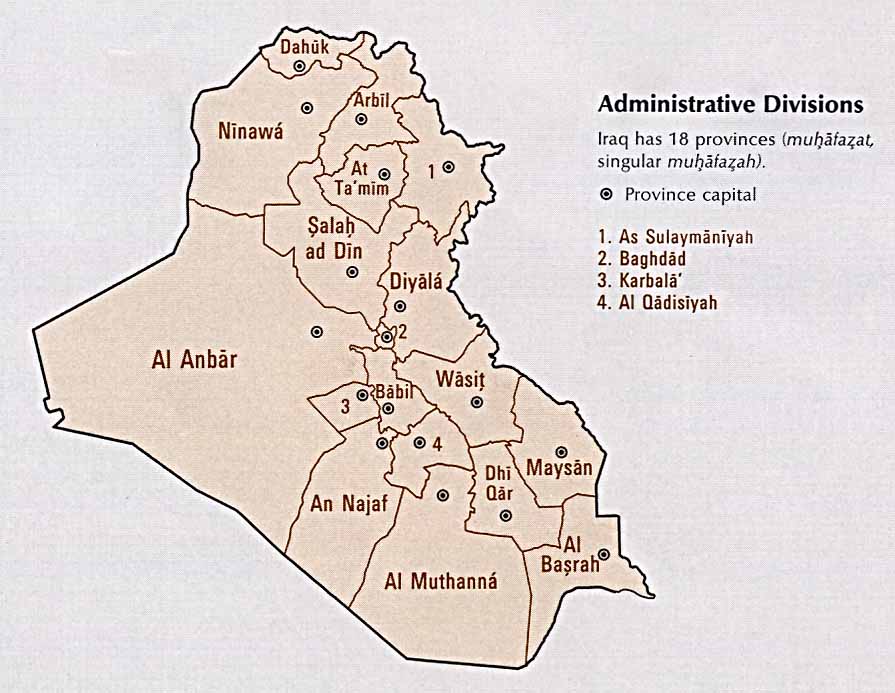
Babil, Irbil, Ninewa, Salahaddin, Tamim, – 46-56%
Dhi Qar, Diyala, Maysan – 31-45%
Baghdad, Karbala, Najaf, Qadisiyah – 26-30%
Anbar, Basra, Muthanna, Wasit – 6-25%
Sulaymaniya – 4-5%
Dohuk – 0%

SOURCES

Blua, Antoine, “Iraq Tussles With Neighbors Over Water,” Radio Free Europe/Radio Liberty, 9/13/09

Chulov, Martin, “Water shortage threatens two million people in southern Iraq,” Guardian, 8/26/09

DiPaola, Anthony and Alexander, Caroline, “Iraq Drought Cuts Harvest, Boosts Imports as Oil Cash Slips,” Bloomberg, 8/5/09

Hope, Bradley, “Iraq digs in to rebuild agricultural sector,” The National, 8/30/09

Inter-Agency Information and Analysis Unit, “The Humanitarian Situation In Iraq, Inter-Agency Fact Sheet,” United Nations Office for the Coordination of Humanitarian Affairs, August 2009

IRIN, “IRAQ: Drought hits rice, wheat staples,” 8/31/09b

Kamal, Adel, “desertification destroys ninawa villages,” Niqash, 7/17/09

Raphaeli, Dr. Nimrod, “Water Crisis in Iraq: The Growing Danger of Desertification,” The Middle East Media Institute, 7/23/09

Sly, Liz, “Iraq in throes of environmental catastrophe, experts say,” Los Angeles Times, 7/30/09

Special Inspector General for Iraq Reconstruction, “Quarterly Report and Semiannual Report to the United States Congress,” 7/30/09

Tharp, Mike, “Once world’s bread basket, Iraq now a farming basket case,” McClatchy Newspapers, 7/17/09

Williams, Timothy, “Idle Iraqi Date Farm Show Decline of Economy,” New York Times, 8/15/09

Wednesday, June 3, 2009

May 2009 International Organization for Migration Report On Iraq's Displaced

At the end of May 2009 the International Organization for Migration (IOM) released its latest report on Iraq's displaced. They specifically are worried about the fate of the two million plus Iraqis that have not returned home yet. They note that while thousands of displaced have gone back to their original provinces, the vast majority have not. Both groups continue to face problems such as finding work and housing, and gaining access to services and assistance. The IOM is concerned that many of these Iraqis will become permanent refugees.

Since 2007 the IOM has noted that Iraqis displaced after the February 2006 Samarra bombing, which triggered the sectarian war, have begun to return. The IOM has counted 49,464 of these families, or 296,598 people, that have come back. Only 7%, of those, 3,443 families, were refugees. That is a small fraction of the estimated 1.6 million that lost their homes after the 2006 attack. They have gone back to 765 different locations in Iraq. 90% of the post-Samarra displaced came from Baghdad, Diyala and Ninewa, so it should be no surprise that those three provinces, plus Anbar have seen the most returns. Qadisiyah, Muthanna, and Dhi Qar had the least with 44, 64, and 108 families respectively. 61% of displaced families surveyed said they wanted to go home.

Post-Feb. 2006 Displaced And Refugee Family Returns (Not Including Kurdistan)

Province

Returning Families

% That Are Refugee Families

Iraq

49,464

7%

Baghdad

31,497

4%

Diyala

8,779

1%

Anbar

4,536

27%

Ninewa

1,602

1%

Maysan

626

49%

Tamim

620

37%

Basra

500

0%

Karbala

298

21%

Babil

258

9%

Najaf

215

55%

Salahaddin

191

35%

Dhi Qar

108

31%

Muthanna

64

88%

Qadisiyah

44

23%

A major factor in returning is the proximity of the displaced to their original homes. 68% of the families that came back resided within their home province. That compared to 21% that were in another province, and 11% that came back from another country. That varied however across each province. In Muthanna and Najaf for example, 100% of the returnees were refugees, while none of those that came back to Basra and Ninewa were in foreign nation beforehand.

Origins Of Returnees By Province

Location

Refugees

Displaced Within Same Province

Displaced In Another Province

TOTAL

11%

68%

21%

Anbar

36%

52%

12%

Babil

15%

52%

33%

Baghdad

6%

71%

23%

Basra

0%

0%

100%

Diyala

6%

61%

33%

Karbala

92%

0%

8%

Maysan

0%

0%

100%

Muthanna

100%

0%

0%

Najaf

100%

0%

0%

Ninewa

0%

100%

0%

Salahaddin

88%

13%

0%

Tamim

58%

11%

31%

Wasit

50%

0%

50%

Conditions in Iraq appeared to be another major reason why families come back. 36.7% of returnees interviewed by the IOM said that better security was the top cause for returning. That was followed by 35.7% that believed a combination of improved security and difficult conditions where they lived was the major factor. Only 15.5% felt that they left because of the hardships they were going through.

Reasons For Return

Reasons for Return

%

Improved security in home area

36.7%

Improved security in home area and difficult conditions

35.7%

Very difficult conditions

15.5%

Other

5.8%

Government returnee payments

4.2%

Improved security in home area, difficult conditions, returnee payments

1.8%

Very difficult conditions and returnee payments

0.3%

The majority of families feel safe after their returns, but there are still some troubling incidents. 59.6% of those polled by the IOM said they felt safe all of the time after going back, while 39.4% said they only felt safe some of the time. There are various anecdotal stories of attacks and threats against displaced. In the Dora neighborhood of Baghdad an IED targeted displaced. Eighteen families in Abu Ghraib came back, but couldn't stay in their homes and became displaced again. Two families from Diyala went back, but were attacked by a militia, which led to the death of two family members. They left the province again as a result. According to IraqSlogger, in Adhamiya, Baghdad, the Sons of Iraq put "X"s on the houses of Shiites that had been displaced telling them not to come back in April 2009. The state of their property is another issue for returnees. 49.1% said that their houses were in good condition, but 38.7% found some damage to them.

The government has also been actively encouraging Iraqis to come back. Baghdad offered $851 for families that did. The authorities have recently announced that they were no longer registering people anymore, which was a prerequisite to receive the money. Not many returnees signed up for this program in the first place, and the government paid even fewer. The IOM found that only 44% of those surveyed had applied for the money, and of those, only 36% said they got it.

For those still displaced, finding work, services, and aid are major problems. 50.4% of male-headed households were out of work, and 97.3% of female-led ones were. Overall, 35% of those surveyed said they could work, but couldn't find a job. Salahaddin, 75%, Muthanna 70%, and Babil, 64%, had the highest responses in that category. In total, 56% of the displaced are unemployed. 64.2% of those surveyed claimed they had six hours or less of electricity. 83.8% did say they had access to the national water system, but that doesn't mean that it is potable. Almost all of the displaced, 98%, said they had their food ration card, but their access varied. 32% said they regularly got their rations, 60% said it was irregular, and 8% said they never got them. Ninewa was the worst with 99% saying they got their rations infrequently. Getting health care also varied greatly from province to province. 90% or more in Anbar, Maysan, Muthanna, Najaf, Ninewa and Salahaddin said they had adequate access, while 57% of returnees in Baghdad, 65% in Basra, and 78% in Tamim claimed they had none. When asked what their greatest needs were, displaced families said food, 63%, fuel, 51%, and health care, 40% were the top priorities. 88% also said they had received no aid outside of the government.

Unemployment

Total: 44% employed, 56% unemployed

Male-headed household: 49.6% employed, 50.4% unemployed

Female-headed household: 2.7% employed, 97.3% unemployed

Overall the IOM is worried about what will happen to the millions of Iraqis that have lost their homes because of the war. Only a small fraction has returned, and those that haven't face a plethora of problems, most importantly finding work and food. Those that have come back also face a similar set of problems. Neither the government, nor non-government organizations such as the IOM have the resources to deal with such a large population. The fear is that many of them will simply have to fend for themselves, perhaps creating a permanent class of displaced both within and without of Iraq for the foreseeable future.

SOURCES

International Organization for Migration, "IOM Emergency Needs Assessments; Post February 2006 Displacement In Iraq, Monthly Report," 4/1/09

- "IOM Monitoring And Needs Assessments of Iraqi Return, May 2009," May 2009

Smith, Daniel and al-Timimi, Yousif, "Residents: Some Sahwa Still Keeping Shi'a Out," IraqSlogger.com, 4/21/09

Saturday, March 14, 2009

Special Inspector General for Iraq Reconstruction’s “Hard Lessons” – Part I: Planning for Postwar Iraq September 2001 to May 2003

The first chapter of the Special Inspector General for Iraq Reconstruction’s “Hard Lessons” review of the U.S. effort to rebuild Iraq focuses upon the pre-war planning. That began in the fall of 2001 and went up right through the U.S. invasion. This period was characterized by three main trends. First, the Defense and State Departments had diametrically opposed views of what Iraq would be like after the war. Second, there was little to no coordination between the different groups working on post-war planning, even within the same agency. Finally, a best-case scenario was adopted as the operative model by the White House, which shaped all the subsequent planning.

Planning for the Iraq war began towards the end of 2001. On November 21, 2001 President Bush ordered Secretary of Defense Donald Rumsfeld to review the Pentagon’s strategy for invading Iraq. Even before that in September, Rumsfeld had already begun working on the Iraq war plan. This led to the Defense and State Departments as well as the National Security Council to eventually begin thinking about post-war Iraq.

At that time Iraq was in a state of disrepair due to Saddam’s rule, the Gulf War, and international sanctions. After the Gulf War Saddam had tried to rebuild Iraq’s infrastructure but it wasn’t successful. The non-oil sector was hit especially hard. By the mid-1990s unemployment and underemployment were over 50%. Gross Domestic Product, which peaked at $74.9 billion in 1990, dropped to below $20 billion for the rest of the decade. Iraq, which was a middle class Arab country before the Gulf War, became a poor underdeveloped one afterwards. 60% of the population depended upon the government food rations system, which wasn’t able to stop malnutrition from occurring. This led to the United Nations’ Oil For Food Program in 1995. That was manipulated both by the government, the U.N., and criminal gangs, and led to massive corruption. One thing the program did provide was an intimate look into the Iraqi economy and its needs. Unfortunately, none of that was looked at by the United States before the invasion.

On September 29, 2001 Secretary Rumsfeld ordered an internal review of the invasion plans for Iraq. Almost all of the planning focused solely upon the military side of the operation, because the Pentagon believed that the State Department would deal with the post-war situation. On December 28 Rumsfeld briefed President Bush. The Secretary stressed three themes that he would stay with until he left office. He said that the invasion would be over fast and quick. Afterwards the U.S. would turn power over to Iraqis, and the American troops would be out quickly. One of Rumsfeld’s deputies Undersecretary of Defense Douglas Feith continually stressed that the U.S. was going to act as liberators not occupiers. That meant Iraqi sovereignty as soon as possible after the war. Rumsfeld and Feith both thought this would make the Iraqis deal with their own problems, and not get the U.S. caught up in nation building. To support their argument the Pentagon pointed to the U.S. invasion of Afghanistan. Following this model also meant that the U.S. would not be responsible for rebuilding Iraq.

The State Department developed a completely different point of view. They considered the sectarian divisions within Iraq, and believed that it would take years for the country to be rebuilt and stabilized. They also didn’t think that Iraq would be like Afghanistan or that Iraqi leaders would emerge after the invasion that could take over the country. Secretary of State Colin Powell famously told President Bush that if the U.S. invaded they would be the ones that would be left to pick up the pieces. Powell warned that there would be no government and no law and order, meaning that the Iraqis would be looking to the U.S. for leadership. This conflict between Defense and State shaped the pre-war planning on Iraq with the dispute never being resolved.

In early 2002 the State Department’s Bureau of Near Eastern Affairs created the Future of Iraq Project. It included 200 Iraqi exiles and experts, and was the largest study done within the government on Iraq. Its major drawbacks were that it was not an operational plan, but rather background information for the administration of Iraq, and was never presented to Secretary Powell as a counter to the Pentagon’s vision. The project was broken up into various working groups, some of which provided high quality material, while others never finished. The basic premise was that the U.S. was going to have to run Iraq after the war, and that this should be a civilian job with the goal of building up democratic institutions before Iraqis could take over. The Coalition Provisional Authority later took up this position.

In the spring of 2003 the White House became involved in Iraq planning when the National Security Council started holding meetings on the topic. In early 2003 the National Security Council’s Deputies bean holding twice-weekly conferences on Iraq. They came up with three alternatives for post-invasion Iraq. One was Iraqis quickly taking over, the second was military rule through the Central Command, and the third was a civilian government, perhaps under the United Nations. They also addressed three major concerns: security, reconstruction, and creating a pro-U.S. stable Iraq.

Which approach the United States would follow was not decided until August 2002. On August 29 the White House issued “Iraq: Goals, Objectives, Strategy.” It said that the U.S. was committed to overthrowing Saddam, and that it would work with Iraqi exiles to liberate Iraq, not occupy it. Those were wins for the Pentagon. However it did say that the U.S. would be involved in the reconstruction of Iraq, something the State Department stressed.

After the paper was released the Joint Chiefs of Staff (JCS), the National Security Council, and the Pentagon increased their efforts. The JCS ordered the Central Command (CENTCOM) to begin planning for post-war Iraq. Two Army majors that worked in Bosnia were given the task. That went against the preferences of Rumsfeld who wanted the U.S. out as quickly as possible. National Security Advisor Condoleezza Rice also had a steering group on Iraq created. Over at the Defense Department Undersecretary Feith created the Office of Special Plans. The major problem was that while work on Iraq was accelerating in the fall of 2002 none of it was coordinated, and there was little sharing of ideas and information. The compartmentalization of these different groups led to a highly disjointed set of ideas.

One example was the National Security Council’s (NSC) humanitarian group. Elliot Abrams and Robin Cleveland of the Office of Management and Budget led it. It was created in September 2002 with members from the Central Intelligence Agency, the United States Agency for International Development (USAID), the Joint Chiefs, the Defense, State, Treasure, Justice, and Commerce departments. They considered the effects of Iraq using chemical weapons, a possible refugee crisis, the U.N.’s Oil for Food program, and what targets not to hit during the war. It also wanted to get Iraq up and running as quickly as possible after the war ended. A major problem was that it had very little information about what Iraq was like. They knew that sanctions had hurt the country, but decided that its oil wealth would pay for any reconstruction. Just as important it had no interaction with the other NSC groups working on military, political, and democratization affairs.

Over at the Pentagon, planning was often vague and based upon best-case scenarios. Different officials were often told that there were plans for post-war security, but there were no actual meetings about it. The Defense Department also followed Rumsfeld’s belief that the war would be short, there would be little damage to Iraq in the process, the country’s oil would pay for everything, an Iraqi leader would emerge, and that would allow the U.S. a quick exit.

On October 15, 2001 Undersecretary Feith briefed the National Security Council on CENTCOM’s planning. They came up with three phases for postwar Iraq. First there would be military control. Second a U.S. civilian authority would take over, and then finally, Iraqi leaders would emerge and the U.S. would turn power over to them and then leave. The military had no timeline for how long this process would take. Feith also said that Rumsfeld should be in charge during this time, allowing for unity of command after the war. This idea led to interagency arguments that lasted for two months.

At the same time, the administration wanted to keep all their work secret. On October 18 for example, Rumsfeld asked Feith to create an official postwar planning office, but then rescinded that order shortly afterwards. That was because the White House had decided that the government could not openly plan for postwar Iraq when it had not declared war yet, and publicly said it was trying to avoid it.

Work continued with some of the most informative coming from the worst-case scenario papers. In October Rumsfeld, Deputy Secretary of Defense Paul Wolfowitz, Feith, and the Joint Chiefs came up with a memo on 29 things that could go wrong in Iraq. Some of them were not finding weapons of mass destruction, sectarian fighting, not being able to find Saddam, Iraq breaking apart, the U.S. being there for 10 years, occupation costs skyrocketing, and world opinion turning against the war. Rumsfeld briefed the NSC and the president on this paper at a NSC meeting. In December Powell received a similar paper partially written by Ryan Crocker, the future U.S. ambassador to Iraq. It warned of a possible sectarian war for power that could lead to the dissolution of the country.

Outside and inside the government there were also warnings about what could happen in post-war Iraq. A review of the U.S.’s efforts at nation-building showed that of the sixteen countries the U.S. intervened in only four West Germany, Japan, Panama, and Grenada stayed democratic ten years after the U.S. left. Three, Cuba, Haiti, and Nicaragua got worse. Academics also noted that Iraq was not like Germany and Japan after World War II. Both were rich, developed, homogenous countries with bureaucracies. That was largely lacking in Iraq. The planning for the occupation of those two countries also started shortly after Pearl Harbor and took years to develop. The U.S. was trying to plan for Iraq on the fly. The National Intelligence Council released a paper in January 2003 that said setting up a democracy in Iraq would be a long and arduous process. In February the Army War College put out a report that said Iraq could fall into civil war because of the ethnic and sectarian divisions in the country, that the armed forces would have to be completely rebuilt, and that rebuilding the country would be a huge effort after the economy had been devastated by sanctions. It also warned that the longer the U.S. stayed, the more resistance would grow to their presence. These reports had little affect on planning however.

Overall the administration’s effort to deal with post-war Iraq was uncoordinated and fragmented. The National Security Council and Condoleezza Rice were supposed to manage policy, but State and Defense largely worked on their own. The various NSC planning groups acted separately as well. The NSC also did not consult with many key agencies until very late in the game. That meant there was no coherent strategy in the White House on what to do about Iraq after the war was over. Many including Secretary Powell, Undersecretary Feith, and a biography have blamed Rice for her weak leadership at the time, and said the administration was dysfunctional during this period. “Hard Lessons” believes part of that was due to the workings of the bureaucracy, but it also reflected the divisive views of the main decision makers. Rumsfeld for example, thought that the U.S. should be in and out of Iraq as quickly as possible, so the U.S. didn’t need to address any of the country’s big problems, while Powell predicted a long occupation. In the fall of 2002 the White House picked a mix of both views, but did not have a single, unified plan of how it was to work.

SOURCES

Collins, Joseph, “Choosing War: The Decision to Invade Iraq and Its Aftermath,” Institute for National Strategic Studies, National Defense University, April 2008

PBS Frontline, “INTERVIEWS Elisabeth Bumiller,” Bush’s War, 3/24/08
- “INTERVIEWS Karen DeYoung,” Bush’s War, 3/24/08

Ricks, Thomas, Fiasco, The American Military Adventure In Iraq, 2006

Ricks, Thomas and DeYoung, Karen, “Ex-Defense Official Assails Colleagues Over Run-Up to War,” Washington Post, 3/9/08

Special Inspector General For Iraq Reconstruction, “Hard Lessons,” 1/22/09

Woodward, Bob, State of Denial, Bush At War, Part III, 2006

Wednesday, March 11, 2009

Dec. 08-Jan. 09 U.N. Humanitarian Update – Iraq

In late February 2009 the United Nations Office for the Coordination of Humanitarian Affairs released its latest humanitarian report on Iraq. The paper is a compilation of several others by UNICEF, Oxfam, and the International Organization for Migration, many of which have been reported here before, but also includes some new reporting as well. The humanitarian update focuses upon six main topics: refugees and the displaced, violence, women’s issues, children, Iraq’s food ration system, and health.

The Displaced

Returning refugees is a growing issue in Iraq. The number of Iraqis coming home has increased from 2007 to 2008. In 2007 an estimated 36,000 displaced people came back, compared to 195,240 in 2008. 25,000 refugees from other countries have also returned over those two years. In 2008 an average of 1,650 displaced families came back each month with the highest numbers during July, August and September, but then declining for the remaining three months of the year. Many have gone back to Baghdad, the sight of most of the displacement in the country. Other families wish to go back as well, but don’t have the financial means to.

The government has offered $432 to families that return from another province, and $216 to those that go back home within their own governorate. Baghdad began this program in October 2008, but it’s not clear whether it will continue in 2009. The Ministry of Displacement and Migration announced in February 2009 for example, that it had run out of funds for this program.

Many of those coming back face a number of problems finding basic necessities. Electricity is spotty, as well as access to public services and health care. Most importantly is finding housing. 41.8% of displaced families surveyed said they had no access to their property. 16.7% said they do have access, and 38.7% said they don’t know the status of their former homes. Of those that could go back 35% said their homes ere currently occupied. 22.1% said their homes were destroyed, 8.6% said they couldn’t go back to them because of security conditions, 2.5% said the military was using their property, while 0.5% said the government had taken it over.

In 2008 the Ministry of Displacement and Migration began plans to build housing projects for the displaced that could not go back home, but many of those plans have been put on hold because of budget cuts. Originally the Ministry was to be given $43.2 million for building housing projects in the 2009 budget, but that amount was slashed to $6.85 million because of the declining revenues from oil.

There are also restrictions and problems the displaced face when trying to receive aid from the government or retrieve their property. First, not all have registered with the Ministry of Displacement and Migration, which is a requirement to receive payments. Only Iraqis that left between January 1, 2006 and January 1, 2008 are covered. The amount of aid offered by the government is also not much, especially for those that had their homes destroyed. Iraqis that rented will probably not be able to get their places back, while those that sold, no matter what the situation, have no recourses. There are also some stories of returnees being threatened and attacked, and being forced to flee again. Finally, women have a much harder time coming up with the requirements to regain their property or get government assistance.

Both the United Nations and the International Organization for Migration (IOM) have programs for the internally displaced, but they are only reaching a fraction of the total. The U.N. has created Protection Assistance Centers for example that have only helped 26,677 people out of around 2 million internally displaced. The IOM has care packages for the displaced, but are only operating in Baghdad, Anbar, Irbil and Basra, and have only given them out to around 2,200 families, approximately 13,200 people.

Violence

Violence, especially against civilians, continues in Iraq, but at much lower levels than before. The number of civilian casualties from December 2008 to January 2009 for example decreased. In December 275 civilians were killed and 854 wounded compared to 192 killed and 591 wounded in January. Two to three dozen bodies are also found on the streets each month. On average thirteen Iraqis civilians were killed per day in 2008. Members of the Iraqi security forces are also targets with 83 killed and 200 wounded in December, and 99 killed and 231 wounded in January. In total 392 Iraqis were killed and 1,054 wounded in December, and 335 died in January, and 1,085 wounded.

Women’s Issues

The U.N. has growing concerns about the state of Iraq’s women. A 2008 report found that women headed 10.2% of Iraq’s households. There are also around 1 million widows in the country. These Iraqis are largely ignored in society, and have a much harder time providing for their families. A 2008 survey of the Iraqi and Middle Eastern press found that only 1% of stories were about women. More than half were about violence, and 20% more were on female suicide bombers. The Iraqi Minister of Women’s Affairs also recently resigned in February 2009 claiming that the government was providing her with few funds, but there are reports that she will go back to her job. Calling attention to their plight, a group of widows held a demonstration in Baghdad calling for government aid on International Women’s Day in March.

Female Headed Households By Province
Basra 5.6%
Najaf 6.8%
Babil 6.9%
Anbar 8.6%
Maysan 8.6%
Salahaddin 8.6%
Wasit 8.8%
Dohuk 10%
Tamim 10.1%
Ninewa 10.2%
Dhi Qar 10.6%
Qadisiyah 10.6%
Diyala 11.2%
Karbala 11.4%
Muthanna 11.8%
Sulaymaniya 11.8%
Baghdad 12.2%
Irbil 12.5%

Children

Children in northern Iraq are facing bad conditions. Schools visited by UNICEF in Diyala and Dohuk were overcrowded, lacked clean water, and sanitation. More than 900 children were also found in Kirkuk begging. Half of them were displaced.

Food

The Iraqi government began its food rations system in 1995 under the U.N.’s Oil for Food program. 95% of Iraqis support the system. In 2007 the Ministry of Trade, which controls it, was going to cut the handouts in half because a lack of funds, but the 2008 supplemental budget stopped that. In 2009 the Ministry of Trade still has plans to reduce the program, this time limiting it only to the poor. The packages cost the government $0.50 per person.

Health

The Ministry of Health is concerned about a measles outbreak. In 2008 6,000 cases were reported in nine provinces. They were also worried that it would spread to Najaf, Sulaymaniya, Irbil, Maysan, and Dohuk. That would place up to 800,000 children at risk. The government is telling families that they need to get their kids vaccinated, and is trying to create a new health program to deal with it.

SOURCES

Aswat al-Iraq, “Widows urge govt. to support them economically, socially,” 3/9/09

Salaheddin, Sinan, “Iraq’s women’s minister to withdraw resignation,” Associated Press, 3/9/09

Al-Shawfi, Mundher, “Iraqi government careless about its own refugees – minister,” Azzaman, 2/27/09

United Nations Office for the Coordination of Humanitarian Affairs, “Humanitarian Update Iraq, December 2008-January 2009” United Nations, 1/31/09

Tuesday, March 3, 2009

Latest United Nations Numbers On Baghdad Province

Baghdad province is a paradox. It is one of the richest in the country, yet has pockets of deep poverty. Security is improving throughout the country and the capital, but it still has the most violence. Electricity production has increased yet half of Baghdad suffers from sever power outages. The United Nations’ Inter-Agency Information and Analysis Unit recently released a paper detailing the situation in the capital province.

Population

Baghdad has the largest, most urbanized population in Iraq. There are 7,145,470 people there, which is 24% of the total population. 87% live in urban areas, 13% in rural ones. The province is divided into nine major districts: Abu Ghraib, Adhamiyah, Kadhimiyah, Karkh, Madain, Mahmudiya, Resafa, Sadr City aka Thawra, and Tarmia.

Population
Baghdad: 7,145,470
Abu Ghraib: 326,626
Adhamiyah: 842,310
Kadhimiyah: 832,310
Karkh: 1,624,057
Madain: 332,883
Mahmudiya 496,053
Resafa: 1,312,052
Sadr City: 1,316,583
Tarmia: 62,147

Security

The security situation in Baghdad has improved with the rest of the country, but it is still the most dangerous area in the country. From June to December 2008 there was a steady decline in security incidents with one large increase from August to October that subsequently leveled off. At the beginning of June there were around 400 security incidents a month in the province. That declined to around 300 in August, but then increased to almost 550 by October. Since then they have decreased to around 250 by the end of 2008. The U.S. military has much more in depth reporting than the U.N. and found that attacks went from 2,221 a month in April 2008 to 713 in December.

Displaced

Baghdad faced the most displacement in the country during the sectarian war. After the Samarra Shiite shrine bombing in February 2006 1.6 million Iraqis became internal refugees. Over 60% of those came from the capital. Today there are 90,731 displaced families in the province, the largest amount in the country. Some Iraqis have begun to return, although it’s still a small percentage of the total. The International Organization for Migration recorded 31,521 families coming back to Baghdad so far as of February 2009. They face a variety of problems including finding jobs, permanent housing, and services.

Employment

Iraq’s unemployment rate matches that of the country’s. Iraq has 18% unemployment. 12% of males in the capital are unemployed, compared to 20% for women. 83% of the male population was involved in the labor force compared to 81% in the country. Unemployment for them was concentrated in Resafa and Sadr City that had double-digit joblessness. As a recent U.N. report found very few women are involved in Iraq’s economy. Only 11% of Baghdad province’s women were either employed or looking for work, compared to 18% in the country. There are wide differences between the districts however. In Mahmudiya and Tarmia 76% and 67% of women respectively were involved in the labor force. In Sadr City it was only 8%. Jobs for women are directly related to education. 43% of women over 10 years old in the province lack a primary education. The U.N. employment study found that women needed a college education to find steady work.

Employment in Baghdad

Male Unemployment (15-64 years old)
Iraq 12%
Tarmia 1%
Abu Ghraib 3%
Adhamiyah 3%
Mahmudiya 3%
Karkh 6%
Kadhimiyah 8%
Madain 8%
Baghdad 12%
Sadr City 15%
Resafa 16%

Males In Labor Force (15-64 years old)
Iraq 81%
Baghdad 83%
Karkh 75%
Mahmudiya 81%
Resafa 82%
Sadr City 83%
Adhamiyah 85%
Madain 85%
Kadhimiyah 83%
Abu Ghraib 87%
Tarmia 96%

Female Unemployment (15-64 years old)
Iraq 13%
Mahmudiya 0%
Tarmia 1%
Abu Ghraib 2%
Madain 5%
Karkh 7%
Sadr City 12%
Adhamiyah 13%
Kadhimiyah 17%
Baghdad 20%
Resafa 23%

Females In Labor Force (15-64 years old)
Iraq 18%
Sadr City 8%
Baghdad 11%
Resafa 16%
Kadhimiyah 17%
Karkh 19%
Madain 27%
Adhamiyah 28%
Abu Ghraib 49%
Tarmia 67%
Mahmudiya 76%

Poverty

Baghdad is one of the richest provinces in the country, but still has pockets of poverty. In Adhamiyah the U.N. found no families in the lowest income quintile. In Abu Ghraib (1%), Karkh (1%), Kadhimiyah (2%), and Resafa (4%) there was also little poverty. That compared to Sadr City (16%), Madain (20%), and Mahmudiya (20%) where poverty was the highest.

% of households in the lowest income quintile
Iraq 22%
Adhamiyah 0%
Abu Ghraib 1%
Karkh 1%
Kadhimiyah 2%
Resafa 4%
Tarmia 12%
Sadr City 16%
Madain 20%
Mahmudiya 20%

Electricity

The Electricity Minister recently announced that Iraq had surpassed pre-war levels of power production. The problem remains that output does not meet demand. The capital is a perfect example. In Karkh, Sadr City, Resafa, and Adhamiyah more than half the population has power cuts for more than 11 hours a day. Abu Ghraib on the other hand has the best electricity supply in the province with only 2% suffering from long power outages.

% of households with more than 11 hours of power cuts or no connection to electricity network
Iraq 52%
Abu Ghraib 2%
Tarmia 29%
Mahmudiya 33%
Madain 40%
Karkh 60%
Sadr City 67%
Kadhimiyah 67%
Resafa 70%
Adhamiyah 76%

Water

Baghdad’s water supply is quite good. 10% of the province compared to 26% in the country is connected to the water network. Only Mahmudiya has a real problem with almost 50% having no access.

% of households not connected to water network
Iraq 26%
Abu Ghraib 0%
Adhamiyah 0%
Kadhimiyah 0%
Karkh 0%
Sadr City 0%
Tarmia 0%
Resafa 5%
Madain 7%
Baghdad 10%
Mahmudiya 47%

Food

Most Iraqis depend upon the country’s food rations, which are the largest in the world. That hasn’t prevented problems with malnutrition however. 22% of Iraqis, and 21% of Baghdad have children five years and younger that suffer from chronic malnutrition. The districts worst affected are Sadr City, Kadhimiyah, and Adhamiyah, while Abu Ghraib, Mahmudiya, and Tarmia have the fewest incidents.

% of children 0-5 years old with chronic malnutrition
Iraq 22%
Baghdad 21%
Abu Ghraib 4%
Mahmudiya 6%
Tarmia 6%
Resafa 14%
Madain 16%
Karkh 18%
Sadr City 20%
Kadhimiyah 32%
Adhamiyah 42%

Health


Baghdad overall does better than the rest of the country in terms of chronic diseases. 8% of the province reported being affected by them compared to 9% in Iraq. Tarmia did the best with only 4% reporting chronic cases, but that compared to Karkh, Kadhimiyah, Abu Ghraib, Sadr City, Adhamiyah, and Resafa that were all in double digits.

% of individuals with chronic disease

Iraq 9%
Baghdad 8%
Tarmia 4%
Mahmudiya 8%
Madain 9%
Kadhimiyah 10%
Karkh 10%
Abu Ghraib 11%
Sadr City 12%
Adhamiyah 14%
Resafa 15%

SOURCES

Inter-Agency Information and Analysis Unit, “Baghdad Governorate Profile,” United Nations Office for the Coordination of Humanitarian Affairs, February 2009
- “Iraq Labour Force Analysis 2003-2008,” United Nations Office for the Coordination of Humanitarian Affairs, January 2009

International Organization for Migration, “Three Years Of Post-Samarra Displacement In Iraq,” 2/22/09

Radio Free Europe/Radio Liberty, “Iraq’s Electricity Production Surpasses Prewar Level,” 2/19/09

Special Inspector General for Iraq Reconstruction, "Quarterly Report and Semiannual Report to the United States Congress," 1/30/09

Wednesday, February 25, 2009

Iraq's Displaced – 3 Years After The Samarra Bombing

There are around 2.8 million internally displaced Iraqis. This crisis has gone through three major phases. First Saddam was responsible for one million Iraqis losing their homes largely due to his campaigns against the Kurds in the north and the Shiites in the south. From 2003-2005 200,000 more were displaced due to the U.S. invasion and the following operations against the insurgency and Shiite militias. Then on February 22, 2006 the Shiite shrine at Samarra was bombed, which set off the sectarian war that lasted until 2007. As a result, 1.6 million Iraqis became internal refugees. The International Organization for Migration (IOM) is the premier refugee organization in Iraq. It has polled and assisted 80% of those that were displaced after the Samarra shrine was blown up. Recently the IOM released a report on the state of these internal refugees on the three-year anniversary of the attack. It found that the process of return has begun, but the vast majority have still not gone back to their homes. Fortunately there has been little new displacement recently. Those that have still not returned are facing increasing problems finding jobs, shelter, and sustenance. The government has not been able to adequately deal with this situation, and the amount of foreign aid has not been adequate either. The IOM warns that Iraq's internal refugees are facing an increasingly uncertain future as a result.

History Of Displacement

2006 saw the largest number of Iraqis lose their homes, but that process has slowed since then. After the February 2006 bombing 5.5% of Iraqis became displaced. On average 14,152 families left their homes a month in 2006. From January to June 2007 that slowed to 8,033 families per month, dropping to 2,269 per month from July to September 2007, and finally 866 a month for the last quarter of the year. By 2008 378 families were losing their homes a month. That went down to almost zero by June 2008. In October the Christian community in Mosul was attacked, with twelve killed. That led to 2,465 families to flee. That process has begun to be reversed.

Displacement By Period


Period

Average number of displaced families per month

Percent of total displaced beginning in 2006

2006

14,152

70.3%

January – June 2007

8,033

23.0%

July – September 2007

2,269

3.3%

October – December 2007

866

1.2%

2008

378

2.2%


Displacement in Iraq also followed certain patterns shaped by the fighting. 57% of the internal refugees are Shiite, 31% are Sunni, 5% are Christians, 4% are Sunni Kurds, and 3% are other. During the sectarian war Shiites left Baghdad and Diyala and fled south. Sunnis on the other hand, exited Baghdad and the south for the north and west. For example, the majority of Iraqis that fled Basra were Sunnis, while most of the displaced there are Shiites from Baghdad. In Anbar almost 100% of the displaced are Sunnis, while 60% that left were Shiites. Almost all of the displaced in Karbala, Maysan, Muthanna, Najaf, Dhi Qar, and Wasit are Shiites from Baghdad and Diyala. Christians and Kurds went north to Ninewa, Tamim, Diyala and Kurdistan. In comparison, the majority of Iraq's refugees that have left the country are Sunnis.

Returns

The issue of return is the newest one facing Iraq's displaced. Based upon its work, the IOM believes that the majority of Iraq's internal refugees want to go back to their homes if security improvements hold. They found that around 130,000 families, 61%, want to go back to their original residences, 45,000 families, 22%, would like to settle where they are, while 35,000, 17%, want to leave and relocate in another country. Already the IOM has identified 49,432 families, around 296,592 people, have returned. 69% of those were displaced within their home province, 20% came back from a different one, and 11% returned from a foreign country. Of that last group most were in Syria and went back to Anbar and Baghdad. The first returns were recorded in April 2007 in the Madain, Abu Ghraib and Taji districts of Baghdad. Since then the numbers coming back have increased, with 31,521 families going back to the capital. Interviews with almost 3,000 of them found that 36% came back because of better security in their communities, and 36% said it was a combination of that plus hardships.

Returning Families By Province


Baghdad

31,521

Diyala

8,818

Anbar

4,542

Ninewa

1,536

Tamim

627

Maysan

626

Basra

493

Other

1,269


That still leaves 273,243 families as internal refugees. Baghdad province has the most, 90,732 families, followed by Diyala, 22,784 families, Ninewa, 19,100, and Dohuk, 18,706. The majority came from just eight of Iraq's eighteen provinces. Baghdad provided the most, 64.3%, as it was the center of the sectarian war. Of those, opinions on return are different depending upon where they currently reside. Baghdad, Diyala, Najaf, Tamim, and Anbar have the highest numbers of those that want to go back to their homes. Most of those come from Baghdad and Diyala. In comparison, Basra, Wasit, Dhi Qar, and Qadisiyah have the most families that want to resettle there.

Location Of Displaced By Province


Location

Number of Families

% of Total

Iraq

273,243

100%

Baghdad

90,732

33%

Diyala

22,784

8%

Ninewa

19,100

7%

Dohuk

18,706

7%

Sulaymaniya

14,585

5%

Babil

12,677

5%

Wasit

12,306

5%

Karbala

10,921

4%

Irbil

10,304

4%

Anbar

9,179

3%

Tamim

7,911

3%

Salahaddin

7,790

3%

Dhi Qar

7,066

3%

Maysan

6,792

2%

Basra

5,989

2%

Qadisiyah

3,858

1%

Muthanna

2,457

1%


Origins Of Displaced


Province

Percentage

Baghdad

64.3%

Diyala

19.0%

Ninewa

6.0%

Salahaddin

3.2%

Anbar

2.6%

Tamim

1.8%

Basra

1.7%

Babil

0.9%

Other

0.5%


Another factor related to going back is the state of their property. Only 16% of the post-Samarra displaced had access to their homes. 43% have no accessibility, mostly because their residence has been occupied or destroyed. 38% don't know the status of their property.

The government has not been able to handle those that have returned. Families that go back are supposed to register with the authorities, making them eligible for 1 million dinars ($870). As of January 2009, only 12,969 families have signed up with the government. Most of those, approximately 9,100, are in Baghdad, followed by Diyala, 3,096, and Anbar, 522. That's only 26% of the returnees. Even though that's a small number, the IOM believes that the government is being overwhelmed dealing with them.

Needs

99% of Iraq's displaced have housing, but the quality varies greatly, and some are worried of losing it. 82% of Iraqi internal refugees surveyed by the IOM said housing was a concern. 59% of the internal refugees rent a house, but those costs are going up and many families are having a hard time earning money. 18% are living with family or friends. 22% are squatting or living in makeshift housing. Many of those feared for their future after Prime Minister Nouri al-Maliki issued Order 101 in 2008 that told the security forces to evict squatters. That was suspended for the January 2009 provincial elections, and there's no word if it will be re-enacted. The last 1% is living in camps. That usually only happens out of desperation.


IOM's polling shows that food, shelter, and work are also top needs. Those are followed by water, legal aid, and health care. Most Iraqis depend upon the government's food rations. 81% of the displaced surveyed said that they need greater access to food. 19% have no access to the food ration system, while 44% only receive them sometimes. Kurdistan, Basra, and Kirkuk have the spottiest access. In Dohuk for example, 90% do not receive their rations. Maysan, Karbala, Muthanna, Salahaddin, Dhi Qar, and Baghdad have the best distribution. Health care was a secondary concern with 16% saying it was a need. That's probably because 86% said they had access to some kind of aid, however that doesn't account for its quality. The health system has been greatly degraded since the U.S. invasion. Many doctors and nurses have left the country, and there is a shortage of equipment and medications.

Conclusion

In the end, the IOM believes that Iraq's displaced are facing a precarious situation. Three years after the Samarra bombing and the majority of the 1.6 million that lost their homes are still displaced. Some Iraqis have begun going back to their homes, but it is still a small percentage of the total, and the government has only been able to help a fraction of them. Those that are still refugees face problems finding work, housing, and food. The IOM has tried to help, but the amount of international aid has not met the needs. These problems will only grow as more time passes.

SOURCES

Aswat al-Iraq, “150 displaced Christian families return to Mosul,” 2/10/09

International Organization for Migration, “Anbar, Baghdad & Diyala, Governorate Profiles,” December 2008
- “Three Years Of Post-Samarra Displacement In Iraq,” 2/22/09

Oweis, Khaled Yacoub, “Iraqi refugees in Syria reluctant to return,” Reuters, 2/12/09

United Nations Office for the Coordination of Humanitarian Affairs, “Iraq Humanitarian Update,” October 2008

UN Assistance Mission for Iraq, “Human Rights Report 1 January – 30 June 2008,” December 2008

Review Orit Bashkin, Impossible Exodus, Iraqi Jews In Israel, Stanford University Press, 2017

   In 2015 an Israeli was looking for an Arab to kill in revenge for the deaths of Jews. He stabbed an Iraqi Jew because he l...