Showing posts with label Drought. Show all posts

Thursday, May 29, 2025

Iraq Announces New Water Initiatives As Global Warming Continues To Disrupt Economy And Lives


As summer nears the Iraqi government has announced several initiatives to address climate change. The question remains is if they will do enough as conditions continue to deteriorate and the country faces an environmental disaster.

Tuesday, September 24, 2024

Iraq Unveils Environmental Strategy


In September Iraq announced a six year national environmental strategy. While having backing of the international community it is unlikely to go anywhere like Iraq’s economic plans.

Wednesday, August 28, 2024

News Of Iraq’s Environmental Degradation Continues


Iraq continues to face the dire consequences of climate change. Each week new stories appear about environmental degradation.

Tuesday, July 30, 2024

World Food Programme Warns About Impact Of Climate Change Upon Iraq


In July the World Food Programme released a report on the current drought in Iraq. It was the latest warning about the devastating affects climate change is having on the country.

Tuesday, November 28, 2023

Norwegian Refugee Council Reports Climate Crisis In Iraq Getting Worse

Farmer in Baaj, Ninewa looking at what used to be farmland (Norwegian Refugee Council)

Iraq’s environmental crisis continues to worsen with no end in sight. The
Norwegian Refugee Council just released a new report which provides more details on the situation.

Tuesday, November 21, 2023

Iraq’s Rainy Season Unlikely To Dissipate Drought

(Al Masalah)

Iraq is in the midst of its rainy season with sporadic flooding. Those that might hope this will be relief from the multi-year drought will be disappointed.

Wednesday, November 8, 2023

Another Study Of Climate Change Induced Displacement In Iraq


The International Organization for Migration (IOM) has started tracking Iraqis displaced by climate change. They have found the phenomena is increasing with each passing month. The group tried to deduce the main causes of this new dilemma Iraq is facing.

Tuesday, October 24, 2023

Study Of 3 Districts Of Iraq Dealing With Climate Change

(Getty Images)

Iraq is facing an environmental crisis with no end in sight. The country is beset by droughts, rising temperatures, desertification, and dust storms. The World Bank counted 15 natural disasters in Iraq over the last 30 years due to climate change.
The Berghof Foundation did a study of three districts to look at how things are developing at the local level in the country.

Tuesday, October 17, 2023

More Iraqis Displaced Due To Climate Change

(IOM)

The United Nations said that Iraq is one of the top 5 nations in the world susceptible to climate change. Fertile land is becoming arid due to drought and desertification. Rain has decreased along with the flow of water down the Euphrates and Tigris due to dams in neighboring countries. Salinity and pollution in the water is increasing as well. Crops have declined as a result along with livestock and fishing. Thousands of people have left their homes because they can no longer make a living. The International Organization for Migration (IOM) released a survey for September 2023 that found the number of people displaced due to the environment has increased.

Monday, March 27, 2023

PM Sudani Claims False Success In Iraq’s Water Policy

(AP)

Prime Minister Sudani recently returned from a trip to Turkey where he claimed a victory. He said that Ankara
agreed to increase water flow down the Tigris for one month to try to help its neighbor. That will do little to alleviate Iraq’s chronic problems especially because Baghdad appears to have no water strategy.

Tuesday, January 10, 2023

Environmental Changes Forcing More Rural Iraqis To Migrate To Urban Areas  

(IOM)

The International Organization for Migration (ION) recently released survey results on the continued migration of Iraqis out of rural areas because of their changing environment. It found that over 68,000 people have been displaced in southern Iraq across 10 provinces.

Wednesday, July 28, 2010

Mosul Dam Sign Of Iraq’s Hydroelectric Problems

A member of the Iraqi Electricity Ministry told the Azzaman paper that the Mosul Dam, the largest in the country and the fourth biggest in the Middle East, was suffering from a lack of water and maintenance. The official said that the dam use to hold 11 billion cubic meters of water, but was now down to only 40% of that. As a result its hydroelectric power plant was producing less than 100 megawatts, down from 320 megawatts. There is also a lack of maintenance at the dam, and a severe need to repair its foundations. The Mosul Dam is on the Tigris River, which originates in Turkey. Since 2007 Iraq has been suffering a massive drought, and its neighbors like Turkey have been building dams along the Tigris and Euphrates Rivers, drastically reducing the water flow into Iraq. As a result, in June 2010 the Ministry of Planning announced that it might have to shut down its hydroelectric power plants. It did say that it has no plans to build anymore of those types of plants in the future because of the country’s water problems.

SOURCES

Chulov, Martin, “Iraq: Water, Water Nowhere,” World Policy Journal, Winter 2009/2010

Saleh, Khayoun, “Iraq’s largest dam loses 60% of its water reserves,” Azzaman, 7/24/10
- “Lack of water likely to force Iraq to shut down thermal and hydro power plants,” Azzaman, 6/8/10

Thursday, July 22, 2010

Oil Companies Voice Their Concerns About Doing Business In Iraq

On July 18 and 19, 2010 Iraq’s Oil Ministry held a conference in Baghdad with the 16 oil companies that won 11 contracts in 2009. British Petroleum, Exxon Mobile, Royal Dutch Shell, Italy’s ENI, China’s CNPC, and others were all in attendance. The point of the meeting was for energy executives and Iraqi officials to go over the details of their deals, which Iraq is hoping will boost oil production from around 2.4 million barrels a day currently to 12 million barrels in six years. The corporations named a number of problems that they faced, which all foreign companies are dealing with in Iraq: lack of infrastructure, security, bureaucracy, etc. The energy giants came away with mixed feelings about whether any of them would be addressed by the government.

One thing the executives complained about was the delays due to the bureaucracy. Companies could not get their people into Iraq because of visa problems. The Oil Minister Hussain Shahristani said that a new process would start where visas could be issued at the airports for all oil workers and businesspeople, but the companies said that was already happening, and it still took 6-7 hours to get through the Basra airport. Two other problems were that many had not set up offices in Iraq yet because of red tape that held up licenses and permits, and the inconsistent application of customs where they had to be paid sometimes, and other times not. Those both pointed to the contradictory regulations in place and the lack of cooperation between Iraq’s ministries, which slowed down the companies even beginning their work in the country.

The facilities and protection at Um Qasr, Iraq’s main port in Basra, was brought up. Um Qasr doesn’t have the capacity to handle all of its shipping traffic. The government has plans to expand it, but that is years away. In the meantime, Baghdad has asked Kuwait to open a special border crossing just for the oil businesses. Kuwait has okayed the plan, but has not given a date for when it will be finalized. Security at the port was also raised as millions of dollars worth of equipment needs to be stored there until it is sent to the oil fields. Basra is a major smuggling point in the Middle East, so some businesses are afraid that their goods could go missing.

Other infrastructure and supply issues discussed were the lack of storage facilities, pipelines, gas equipment, and water. Iraq is currently suffering the third year of drought, its neighbors Iran, Syria, and Turkey have built a series of dams severely restricting the flow down Iraq’s rivers, and the country’s water system has been neglected, is inefficient, and full of leaks. Water is necessary to create pressure during the oil extraction process. The country’s oil infrastructure has been in steady decline since 1990 when United Nations sanctions were imposed for Iraq’s invasion of Kuwait. Equipment is old, aging, breaking down, and currently lacks the capacity to handle any increase. The oil companies and government will have to work together to invest millions of dollars to repair and expand the infrastructure, and water will have to be imported as well.

Finally, central and southern Iraq has millions of land mines and unexploded ordinance left over from the Iran-Iraq War and Gulf War that need to be removed and destroyed so that the oil companies can work safely. The Oil and Environmental Ministries have created a joint committee to remove these explosives, but they have just started their work, one year after the first oil deal was awarded. A non-government organization involved in mine clearing said that there are 25 million mines alone in Iraq, and that the government’s effort would not be enough. This could cause a major delay, and threaten the deadlines the corporations have to meet. 

Press reports on the conference mentioned mixed feelings by the oil companies. Some thought that it was good that these issues were raised, while others complained that there were no concrete solutions presented. Many were also worried what a new Iraqi government might do. They could void any agreements that came out of the meeting, and more importantly might delay, change or end the contracts signed in 2009. For those reasons, a few executives warned that not all of these oil deals would be successful because there are so many barriers that need to be overcome. If Iraq were to reach the 12 million barrels a day mark that it has set for itself in six years, it would be the greatest petroleum expansion in history. It’s that potential that keeps oil corporations excited about Iraq, and willing to deal with all the delays and problems that it poses.

SOURCES

Chulov, Martin, “Iraq: Water, Water Nowhere,” World Policy Journal, Winter 2009/2010

El Gamal, Rania, “Baghdad oil talks do little to ease firms’ concerns,” Reuters, 7/21/10

Lando, Ben, “IOCs and ministries air concerns in long haul to 12.5 M bpd,” Iraq Oil Report, 7/21/10

Radio Free Europe/Radio Liberty, “Iraqi Oil-Industry Development Hampered By Mines, Bombs,” 7/21/10

Tuesday, October 20, 2009

Two Provinces Respond To The Drought

Basra in southern Iraq and Irbil in Kurdistan are responding to the drought in different ways. Basra wants to be declared a disaster area and is calling for immediate relief, while Irbil is thinking more long-term and trying to create a water policy.

According to the United Nations, 46-56% of Irbil’s cropland has been hit by the drought. Many farmers in the north rely upon rain to grow their crops, and that has been down 33-50% from 2007 to 2008. As a result, Irbil’s crop production dropped 80% last year. In response, the Kurdistan Regional Government (KRG) is attempting to create its first water policy. Currently, residents of the region pay $1 for unlimited water use per month, with the rest subsidized by the KRG. A Swedish company was hired to install 100 water meters in one area of Irbil and found that Kurds use more water than many countries. The KRG now plans on installing 100,000 water meters by the end of the year to start regulating water use. This would be a first in the entire country.

In Basra, not only has its farmland been hit by the drought, but its fresh water supply has as well. 6-25% of the province’s cropland has been affected by the drought. More important is the rising salinity levels, and the incursion of seawater inland. As a result, up to 5,000 villagers have left their land, and the governorate’s director of agriculture warned that farming might be wiped out. The situation is so bad that the local council has asked the province be declared a disaster area. Rather than move to conserve water like Irbil, Basra is in more of a crisis mode and thinking short-term. At the beginning of September 2009, the governor went to Baghdad to talk with Prime Minister Nouri al-Maliki who promised a $20 million project to build water pipes to Basra. That would obviously provide no immediate relief. For that the Ministry of Municipalities and Public Works initiated eight new water purification projects, and the province signed a deal with Iran to deliver 650,000 liters of drinking water every two days. On October 9, the first Iranian shipped docked in Basra’s harbor to deliver the water.

As reported before, Iraq’s drought is reaching disaster levels. Population growth, lack of rain, and no government water policy are the major causes. Iraq’s neighbors are also facing a drought, and they have built dams along many of the major waterways that flow into Iraq. The country’s crops and population have both been affected. Baghdad has still not come up with any real response even though the drought has lasted for two years. That has left the provinces to fend for themselves. Basra is looking short-term, while Irbil is taking the long view. Both approaches need to be considered and coordinated with the central government, but that is simply not happening even though conditions are getting worse.

SOURCES

Alsumaria, “Iran provides Iraq with drinking water,” 10/9/09
- “Will Basra be announced a disaster area?” 9/30/09

Aswat al-Iraq, “8 new water projects in Basra,” 9/26/09
- “Basra governor vows drinking water to all Basra,” 9/6/09
- “Official says Basra’s agriculture may be wiped out,” 8/26/09

Blua, Antoine, “Iraq Tussles With Neighbors Over Water,” Radio Free Europe/Radio Liberty, 9/13/09

Chulov, Martin, “Surge of seawater drives Iraqis from their homes in the south,” Guardian, 9/11/09
- “Water shortage threatens two million people in southern Iraq,” Guardian, 8/26/09

Hamad, Qassim Khidhir, “Kurdish authorities call for water restrictions,” Niqash, 10/8/09

United Nations Office for the Coordination of Humanitarian Affairs, “Iraq Humanitarian Update,” October 2008

Al-Wazzan, Saleem, “salt levels in shatt al-arab threaten environmental disaster,” Niqash, 9/2/09

Zavis, Alexandra, “First violence, now drought threatens Iraq farmers,” Los Angeles Times, 6/26/08

Sunday, October 4, 2009

Iraq’s 2009 Drought

Iraq is facing a drought again. Officially, it has been going on for the last two years. Unofficially the United Nations says four. The lack of rain, no government water policy, and population growth are the main causes, but Baghdad has been blaming its neighbors as well. Iran, Syria, and Turkey have all built dams that affect Iraq’s two main rivers, the Euphrates and Tigris, along with smaller tributaries. Iraq needs 500 cubic meters per second from both major rivers according to the Water Ministry, but as of August 2009 was only receiving 440 cubic meters per second from the Euphrates and 100-160 cubic meters from the Tigris. All four countries have been holding meetings over water issues, with few results.

Together these problems are having larger and larger effects upon Iraq’s agriculture, rural areas, and power supply. Iraq’s rice production has dropped from 500,000 tons per year to 250,000 tons. Wheat has declined from 3.5 million tons to 1 million tons. As a result, Iraq has become one of the largest food importers in the world, when it was self-sufficient in the 1980s. It will need to import 4 million tons of wheat alone this year, at a cost of $1.4 billion. Overall, Iraq will have to buy 80% of its food needs this year. The drought is also leading to population shifts. 3,000 people in Basra have left their homes because of rising salt levels in the land. In Ninewa, 60 out of 150 villages in the Al-Tal district are deserted in what was once the most productive wheat and barley area of the province. 90% of the land is also desert or suffering from desertification. A report by the European Water Associated warned that Iraq could become barren like Saudi Arabia if something isn’t done. Hydroelectric power production is also down. In the city of Nasiriyah in Dhi Qar province, two of four turbines have been shut down because water levels are so low.

With no government planning, little money to support farmers, minimal international aid, and a lack of cooperation so far from its neighbors, Iraq’s water situation is likely to get worse before it gets better. More rain is likely to be the only respite, otherwise it will face another year of drought, whose effects are spreading from the countryside to Iraq’s cities with migration, decreased power production, and food imports.


Farmland Affected
Affected farmland 36,919 square kilometers
Total farmland 96,706 square kilometers
% of affected farmland 38.7%
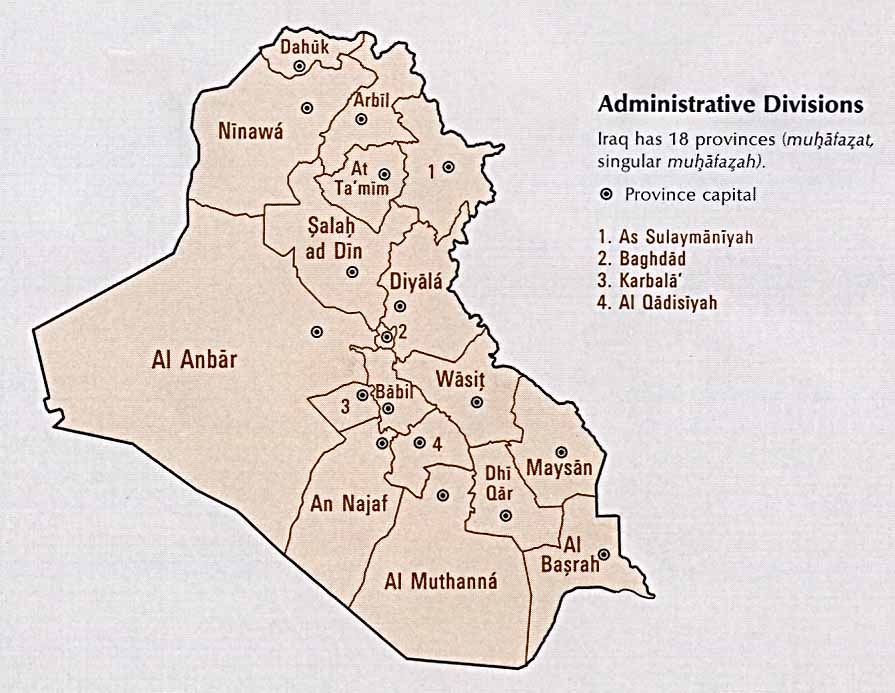
Babil, Irbil, Ninewa, Salahaddin, Tamim, – 46-56%
Dhi Qar, Diyala, Maysan – 31-45%
Baghdad, Karbala, Najaf, Qadisiyah – 26-30%
Anbar, Basra, Muthanna, Wasit – 6-25%
Sulaymaniya – 4-5%
Dohuk – 0%

SOURCES

Blua, Antoine, “Iraq Tussles With Neighbors Over Water,” Radio Free Europe/Radio Liberty, 9/13/09

Chulov, Martin, “Water shortage threatens two million people in southern Iraq,” Guardian, 8/26/09

DiPaola, Anthony and Alexander, Caroline, “Iraq Drought Cuts Harvest, Boosts Imports as Oil Cash Slips,” Bloomberg, 8/5/09

Hope, Bradley, “Iraq digs in to rebuild agricultural sector,” The National, 8/30/09

Inter-Agency Information and Analysis Unit, “The Humanitarian Situation In Iraq, Inter-Agency Fact Sheet,” United Nations Office for the Coordination of Humanitarian Affairs, August 2009

IRIN, “IRAQ: Drought hits rice, wheat staples,” 8/31/09b

Kamal, Adel, “desertification destroys ninawa villages,” Niqash, 7/17/09

Raphaeli, Dr. Nimrod, “Water Crisis in Iraq: The Growing Danger of Desertification,” The Middle East Media Institute, 7/23/09

Sly, Liz, “Iraq in throes of environmental catastrophe, experts say,” Los Angeles Times, 7/30/09

Special Inspector General for Iraq Reconstruction, “Quarterly Report and Semiannual Report to the United States Congress,” 7/30/09

Tharp, Mike, “Once world’s bread basket, Iraq now a farming basket case,” McClatchy Newspapers, 7/17/09

Williams, Timothy, “Idle Iraqi Date Farm Show Decline of Economy,” New York Times, 8/15/09

Thursday, September 24, 2009

Maliki’s Campaign Promises May Be Unrealistic

Prime Minister Nouri al-Maliki recently went on a short tour of southern Iraq to drum up support in anticipation of the January 2010 parliamentary elections. First he went to Basra, Iraq’s second largest city, on September 10, 2009. He then went to neighboring Dhi Qar province on September 14. Maliki’s State of Law List won both governorates in the 2009 vote, and control of the south is crucial in the Prime Minister’s re-election campaign.


During his visits Maliki gave speeches and talked with local officials about one of his main campaign themes, the provision of services. In Basra he berated the governor and provincial council for not improving water and electricity. Back in June the head of Basra’s reconstruction committee said that the province was short 97 billion Iraqi dinars to pay for projects. The province is also currently suffering from the effects of the drought with seawater from the Persian Gulf encroaching into fresh water areas. So far 5,000 villagers have left their homes because of the water crisis. In response, the day before Maliki arrived in Basra City, Baghdad transferred 208 billion dinars to the province to help with expenses, promised a $20 million water pipeline project to deliver fresh water, and announced $25 million to develop the area’s marshes. While in Dhi Qar he promised that the province would get its fair share of the budget, and said with improvements in the economy they could expect more money as well.

When Maliki’s State of Law list ran in the 2009 provincial elections they promised better governance and services, and are doing the same for the 2010 national ballot. This completely ignores the financial situation in Iraq. With the world recession the country’s main source of revenue, oil, took a precipitous drop in value. The 2009 budget saw large cuts as a result, with Iraq’s 18 provinces receiving a $1,748.2 million decrease in their capital budgets that pays for infrastructure and investment, while operational costs that go towards salaries, pensions, etc. ate up 80% of the overall budget. Oil prices have begun to creep back up, but so far, not enough to make a large increase in the 2010 budget. Maliki therefore, can talk to governors and provincial councils all he wants about better services, but there is simply no money to make that a reality right now.

SOURCES

Aswat al-Iraq, “Al-Maliki pays surprise visit to Thi-Qar,” 9/14/09
- “Minister says govt. unable to cover projects, eyes private sector,” 9/3/09
- “New financial amounts allocated for Basra,” 9/9/09
- “PM arrives in Basra,” 9/10/09

Chon, Gina, “Biden, on Iraq Trip, Will Meet Maliki,” Wall Street Journal, 9/16/09

Chulov, Martin, “Surge of seawater drives Iraqis from their homes in the south,” Guardian, 9/11/09

IraqSlogger.com, “Basra: Moritorium on New Development Projects,” 6/3/09

News Network Nasiriyah, “During a meeting with the masses of Dhi Qar,” 9/14/09

Wednesday, March 4, 2009

Another Tough Year Ahead For Iraq’s Farmers

Iraq was once one of the major agriculture producers of the Middle East. Now the farming sector has fallen into disrepair, and Iraq is a major food importer. Both Baghdad and the U.S. military however are hoping that it will make a come back to provide a source of growth to make up for the plummeting price of oil, and jobs for an economy that is still facing high unemployment. The problem is that the farm sector faces such large structural problems that it will probably take a decade for it to recover.

In 2008 Iraq faced one of the worst drought in years. Rainfall in 2007 was down 40% according to the Iraqi government, and affected the northern provinces of Irbil, Dohuk, Tamim, Diyala, and Ninewa the worst. Barley and wheat that are dependent upon rain were hit the hardest. Production for both dropped 51%, and in November 2008, the government announced that it would have to import 50 thousand tons of wheat to make up for the shortfall. The Ministry of Agriculture started several assistance programs, but U.S. government observers didn’t think that many were effective.

2009 looks to be no better. The Iraqi paper Al Sabah reported that the Water Resource Ministry announced in January that snow and rain were down 1/3 from normal levels. In February the Agriculture Minister said that farm production is down 30%. This year the United Nations has also designated Iraq one of 32 countries that needs external food aid. Iraq already imports 50% of its food needs.

The lack of water was just the latest hit to a sector of Iraq’s economy that has fallen on hard times since the 1980s. 26% of Iraqis are involved in farming, and it accounts for 8% of the country’s production making it one of the largest after oil. It has largely been neglected since the Saddam times however, and then faced international sanctions, the chaos and sectarian war that followed the U.S. invasion, and government incompetence. For example, many farm workers have left the rural areas for the cities. The fighting also disrupted trade within the country. Corrupt government officials is another issue. The chief Iraqi inspector in Wasit told The National that corruption was everywhere in the province. Many officials take cuts of aid that is supposed to go to farmers, and families often offer bribes to get assistance from the government. The government is also not able to supply fertilizer and water from the irrigation system. Electrical shortages have limited power for pumps. There are few tariffs, which means Iraq has been flooded with cheap food imports from Syrian, Iran, and Turkey since the U.S. invasion. The lack of adequate drainage is also leading to high salinity in the south. 5% of the country’s arable land is disappearing a year as a result. Finally, there is little use of modern farming techniques, and a lack of credit. Many farmers can’t qualify for loans anyway, and need bribes if they want one. All of these make Iraqis less competitive than their foreign competitors.

Baghdad is now trying to promote the farm sector in a drive to diversify the economy. Prime Minister Nouri al-Maliki announced a $200 million plan for agriculture. The government is going to subsidize seed sales and support for livestock and dates. Baghdad also has a plan to reclaim six million acres of land with high salinity. At the same time the government has cut subsidies for fuel and fertilizer.

Many U.S. officials in Iraq are skeptical of these plans. The head of the U.S. Provincial Reconstruction Team in Maysan and another member in the province told Reuters that the business was so dysfunctional and broken, and the government so incompetent and corrupt that it would be a Herculean task to revive farming. A U.S. Department of Agriculture report said the sector was “a disaster.” A U.S. farm expert thought it would take ten years to recover.

None of this is good news for Iraq’s struggling economy. The country is almost completely dependent upon oil to earn money. Now that prices have dropped for crude, the government is facing some tough decisions. Baghdad is talking about diversifying, and it’s important that the Agriculture Ministry is getting more money, but it’s unclear whether this is mere lip service or a real commitment.

SOURCES

Alsumaria, “Iraq waning farm sector urges recovery,” 3/3/09

Ashton, Adam, “Iraqi farmers are back in business, and Iraqis love local produce,” McClatchy Newspapers, 12/20/08

Aswat al-Iraq, “Agro-production down due to scarce rain – minister,” 2/23/09

Department of Defense, “Measuring Stability and Security in Iraq,” December 2008

Iraq Directory, “Iraq is Submitting a Tender to Buy 50 Thousand Tons of Wheat,” 11/25/08

Latif, Nizar, “Iraq in midst of ‘agricultural disaster,’” The National, 12/11/08

Ryan, Missy, “Iraq’s ailing farm sector more crucial than ever,” Reuters, 2/28/09

Al Sabah, “Iraq faces massive water shortage, Water Resources said,” 1/21/09

Sands, Phil and Latif, Nizar, “Corruption at the root of Iraq’s failing agriculture,” The National, 2/24/09

Special Inspector General for Iraq Reconstruction, “Quarterly Report and Semiannual Report to the United States Congress,” 1/30/09

Saturday, February 28, 2009

February 2008 UNICEF Report on Iraq

UNICEF recently released a report on Iraq. It not only focused upon the country’s children, but health, education, poverty, and the displaced. The organization said that with the reduction in violence there was greater access to Iraq’s communities. That was revealing more examples of poverty and deprivation than anyone knew about previously.

The biggest issue UNICEF reported on was a developing measles threat. It said that nine provinces had reported measles affecting 6,000 people since early 2008. The Iraqi Ministry of Health is worried that it could spread. Najaf, Sulamaniya, Irbil, Maysan, and Dohuk were endangered by this disease, while a more recent report from the United Nations’ IRIN news agency said that Salahaddin, Tamim, Anbar, Diyala, Baghdad, Babil and Dhi Qar were hit the hardest. Most victims were small children under the age of six. Government officials said that the main cause of the spread of measles was the lack of security, which kept health workers out of many areas.

The United Nations agency also went to a few schools in the northern provinces of Diyala, Irbil, and Dohuk. All of them were lacking basic services, especially access to clean water. In Dohuk the schools lacked bathrooms, while children in two villages in Irbil were suffering from water born diseases.

The displaced was another issue the report dealt with. In Tamim, 900 children were found begging on the streets of Kirkuk. 100 of them were orphans. Around half were internal refugees. All of them were trying to support their impoverished families. Internal refugees that were returning to the province lacked shelter, and access to water and sanitation. In Basra 250 squatters in an old navy had no sanitation, health care, or clean water. On the positive side 1,325 displaced families returned to the city of Mosul in Ninewa.

In 2008 Iraq suffered a sever drought. The worst hit areas were in the north. UNICEF traveled to Irbil and Ninewa and saw the drought’s lingering effects. In two areas of Irbil there was high poverty exacerbated by the lack of water that destroyed their farms, which were also their main source of food.

Examples of impoverishment were also found in Anbar. The outskirts of the province had deep poverty. Two areas by Ramadi that suffered because of the violence are now improving because the government has started programs for children. They still lack adequate health, sanitation and other basic services however.

The last part of the report detailed the various projects UNICEF was working on in Iraq. So far, the organization has committed $8 million for humanitarian projects in 59 communities. Those have mainly focused upon water, schools, and health campaigns. The major problem is that United Nations can hardly meet its obligations. UNICEF is short 89% of the money it needs for its various programs.

UNICEF is hoping that the provincial elections will lead to more responsible local governments that will address the needs of the country’s children. They are afraid about the spread of measles. The lack of services is also a large problem across the country. Iraq’s infrastructure has not been kept up because of the violence. Even as that has declined, there is still large-scale neglect. Finally poverty is another major issue. It has led to children begging, and kept them from going to school. More and more of these cases are being discovered as attacks have declined. The lack of money for both the United Nations and the Iraqi government after the fall in oil prices will probably mean these issues will not be solved any time soon however.

SOURCES

IRIN, “IRAQ: Measles emerges in violence-hit regions,” 2/24/09

UNICEF, “UNICEF Humanitarian Action Update Iraq,” 2/17/09

Sunday, February 15, 2009

U.S. Reports On Iraq’s Economy & Services

In January 2009 both the Defense Department and the Special Inspector General for Iraq Reconstruction (SIGIR) released their quarterly reports to Congress on Iraq. Both included overviews of Iraq’s economy and services. While the Pentagon tends to stress the positives, the SIGIR has some of the most up to date statistics, and gives a much more in depth look at the major sectors of Iraq’s economy. Both found aggregate improvements in the country, but still massive problems that need to be addressed.

Growth

The Iraqi Ministry of Planning recently reported that Iraq’s Gross Domestic Product (GDP) grew 10.9% in 2008. That was above the 9% growth predicted by the International Monetary Fund (IMF). While the improved security conditions has allowed more space for Iraqi businesses, the one major reason why Iraq’s economy grew so much last year was because of the massive increase in the price of oil. With the dramatic drop in the petroleum market, Iraq’s economy can be expected to shrink in 2009. There are also large structural problems. Iraq’s oil sector has been largely stagnant since the U.S. invasion. The violence has kept foreign investors away and hindered local businesses, which has left the state the driving force in the economy. The country needs massive investment to upgrade its infrastructure and provide jobs. Officially the unemployment rate is 15%, but the Minister of Planning Ali Baban and other sources believe it is much higher. The SIGIR thinks that unemployment and underemployment could be as high as 60%. Corruption also affects every part of the government and economy, and takes a large toll.

Oil & Gas

Oil is the main driver of Iraq’s economy. All the oil companies are state-run, and are expected to account for 85% of the country’s revenue in 2009. The drop in oil prices therefore will cause a major crisis for Iraq at least in the short term. Besides that the country has no flexibility in its oil exports to make up for fluctuations in international prices. Oil production in 2008 averaged 2.42 million barrels a day, an almost 15% increase from 2.11 million barrels a day in 2007. However that was below the 2.5 million mark from before the U.S. invasion. Overall, production has been stagnant since 2003, with minor changes up and down. The same thing applies to exports. In the last three months of 2008 Iraq exported 1.79 million barrels a day, a 3% increase from the previous quarter, but a 6% decrease from the same period in 2007.

The U.S. has spent $1.86 billion on the oil and gas industry, but it still needs several billion dollars more in investment. An audit by the SIGIR of work done by Kellog Brown & Root to work on Iraq’s southern oil fields and port found that Iraqis may not be taking care of many of these projects finished by the United States. At the end of 2008 the Oil Ministry also began two rounds of bidding for international companies to invest in nineteen oil and gas fields across the country. By the middle of this year the Ministry hopes to have these contracts completed. They are hoping that these corporations will boost exports to two million barrels a day in 2009, and overall production to 6 million by 2015. Iraq has also signed up a Japanese company to work on improving the port in Basra where the vast majority of the country’s exports flow through. Baghdad is moving ahead with these deals despite the fact that the Hydrocarbon law that will define the role of companies and the government in the oil and gas fields has been deadlocked in parliament for almost two years now.

Despite Iraq’s oil wealth it cannot meet its public’s demand for refined petroleum products. At the end of 2008 it did not meet its benchmarks for production of a range of goods like gas and diesel. By that time it was short 51% of gas needs, 36% of diesel, 24% of liquefied petroleum, and 15% of kerosene demand. The production of these products has gone up, but it is being outstripped by the Iraqis’ desires for more.

Corruption and transparency is also a problem with the industry. In December 2008 the IMF said that Iraq was not doing enough to fight corruption in the oil sector. The IMF and United Nations also both criticized Baghdad for not setting up rules for better accountability with its revenues. The huge amount of money generated by petroleum is obviously a huge attraction to officials hoping to steal, but Prime Minister Nouri al-Maliki has never shown any enthusiasm for stopping it. Instead he sees it as a public relations problem to be solved by simply not talking about it.

Farming

The Pentagon’s report said that farming has the biggest opportunity for growth this year. Agriculture accounts for 6% of GDP, and employs around 25% of the workforce, the second largest private employer in Iraq. Most of it is subsistence however, rather than for profit. The Defense Department listed all the structural impediments to this sector actually improving any time soon. Farming lacks government support, tariffs to keep out foreign competition, modern technology and techniques, electricity and fuel shortages that hinder the use of pumps for irrigation, a system that is broken down throughout the country, credit and investment, markets, and security. For those reasons Iraq imports 50% of its food needs.

In 2008 Iraq was also hit by a drought. It was mostly concentrated in the north affecting the provinces of Irbil, Dohuk, Tamim, Diyala, and Ninewa the worst. As a result wheat and barley production are down 51%, two of Iraq’s three major crops. The Water Resource Ministry reported in January 2009 that rain and snow was again down one third from normal, which could mean another water shortage this year. Kurdistan is working with the U.N. to help relieve the issue, while the Ministry of Agriculture began several assistance programs as well. The U.S. doesn’t think the government’s moves have been very effective however.

State Owned Businesses

As reported before, under Saddam the economy was state-run. After the U.S. invasion, the Coalition Provisional Authority unsuccessfully tried to privatize it, which led to the closing of hundreds of government owned businesses that employed up to 15% of the workforce. In 2006 the Defense Department began a program to revitalize these public industries to create more jobs. Over $100 million has been put into this project. That funding is now coming to an end, and Baghdad will now be responsible for their revitalization. At the end of 2008 the SIGIR did an audit of this effort, but found no reliable data to determine whether it was effective or not. It also found that cash was being given out without invoices, which would encourage corruption.

Debt

One area where Iraq has made a lot of progress has been with its foreign debt. Iraq owes money to two groups, the Paris Club and non-Paris Club countries. Most of this was from the Saddam era. Since 2004 Baghdad has been able to get $74 billion of its debt forgiven. That leaves $50-$75 billion still owed. The Paris Club, which is made up of western industrialized countries holds $7.6 billion in Iraq debt, down from $50 billion. Iraq reached an agreement with them on this remaining amount at the end of 2008. Most of Iraq’s remaining obligations belong to Saudi Arabia, China, and Kuwait. Negotiations with them are on going.

Banking

Banking is another industry the government is hoping will grow in 2009. The Iraqi Central Bank has been able to keep inflation in check. In 2006 it was at 32%, but by September 2008 it was cut to 12.9%. Control over inflation has allowed the Iraqi dinar to appreciate in value. From November 2006 to October 2008 Iraq’s currency increased 20% in value, and stood at 1,172 dinars for one American dollar in December 2008. The low inflation and appreciation has given Iraqis more buying power. The Central Bank is now cutting interest rates to encourage loans.

State owned banks account for 90% of all banking assets in the country. There are seven such enterprises that control 66% of the branches. The two main ones are the Rafidain and Rasheed Banks that have 150 branches each. The Agricultural Cooperative Bank, the Real Estate Bank, the Industrial Bank, the Iraq Bank, and the Trade Bank of Iraq follow those. In total the government has 397 bank branches. The largest private banks are the Al-Qarka Bank for Investment and Funding with 68 branches, the Investment Bank of Iraq with 22, and the Basra International Bank for Investment with nineteen. There are 194 private bank branches overall. Private banks have expanded with the improvement in security with more moving out to the provinces.

Like everything else, Iraq’s banks still have many problems. A December 2008 audit of the Rasheed and Rafidain banks found no business plan, no rules or regulations for workers, no reporting rules, no technology, little risk management, and hardly any services offered. For example, there are no personal accounts, safety deposit boxes, or dealings with foreign banks. More importantly, in late December 2008 two state-run banks ran out of cash, leaving Diyala province with no money to pay for government salaries, pensions, or reconstruction projects. The head of the Rafidain bank told Radio Free Europe/Radio Liberty in January 2009 that if banking were a sign of economic progress, Iraq would be far behind. The entire system needs to be reformed as a result.

This year the government is attempting to solve some of these problems by encouraging foreign banks to do business in Iraq. At the end of January 2009 the Finance Ministry held a conference asking international banks to invest and open branches in Iraq. The Finance Ministry promised them that he could clear any bureaucratic obstacles that they might face. The two-day event was attended by officials from American, English, Turkish, Iranian, Lebanese, Jordanian, and Bahrain owned banks. The Iraq Central Bank had already issued licenses to three foreign banks. JP Morgan Chase and Citibank said they were interested as well.

Stock Exchange

The Iraqi Stock Exchange was opened for business in August 2007. Since then it has sputtered forward. The number of shares traded in 2008 was down from 2007, although there are now more foreign stocks available. In 2007 there were 94 companies listed on the exchange. In 2008 that only increased by two. The number of sessions went up from 119 in 2007 to 139 in 2008, as well as the shares traded, however their value went down from $357 million to $251 million.

Services

American surveys of Iraqis have found mass disappointment with the delivery of services. The Pentagon declared that in 2009 meeting basic needs would be the top issue surpassing security for the first time since the invasion. It should be no surprise than that this was a major issue in the January 2009 provincial elections. While the U.S. has found some improvement in the government’s abilities, supply of essential services still does not meet demand.

Iraqis are generally unhappy with their supply of food, water, electricity, sewage, and health. A survey from the end of 2008 found that only 16% were satisfied with the amount of electricity they received, down from 32% in 2007. 26% said they were happy with their health services, down from 36% in 2007. 31% were satisfied with their drinking water, the same amount as 2007.

Electricity

Electricity production has increased, but it is only meeting 66% of demand. By the end of last year Iraq was producing 4,997 megawatts per day, a record high. That was a 2% increase from the previous quarter. The capacity of Iraq’s generators has increased by around 1,500 megawatts on average. Like the oil industry, the power system needs massive investment to repair and upgrade facilities. Security and fuel shortages also hinder production. Climate changes, like the drought have also cut hydroelectric output.

The U.S. has spent $4.78 billion on Iraq’s electrical system and added 2,683 megawatts. Iraqis have matched this investment. In 2007 they spent $1.4 billion, in 2008 $2.3 billion, and in 2009 the proposed budget sets aside $1.1 billion. The Ministry of Electricity signed a $3 billion deal recently with General Electric to provide generators. The Ministry wants to double production eventually, and match demand. In the meantime, many Iraqis have been forced to rely upon private generators that produce between 2,000-3,000 megawatts. Thankfully, the number of attacks on the system are also down with no major ones since April 2008. Previous ones however have kept four of eleven damaged power lines out of use.

Health

Baghdad is making small steps to provide more health services, but lacks the personnel to be effective. Iraq has 27.5 million people, but only 15,500 doctors. A study said they need about 100,000. Many physicians have left the country due to the violence. The Health Ministry has a large budget, $192 million in 2008, but like the rest of the administration, has not been able to spend most of it. By the end of September 2008 they had only expended $28.5 million, 14.8%. The Ministry did launch a public relations campaign to educate Iraqis about health issues last year, has plans to build six new hospitals and 1,000 health clinics by the end of the decade, and conducted a successful five day polio campaign that vaccinated 97% of Iraq’s five million children. Until Iraq is able to meet its staffing deficit however, it will be hard to do more.

Water

Iraq’s water system is in disrepair. The facilities are operating below capacity because of a lack of maintenance, and problems with operating them. For example, when the U.S. turned over the Nassiriya Water Treatment Plant in September 2007, which cost $278 million to build, it had a capacity to treat 10,000 cubic meters of water per hour. When the SIGIR later looked at it they found that Baghdad wasn’t providing enough power, leaks were not fixed, and the personnel were not trained for their jobs. By the beginning of 2008 when American inspectors went back they found that it was operating at less then a quarter of its capabilities. The U.S. had to sign two contracts worth $1.1 million to save the project, since it felt that Baghdad would not.

As reported before, Iraq suffered a cholera outbreak in 2008 that affected more than half of its eighteen provinces. Besides the incompetence of some provincial officials that used expired chlorine to clean water, the broken down sewage and water system were largely to blame. International organizations have said that Iraq will face annual cholera incidents as a result.

Food Rations

Iraq has the largest food ration system in the world. It took up 8% of the 2008 budget. It is looked at as a basic indicator of how well the government can provide services. For 2009 there are plans to cut wealthy families from the program because of the budget crisis caused by the drop in oil prices. Less money is also going to be appropriated for it overall.

Transportation and Communication


Iraq’s Ministries of Transportation and Communication have not been able to spend most of their 2008 budgets. Transportation only spent $55 million by the end of September 2008 of its $322 million, 17%, while Communications expended $28 million of its $315 million budget, 8.8%. Iraq’s roads are in need of repair, but the lack of spending by the government means that will not be taken care of. The Ministry of Transportation does have a plan to revitalize the country’s railway system. It is opening a plant at Abu Ghraib to manufacture railroad ties at a cheaper price than imports.

Conclusion

Overall, Iraq’s economy is too dependent upon oil, and its management by the government is inefficient and corrupt. Petroleum is the only thing that makes Iraq’s economy grow, since its other industries are small and underdeveloped. The legacy of Saddam’s system still resonates, as Iraq’s bureaucracy does not function without orders from the top officials. There is little to no individual initiative. Many ministers have to sign for everything even down to hiring people. The government is also paper based, which makes things move at a snail’s pace. Many of the country’s best and brightest have left the country and are not coming back. That has led to a massive talent deficit. The lack of transparency and accounting has allowed large-scale corruption to occur largely unencumbered by any real government effort to stop it. The lack of tariffs has meant that many private businesses have suffered from cheap foreign imports. Fuel and electricity shortages, and the lack of security have increased costs. Iraqis have also shown a general lack of willingness to maintain their infrastructure, which leads to breakdowns and plants operating at less then capacity. The one positive is that security has improved, which could allow foreign companies in oil, gas, electricity, and banking to finally invest in Iraq. The lack of competent bureaucrats could negatively affect that as well as they could give foreigners too much control over Iraq’s resources, deter companies from coming because of bad contracts, or provide new avenues for graft and bribes. Still foreign know how, technology, and money is desperately needed. It will be a long and hard struggle to overcome Iraq’s many problems, and create a diversified economy that can meet the needs of its public. There is no guarantee that it will ever happen.


SOURCES

Abouzeid, Rania, “Mismanaging Iraq: No Cash to Carry,” Time, 12/29/08

Associated Press, “Iraqi official appeals to foreign banks to invest,” 1/28/09

Aswat al-Iraq, “GDP higher by 10.9 % in 2008,” 2/11/09
- “Iraqi Unemployment Rate Dropped by 15% in 2008,” 1/27/09

Chon, Gina, “Western Bank Giants Prepare to Revamp Iraq’s Financial System,” Baghdad Life Blog, Wall Street Journal, 1/28/09

Department of Defense, “Measuring Stability and Security in Iraq,” December 2008

O’Hanlon, Michael and Campbell, Jason, “Iraq Index,” Brookings Institution, 11/20/08

Radio Free Europe/Radio Liberty, “Official: Iraqi Banking System Needs Overhaul,” 1/13/09

Al Sabah, “Iraq faces massive water shortage, Water Resources said,” 1/21/09

Special Inspector General for Iraq Reconstruction, “Quarterly Report to the United States Congress,” 10/30/09
- “Quarterly Report and Semiannual Report to the United States Congress,” 1/30/09

El-Tablawy, Tarek, “Official: 80 percent of Iraq pipelines damaged,” Associated Press, 2/11/09

This Day In Iraqi History - Oct 20 Iraqi forces and Peshmerga fought in Kirkuk in aftermath of Kurdish independence referendum

1922 Interior Min Sadoun told governors to start preparing for parliamentary elections and to             urge voters to only elect ca...