Showing posts with label Debt. Show all posts

Friday, October 30, 2026

Review Mokhtar Lamani and Bessma Momani, editors, From Desolation To Reconstruction, Iraq’s Troubled Journey, Wilfrid Laurier University Press, 2010


From Desolation To Reconstruction, Iraq’s Troubled Journey was the result of work at the Canadian Center for International Governance Innovation. It is an anthology of different authors focusing upon issues Iraq faced during the U.S. occupation such as the Kurdish question, foreign debt, federalism, and the U.S. attempt to spread democracy in the Middle East. Like any collection the chapters vary widely in quality and many of them are out of date because they are suggesting solutions to problems in 2009. Despite the inconsistencies there are some interesting selections.

Wednesday, September 30, 2026

Iraq’s Debt And Borrowing Continues To Grow As Iran Conflict Persists


The Iran War has thrown Iraq into a crisis. It depends upon oil exports to fund its government. While sales are increasing for now revenues are still far below pre-conflict levels. That has led Baghdad to borrow huge sums and draw from the country’s foreign reserves.

Tuesday, May 19, 2026

Iraq’s Financial Woes Continue Due To Iran War And Trump Administration


A combination of foreign events is undermining Iraq’s fragile economy. On the one hand the Strait of Hormuz Iraq’s main oil export route remains closed cutting off the country’s main source of revenue. On the other hand, the money Baghdad is making from petroleum is being held hostage by the Trump administration that wants the new Prime Minister Ali al-Zaidi to crackdown upon the pro-Iran Resistance. Together this is driving the government towards insolvency.

Tuesday, April 14, 2020

Iraq Asks World Bank For Help During Financial Crisis


Iraq is facing a dual crisis caused by the Russian-Saudi oil war and the global coronavirus that has collapsed the international oil market which the country depends upon. In response, Baghdad has gone to the World Bank asking for help.

Tuesday, January 4, 2011

Special Inspector General For Iraq Reconstruction’s “Hard Lessons” Chapter 8 “Treasury’s Triage”

Chapter 8 of the Special Inspector General for Iraq Reconstruction’s “Hard Lessons” review of the American rebuilding effort covers the initial U.S. work to reform Iraq’s economy. Immediately after the March 2003 invasion, Iraq was a wreck. The Iraqi military and government had collapsed, and looting was taking place in many of its urban centers. U.S. officials were caught by surprise at the chaotic situation, and were in panic mode trying to put everything back together again. They focused upon getting Iraq’s ministries and banks to re-open, pumping money into the economy, and then moved onto longer term policies such as reforming the currency system, relieving Iraq’s debt, and trying to implement free market policies. The Americans were largely successful at stabilizing the immediate situation and helping with Iraq’s money and debt, but failed at bringing wide-ranging capitalist principles to the nation.

In April 2003, officials from the Treasury Department arrived in Iraq. They found the country’s finances in tatters. The two largest banks, Rafidain and Rasheed, had been looted, and only two of Rafidain’s 170 branches were still open. The Central Bank of Iraq only had $350 million in gold in its vaults. Almost $1 billion in foreign currency had been withdrawn from its accounts before the U.S. invasion. Government ministries were bankrupt, there was no money to pay civil servants, Iraq’s currency, the dinar, was unstable, and the looting had done an estimated $12 billion in damages. 

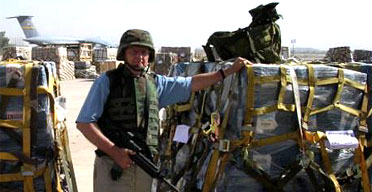
Pallets full of U.S. cash were flown into Baghdad to get the Iraqi government and economy running again (Guardian)

The first order of business for the Americans was to get money flowing again through the Iraqi economy. They got the bank’s to re-open, began paying government employees, reformed the civil service code and pensions, created a budget for the ministries, stabilized the dinar, and temporarily stopped debt payments to build up foreign reserves. This was mostly funded through the Development Fund for Iraq that was created by the United Nations. Since the Gulf War sanctions, Iraq’s oil revenues had been regulated by the international body, and deposited in the Federal Reserve Bank in New York. $12 billion from the Fund was eventually flown to Iraq in new $100 bills, and distributed throughout Iraq with little to no accountability. The priority was to get people back to work and the economy up and running as quickly as possible, so the U.S. skipped the book keeping.

Next the U.S. moved to Iraq’s currency. At the time, the country used two types of money. In Kurdistan there were Swiss dinars, and the rest of the country used Saddam dinars. The latter was easy to counterfeit, and was plagued by high inflation. The U.S. came up with a single dinar and a new exchange rate. In July 2003 CPA head Paul Bremer announced that the Central Bank of Iraq would replace the old notes with the new ones. That process lasted from October 2003 to January 2004.

By the end of 2003 the Americans were working on Iraq’s considerable debt. The Iran-Iraq and Gulf Wars had left the country $130 billion in the hole. The Treasury Department started renegotiation this debt, and got an 18-month moratorium on payments. In December, President Bush appointed former Secretary of State and Treasury James Baker to work on debt relief. He went to the Paris Club made up of 19 industrial countries, and got them to forgive 80% of the $38.9 billion Iraq owed them. In July 2004 the G-8 agreed to an IMF plan to reduce 90-95% of their Iraqi debt. Later, Finance Minister Adel Abdul Mahdi of the Iraqi interim government got the Paris Club to forgive 95% of Iraq’s debt and rescheduled the rest.

CPA’s economic director McPherson wanted free market reforms in Iraq (Oklahoma State Univ.)

The CPA also wanted to transform Iraq from a socialist to capitalist country. That was largely based upon the ideas of the CPA’s economic policy head Peter McPherson. He modeled his plans after Eastern Europe, which went through rapid economic changes after the fall of the Iron Curtain. McPherson's ideas were fully supported by Bremer.

In July McPherson focused upon Iraq’s 192 state-owned businesses. Most of them were closed during the war, and even when opened suffered from a lack of assets, obsolescence, high costs, and surplus employees. The looting and post-war chaos had made their situation worse. At the same time they accounted for 1/8 of the workforce, provided basic services, and included 90% of the country’s industry. McPherson decided to close all but the most efficient ones by freezing their assets and cutting off their money. The Treasury Department objected because they were afraid of the affects upon employment and whether it was legal under international law for an occupying power to carry out such changes. There were also differences within the CPA, and many Iraqi objections. That led the CPA to change course in just a matter of days and re-open the companies that would help with reconstruction such as cement factories. By August a third of the businesses were open again.

The U.S. also wanted to transform Iraq’s banks. Under Saddam they were mostly used for savings and transferring money. The Americans wanted them to support businesses, provide loans, and promote economic growth. The CPA suspended the old banking laws, created the Trade Bank of Iraq, started new regulations, and tried to modernize the banking system and change its credit policies. This U.S. effort was only slightly more successful than the ones aimed at bringing capitalism. By 2010 Iraq’s banks are still dominated by large and inefficient state-run ones like Rafidain and Rasheed, which lack transparency, business models, and have high costs. More importantly, Iraq remains a cash rather than credit based economy. 

In the end, the U.S. was successful at getting the economy, banks, and government up and running again, while its long-term plans were sidelined due to differences within the American camp, and opposition from Iraqis. Billions of dollars were pumped into the country through the CPA’s use of the Development Fund for Iraq, and much of the country’s debt was rescheduled or forgiven. The attempt to bring free market reforms to the state-run businesses and banks were either derailed or were ineffective, while the U.S. never even considered privatizing the country’s main asset, oil, because it didn’t want to appear to be after Iraq’s resources. The insurgency was also taking off, switching the emphasis from the economy to security. The result, was that by the beginning of 2004 the U.S. had largely given up on any ideas of bringing capitalism to Iraq, and simply wanted the economy working in the midst of a growing war with militants. This would foreshadow the coming actions by the Americans, who would score several more tactical victories in Iraq. The larger and more important strategic situation however, was much more difficult for the U.S. to shape because it was largely determined by Iraqis who had their own contested ideas about their country’s future.

SOURCES

England, Andrew, “Calls for bank reform to unlock Iraq’s potential,” Financial Times, 12/13/10

Packer, George, “War After The War,” New Yorker, 11/24/03

Pallister, David, “How the US sent $12bn in cash to Iraq, And watched it vanish,” Guardian, 2/8/07

Special Inspector General for Iraq Reconstruction, “Hard Lessons,” 1/22/09

Sterngold, James, “Another enemy looms – Iraq debt,” San Francisco Chronicle, 5/23/04

Wednesday, December 15, 2010

Wikileaks Documents Show Continued Saudi Opposition To Shiite Rule In Iraq

Saudi Arabia’s King Abdullah has refused to normalize relations with Iraq over fears of Shiite rule and Iranian influence (Britannica Blog)

Included in the recent Wikileaks release of U.S. State Department cables were several discussions between American diplomats and Saudi and Iraqi officials about Iraq-Saudi relations. Those talks disclosed the continued problems between the two Arab governments. The Saudis were weary of democracy, believing it turned Iraq over to the Shiite majority who were seen as being pro-Tehran. They therefore supported Sunni parties and tribes in the March 2010 elections. The Iraqis on the other hand, believed that the Saudis were trying to undermine the government and create sectarian tensions. This set of strained relations has been present ever since the U.S. invasion in 2003.

The State Department papers covered Iraqi-Saudi issues from early 2009 to the beginning of 2010. On March 15, 2009 Saudi Arabia’s King Abdullah told President Obama’s counterterrorism adviser John Brennan that he didn’t trust Prime Minister Nouri al-Maliki, and believed that he was an Iranian agent. In July, during a visit by Maliki to Washington, he asked President Obama to get the Saudis to stop interfering in Iraq. The premier said that Riyadh was backing Sunnis and increasing sectarian tensions in the country. On September 24, then U.S. Ambassador to Iraq Christopher Hill wrote the Saudis’ mistrust of Shiites, who they saw as being pawns of Iran, led Riyadh to not only want greater Sunni power, but a weak and fractured government in Baghdad to stave off Tehran’s influence. Maliki told the Americans that he believed part of the problem was that the Wahabi Saudis looked down upon Shiites in general. He cited Saudi clerics who would often make anti-Shiite statements with no responses by the government. Due to these fears and biases the Saudis were giving money and media support to Sunni parties and tribes before the 2010 election to oppose the Supreme Islamic Iraqi Council and the Iraqi National Alliance, which were the most pro-Iranian forces in Iraq. Several Iraqi officials complained about this interference to U.S. diplomats. On December 14, President Jalal Talabani went to the Americans accusing the Saudis of talking Kuwait out of several agreements with Baghdad. Finally, a February 2010 paper said that Turkey’s Foreign Minister reported that the Saudis were spending large amounts of money on Iraqi political parties because they didn’t want another Shiite led government. 

The comments contained in the State Department cables should be no surprise as Iraq and Saudi Arabia have had rough relations since the 2003 overthrow of Saddam. In 2004 reports started to emerge that Saudi charities were funding the Iraqi insurgency. In 2007, the U.S. military announced that 45% of the foreign fighters coming to Iraq were from Saudi Arabia, and almost half of the 135 foreigners held by American forces were Saudis. Riyadh admitted that their young men were going to Iraq, but claimed that they were doing all they could to stop them. An advisor to Maliki questioned that remark, and countered by saying that the Saudis knew exactly what was happening and were doing nothing about it. During an August 2007 visit by Secretary of State Condoleeza Rice and Secretary of Defense Robert Gates, the kingdom claimed that Iraq was the real threat to the region because terrorists there could spread to Saudi Arabia. U.S. Ambassador to Iraq Zalmay Khalizad later went on TV and stated that the Saudis were destabilizing Iraq. King Abdullah also refused to meet Maliki, and although the king promised the U.S. to open an embassy in Baghdad at the end of 2007 that has never happened. In April 2009 Prince Turki al-Faisal stated that the U.S. invasion turned Iraq over to Iran, and Maliki responded the next month by accusing the kingdom of not stopping their people from joining the insurgency. As a result, the prime minister said he was giving up on improving relations between the two countries. (1) In February 2010, just before Iraq’s elections, King Abdullah gave Allawi the royal treatment when he visited Riyadh, and then two months later held meetings with Kurdish President Massoud Barzani, Iraqi President Jalal Talabani, Vice President Tariq Hashemi, and even the head of the Supreme Council Ammar al-Hakim, but refused to offer an invitation to Maliki. In May the head of Saudi intelligence accused the prime minister of trying to overturn his country’s voting results. 

Finally, the sore relations have held up trade and aid between the two. The Saudis promised $500 million in assistance after the U.S. invasion, but have only delivered a small fraction of that amount. They also initially promised to forgive 80% of Iraq’s debt, which was largely accumulated when Riyadh supported Saddam in the Iran-Iraq War, but then refused to do so. They have not opened the border crossings between the two countries as well, limiting commerce.

Despite Iraqi and American attempts to forge better ties between Baghdad and Riyadh since 2003, the Saudis’ paranoia about Iran and their bias against Shiites, have prevented any thawing of relations. Instead, the kingdom has tried to keep Iraq’s government at bay diplomatically and economically, while both knowingly or tacitly supporting the insurgency, and backing Sunni parties to counter the Shiite ones. This has largely failed to change anything in Iraq, other than gain the ire of the Iraqi government. Unless some kind of nationalist coalition like Iyad Allawi’s comes to power, it seems that the Saudis will continue to give a cold shoulder to Iraq. That has an impact throughout the region, as Iraq will have a hard time gaining full acceptance in the larger Middle East until Saudi Arabia finally comes to terms with the fact that Shiites are going to be running Iraq for the foreseeable future.

FOOTNOTES

1. Agence France Presse, “No More Gestures To Saudi Arabia – Iraqi PM Maliki,” 5/28/09

SOURCES

Agence France Presse, “No More Gestures To Saudi Arabia – Iraqi PM Maliki,” 5/28/09
- “Saudis rebuff Iraq over insurgency,” 5/30/09

Dagher, Sam, “Anti-Saudi tide rises in Iraq,” Christian Science Monitor, 8/9/07

Dunne, Charles, “Iraq Going Forward: Threats to its Sovereignty, Prospects for its Future Role in the Middle East,” Institute for the Theory and Practice of International Relations, College of William and Mary, 4/13/09

Epstein, Rafael, “US blames Islamic charities for funding Iraq attacks,” ABC Radio, 10/22/04

Gause, F. Gregory, “Iraq 2012: The Regional Context,” Senate Foreign Relations Committee, 4/3/08

Gordon, Michael, “Meddling by Neighbors Adds to Iraq’s Woes,” New York Times, 12/5/10

Hill, Christopher, “The Great Game, In Mesopotamia: Iraq And It’s Neighbors, Part I,” U.S. Embassy, Baghdad, 9/24/09

Jeffrey, James, “U/S Burns’ February 18 Meetings With U/S,” U.S. Embassy, Ankara, 2/25/10

Kaysi, Danial Anas, “The Saudis go to Baghdad,” The National Interest, 4/30/10

Kelley, Matt, “Allies fall short on Iraq aid pledge,” USA Today, 1/30/08

Laessing, Ulf, “ANALYSIS-Saudi wants bigger role in Iraq to counter Iran,” Reuters, 8/2/10

Lynch, Marc, “Iraq and the Gulf on the rocks,” Marc Lynch Blog, Foreign Policy, 6/2/09

Oppel, Richard, “Foreign Fighters in Iraq Are tied to Allies of U.S.,” New York Times, 11/22/07

Parker, Ned, “The Conflict In Iraq: Saudi Role In Insurgency,” Los Angeles Times, 7/15/07

Raphaeli, Dr. Nimrod, “Western Countries Cancel Iraqi Debt, Gulf Countries Don’t,” Middle East Media Research Institute, 5/15/08

Rubin, Alissa, “Iraq Tries to Prove Autonomy, and Makes Inroads,” New York Times, 4/15/09

Sabah, Zaid and Tyson, Ann Scott, “Security Pact on Iraq Would Set U.S. Exit,” Washington Post, 12/11/07

Trend, “Experts: Saudi Arabia has few pressure levers for next Iraqi Government,” 4/16/10

Youssef, Nancy and Strobel, Warren, “U.S., Saudi Arabia have drifted apart,” McClatchy Newspapers, 8/2/07

Monday, June 15, 2009

Baghdad Hoping For Supplemental Budget Later In 2009

World oil prices have slowly crept back up in recent months. A barrel of oil is selling for around $70 per barrel on international markets. Iraq crude sells at a lower price, but it has been going up as well, along with exports. Baghdad is hoping that if the trend continues, the government will be able to pass a supplemental budget later in 2009 that will help alleviate some of the country’s financial problems.

At the beginning of April Iraq passed its 2009 budget. The budget went through three revisions before it was finally passed, and was still expected to run a $20 billion deficit. That was because it was based upon 2 million barrels a day average in exports and a $50 a barrel price, neither of which Iraq was achieving at that time. By May the Oil Ministry claimed Iraqi crude had reached the $50 mark, but was still only selling 1.905 million barrels a day. To make up the difference the Finance Ministry took out a two-year $7 billion loan from the International Monetary Fund.

The budget crunch is being felt already in the provinces. At the end of May, Maysan officials announced that they were going to run a deficit in 2009, and had no new money for development projects. They were looking for outside investment to fund growth. At the beginning of June, IraqSlogger reported a similar situation in Basra. The head of the reconstruction committee there said they too had no money for new projects, and were short about $84 million for what they needed.

With oil prices going up, Baghdad is now more optimistic about its money problems. Prime Minister Nouri al-Maliki recently said that he was hoping that the central government could pass a supplementary budget later this year if Iraqi crude continued to accrue in price. That would hopefully add much needed money to the ministries and provinces, all of which have had to cut their budgets. Of course, there’s also the issue of spending their funds, something Baghdad and the provinces still struggle with.

Iraq needs billions of dollars to improve its governance, services, and economy. U.S. reconstruction is coming to an end, so Iraq is increasingly on its own to provide money for development. The 2009 budget problems then, come at a bad time. Even if Iraq is able to meet its oil production and price goals, it will still be in debt to the IMF, and many of Iraq’s provinces will be left wanting until if and when a supplemental budget is passed. That will mean much needed rebuilding will be delayed.

SOURCES

Abdul-Zahra, Qassim, “Iraq passes sharply reduced budget for 2009,” Associated Press, 3/5/09

Agence France Presse, “Iraq presidency approves slashed budget,” 4/3/09

Aswat al-Iraq, “Finance ministry to sign new agreements with IMF,” 5/27/09
- “Increase in oil exports contributes to budget balance – ministry,” 6/2/09

Iraq Directory, “Maysan province seeks to attract foreign investment to compensate the fiscal deficit in budget,” 5/30/09
- “New supplementary budget with the rise of oil prices,” 6/10/09

IraqSlogger.com, “Basra: Moritorium on New Development Projects,” 6/3/09

Reuters, “As oil prices rise, Iraq nurtures budget hopes,” 6/8/09

Thursday, May 21, 2009

Going Into Debt To Cover Budget Deficit

On April 3, 2009 the Presidential Council passed the $58.9 billion 2009 Iraqi budget. It was based upon 2 million barrels a day in oil exports at a price of $50 a barrel. In that month the country was only able to sell 1.82 million barrels a day at $47 a barrel. As a result, the country is expected to run anywhere from a $25 billion to $30 billion deficit. Parliament originally believed that this would be covered by the country’s large foreign reserves that had built up since 2005 due to rising oil prices and an inability of Baghdad to spend most of its money. The Finance Minister Baqir Jabr said this stands at $75 billion, $44 billion in the Central Bank of Iraq and $30 billion held by the Finance Ministry itself. On April 27 Minister Jabr however said that the government couldn’t use that fund. That was followed by the Central Bank announcing in May that it had turned down the government’s request to cover the deficit. That leaves Baghdad with only two means to make up the difference. One, it can hope that the Oil Ministry is able to boost oil production to bring in more money. That’s unlikely to happen anytime soon. The other option is for the government to get a loan from the International Monetary Fund (IMF). That’s the route Baghdad is currently following.

It seems that parliament was completely unaware of the rules governing the budget when it was passed or were misinformed about them. There were several reports that lawmakers expected the budget deficit to be covered by the country’s reserves. It was only after that it was passed that the Finance Minister let them know that they could not use this money. The legislature either never talked to the Ministry or the Central Bank when it was debating the budget or were misled. In the end, parliament ended up passing a budget, almost half of which it can’t pay for. To make matters worse, it will go further in debt, borrowing money from the IMF to cover the difference, despite the fact that it has a massive reserve. Hopefully that can be used to pay the loan back, otherwise the situation will get worse in the next fiscal year unless petroleum prices skyrocket up again.

For more on Iraq's budget see:

Falling Oil Revenues, and Uneven Production

Baghdad Failing To Invest In Its Future

Presidential Council Vetoes 2009 Budget

Ups and Downs Of Iraq's Oil Industry And Its Implications For The Budget

Iraq's Budget Stalled

How Are The Current Provincial Councils Doing?

Iraq Revises Budget Once Again

Iraq Cuts Budget

Are Budget Cuts Ahead For Iraq?

Iraq's New Budget Woes

Iraq Cuts Its 2009 Budget, But Still Can't Spend It

NY Times Finds Iraq Spends Even Less Of Its Budget

GAO August 2008 Report On Iraq's Budget And Spending

SOURCES

Abdul-Zahra, Qassim, “Iraq passes sharply reduced budget for 2009,” Associated Press, 3/5/09

Agence France Presse, “Iraq presidency approves slashed budget,” 4/3/09

Aswat al-Iraq, “MP expects 50% deficit in 2009 budget,” 4/27/09

Azzaman, “Iraq’s hard cash reserves estimated at more than $70 billion, minister says,” 3/18/09

Cockburn, Patrick, “Collapse in Iraqi oil price shatters hope of recovery,” Independent, 3/20/09

Cordesman, Anthony, “The Changing Situation in Iraq: A Progress Report,” Center for Strategic and International Studies, 4/4/09

Hafidh, Hassan, “UPDATE: Iraq April Oil Exports 1.82M B/d, Up 0.33% On Month,” Dow Jones, 5/3/09

Al-Hashemi, Mostafa, “Iraq not to tap hard cash reserves despite fall in oil prices,” Azzaman, 4/27/09

Iraq Directory, “Central Bank of Iraq (CBI) declined government’s request to borrow from Reserved funds,” 5/5/09

Levinson, Charles, “Toll Rises as Iraq Slows Surge,” Wall Street Journal, 5/9/09

Sly, Liz, “Economic downturn finally hits Iraq,” Los Angeles Times, 5/11/09

Sunday, February 15, 2009

U.S. Reports On Iraq’s Economy & Services

In January 2009 both the Defense Department and the Special Inspector General for Iraq Reconstruction (SIGIR) released their quarterly reports to Congress on Iraq. Both included overviews of Iraq’s economy and services. While the Pentagon tends to stress the positives, the SIGIR has some of the most up to date statistics, and gives a much more in depth look at the major sectors of Iraq’s economy. Both found aggregate improvements in the country, but still massive problems that need to be addressed.

Growth

The Iraqi Ministry of Planning recently reported that Iraq’s Gross Domestic Product (GDP) grew 10.9% in 2008. That was above the 9% growth predicted by the International Monetary Fund (IMF). While the improved security conditions has allowed more space for Iraqi businesses, the one major reason why Iraq’s economy grew so much last year was because of the massive increase in the price of oil. With the dramatic drop in the petroleum market, Iraq’s economy can be expected to shrink in 2009. There are also large structural problems. Iraq’s oil sector has been largely stagnant since the U.S. invasion. The violence has kept foreign investors away and hindered local businesses, which has left the state the driving force in the economy. The country needs massive investment to upgrade its infrastructure and provide jobs. Officially the unemployment rate is 15%, but the Minister of Planning Ali Baban and other sources believe it is much higher. The SIGIR thinks that unemployment and underemployment could be as high as 60%. Corruption also affects every part of the government and economy, and takes a large toll.

Oil & Gas

Oil is the main driver of Iraq’s economy. All the oil companies are state-run, and are expected to account for 85% of the country’s revenue in 2009. The drop in oil prices therefore will cause a major crisis for Iraq at least in the short term. Besides that the country has no flexibility in its oil exports to make up for fluctuations in international prices. Oil production in 2008 averaged 2.42 million barrels a day, an almost 15% increase from 2.11 million barrels a day in 2007. However that was below the 2.5 million mark from before the U.S. invasion. Overall, production has been stagnant since 2003, with minor changes up and down. The same thing applies to exports. In the last three months of 2008 Iraq exported 1.79 million barrels a day, a 3% increase from the previous quarter, but a 6% decrease from the same period in 2007.

The U.S. has spent $1.86 billion on the oil and gas industry, but it still needs several billion dollars more in investment. An audit by the SIGIR of work done by Kellog Brown & Root to work on Iraq’s southern oil fields and port found that Iraqis may not be taking care of many of these projects finished by the United States. At the end of 2008 the Oil Ministry also began two rounds of bidding for international companies to invest in nineteen oil and gas fields across the country. By the middle of this year the Ministry hopes to have these contracts completed. They are hoping that these corporations will boost exports to two million barrels a day in 2009, and overall production to 6 million by 2015. Iraq has also signed up a Japanese company to work on improving the port in Basra where the vast majority of the country’s exports flow through. Baghdad is moving ahead with these deals despite the fact that the Hydrocarbon law that will define the role of companies and the government in the oil and gas fields has been deadlocked in parliament for almost two years now.

Despite Iraq’s oil wealth it cannot meet its public’s demand for refined petroleum products. At the end of 2008 it did not meet its benchmarks for production of a range of goods like gas and diesel. By that time it was short 51% of gas needs, 36% of diesel, 24% of liquefied petroleum, and 15% of kerosene demand. The production of these products has gone up, but it is being outstripped by the Iraqis’ desires for more.

Corruption and transparency is also a problem with the industry. In December 2008 the IMF said that Iraq was not doing enough to fight corruption in the oil sector. The IMF and United Nations also both criticized Baghdad for not setting up rules for better accountability with its revenues. The huge amount of money generated by petroleum is obviously a huge attraction to officials hoping to steal, but Prime Minister Nouri al-Maliki has never shown any enthusiasm for stopping it. Instead he sees it as a public relations problem to be solved by simply not talking about it.

Farming

The Pentagon’s report said that farming has the biggest opportunity for growth this year. Agriculture accounts for 6% of GDP, and employs around 25% of the workforce, the second largest private employer in Iraq. Most of it is subsistence however, rather than for profit. The Defense Department listed all the structural impediments to this sector actually improving any time soon. Farming lacks government support, tariffs to keep out foreign competition, modern technology and techniques, electricity and fuel shortages that hinder the use of pumps for irrigation, a system that is broken down throughout the country, credit and investment, markets, and security. For those reasons Iraq imports 50% of its food needs.

In 2008 Iraq was also hit by a drought. It was mostly concentrated in the north affecting the provinces of Irbil, Dohuk, Tamim, Diyala, and Ninewa the worst. As a result wheat and barley production are down 51%, two of Iraq’s three major crops. The Water Resource Ministry reported in January 2009 that rain and snow was again down one third from normal, which could mean another water shortage this year. Kurdistan is working with the U.N. to help relieve the issue, while the Ministry of Agriculture began several assistance programs as well. The U.S. doesn’t think the government’s moves have been very effective however.

State Owned Businesses

As reported before, under Saddam the economy was state-run. After the U.S. invasion, the Coalition Provisional Authority unsuccessfully tried to privatize it, which led to the closing of hundreds of government owned businesses that employed up to 15% of the workforce. In 2006 the Defense Department began a program to revitalize these public industries to create more jobs. Over $100 million has been put into this project. That funding is now coming to an end, and Baghdad will now be responsible for their revitalization. At the end of 2008 the SIGIR did an audit of this effort, but found no reliable data to determine whether it was effective or not. It also found that cash was being given out without invoices, which would encourage corruption.

Debt

One area where Iraq has made a lot of progress has been with its foreign debt. Iraq owes money to two groups, the Paris Club and non-Paris Club countries. Most of this was from the Saddam era. Since 2004 Baghdad has been able to get $74 billion of its debt forgiven. That leaves $50-$75 billion still owed. The Paris Club, which is made up of western industrialized countries holds $7.6 billion in Iraq debt, down from $50 billion. Iraq reached an agreement with them on this remaining amount at the end of 2008. Most of Iraq’s remaining obligations belong to Saudi Arabia, China, and Kuwait. Negotiations with them are on going.

Banking

Banking is another industry the government is hoping will grow in 2009. The Iraqi Central Bank has been able to keep inflation in check. In 2006 it was at 32%, but by September 2008 it was cut to 12.9%. Control over inflation has allowed the Iraqi dinar to appreciate in value. From November 2006 to October 2008 Iraq’s currency increased 20% in value, and stood at 1,172 dinars for one American dollar in December 2008. The low inflation and appreciation has given Iraqis more buying power. The Central Bank is now cutting interest rates to encourage loans.

State owned banks account for 90% of all banking assets in the country. There are seven such enterprises that control 66% of the branches. The two main ones are the Rafidain and Rasheed Banks that have 150 branches each. The Agricultural Cooperative Bank, the Real Estate Bank, the Industrial Bank, the Iraq Bank, and the Trade Bank of Iraq follow those. In total the government has 397 bank branches. The largest private banks are the Al-Qarka Bank for Investment and Funding with 68 branches, the Investment Bank of Iraq with 22, and the Basra International Bank for Investment with nineteen. There are 194 private bank branches overall. Private banks have expanded with the improvement in security with more moving out to the provinces.

Like everything else, Iraq’s banks still have many problems. A December 2008 audit of the Rasheed and Rafidain banks found no business plan, no rules or regulations for workers, no reporting rules, no technology, little risk management, and hardly any services offered. For example, there are no personal accounts, safety deposit boxes, or dealings with foreign banks. More importantly, in late December 2008 two state-run banks ran out of cash, leaving Diyala province with no money to pay for government salaries, pensions, or reconstruction projects. The head of the Rafidain bank told Radio Free Europe/Radio Liberty in January 2009 that if banking were a sign of economic progress, Iraq would be far behind. The entire system needs to be reformed as a result.

This year the government is attempting to solve some of these problems by encouraging foreign banks to do business in Iraq. At the end of January 2009 the Finance Ministry held a conference asking international banks to invest and open branches in Iraq. The Finance Ministry promised them that he could clear any bureaucratic obstacles that they might face. The two-day event was attended by officials from American, English, Turkish, Iranian, Lebanese, Jordanian, and Bahrain owned banks. The Iraq Central Bank had already issued licenses to three foreign banks. JP Morgan Chase and Citibank said they were interested as well.

Stock Exchange

The Iraqi Stock Exchange was opened for business in August 2007. Since then it has sputtered forward. The number of shares traded in 2008 was down from 2007, although there are now more foreign stocks available. In 2007 there were 94 companies listed on the exchange. In 2008 that only increased by two. The number of sessions went up from 119 in 2007 to 139 in 2008, as well as the shares traded, however their value went down from $357 million to $251 million.

Services

American surveys of Iraqis have found mass disappointment with the delivery of services. The Pentagon declared that in 2009 meeting basic needs would be the top issue surpassing security for the first time since the invasion. It should be no surprise than that this was a major issue in the January 2009 provincial elections. While the U.S. has found some improvement in the government’s abilities, supply of essential services still does not meet demand.

Iraqis are generally unhappy with their supply of food, water, electricity, sewage, and health. A survey from the end of 2008 found that only 16% were satisfied with the amount of electricity they received, down from 32% in 2007. 26% said they were happy with their health services, down from 36% in 2007. 31% were satisfied with their drinking water, the same amount as 2007.

Electricity

Electricity production has increased, but it is only meeting 66% of demand. By the end of last year Iraq was producing 4,997 megawatts per day, a record high. That was a 2% increase from the previous quarter. The capacity of Iraq’s generators has increased by around 1,500 megawatts on average. Like the oil industry, the power system needs massive investment to repair and upgrade facilities. Security and fuel shortages also hinder production. Climate changes, like the drought have also cut hydroelectric output.

The U.S. has spent $4.78 billion on Iraq’s electrical system and added 2,683 megawatts. Iraqis have matched this investment. In 2007 they spent $1.4 billion, in 2008 $2.3 billion, and in 2009 the proposed budget sets aside $1.1 billion. The Ministry of Electricity signed a $3 billion deal recently with General Electric to provide generators. The Ministry wants to double production eventually, and match demand. In the meantime, many Iraqis have been forced to rely upon private generators that produce between 2,000-3,000 megawatts. Thankfully, the number of attacks on the system are also down with no major ones since April 2008. Previous ones however have kept four of eleven damaged power lines out of use.

Health

Baghdad is making small steps to provide more health services, but lacks the personnel to be effective. Iraq has 27.5 million people, but only 15,500 doctors. A study said they need about 100,000. Many physicians have left the country due to the violence. The Health Ministry has a large budget, $192 million in 2008, but like the rest of the administration, has not been able to spend most of it. By the end of September 2008 they had only expended $28.5 million, 14.8%. The Ministry did launch a public relations campaign to educate Iraqis about health issues last year, has plans to build six new hospitals and 1,000 health clinics by the end of the decade, and conducted a successful five day polio campaign that vaccinated 97% of Iraq’s five million children. Until Iraq is able to meet its staffing deficit however, it will be hard to do more.

Water

Iraq’s water system is in disrepair. The facilities are operating below capacity because of a lack of maintenance, and problems with operating them. For example, when the U.S. turned over the Nassiriya Water Treatment Plant in September 2007, which cost $278 million to build, it had a capacity to treat 10,000 cubic meters of water per hour. When the SIGIR later looked at it they found that Baghdad wasn’t providing enough power, leaks were not fixed, and the personnel were not trained for their jobs. By the beginning of 2008 when American inspectors went back they found that it was operating at less then a quarter of its capabilities. The U.S. had to sign two contracts worth $1.1 million to save the project, since it felt that Baghdad would not.

As reported before, Iraq suffered a cholera outbreak in 2008 that affected more than half of its eighteen provinces. Besides the incompetence of some provincial officials that used expired chlorine to clean water, the broken down sewage and water system were largely to blame. International organizations have said that Iraq will face annual cholera incidents as a result.

Food Rations

Iraq has the largest food ration system in the world. It took up 8% of the 2008 budget. It is looked at as a basic indicator of how well the government can provide services. For 2009 there are plans to cut wealthy families from the program because of the budget crisis caused by the drop in oil prices. Less money is also going to be appropriated for it overall.

Transportation and Communication


Iraq’s Ministries of Transportation and Communication have not been able to spend most of their 2008 budgets. Transportation only spent $55 million by the end of September 2008 of its $322 million, 17%, while Communications expended $28 million of its $315 million budget, 8.8%. Iraq’s roads are in need of repair, but the lack of spending by the government means that will not be taken care of. The Ministry of Transportation does have a plan to revitalize the country’s railway system. It is opening a plant at Abu Ghraib to manufacture railroad ties at a cheaper price than imports.

Conclusion

Overall, Iraq’s economy is too dependent upon oil, and its management by the government is inefficient and corrupt. Petroleum is the only thing that makes Iraq’s economy grow, since its other industries are small and underdeveloped. The legacy of Saddam’s system still resonates, as Iraq’s bureaucracy does not function without orders from the top officials. There is little to no individual initiative. Many ministers have to sign for everything even down to hiring people. The government is also paper based, which makes things move at a snail’s pace. Many of the country’s best and brightest have left the country and are not coming back. That has led to a massive talent deficit. The lack of transparency and accounting has allowed large-scale corruption to occur largely unencumbered by any real government effort to stop it. The lack of tariffs has meant that many private businesses have suffered from cheap foreign imports. Fuel and electricity shortages, and the lack of security have increased costs. Iraqis have also shown a general lack of willingness to maintain their infrastructure, which leads to breakdowns and plants operating at less then capacity. The one positive is that security has improved, which could allow foreign companies in oil, gas, electricity, and banking to finally invest in Iraq. The lack of competent bureaucrats could negatively affect that as well as they could give foreigners too much control over Iraq’s resources, deter companies from coming because of bad contracts, or provide new avenues for graft and bribes. Still foreign know how, technology, and money is desperately needed. It will be a long and hard struggle to overcome Iraq’s many problems, and create a diversified economy that can meet the needs of its public. There is no guarantee that it will ever happen.


SOURCES

Abouzeid, Rania, “Mismanaging Iraq: No Cash to Carry,” Time, 12/29/08

Associated Press, “Iraqi official appeals to foreign banks to invest,” 1/28/09

Aswat al-Iraq, “GDP higher by 10.9 % in 2008,” 2/11/09
- “Iraqi Unemployment Rate Dropped by 15% in 2008,” 1/27/09

Chon, Gina, “Western Bank Giants Prepare to Revamp Iraq’s Financial System,” Baghdad Life Blog, Wall Street Journal, 1/28/09

Department of Defense, “Measuring Stability and Security in Iraq,” December 2008

O’Hanlon, Michael and Campbell, Jason, “Iraq Index,” Brookings Institution, 11/20/08

Radio Free Europe/Radio Liberty, “Official: Iraqi Banking System Needs Overhaul,” 1/13/09

Al Sabah, “Iraq faces massive water shortage, Water Resources said,” 1/21/09

Special Inspector General for Iraq Reconstruction, “Quarterly Report to the United States Congress,” 10/30/09
- “Quarterly Report and Semiannual Report to the United States Congress,” 1/30/09

El-Tablawy, Tarek, “Official: 80 percent of Iraq pipelines damaged,” Associated Press, 2/11/09

Saturday, November 15, 2008

Special Inspector General for Iraq Reconstruction’s Quarterly October Report

At the end of October the Special Inspector General for Iraq Reconstruction (SIGIR) issued its quarterly report on reconstruction, and the Iraqi government and economy. As usual, it provides some of the most comprehensive and up to date statistics on Iraq available. For the U.S., its reconstruction program is coming to an end, as there are no more large appropriations coming in the future. On the Iraqi side, the country has moved from a failed state where nothing was working, to a fragile state. It still needs to move towards a stable one. That requires the ability to spend its budget, continued improvement in the security forces, its justice system, fighting corruption, and its infrastructure, and economy.

Security and Iraqi Forces


2008 has seen a continued improvement in security. The number of attacks from April 1 to July 1 compared to July 1 to September 30 declined approximately 35% from 5,318 to 3,435. Violence is down to levels not seen since 2004. That still makes it a dangerous country, but nowhere near the bloody months of the sectarian war that lasted from 2006-2007. General Ray Odierno, the new U.S. commander in Iraq, said that the nation has progressed to a fragile state.

Part of the reason for the improved situation in the country has been the dramatic increase in the Iraqi security forces, although there are problems telling just how many there are. The number of trained police and soldiers has grown from 87,414 to 531,000 since 2003. There happens to be 591,695 on the payroll however. An October 21 audit by the SIGIR found that there are in fact, no accurate figures on how many members of the security forces are actually still on duty. The U.S. has changed what it counts over the years, and Iraqi payrolls aren’t reliable. Corruption also plays a role as Iraqi officers collect pay from ghost soldiers, there are also officials who do not follow procedures, and others who do not want accurate accounting. Finally, there are many Iraqis on leave, absent without leave, dead, and wounded, that are still counted. At the local level, there are also many police that have received no training because the provinces have large leeway in hiring, independent of the Interior Ministry. Eight of Iraq’s 18 provinces for example, have more police on the payroll than are authorized by Baghdad. The U.S. has tried to automate the many power system, but that plan has run into major problems. The SIGIR found that depending upon the time period and accounting methods, the U.S. could either be undercounting the number of Iraqis or over counting. This problem may never be solved.

However many are on duty, they are making improvements, with problems still looming. There are now 164 Iraqi Army battalions, 107 of which are in the lead or acting independently. This has allowed the U.S. to move to more of a support role. There are still not enough non-commissioned officers (NCOs) and officers however. The Ministry of Defense has attempted to solve this problem by offering jobs to former soldiers from Saddam’s army that lost their positions when the Coalition Provisional Authority disbanded the military in 2003. So far, 97,000 have signed up for this program as of early October 2008, but only 738 officers and 1,425 NOCs were accepted by September 13. The Accountability and Justice Law that replaced the old DeBaathificaition process says that the Defense and Interior Ministries cannot take in any former Baathists, but it is unclear if or how many of these ex-soldiers fit that description. Iraq’s government however, tends to implement laws how they want to, rather than how they were written. The Defense Ministry’s training centers have also produced 12,000 new NCOs as of July 2008. The Ministry also has problems with logistics and procurement, while Interior has corruption, sectarianism, and issues with command and control and maintenance. The rapid expansion of forces, has also strained Iraq’s training centers, many of which lack adequate equipment and facilities. The lack of housing for example has reduced training by 14%.

Iraq's Justice System And Corruption

Despite increases in the number of officials, and new facilities opening, Iraq’s justice system still does not work. Judges are routinely threatened and killed. In 2008, seven judges have been assassinated. Since 2003 over 40 judges and families members have also died. The Interior Ministry said they are working on security for the judiciary, but the SIGIR has found no evidence that anything is actually being done. The U.S. is still working hard to open new courts, nine new ones from July to October 2008, expand the staff, 428 new judges, 287 new investigative judges, 689 new investigators, and 313 prosecutors, as well as rebuild courthouses. The number of cases however, continues to overwhelm the system. By October 8, there were 31,578 detainees and 10,169 prisoners. Overcrowded jails and mistreatment were the norm. The United States is in the process of building six new prisons to relieve the stress.

Like the rest of the government, corruption is rife in the Justice Ministry, but the ability to fight it is still minimal. The main anti-corruption office is the Commission on Integrity, but the Amnesty Law closed down half of its cases. The Commission also doesn’t really operate outside of Baghdad, and many of its staff have been killed, so it is very limited in what it can do. The Board of Supreme Audit is supposed to check spending, but the dramatic increase in Iraq’s budget with the rise of oil prices has meant its work has grown tremendously, while its speed has slowed. The International Monetary Fund has reported some improvement in oil smuggling as metering has improved as well as transparency in the industry. The United Nations has also launched a major anti-corruption effort to help Baghdad.

U.S. Reconstruction

The U.S. has appropriated almost $18 billion for Iraq reconstruction since 2003. As of September 30, 2008 there is no more new funding for this effort. 94% of the money that has been appropriated by Congress has been spent. There are still considerable amounts of money that is yet to be expended, such as $6.9 billion for Iraq’s security forces, but Iraq is basically now in charge of financing its own reconstruction in the future. Baghdad has appropriated $45.98 billion for this purpose since the invasion.

U.S. Funds For Iraq’s Security Forces
$17.94 billion has been appropriated
$14.09 billion has been obligated
$11.04 billion has been spent
$6.9 billion still to be spent
$3.85 billion left to be appropriated

Totals For U.S. Funds Obligated For Iraq’s Services
$4.65 billion for electricity
$2.6 billion for water
$1.75 billion for oil and gas
$1.1 billion for transportation and communication
$900 million for health care

Iraq’s Budget

The problem as usual on the Iraqi side is their inability to spend much of their capital budget, which goes to infrastructure. In 2008, Baghdad appropriated $20 billion for its overall capital budget, but the SIGIR did not know how much of it had actually been spent. Out of Iraq’s major ministries, none has been able to spend more than 30% of its capital budgets by June 2008. Some Iraqi ministries, such as Electricity, do not allow U.S. advisors to operate within them, which also makes improving their spending difficult.

Capital Budget Spending Of Iraq’s Ministries As Of June 2008

Water Ministry:
  • Appropriated $375 million
  • Spent $113 million
  • 30.1% spent
Oil Ministry:
  • Appropriated $2 billion
  • Spent $410 million
  • 20.5% spent
Electricity Ministry:
  • Appropriated $1.3 billion
  • Spent $229 million
  • 17.6% spent
Health Ministry:
  • Appropriated $83 billion
  • Spent $8 million
  • 9.6% spent

As reported earlier, Iraq’s increasing budgets have not improved the standard of living for average Iraqis. Its per capita income of $1,214 is lower than Saudi Arabia ($15,440), Algeria ($3,620), and Syria ($1,760) for example.

Government Services

The United Nations reports that 50% of Iraqis do not have access to one or more services. Besides the basics like health care and electricity, Baghdad also provides basic food rations to over 12 million people. The Ministry of Trade is responsible for this system, because most of the food is imported. The Ministry is facing increasing world food prices, but has not received as much money as it asked for from Iraq’s parliament. The ration system also distorts prices in Iraq’s farming industry, which is fifth largest sector of Iraq’s GDP.

Electricity

The United States and Baghdad have worked to improve Iraq’s electrical capacity, yet it is nowhere near meeting demand. Iraq averaged 117,849 megawatts of electricity from July to October 2008. That was an 8% increase from the same quarter in 2007. Average demand for electricity however, stood at 209,483 megawatts, a 7% increase from the same time last year. U.S. reconstruction funds have led to 550 new power projects worth $4.3 billion. This has added 2,500 megawatts to the system. The problem has been that since the invasion, Iraqis have greatly expanded their consumer goods, which has kept demand far above what can be produced.

Economy

Despite all of Iraq’s problems, its economy is growing. This was mostly due to the sky rocketing price of oil, which provides 65% of the country’s GDP, and 90% of its revenue. That’s now going to take a hit as crude prices have dropped with the looming world recession. Still, in the first half of 2008, all of the none oil sectors of the economy grew as well except for farming, which has been hit by one of the worst droughts in decades. Inflation has also taken a dramatic drop. Still, most Iraqis can’t meet their basic needs, and most provinces suffer from high unemployment, malnutrition, and illiteracy, which limited job opportunities. The government has not calculated unemployment and underemployment figures for a few years now, but their last numbers were 18% and 38% respectively. Most believe up to 60% of the country is unemployed or underemployed.

Debt

Iraq’s debt has been dramatically reduced thanks to the help of the United States. Before a 2004 meeting of the Paris Club, which brings together many of the largest creditor nations in the world, Iraq had a $142 billion debt. Now it only owes $43 billion. The IMF is working on reducing $16 billion more. Iraq’s outstanding debts belong to Saudi Arabia ($15-$39 billion), China ($8.5 billion), Kuwait ($8.2 billion), and Qatar ($5 billion).

Oil

Oil is Iraq’s major industry. According to the Finance Ministry it will account for 94% of the country’s 2009 budget. From July to October oil production reached 2.47 million barrels a day. That was a 2% increase from the previous quarter, and an 18% increase from the same quarter in 2007. Exports of crude averaged 1.73 million barrels a day, an 8% increase from the last quarter, and a 2% increase from the same quarter last year. Overall, for 2008 the country has averaged 1.86 million barrels a day in exports, which is below the 1.9 million benchmark set by the Oil Ministry.

The government is working to improve its infrastructure and production. It has appropriated $5 billion for new pipes in Basra. This project started in August 2007. This is desperately needed, because as earlier reported, Basra’s pipelines are in danger of having catastrophic failures at any time. The Oil Ministry is also working to place meters throughout the country to accurately monitor production, although this is still a work in progress. The oil law and revenue sharing law continue to be deadlocked in parliament, so the Oil Ministry has to work on an ad hoc basis to sign deals with international oil companies to try to invest in Iraq’s oil industry.

Like many other oil exporting countries, Iraq lacks adequate facilities to refine crude and provide for its public. On September 21, 2008 for example, the country couldn’t meet demand for any oil products such as gas, kerosene, liquefied gas, or diesel. Iraq has to rely upon imports to meet these needs.

Conclusion

Overall, the new SIGIR report continues with previous ones from this year. The United States and Iraq have spent billions on Iraqi reconstruction, the Iraqi economy has grown since 2007, and improved security should make this work easier, yet little of this has had any affect upon the general public. Basic services do not meet demand, half or more of the country does not have steady work, and corruption and lack of skilled bureaucrats continue to hinder the government’s ability to improve its spending to fix these problems. These issues will take a long time to solve, some like corruption, may never be.

For other Special Inspector General for Iraq Reconstruction reports see:

Overview Of Iraq’s Provinces

Special Inspector General for Iraq Reconstruction’s July Report’s Major Findings

Special Inspector General for Iraq Reconstruction’s Numbers for Iraq’s Internally Displaced

Special Inspector General for Iraq Reconstruction’s Numbers for Sons of Iraq

SOURCES

International Center for Transitional Justice, “Briefing Paper: Iraq’s New ‘Accountability and Justice’ Law,” 1/22/08

Special Inspector General for Iraq Reconstruction, “Challenges in Obtaining Reliable and Useful Data on Iraqi Security Forces Continue,” 10/21/08
- “Quarterly Report to the United States Congress,” 10/30/08

Friday, August 8, 2008

The Arab Opening To Iraq

Since the U.S. invasion, Iraq has been one of the black sheep of the Arab world. The government was not only installed under the aegis of the U.S., but it was Shiite and Kurdish led in a Sunni Arab world. Add to that a series of terrorist attacks against the diplomats of neighboring countries, and one can see why Iraq had few ties to the Gulf region and the rest of the Middle East. That’s why it was no minor event when Arab states began forgiving Iraq’s debt and announcing a new range of diplomatic relationships during the summer of 2008.

New Relations

In the last few months a number of Arab governments have begun opening up towards Iraq. Kuwait was the latest to announce that it was naming an ambassador to Iraq in mid-July 2008. Kuwait originally closed its Iraqi embassy when Saddam invaded in1990. In 2003 it was re-opened, but only with a charge d’affaires. At the beginning of the month, Jordan announced that it would be sending an ambassador to Baghdad as well. At the same time, the United Arab Emirates (UAE) canceled the $7 billion that Iraq owed it, and said it too was going to send an ambassador soon. These last two announcements came after Prime Minister Nouri al-Maliki traveled to those countries. In early June Bahrain also said that it was going to open an embassy and send an ambassador. Saudi Arabia promised one back in September 2007, but hasn’t sent one yet.

One of the major reasons why so many of Iraq’s neighbors have not had full diplomatic relations was that insurgents attacked them. In 2003 the Jordanian embassy was bombed in Baghdad by Al Qaeda in Iraq, one of its first large-scale terrorist acts in the country. The UAE had one of its diplomats kidnapped around the same time. Egypt, Algeria, Bahrain, Sudan, and Morocco have had staff members killed, wounded or kidnapped as well. The lack of security is still a major concern for many countries.

A larger and more important issue is that the Arab, and most of the Muslim world, is run by Sunnis. Iraq is not only run by Shiites, but also has a powerful Kurdish element as well in the ruling coalition. Many of Iraq’s neighbors believe that Maliki’s government is controlled by Iran, another Shiite led regime that they see as one of the main destabilizing forces in the region. In turn, some of Iraq's Shiite politicians are hostile towards the Arab states for not helping them during Saddam’s rule.

Relations are not perfect between Iraq and its neighbors, but the recent changes are significant. Iraq still owes Kuwait $15 billion. The main Gulf state, Saudi Arabia, still has no ambassador, and Iraq owes them $15 billion as well. What is more important is that Arab countries are finally coming to accept Iraq’s government. Before, Baghdad only had two major friends, the U.S. and Iran. Many of Iraq’s leaders have long standing ties with Iran because Tehran took them in and supported them during the Saddam years. The lack of relations with the rest of the Middle East after the U.S. invasion meant Baghdad could only look towards Iran in the region. Perhaps now Iran’s influence can eventually be countered if Iraq becomes more integrated into the Middle East.

SOURCES

Abdul-Zahra, Qassim, “Kuwait names 1st ambassador to Iraq since Gulf War,” Associated Press, 7/17/08
- “UAE cancels Iraq debt, names new ambassador,” Associated Press, 7/6/08

Altman, Alex, Cruz, Gilbert, Goodman, Adam, Pickert, Kate, Sharples, Tiffany, Stephey, M.J., Suddath, Claire, “3. United Arab Emirates,” 7/21/08

Adas, Basil, “Absence of Arab missions raises questions,” Gulf News, 4/29/08

Associated Press, “Bahrain getting ready to open Baghdad embassy,” 6/8/08

Black, Ian, “Jordan appoints ambassador to Iraq after five-year absence,” Guardian, 7/2/08

DeYoung, Karen, “Iraq Finds Its Arab Neighbors Are Reluctant to Offer Embrace,” Washington Post, 5/16/08

Lynch, Marc, “Arabs stepping up in Iraq … because they expect US drawdown?” Abu Aardvark Blog, 7/7/08

Stack, Liam, “Arab states still wary of investing in Iraq,” Christian Science Monitor, 5/29/08

Yacoub, Sameer, “United Arab Emirates to name ambassador to Baghdad,” Associated Press, 6/5/08

This Day In Iraqi History - Nov 14 British army ordered to seize Basra vilayet WWI

1914 Sheikh of Islam called for jihad against British and French during WWI Call was repeated in all Sunni mosques in Mosul, Baghdad a...