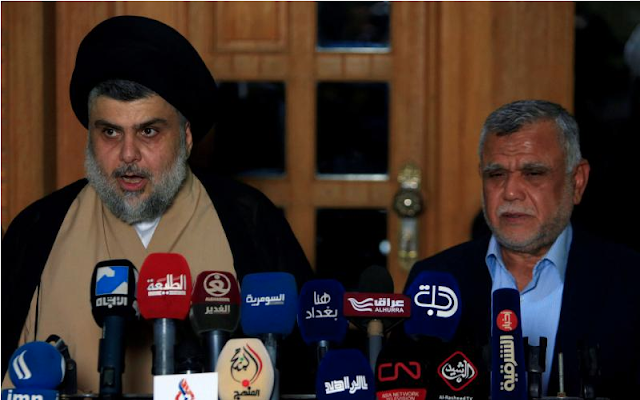
Asaib Ahl al-Haq (AAH) has gone through a dramatic
transformation since its founding in 2006. Originally, its leader Qais Khazali
started the group because he differed with Moqtada al-Sadr about how to fight
the Americans. AAH then became one of many militias supported by the Iranians.
That alliance led Khazali to send his men to Syria to defend the Assad
government in 2012. At the same time, Khazali moved towards politics and an
alliance with Prime Minister Nouri al-Maliki. That proved eventful, because
when the insurgency re-emerged in 2013, the premier called on AAH to help
defend the country. Now AAH is on the frontline and taking part in almost every
major operation to fight the militants. That has allowed AAH to move from being
just one of many Shiite militias to claim that it is one of the main defenders
of the Iraqi state.
Qais Khazali was a
leading student of Ayatollah Mohammed Sadiq al-Sadr and claims to be the true
inheritor of his legacy (Wikipedia)
The rise of Qais Khazali began with Ayatollah Mohammed Sadiq
al-Sadr, but he would later break with his teachings. Khazali was one of Sadr’s
leading students, while the ayatollah
expanded
the work of his cousin Ayatollah Mohammed Baqir al-Sadr by appealing to poor
Shiites who had migrated to Iraq’s cities, setting up social programs for them,
and restarting Friday prayers. Sadr was also an ardent nationalist who called
for an Islamic State led by Iraq’s Shiites. (1) When Sadr was killed by the
government in 1999, Khazali and several others of his followers
kept
the movement alive by going underground. By 2003 he was one of the top
lieutenants to Sadr’s son Moqtada. When those two split, Khazali claimed he was
the true inheritor of Sadiq al-Sadr. Khazali called on other Sadrists to join
him in fighting the U.S.-led occupation in his nationalist Islamic movement.
(2) That resistance was largely funded by Tehran, which led Khazali towards
supporting an
Iranian
style religious state and Ayatollah Ruhollah Khomeini’s vilyat al-faqih,
the rule of the jurist. In doing so he became a disciple of Ayatollah Ali
Khamenei. In
August
2012 for instance, Asaib Ahl Al-Haq posted hundreds of posters of Ayatollah
Sadiq al-Sadr and Ayatollah Khamenei all over Baghdad and Basra. The Sadr
movement has constantly
denounced
AAH for its connections with Iran, and Moqtada al-Sadr has called them
“people
of the falsehood” and
“foreign
entities” meaning that they are not part of the Sadr legacy nor real Iraqis
because of their loyalty to Tehran. Since Ayatollah Sadiq al-Sadr argued that
Iraq’s Arab Shiites
should
lead the Hawza, the religious establishment, and not Iranians it would be
hard to see how Khazali is maintaining the ayatollah’s traditions. Instead, his
relationship with Tehran has led him to be under its religious and political
influence. That has shaped most of his and AAH’s activities over the last
several years.

Qais Khazali went
from being one of Moqtada al-Sadr’s (pictured in the background poster) top
lieutenants to breaking away and forming his own group Asaib Ahl Al-Haq (AP)
Qais Khazali and Moqtada al-Sadr broke over differences on
how to confront the American occupation of Iraq. In
August
2004, the Mahdi Army launched its battle for control of the holy city of
Najaf, which ended with a ceasefire. Khazali objected and went back to Baghdad
to continue fighting the Americans. By October Khazali had formed his own
militia along with Akram al-Kabi who was in charge of the Mahdi Army in Najaf,
Abdul Hadi al-Darraji, a senior Sadrists in Baghdad, and several others. Sadr
tried to woo them back by offering them high-level positions in 2005, but
Khazali and the others continued on with their own independent activities. In
2006, Khazali finally broke with Sadr for good and went on to create Asaib Ahl
Al-Haq. He brought along with him more leading Sadrists such as Mohammed
Tabatabai, Kazim Abadi, and his brother Laith Khazali. All of them with the
exception of Laith had been students of Ayatollah Sadiq al-Sadr together.
Moqtada al-Sadr and Qais Khazali were just as opposed to the U.S. occupation of
Iraq. Their differences were over tactics, as well as politics. In 2005 the
Sadrists became major members in the new Iraqi government as Moqtada aspired to
become one of the leaders of the country rather than just a militia commander.
Khazali didn’t show any interest in that effort since the government worked
with the Americans. Khazali also probably did see himself as one of the true
leaders of the Sadr movement as he had studied under the Ayatollah, while
Moqtada lacked religious training. Sadr was also known to be mercurial. All
together this led the two to part ways.

Image from an AAH video
of an IED attack upon an American Humvee (AP)
By the summer of 2006 AAH started carrying out its first
operations against the Coalition, and quickly received Iranian backing.
Khazali’s militia became organized into four main groups: the Imam al-Ali
Brigade in southern Iraq, the Imam al-Kazem Brigade in western Baghdad, the
Imam al-Hadi Brigade in eastern Baghdad, and the Imam al-Skeri Brigade in
Diyala and Kirkuk. By July these brigades claimed responsibility for attacks in
Sadiya, Rustamiya, Sabi al-Bour, and Shaab in Baghdad, Nasiriyah in Dhi Qar,
Diwaniya in Qadisiyah, and Daquq in Kirkuk. Khazali needed a source of funding
and weapons to carry out these activities, and found a
willing
sponsor in the Iranian Revolutionary Guard Corps Quds Force (IRGC-QF). In
May, IRGC-QF commander General Qasim Suleimani and Hezbollah commander Ali
Mussa Daqduq who had been sent to Iraq to coordinate militia activity with the
Iranians met in Tehran to re-think their tactics. They had been working with
the Mahdi Army and several other militias to oppose the American effort in the
country, but the Sadrists were fracturing into many small groups such as
Khazali’s, and Sadr proved difficult to work with. Instead, Suleimani and
Daqduq
decided
to work with some of these breakaway entities, which were easier to control.
Khazali became the beneficiary of this revision in policy. That opened the door
to training by the Quds Force and Hezbollah in both Iran and Lebanon. Daqduq
would also become the main link between Suleimani and Khazali. Mustafa
Sheibani, a former Badr Brigade members helped smuggle Iranian weapons and money
to AAH. The Sheibani network was noted for delivering Explosively Formed
Penetrators (EFPs) to Shiite militias like Khazali’s. Tehran facilitated
Khazali’s break from Sadr, and enabled him to carry out attacks upon the
Americans. His most notorious operation however backfired.

American mugshots of
Qais and Laith Khazali after their arrests for the attack upon the Karbala
Provincial Joint Coordination Center in 2007
In 2007 AAH carried out an elaborate infiltration into an
American base, which led to the arrest of the group’s leadership. In
January,
a number of AAH operatives drove into the Karbala Provincial Joint Coordination
Center in SUVs commonly used by Americans and dressed in U.S. uniforms. They
then killed one U.S. soldier and kidnapped four others who were later shot as
well.
IRGC-QF
provided the militia with
intelligence
on the base and planned the attack. This would lead to the
arrest
of Qais and Laith Khazali and Hezbollah commander Daqduq in Basra in March.
This completely disrupted AAH’s activities for several months. Eventually Akram
al-Kabi took over the movement while the Khazali’s were in custody. In
retaliation, AAH
kidnapped
five British nationals, the bodyguards Alan McMenemy, Alec MacLachlan, Jason
Swindlehurst, Jason Creswell, and technician Peter Moore from the Finance
Ministry in Baghdad in May using
80-100
militiamen wearing Interior Ministry uniforms. The captives were
taken
to Sadr City and then Iran where they were allegedly turned over to the
IRGC-QF. AAH then
demanded
the release of their leaders in return for their prisoners. This led to several
years of
negotiations
that were conducted by AAH members in Iran. At one point General Suleimani
offered
to stop attacks by Iranian backed militias if Qais Khazali were released, but
the Americans turned him down. By 2008 AAH was feeling added pressure to get
its leaders released because the militia had been dispersed by the Charge of
the Knights offensive in Basra, Maysan, and Baghdad, with most of its fighters
fleeing to Iran. By January 2009 an elaborate deal had finally been worked out
between the Iraqi, British, and American governments, which allowed Laith
Khazali to be
released.
In return for releasing not only the Khazali and Daqduq, but also most of the group's
fighters held by the U.S. and airing a video, the 5 Brits would be returned.
Several
AAH commanders, and around
300
of its men were eventually released before Qais Khazali was set free in January
2010. In return Peter Moore was returned in December 2009, but his four guards
were all
dead
having been shot shortly after they were taken from the Finance Ministry. The
last one of their bodies, that of Alan McMenemy was not delivered to the
British authorities until
January
2012. This set a precedent of kidnapping foreigners to achieve the
organization’s goals. In
January
2010 it seized American contractor Issa Salomi in Baghdad, and claimed it
held a second American,
Ahmad
Quasay al-Taae, which it took
back
in 2006. Two months later AAH got four of its members
out of
prison for Salomi. What appeared to be a major setback, actually ended up
working to the group’s benefit. AAH not only survived the arrest of its leader,
but also got almost all of its militiamen eventually released via kidnappings.
It now had the manpower to pick up the pace of its operations against the
Americans as they prepared to withdraw from Iraq.
By the end of 2008 AAH had been able to reorganize itself.
Many of its fighters eventually infiltrated back to Iraq after the Charge of
the Knights campaign. There was then a
cease-fire
while talks with Baghdad and the Coalition were on going to get the release of
the Khazalis. That ended when Qais Khazali was released in January 2010. It
then began to expand. Abu Dura for example, who was known as the Shiite Zarqawi
during the civil war came back to Iraq in 2010 and was said to have joined the
militia. (3) AAH also started a recruiting campaign (4) offering people large
salaries and other benefits to joint it and carry out operations against the
Coalition. Much of this money was coming from Tehran who was said to be
providing AAH with up to
$5
million a month. At the end of 2011, it began
picking
up attacks on the Americans so that it could take credit for their
withdrawal. It would later
claim
responsibility for over 6,000 attacks upon the U.S. and Coalition forces from
2006-2011. The Coalition wasn’t the only focus of the group however. By 2011,
AAH was accused of carrying out assassinations (5) of Defense and Interior
Ministry officials in Baghdad. (6) In
2012
the United Nations documented 56-90 murders of homosexuals and emo kids, and
blamed AAH for most of those killings. The
next year the militia was
accused of attacking cafes in the capital for allegedly hiring under-aged
girls, being used for prostitution, staying open too long, and breaking
religious rules on contacts between the sexes. One of the main reasons why
Khazali created Asaib Ahl Al-Haq was to oppose the American occupation. When
the U.S. announced that it was withdrawing at the end of 2011, it saw a golden
opportunity to not only claim credit for the Americans departure, but to expand
its base as well. It also showed that it opposed factions within the Iraqi
government, and was willing to kill them. Finally, its Islamic ideas led to
attacks upon groups and businesses it considered immoral and unIslamic.
Overall, the group proved that it held extremist views and would use violence
as its main means to achieve its goals.
As AAH grew its rivalry with the Sadrists became violent. Sadr
had tried several times to reach out to Khazali, but those efforts failed. By
2010 the two were fighting. In
December AAH
attempted to bury two of its fighters in a cemetery in Najaf reserved for
Sadrists, which led to a shoot out. Starting in the
summer of
2011 there were said to be almost daily confrontations between the two. On
June
8, Sadrist Assad Khader Mohammed was killed in Baghdad. June 18 there was a
clash between the two in a market in Sadr City. That led the Sadrists to do a
drive by on Abu Dura. Then from June 28 to August 4 four Sadrist and AAH
members were assassinated in tit for tat killings. In
June
2013 an argument led to a shooting at a Sadrist rally in Baghdad, which the
movement claimed was an
attempt
on the life of Hazim Araji who headed the Sadr office in Kadhimiya. The next
month AAH men
burned
shops owned by Sadrists in Baghdad’s Karrada district. That led to more
fighting in
Sadr
City, and the burning of three homes owned by Sadrists. In
August
there was shooting after a shouting match in Hurriya that left a Mahdi Army
leader dead. The Sadrists then retaliated by kidnapping an AAH leader. Finally
in
November
there was heavy fighting in Sadr City and Zafaraniya that led to 15 fatalities.
The conflict between Sadr and Khazali had always been an intense one. Sadr
considered Khazali an existential threat to his movement, since he was a
leading student of his father, had much more religious training then him, and
drew away some of his top commanders and officials when he left. Usually the
two just attacked each other verbally, but that eventually escalated to a small
scale ware lasting several years, which mostly raged in the capital. This
conflict continues to this day.
Despite AAH’s history of violence, it finally decided to
turn towards politics, which led to an alliance with Prime Minister Nouri
al-Maliki. At the
start
of 2009 the first stories emerged of AAH considering a run in that year’s
provincial elections. This opened the door to a number of
talks
with the premier and the National Reconciliation Committee where the group
promised to give up violence as well after Qais Khazali was freed from American
captivity. As part of the negotiations Maliki agreed to
free
all AAH prisoners. When Khazali was finally released at the start of 2010
however, he broke off talks (7) and moved to Iran. A year later, AAH was back
at the table with the National Reconciliation Committee (8) this time saying
that it would join politics
after
the U.S. withdrawal. AAH was serious this time as most of its leadership
returned to Baghdad from Iran at the end of the year, and on
December
26 Qais Khazali officially said that his group would be taking up the
ballot. Maliki once again courted them, allowing it to carry out a parade in
January
2012 to celebrate the departure of American forces, and a military march in
June,
which was attended by members of the premier’s Dawa Party. The group didn’t end
up running in the 2013 provincial elections, but it did look to expand its
base. It opened offices in Baghdad, Hillah, Najaf, Khalis, Tal Afar and Basra
along with one in Beirut, Lebanon, plus religious schools in Baghdad, Maysan,
Basra, Dhi Qar, Najaf, and Muthanna. It also tried to portray itself as a
nationalist group by meeting with Sunni and Sabean leaders. In
December
2013 AAH decided to run in the 2014 national vote, and would support
Maliki’s State of Law. It ended up winning
one
seat in Baghdad with its Sadiqun list. Like Sadr before him, Khazali was
hoping that he could turn his militia into a political party and join the
government in Baghdad. Maliki welcomed this move because he was hoping that AAH
could cut into Sadr’s base. That was the reason why he never did anything about
all the fighting that took place between the groups. Although the one seat it
won in 2014 was insignificant it showed the larger aspirations of Khazali and
his alliance with Maliki.

Funeral procession
for AAH fighters killed in Syria, Nov 2013 (Reuters)
Although AAH was making a peaceful turn in Iraq, it had not
given up violence as it went to fight in Syria. In
2012
General Suleimani called on his Iraqi allies to help protect the Assad
government. AAH sent fighters
early
that year. It was supposedly protecting the Sayid Zainab shrine in the Damascus
suburbs, (9) but its first fighter was killed in Hama just over 130 miles to
the north. AAH initially
denied
its involvement, but finally admitted it in
2013
when it started having public funerals for its men that died there. Members of
AAH joined the Abu Fadhl Al-Abbas brigade, and eventually
formed
its own Syrian militia the Liwa Kafeel Zainab. To prepare for the fighting many
AAH militiamen went to Iran for training, received money and weapons from
Tehran, had Iranian advisers on the ground with them, and aid from
Lebanese
Hezbollah. Iran was intent on protecting its ally the Assad government when
protests broke out there. Part of that strategy was using Iraqi militias to
prop up the regime and fight the rebels. AAH responded to that call showing
that it had become one of many Iranian proxies that could be used in the
region. AAH would eventually become part of the backbone of the Syrian regime’s
defenses, something that would be repeated in Iraq.

ISF M113 armored
personnel carrier with AAH logo painted on the front showing the integration of
the militia within the government’s forces (W.G.
Dunlop)
When the Iraqi insurgency took off in 2013 AAH quickly
became involved in the fighting. Towards the end of
2013
Maliki reportedly began using militias like AAH as an ad hoc defense force. In
September,
an AAH leader told the New York Times that it was working with the Iraqi
Security Forces (ISF), and there were reports that its militiamen had access to
government badges and weapons. The next month Khazali
announced that
he was creating popular committees in mixed Sunni-Shiite neighborhoods, because
he felt like the ISF were incompetent and could not protect people. In
January
2014, he came out in
support
of Maliki’s effort in Anbar where open fighting had broken out at the end of
December, and began
bringing
back his fighters from Syria to Iraq to be deployed in that province. One
commander was said to have been
killed
in Anbar that month. In
March,
Maliki organized AAH, Kataib Hezbollah and the Badr Brigades into a new
security force for Baghdad out of
frustration
with the ISF. The next month it
started
a new recruitment program and formed Popular Defense Brigades. By the time
Mosul fell, AAH was already integrated within many ISF units and was deployed
in central and western Iraq. It would then be used in every major operation
starting with the defense of
Samarra
in June. It would then go on to help clear
Muqtadiya,
Diyala and take part in the
failed
thrusts at
Tikrit
in June, it fought for Jurf al-Sakhr in Babil in
July, helped end the siege
of Amerli in Salahaddin in
August,
and continued fighting in Anbar in
September
to name just a few. Everyone acknowledges that after the fall of Mosul and the
collapse of the ISF in the north, Baghdad became reliant upon militias. What is
less known was these armed groups were already operating alongside and within
the security forces in 2013. The government’s turn towards militias was
promoted by Iran, as it tried to replicate its Syrian strategy in Iraq. For
example, after insurgents took Mosul General Suleimani flew to Iraq, and
met
with Khazali as part of his planning for the defense of Baghdad. IRGC-QF also
provided
advisers, weapons, training, and planning for AAH operations. In doing so, both
AAH and Iran gained more power not only within the security forces, but the
state as well.
As in the previous Iraqi civil war from 2005-2008, AAH was
not only involved in fighting the insurgents, but carrying out sectarian
attacks as well. In
October
2013, it was reported that Maliki was using AAH for retaliatory attacks in
Baghdad after terrorist bombings. This was confirmed by an AAH commander who
told
the Washington Post in early 2014 that it was behind targeted killings after
bombings of Shiite neighborhoods in the capital. It was also
accused
of pushing out families from Jurf al-Sakhr in northeast Babil in January. In
April
AAH was thought to be behind death squad operations, and attacking homes and
mosques in Diyala. The most glaring example was at the end of that month, when
insurgents temporarily took over the town of
Buhriz.
When the ISF and AAH
retook
the village, armed men drove through it shouting Shiite slogans, burned houses
and mosques, and rounded up 28 young men and executed them. After Tikrit fell
to the Islamic State in June, AAH set up
checkpoints
in Salahaddin looking for ISF deserters and people fleeing the city, and ended
up shooting at three cars and killing 12 people. It also
kidnapped
three Sunni men, killed them, and dumped their bodies in Sadiya, Baghdad on
June 12. On
June
17, Badr and AAH were believed to be behind the killing of 43 detainees who
were taken from a prison in Jumarkhe, Diyala. The following month,
50
bodies were found blindfolded and shot in Khamisiya, Babil with rumors
pointing to AAH being responsible. In early
July
AAH militiamen destroyed nine houses and five mosques in Ballor, Mansuriya, and
Muqtadiya, and were involved in the killing of three civilians in Sensl and
seventeen others in Nofal all in Diyala. Later in July, 8 black SUVs full of
gunmen
abducted
the head of the Baghdad provincial council Riyad al-Adhadh and four of his
bodyguards. They were taken to a secret facility in the capital where the
guards were beaten and asked to confess that Adhadh supported the insurgency.
The head of council was released after Prime Minister Maliki, the speaker of
parliament, and several other Iraqi leaders and Western diplomats intervened.
Qais Khazali secured his release, which led many to believe that AAH or a group
connected to it was behind the incident. From June 1 to July 9 Human Rights
Watch
documented
the deaths of 61 people with AAH being the most likely culprit. In
September,
AAH was
accused
of cutting off water supplies to Sunni areas, bulldozing and blowing up houses,
ordering civilians to leave, kidnappings, executions, and mass arrests in
northern Babil. The current Iraqi war is quickly repeating the worst aspects of
the last civil conflict. Militias are targeting civilians because they are considered
the support base of the insurgents, and therefore legitimate targets. This is
leading to sectarian cleansing in places such as Salahaddin, Diyala and the
Baghdad belts. While groups like AAH are behind many of these attacks, they
could not be successful without the knowledge and support of the security
forces and government, which again mirrors what happened from 2005-2008.
AAH has also been involved in criminal activities such as
kidnappings for ransom. The most infamous incident occurred on
October
20, 2014 when there was a 20 minute shootout between the Federal Police and
militia gunmen in Karrada, Baghdad. A spokesman for the Interior Ministry said
that police were raiding a hotel where a kidnapping ring was operating. This
came after a Kurdish businesswoman and relative of deputy premier Rowsch
Shaways Sara Hamid Niran, who was
abducted
in September, escaped form her captors and made it to an ISF checkpoint. The
police then surrounded the hotel she fled from. They found militiamen there who
demanded that Niran be handed back to them. Gunfire ensued and four policemen
ended up being wounded. A government official blamed AAH for the abduction.
This was just one of many kidnappings, which have escalated throughout this
year. While rogue elements might have been responsible for this act, it could
have been one of many illegal activities AAH was involved in to raise funds for
itself, something militias have been involved in before.
Since its inception in 2006 Asaib Ahl Al-Haq has increased
its standing. It started off as one of many breakaway factions from the Sadr
Trend. What set it apart was that its leadership was made up of many prominent
students of Ayatollah Sadiq al-Sadr and Mahdi Army commanders. It also gained
Iranian backing because they shared a mutual interest in driving the Americans
out of Iraq. It continued to work as an Iranian proxy when it sent troops to
fight in Syria. At the same time, it moved into Iraqi politics gaining an early
and powerful ally in Prime Minister Maliki. Today AAH claims to be a protector
of the nation and the Shiite community against the insurgency, while
politicians praise its activities, and it is routinely featured in the Iraqi media.
That has led supporters to overlook its allegiance to Iran and sectarian attacks,
and see it as a nationalist force. This has all allowed Qais Khazali to finally
acquire the position he has always wanted, to be at the table of the Iraqi
elite.
FOOTNOTES
1. Cole, Juan, “The United States and Shi’ite Religious
Factions in Post-Ba’thist Iraq,” Middle East Journal, Autumn 2003
2. Al Akhbar News, “Iraq: Qais al-Khazali: In the shadows of
resistance,” 1/21/12
3. Fayad, Ma’ad, “Iraq: Notorious Shiite Warlord Returns to
Baghdad,” Asharq Al-Awsat, 8/18/10
4. Sotaliraq, “League of the Righteous in Iraq, giving their
followers the amount of two million dinars for every military operation, and
news on the financing of Iranian,” 6/22/11
5. Alsumaria, “Iraq Minister: League of the Righteous
willing to engage in national reconciliation,” 5/25/11
6. Radio Nawa, “Qassim Atta: League of the Righteous, and Al
Qaeda were responsible for the death in Baghdad,” 7/29/11
7. Alsumaria, “Asaib Ahl Al Haw group suspended talks with
Iraq’s Government,” 2/5/10
8. Alsumaria, “Iraq Minister: League of the Righteous willing
to engage in national reconciliation,” 5/25/11
9. Shafaq News, “Source: Asaib alhel al – Haq intensify
their presence in Damascus to protect Zeinab shrine,” 7/26/12
SOURCES
Abbas, Mushreq, “Iraqi Government Suppresses Baghdad
Demonstrations,” Al-Monitor, 8/5/13
Abbas, Yasir and Trombly, Dan,
“Inside the Collapse of the Iraqi Army’s 2nd Division,” War On The
Rocks, 7/1/14
Abdul-Zahra, Qassim, “Anti-US Iraqi cleric facing leadership
challenge,” Associated Press, 2/20/09
- “Report: Deal close to free Britons seized in Iraq,”
Associated Press, 3/29/09
Abdul-Zahra, Qassim and Jakes, Lara, “Grand Ayatollah Ali
Khamenei, Iranian Leader, Is New Poster Boy In Iraq,” Associated Press, 9/25/12
Agence France Presse, “2nd UPDATE: Iraqi PM Met
Group Behind Kidnap Of Britons,” 8/3/09
- “British hostages in Iraq died from gunshots,” 6/30/09
- “Over 100 from Iraqi group who killed Britons freed,”
9/27/09
AIN, “Muqtada al-Sadr describes Asaeb Ahlulhaq as
“governmental militia,”” 12/12/13
Al Akhbar News, “Iraq: Qais al-Khazali: In the shadows of
resistance,” 1/21/12
Ali, Ahmed, “2013 Iraq Update #23: Sadrists and Asa’ib Ahl
Al-Haq Fight for Baghdad,” Institute for the Study of War, 6/11/13
Ali, Ahmed and Kagan, Kimberly,
“The Iraqi Shi’a Mobilization to Counter the ISIS Offensive,” Institute for the
Study of War, 6/14/14
Ali, Rafid Fadhil, “The People of Righteousness: Iraq’s
Shi’a Insurgents Issue Demands for Hostages,” Terrorism Monitor, Jamestown
Foundation, 2/12/10
Alsumaria, “Asaib Ahl Al Haq group: dropping arms out of
question until full US withdrawal,” 11/2/11
- “Asaib Ahl Al Haq group suspended talks with Iraq’s
Government,” 2/5/10
- “Asaib Ahl Haq kidnaps another American,” 2/8/10
- “Iraq Minister: League of the Righteous willing to engage
in national reconciliation,” 5/25/11
- “US Army accuses Asaib Ahl Al Haq of targeting its forces
to make believe they are forced to withdraw,” 11/25/11
- “US Forces release 2 Asaib Ahl Al Haq members,” 7/30/09
Al-Amiry, Kholoud Ramzi, “The Prime Minister Who Plays with
Fire,” Sada, 4/19/12
Arraf, Jane, “Kidnapping of American in Iraq sparked by
faltering reconciliation talks,” Christian Science Monitor, 2/11/10
- “US likely to release insurgent accused of killing five US
soldiers,” Christian Science Monitor, 6/11/09
Arango, Tim, “Abduction of Sunni Displays Gangland Edge of
Iraqi Politics,” New York Times, 7/27/14
- “Freed American in Iraq Expected to Return to U.S.,” New
York Times, 3/28/10
- “Rise in Deadly Attacks on Shiites in Iraq Stirs Anger at
Government,” New York Times, 9/27/13
Arango, Tim, Al-Salhy, Suadad, and
Cowell, Alan, “Iraqi Kurds Take Oil City as Militants Push Forward,” New York
Times, 6/12/14
Associated Press, “Baghdad’s blast walls to come down,”
8/6/09
- “Body of UK hostage turned over to embassy in Iraq,”
1/20/12
- “Militant Video Shows Abducted American In Iraq,” 2/6/10
August, Oliver, “End the torment, says Brown as death of
British hostage is confirmed,” Times of London, 9/4/09
Awan Daily, “Maliki announced next week, the electoral
coalition,” 9/25/09
Bradley, Matt and Nabhan, Ali,
“Fledgling Iraqi Military Is Outmatched on Battlefield,” Wall Street Journal,
4/27/14
Buratha News, “Al Bhan and Arab in Jurf al-Sakhar cleared of
Daash rats,” 7/11/14
- “The killing of Mufti of Jurf al-Sakhr Musab al-Owaisi
with 70 other terrorists in violent clashes in the north of Babylon province,”
7/13/14
- “League of the Righteous Movement launches initiative for
the formation of popular committees that help the security forces to close
streets,” 10/9/13
Chulov, Martin, “Controlled by
Iran, the deadly militia recruiting Iraq’s men to die in Syria,” Guardian,
3/12/14
- “Iraq faces the abyss after its
military melts away,” Guardian, 6/13/14
- “Shia cleric’s release by US forces provided key to Peter
Moore’s freedom,” Guardian, 12/30/09
- “Split among captors hits hope of freedom for British
hostages in Iraq,” Guardian, 5/28/09
Cochrane, Marisa, “Asaib Ahl al-Haq and the Khazali Special
Groups network,” Institute for the Study of War,” 1/13/09
- “The Fragmentation of the Sadrist Movement,” Institute for
the Study of War, January 2009
Cockburn, Patrick, “Revealed: why UK hostages were killed,”
Independent, 7/10/09
Cole, Juan, “The United States and Shi’ite Religious
Factions in Post-Ba’thist Iraq,” Middle East Journal, Autumn 2003
Coles, Isabel, “Iranians play role in breaking IS siege of
Iraqi town,” Reuters, 9/1/14
Colvin, Marie, “Families told release of UK hostages not a
done deal,” Times of London, 3/29/09
Daragahi, Borzou, “Iraq’s sectarian war rages on as world
focuses on Isis,” Financial Times, 9/26/14
Dziadosz, Alexander, “Bruised Iraqi army leans on Shi’ite
militias, volunteers,” Reuters, 7/10/14
Evers, Erin, “Beyond Mosul,” Open Democracy, 9/26/14
-“Time is Running Out for Iraq as Nation Spirals into
Chaos,” MSNBC, 7/20/14
Fayad, Ma’ad, “Iraq: Notorious Shiite Warlord Returns to
Baghdad,” Asharq Al-Awsat, 8/18/10
Fordham, Alice, “Hostage Peter Moore’s fate tied to that of
Laith and Qais al-Khazali,” Times of London, 12/31/09
Fulton, Will, Holliday, Joseph & Wyer, Sam, “Iranian
Strategy In Syria,” AEI’s Critical Threats Project & Institute for the
Study of War, May 2013
Gordon, Michael, “Iran’s Master of Iraq Chaos Still Vexes
U.S.,” New York Times, 10/2/12
Habib, Mustafa, “niqash interview: iraq’s reconciliation
minister on negotiating with militias, saddam hussein and libya,” Niqash,
11/10/11
Hadi, Ahmad, “cousin against
cousin: iraqi militias in anbar bloody family ties,” Niqash, 6/5/14
Harari, Michal, “Status Update: Shi’a Militias in Iraq,”
Institute for the Study of War, 8/16/10
Hauslohner, Abigail, “Fifty bodies found in Iraq, raising
fears of sectarian war,” Washington Post, 7/9/14
Haynes, Deborah, “Hope for British hostages in Iraq after
release of Shia militant,” Times of London, 6/9/09
Healy, Jack and Schmidt, Michael, “Political Role for
Militants Worsens Fault Lines in Iraq,” New York Times/ 1/5/12
Hendawi, Hamza and Abdul-Zahra,
Qassim, “Rise of Shiite Militias Pose a Threat to Iraq,” Associated Press,
6/15/14
Hess, Pamela, “Hit squads training in Iraq,” Associated
Press, 8/15/08
Hines, Nico, “Peter Moore: 31 months of Iraqi captivity,”
Times of London, 12/30/09
Human Rights Office of the High Commissioner for Human
Rights/United Nations Assistance Mission for Iraq (UNAMI) Human Rights Office,
“Report on Human Rights in Iraq: January to June 2012,” October 2012
- “Report on the Protection of Civilians in Armed Conflict
in Iraq: 6 July – 10 September 2014,” 10/2/14
- “Report on the Protection of
Civilians in the Non International Armed Conflict in Iraq: 5 June – 5 July
2014,” 7/18/14
Human Rights Watch, “Iraq: Campaign of Mass Murders of Sunni
Prisoners,” 7/11/14
- “Iraq: Pro-Government Militias Trail of Death,” 7/31/14
Institute for the Study of War,
“Final 2014 Iraqi National Elections Results by Major Political Groups,”
5/19/14
- “Overt Shi’a Militia
Mobilization in Mixed Areas,” 4/17/14
Iraq Times, “Al-Asaib militia
“Righteous People” to officially join Maliki’s coalition in the next election,”
12/29/13
Iraq, Ali Abu and Van Heuvelen, Ben, “Basra security
continues to decline,” Iraq Oil Report, 10/25/14
Jabar, Faleh, The
Shi’ite Movement in Iraq, London: SAQI Books, 2003
Jakes, Lara, “Shiite militias step up Iraq attacks on US
troops,” Associated Press, 6/30/11
Kagan, Frederick, Majidyar, Ahmad, Pletka, Danielle,
Sullivan, Marisa Cochrane, “Iranian Influence In The Levant, Egypt, Iraq, And
Afghanistan,” American Enterprise Institute and the Institute for the Study of
War, May 2012
Karim, Ammar, “Baghdad shootout points to growing militia
threat,” Agence France Presse, 10/21/14
Knights, Michael, “Analysis: Iraq’s never-ending security
crisis,” BBC, 10/3/13
- “The Evolution of Iran’s Special Groups in Iraq,” CTC
Sentinel, November 2010
- “Iran’s Foreign Legion: The Role of Iraqi Shiite Militias
in Syria,” Washington Institute for Near East Studies, 6/27/13
Lake, Eli, “EXCLUSIVE: Iraqi official’s top aide linked to
Shi’ite terrorists,” Washington Times, 8/28/09
Lewis, Jessica, Ali, Ahmed, and Kagan, Kimberly, “Iraq’s
sectarian crisis reignites as Shi’a militias execute civilians and remobilize,”
Institute for the Study of War, 5/31/13
Londono, Ernesto and Fadel, Leila, “U.S. failure to
neutralize Shiite militia in Iraq threatens to snarl pullout,” Washington Post,
3/4/10
Al Mada, “3 Baghdadi neighborhoods witnessing armed clashes
between “known militias,”” 12/1/13
- “An armed group attacked a hospital in Sadr City and
infringe on the emergency department physicians,” 1/29/13
- “Sadr accused “the people of falsehood” of trying to
assassinate al-Araji, and declared three days of mourning,” 6/3/13
- “Tensions between the Sadrists and Asaib worry
neighborhoods of Baghdad and al-Khazali and clings to the truce,” 6/11/13
Mahmood, Mona, O’Kane, Maggie, Grandjean, Guy, “Why Iran’s
kidnap squad struck,” Guardian, 12/31/09
Mandee, Samira Ali and Bezhan, Frud, “Iraqi Militias Make
Comeback Amid Surging Sectarian Violence,” Radio Free Europe/Radio Liberty,
6/20/13
Al Masalah, “”League of the
Righteous” declares its readiness to defend Iraq and sanctuaries and calls for
politicians to unite and support the security forces,” 6/11/14
Mohammed, Abeer, “Maliki’s Chess Game,” Institute of War
& Peace Reporting, 9/10/09
Morris, Loveday, “Iraqi army
increasingly bolstered by Shiite militias as ISIS advances,” Washington Post,
6/20/14
- “Shiite militias in Iraq begin to remobilize,” Washington
Post, 2/9/14
Multi-National Division-B, “(Enemy Action) Indirect Fire RPT
(Rocket) JASG-C, JDOC : 0 INJ/DAM,” U.S. Military, 12/31/09
Muayed, Ahmed, “tricked into joining terror group: how
militias are recruiting iraqi youth,” Niqash, 8/22/13
Naame Shaam, “Iran in Syria From an Ally of the Regime to an
Occupying Force,” September 2014
Naji, Jamal, “Abadi shakes up military leadership after
Anbar massacre,” Iraq Oil Report, 9/24/14
Najm, Haider, “café clashes: Baghdad conservatives try to
close ‘immoral’ coffee shops,” Niqash, 7/25/13
National Iraqi News Agency, “Ahl Al-Haq denies links to fake
checkpoints, demanding the Govt to take firm and strict action,” 5/26/13
- “Sadr condemns clashes between his supporters and /
Ahlil-Haq militia/in Baghdad,” 6/3/13
New Sabah, “”The people of the right to” reveal the details
turned into a brawl and shooting deaths,” 6/9/13
- “Sadr solemn assembly a “threat” addressed to the
Government,” 8/6/13
- “Struggle for influence a prominent feature of the
relationship between the two factions,” 9/29/13
Nordland, Rod, “Iraqi Group Renounces Violence,” New York
Times, 8/4/09
Nordland, Rod and Dagher, Sam, “U.S. Will Release More
Members of an Iraqi Militia,” New York Times, 8/18/09
Now, “Talking to a Hezbollah
fighter in Syria,” 2/24/14
Parker, Ned, Rasheed, Ahmed and
Salman, Raheem, “Before Iraq polls, Shiite militias unleashed war on Sunni
insurgents,” Reuters, 4/29/14
- “Sectarian strife threatens Iraq
ahead of election,” Reuters, 4/27/14
Parker, Ned and Salman, Raheem,
“In defense of Baghdad, Iraq turns to Shi’ite militias,” Reuters, 6/14/14
Prothero, Mitchell, “Iraqi
commandos and Shiite militias battling to retake Tikrit,” McClatchy Newspapers,
6/27/14
Radio Nawa, “Hezbollah Brigades and the League of the
Righteous Andon today under the banner of national reconciliation,” 12/24/11
- “Qassim Atta: League of the Righteous, and Al Qaeda were
responsible for the death in Baghdad,” 7/29/11
Ramzi, Kholoud, “mahdi army vs league of righteous: fears
that fresh violence between shiites could spread,” Niqash, 7/14/11
Roads To Iraq, “Asaib Al-Haq: We still have a British and an
American hostages,” 2/2/10
- “Leader of “Asaib” militia not released yet,” 1/6/10
Roggio, Bill, “New Special Groups splinter emerges on Iraqi
scene,” Long War Journal, 8/20/08
Rosen, Armin, “Iraq Official Says
Iran’s Military Mastermind Is In Charge,” Business Insider, 6/18/14
Rubin, Alissa and Gordon, Michael, “U.S. Frees Suspect in
Killing of 5 G.I.’s,” New York Times, 6/9/09
Sadah, Ali Abel, “Sadr Gives Maliki ‘Final Warning,’”
Al-Monitor, 5/29/13
- “Sadr Reconsiders Political Role, Mahdi Army,” Al-Monitor,
8/28/13
Al-Salhy, Suadad, “Iraq Shi’ite militia says U.S. has
‘failed,’ pledges to lay down arms in wake of Sunni bombings,” Reuters, 1/5/12
- “Iraqi Shi’ite militants fight for Syria’s Assad,”
Reuters, 10/16/12
Al-Salhy, Suadad, and Westall, Sylvia, “Insight: Iraqis
hesitate on the edge of chaos,” Reuters, 9/19/13
Schreck, Adam and Abdul-Zahra, Qassim, “In Iraq, militia’s
shift could bolster Iran’s hand,” Associated Press, 1/6/12
Semple, Kirk, “40 Are Killed in Attacks Targeting Shiites in
Iraq,” New York Times, 10/20/14
Sengupta, Kim, “Britain backs prisoners release to free
three hostages,” Independent, 6/23/09
Shafaq News, “Asa’ib Ahl al-Haq
leader threatens to strike Kurdish interests,” 6/15/14
- “Source: Asaib alhel al – Haq intensify their presence in
Damascus to protect Zeinab shrine,” 7/26/12
Al-Sharq Al-Awsat, “Al-Sadr fled to Iran due to
assassination fears,” 1/26/11
Al-Shibeeb, Dina, “More militias disband their arms in
Iraq,” Al Arabiya, 4/28/11
Sly, Liz, “Iranian-backed militant group in Iraq is
recasting itself as a political player,” Washington Post, 2/18/13
Sly, Liz and Hauslohner, Abigail,
“Shiite militia seizes control of Iraqi town, slowing ISIS drive toward
Baghdad,” Washington Post, 6/14/14
Smyth, Phillip, “All the Ayatollah’s Men,” Foreign Policy,
9/18/14
- “Hizballah Cavalcade: The Badr Organization’s Syrian
Expeditionary Force: Quwet al-Shahid Muhammed Baqir al-Sadr,” Jihadology,
10/18/13
- “Hizballah Cavalcade: Roundup of Iraqis Killed in Syria,
Part 1,” Jihadology, 5/11/13
- “Hizballah Cavalcade: Roundup of Iraqis Killed in Syria,
Part 2,” Jihadology, 5/17/13
- “Hizballah Cavalcade: Saraya
al-Dafa’ al-Sha’bi: Kata’ib Hizballah’s New Force in Iraq,” Jihadology, 6/9/14
- “Iranian Proxies Step Up Their
Role in Iraq,” Washington Institute for Near East Policy, 6/13/14
- “Selling Sectarianism: Shia Islamist Groups & Maliki’s
Anbar Offensive,” Hizballah Cavalcade, 2/3/14
Sotaliraq, “Jurf al-Sakhr front
forgotten war in Iraq and the suffering of new entrants of Asaib Ahl Al-Haq,”
5/30/14
- “League of the Righteous in Iraq, giving their followers
the amount of two million dinars for every military operation, and news on the
financing of Iranian,” 6/22/11
Sullivan, Marisa Cochrane, “Iraq’s Parliamentary Election,”
Institute for the Study of War, 10/21/09
Al-Tamimi, Aymenn Jawad, “Iraq:
Who are Asa’ib Ahl al-Haq Islamists?” Islamist Gate, 3/6/14
Al-Tamimi, Aymenn Jawad and Spyer, Jonathan, “Iraq’s Shi’a
Militias and Iran,” The Tower, December 2014
Tu’mah, Abd-al-Wahid, “One British hostage set to be
released in Iraq, ‘before the end of the week’ – paper,” BBC Monitoring
International Reports, 7/8/09
Ur News, “League of the Righteous
to defeat al-Maliki, the Sadrists,” 12/24/13
- “War fires between Asaib and the Sadrists,” 7/4/13
Waleed, Khaled, “weapons for words: extremists enter
politics, threaten govt power balance,” Niqash, 1/26/12
Wyer, Sam, “The Resurgence of Asa’ib Ahl al-Haq,” Institute
for the Study of War, December 2012
Zahra, Hassan Abdul, “Iraq’s Sadr in war of words with
splinter group,” Agence France Presse, 12/18/10
- “Iraqi Shiite militia ‘ready to lay down arms,’” Agence
France Presse, 12/26/11
Zucchino, David, “In Iraq, Shiite militias are both friend
and foe,” Los Angeles Times, 10/30/14