Showing posts with label History. Show all posts

Friday, November 22, 2024

Review Edwin Black, Banking On Baghdad, Inside Iraq’s 7,000-Year History of War, Profit, and Conflict, John Wiley & Sons, Inc., 2004

Black, Edwin, Banking On Baghdad, Inside Iraq’s 7,000-Year History of War, Profit, and Conflict, John Wiley & Sons, Inc., 2004


Edwin Black’s Banking On Baghdad, Inside Iraq’s 7,000-Year History of War, Profit, and Conflict joins his later The Farhud, Roots of the Arab-Nazi Alliance in the Holocaust as two horrible books on Iraq. That’s because in both volumes Iraqis disappear from their own history. The first third of Banking is fine covering ancient Iraqi history. When it gets to the later Ottoman times to almost the end the narrative is dominated by Western desires to exploit Iraq’s oil. It then gets sidetracked by the Mufti of Jerusalem making an alliance with the Nazis. Most of the story is dominated by Western governments, oil companies and the Mufti of Jerusalem rather than Iraqis.

Thursday, May 16, 2024

Review Pride And Power, A Modern History Of Iraq

Franzen, Johan, Pride And Power, A Modern History Of Iraq, Hurst & Company, 2020


Pride And Power, A Modern History Of Iraq by Johan Franzen is a very dense history of Iraq from the Ottoman period to the present. It is chock full of detail after detail. There are some new bits of information relayed but the last third of the book that starts with the Gulf War falters. Its version of the 2003 invasion is especially disappointing making it an uneven book.

Friday, August 4, 2023

Review Iraqi Jews, A History of Mass Exodus

Shiblak, Abbas, Iraqi Jews, A History of Mass Exodus, London: SAQI, 2005


Abbas Shibak’s Iraqi Jews, A History of Mass Exodus is a short history of the Jewish migration from Iraq to Israel in the 1950s. The author believes the creation of Israel in 1948 and the Iraqi government’s wish to suppress forces pushing for democratic change created an environment of instability for Iraqi Jews that led them to leave their country. By 1953 almost the entire community was gone.

Thursday, August 18, 2022

Review ‘Iraq, 1900 To 1950, A Political, Social, and Economic History

Longrigg, Stephen, ‘Iraq, 1900 To 1950, A Political, Social, and Economic History, London, New York, Toronto: Oxford University Press, 1956


Iraq, 1900 to 1950, A Political, Social, and Economic History by Stephen Longrigg is one of the early histories of the country in English. Longrigg first entered Iraq in 1915 during World War I as a British officer and then lived there for the next 16 years as an adviser to the government and then as an official of the Iraq Petroleum Company. The book argues that Iraq was constantly developing after its backwardness under the Ottomans. Its real theme was supporting British imperialism and oligarchic rule in the country.

Thursday, August 11, 2022

Review Wings of Iraq: Volume 2: The Iraqi Air Force, 1970-1980

Cooper, Tom, Sipos, Milos, Wings of Iraq: Volume 2: The Iraqi Air Force, 1970-1980, Worwick: Helion & Company Limited, 2022


The second volume of the Wings of Iraq by Tom Cooper and Milos Sipos picks up right where the last one left off. The main topic is Iraq’s attempt to modernize its force after it found itself outclassed in the 1967 and 1973 Arab-Israeli Wars. The air arm was split over whether to turn to the Soviets or France to accomplish this. The authors rely upon both Iraqi and Iranian sources plus many interviews with former Iraqi personnel. It provides the best coverage of this arm of the military published so far. The main takeaway was that Baghdad became completely reliant upon the USSR but Moscow was an unreliable partner.

Friday, August 5, 2022

Review Independent Iraq 1932-1958, A Study in Iraqi Politics

Khadduri, Majid, Independent Iraq 1932-1958, A Study in Iraqi Politics, London, New York, Karachi: Oxford University Press, 1960


Majid Khadduri was one of the first prominent Western writers on Iraq. He was born in Mosul and immigrated to the United States where he became a professor at Johns Hopkins University. His work was some of the most detailed on Iraq at the time owing to his extensive research and his connections with many leading politicians who gave him an inside view of how the government worked. Independent Iraq 1932-1958 is a perfect example of this access. At the same time his closeness to the elite meant that he often presented their point of view uncritically.

Thursday, July 21, 2022

Review Republican ‘Iraq, A Study in ‘Iraqi Politics since the Revolution of 1958

Khadduri, Majid, Republican ‘Iraq, A Study in ‘Iraqi Politics since the Revolution of 1958, London, New York, Toronto: Oxford University Press, 1969


Majid Khadduri was one of the first prominent Iraqi historians writing in English. He was born in Iraq and then came to work at Johns Hopkins University. Starting with his 1960 Independent Iraq he published books on the country covering the monarchy up to the Gulf War. His early histories were indispensable because he had access to many of the people involved in events. Republican ‘Iraq, A Study in ‘Iraqi Politics since the Revolution of 1958 covers the “revolutionary regimes” of General Qasim, the Baath and the Arif brothers that ruled from 1958 to 1968. Khadduri’s thesis was that the military stepped into politics to overthrow the old regime and created an autocratic form of government.

Thursday, April 28, 2022

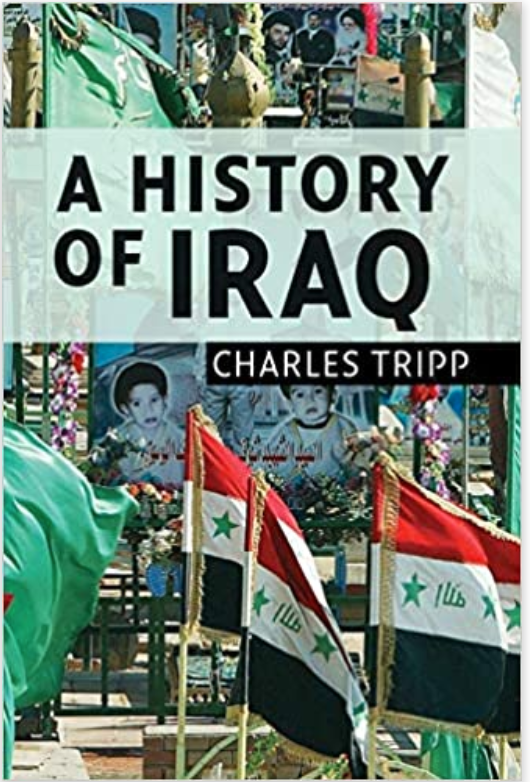
Review A History of Iraq

Tripp, Charles, A History of Iraq, Cambridge, New York, Melbourne, Madrid, Cape Town, Singapore, Sao Paulo, Delhi: Cambridge University Press, 2007

 A History Of Iraq by Professor Charles Tripp is one of the seminal histories of Iraq in English. It focuses upon the development of the state and how it affected the country’s people. In doing so, Tripp emphasizes three main themes. One was the autocratic tendencies of Iraq’s leaders who were more concerned about maintaining control than meeting the needs of the public. Second was the system of patronage and clients those rulers created which often times exercised the real power behind the scenes. Last, was the use of violence which was initially used to subdue elements the population and then to seize control of the government.

Friday, April 1, 2022

Review The Shi’is Of Iraq

Nakash, Yitzhak, The Shi’is Of Iraq, Princeton and Oxford: Princeton University Press, 2003


The Shi’is Of Iraq by Yitzhak Nakash has a wealth of information about the development of the Shiite community in Iraq. It discusses how and why the Arab tribes were converted in the 1800s and how the lack of a strong leadership hurt the community once the Iraqi state was established in 1920. The author’s goal was to highlight the uniqueness of Iraq’s Shiites since most studies of the sect only focus upon Iran which had a much different experience. That’s not to mention that until the Iraq War Shiites were largely ignored and unknown in the West so this was a needed addition to the cannon.

Friday, March 11, 2022

Review The Greatness That Was Babylon

Saggs, H.W.F., The Greatness That Was Babylon, New York and Scarborough: A Mentor Book, 1962


The Greatness That Was Babylon by H.W.F. Saggs is a dense volume that reads like a college textbook for all the good and bad that implies. It has chapters on all different aspects of ancient Mesopotamia to the Babylonian period from history to culture to religion to literature to even mathematics. It goes into great depth into each, but all may not be of interest.

Friday, March 4, 2022

Review Relations Of The People to The Land In Southern Iraq

Baali, Fuad, Relations Of The People to The Land In Southern Iraq, Gainesville: University of Florida Press, 1966


Relations Of The People To The Land In Southern Iraq is a 1966 survey of land ownership in Iraq and the problems that ensued. Before the 1958 coup the country was dominated by large landowners which led to a ruling oligarchy and mass poverty. Fuad Baali attempts to explain how this situation came about by going through Iraqi history and laws.

Thursday, January 6, 2022

Review Iraq’s Democratic Moment

Hadid, Foulath, Iraq’s Democratic Moment, London: Hurst & Company, 2012


Iraq’s Democratic Moment by Foulath Hadid is a history of Al-Ahali and the National Democratic Party (NDP), two opposition movements during the monarchy period in Iraq which lasted from 1920-1958. Hadid argues that these two parties pushed for democracy in a system that had elections but was mainly authoritarian and under British influence. It’s an excellent account of the politics of the country during this era, but there are some major problems in how Hadid deals with the Assyrians, the military and the monarchy.

Wednesday, October 20, 2021

Review Iraq Since 1958, From Revolution To Dictatorship

Farouk-Sluglett, Marion and Sluglett, Peter, Iraq Since 1958, From Revolution To Dictatorship, New York: I.B. Tauris, 2003


Iraq Since 1958, From Revolution To Dictatorship by Marion Farouk-Sluglett and Peter Sluglett is one of the seminal Iraqi History books in English. It covers the history of Iraq from the monarchy to Saddam Hussein’s rule in the 1990s. The Slugletts main focus is on the governments that came after the 1958 coup and how they struggled to stay in power because they lacked a popular base.

Friday, October 15, 2021

Review when baghdad ruled the muslin world, the rise and fall of islam’s greatest dynasty

 Kennedy, Hugh, when baghdad ruled the muslin world, the rise and fall of islam’s greatest dynasty, Cambridge: Da Capo Press, 2004


Hugh Kennedy takes an unconventional approach to telling the history of the Abbasid caliphate in when baghdad ruled the muslim world, the rise and fall of islam’s greatest dynasty. He was inspired by the poems and stories that are the source material for historians to study this time period. He therefore wrote a narrative about the empire rather than a straight history. It proved to be a very approachable book on the Abbasids.

Thursday, June 17, 2021

Review The Outlaw State, Saddam Hussein’s Quest for Power and the Gulf Crisis

Sciolino, Elaine, The Outlaw State, Saddam Hussein’s Quest for Power and the Gulf Crisis, New York, Chichester, Brisbane, Toronto, Singapore: John Wiley & Sons, Inc., 1991


The 1990 invasion of Kuwait set off the first book boom on Iraq in the West. Many of these releases were by authors simply wishing to cash in on the fad leading to a wide range in quality. The Outlaw State, Saddam Hussein’s Quest for Power and the Gulf Crisis was one of the better books to come out during this period. The author Elaine Sciolino was a New York Times reporter who’d been to Iraq several times during the Iran-Iraq War in the 1980s and right before the start of the Gulf War. Each chapter is on a different topic from Saddam Hussein’s dictatorship to a history of Iraq to its weapons of mass destruction. Rather than just focusing upon the Kuwait crisis its main goal was to provide background to Iraq and why it went to war. Sciolino’s main thesis was that Saddam believed in using force rather than negotiations due to his background and he miscalculated the international situation.

Wednesday, May 5, 2021

Review Iraq & the Kurdish Question, 1958-1970

Jawad, Sa’ad, Iraq & the Kurdish Question, 1958-1970, London: Ithaca Press London, 1981


Iraq & the Kurdish Question, 1958-1970 by Sa’ad Jawad is a very good breakdown of the politics surrounding the Kurdish movement. It has several major themes. The first is the divisions within the Iraqi Kurds between the tribal leaders and the intellectuals. The latter in the form of the Kurdistan Democratic Party (KDP) tried but failed to provide leadership. The former were able to maintain their power and their feudal systems as a result. The second was how successive Iraqi governments never came to a compromise with the Kurds over their demands for autonomy. The third was how foreign powers, especially Iran was able to dominate the movement militarily and economically.

Thursday, April 8, 2021

Review Desert Queen, The Extraordinary Life of Gertrude Bell: Adventurer, Adviser to Kings, Ally of Lawrence of Arabia

Wallach, Janet, Desert Queen, The Extraordinary Life of Gertrude Bell: Adventurer, Adviser to Kings, Ally of Lawrence of Arabia, New York: Anchor Books, 2005


Desert Queen is one of the better biographies of Gertrude Bell. The author Janet Wallach had a real literary flair to her writing so it doesn’t read like your typical story of a historical figure. The book emphasizes three main aspects which the author believed shaped Bell’s life. Those were love of her family especially her father, her love of men which was always frustrated, and her of Iraq which she helped create after World War I.

Wednesday, March 31, 2021

Review The Industrialization Of Iraq, Harvard Middle Eastern Monographs, No. 5

Langley, Kathleen, The Industrialization Of Iraq, Harvard Middle Eastern Monographs, No. 5, Cambridge: Harvard University Press, 1962


The Industrialization of Iraq by Kathleen Langley is an overview of the development of Iraq from the Ottoman era up to the 1958 coup. The author found  no real plan to grow the economy until the 1930s. When one was finally created it was haphazard at best and failed in its goals. Langley’s thesis is that Iraq had potential for growth and the money to do it with its oil profits but only helped the rich and not the public overall.

Wednesday, March 24, 2021

Review The Reckoning, Iraq and the Legacy of Saddam Hussein

Mackey, Sandra, The Reckoning, Iraq and the Legacy of Saddam Hussein, New York, London: W.W. Norton & Company, 2002


The Reckoning, Iraq and the Legacy of Saddam Hussein by Sandra Mackey is a history of the country from ancient times to right before the U.S. invasion. Mackey’s thesis is that Iraq has always sought a national identity but failed to create one. That has left it constantly divided along ethnic (Arab and Kurd) and sectarian (Sunni and Shiite) lines. The problem with her thesis was that she took the ethnosectarianism of the 1990s and 2000s and projected that back into the past.

Wednesday, March 17, 2021

Review Saddam Hussein, A Political Biography

Karsh, Efraim and Rautsi, Inari, Saddam Hussein, A Political Biography, New York: Grove Press, 2002


Saddam Hussein, A Political Biography is an up and down book about Saddam Hussein up to the 1990s. It goes from his upbringing to his rise within the Baath Party and then his leadership of Iraq which led to two disastrous wars. Those two conflicts are where authors Efraim Karsh and Inari Rautsi run into some problems especially in their portrayal of the Iran-Iraq War. Their main argument is that Saddam Hussein was a calculating survivor who used pan-Arabism in an attempt to assert his will over the Middle East.

Review Orit Bashkin, Impossible Exodus, Iraqi Jews In Israel, Stanford University Press, 2017

   In 2015 an Israeli was looking for an Arab to kill in revenge for the deaths of Jews. He stabbed an Iraqi Jew because he l...