Showing posts with label World War I. Show all posts

Friday, July 17, 2026

Review Nikolas Gardner, The Siege of Kut-al-Amara, At War In Mesopotamia 1915-1916, Indiana University of Press, 2014


The British defeat at Kut during the Mesopotamia campaign was England’s second worse during World War I. Around 12,000 troops were taken prisoner almost half of which died in captivity. Nikolas Gardner in The Siege of Kut-al-Amara, At War In Mesopotamia 1915-1916 attempts to challenge the conventional wisdom about Kut. He makes a convincing argument that the commander General Sir Charles Townshend was responsible for the surrender.

Saturday, March 14, 2026

Review Edmund Candler, The Long Road to Baghdad, Volume II, Houghton Mifflin Company, 1919


Edmund Candler was a journalist who traveled with the British forces during the Mesopotamia campaign of World War I. This second volume of his book The Long Road to Baghdad covers the end of the war from 1917-1918. The vast majority of the writing is a blow by blow account of the various battles fought as the British conquered what would become Iraq. It does bring up larger issues however such as the lack of a strategy and the contempt the English had for the Ottomans and Arabs.

Friday, October 31, 2025

Review James Barr, A Line In The Sand, The Anglo-French Struggle For The Middle East, 1914-1948, W.W. Norton & Company, 2012


Barr, James, A Line In The Sand, The Anglo-French Struggle For The Middle East, 1914-1948, W.W. Norton & Company, 2012


In A Line In The Sand, The Anglo-French Struggle For The Middle East, 1914-1948 James Barr delves into the imperialist rivalry between England and France for control of the Middle East starting during World War I. When the war started the two powers wanted to carve up the Ottoman Empire with Paris having eyes on Syria and Lebanon and London on Iraq, Jordan and Palestine. Initially they agreed upon this division but then came into conflict. Barr presents a very interesting history of power politics, intrigue and terrorism that left neither nation happy.

Friday, October 17, 2025

Review Arnold Wilson, Loyalties Mesopotamia 1914-1917, A Personal and Historical Record, Oxford University Press, 1930

Wilson, Arnold, Loyalties Mesopotamia 1914-1917, A Personal and Historical Record, Oxford University Press, 1930


Arnold Wilson was a political officer for the British Expeditionary Force that invaded Mesopotamia in 1914 during World War I. His Loyalties Mesopotamia 1914-1917 details both the fighting in Iraq and how the English set up an administration to govern the conquered territories. Two main takeaways were how badly India managed the war and how much Wilson and the British resented the Arabs they came to rule over.

Friday, April 25, 2025

Review Aaron Klieman, Foundations of British Policy In The Arab World: The Cairo Conference of 1921, Johns Hopkins University Press, 1970

Klieman, Aaron, Foundations of British Policy In The Arab World: The Cairo Conference of 1921, Johns Hopkins University Press, 1970


At the end of World War I the English found themselves in possession of a large amount of Ottoman territory. London had made various promises to different groups which were often contradictory because it had no strategy for the region. In 1921 Colonial Secretary Winston Churchill organized a meeting in Egypt to attempt to find a solution to all these issues. The Cairo Conference came to shape much of the modern Middle East. That is the topic of Aaron Klieman’s Foundations of British Policy In The Arab World: The Cairo Conference of 1921. The author argues that Churchill was able to create a short term success for the British Empire which eventually collapsed.

Friday, January 24, 2025

Review Charles Townshend, Desert Hell, The British Invasion of Mesopotamia, The Belknap Press of Harvard University Press, 2011

Townshend, Charles, Desert Hell, The British Invasion of Mesopotamia, The Belknap Press of Harvard University Press, 2011


Charles Townshend’s Desert Hell is one of the better books about the British campaign in Mesopotamia during World War I. It not only covers the military side but the politics as well up to the creation of the British Mandate in Iraq after the war. His main thesis is that the war and the formation of Iraq were dysfunctional from the start because there was no political or military strategy behind them.

Friday, October 25, 2024

Review A Quest in the Middle East, Gertrude Bell and the Making of Modern Iraq

Lukitz, Liora, A Quest in the Middle East, Gertrude Bell and the Making of Modern Iraq, I.B. Tauris, 2006


In A Quest in the Middle East, Gertrude Bell and the Making of Modern Iraq Liora Lukitz attempts to paint the personal and professional life of Gertrude Bell. The story constantly switches back and forth between those two aspects using her correspondence as a uniting factor. The author portrays Bell as a woman who fled the constraints of her upper class family in England for the adventure of the Middle East where she helped create the country of Iraq.

Thursday, August 1, 2024

Review Battles On The Tigris, The Mesopotamian Campaign Of The First World War

Wilcox, Ron, Battles On The Tigris, The Mesopotamian Campaign Of The First World War, Pen & Sword, 2006


Battle On The Tigris by Ron Wilcox is a military history of England’s Mesopotamian campaign during World War I. It only provides the British perspective and cheers on that side. Most of it is a blow by blow account of each battle but it also provides some perspective on the leadership or lack thereof during the war and scandals over the lack of support the troops received. It provides a good starting point for someone interested in this little known part of the First World War.

Thursday, June 6, 2024

Review Cairo 1921, Ten Days That Made the Middle East

Faught, C. Brad, Cairo 1921, Ten Days That Made the Middle East, Yale University Press, 2022


The 1921 Cairo conference held by British Colonial Secretary Winston Churchill helped create the modern Middle East. Borders were drawn, kings were installed, and a new policy of neo-colonialism was created. That’s what C. Brad Faught’s Cairo 1921, Ten Days That Made the Middle East focuses upon.

Thursday, January 11, 2024

Review U.S. Policy In Post-Saddam Iraq

Eisenstadt, Michael and Mathewson, Eric, Editors, U.S. Policy In Post-Saddam Iraq, Washington, DC: Washington Institute for Near East Policy, 2003


Before the 2003 invasion of Iraq the Washington Institute for Near East Policy realized the United States could learn a lot from the British time in the country starting in World War I. The Institute collected together a group of Iraq experts and had them write about the United Kingdom’s experience and then make suggestions for the Bush administration. The authors provided a good history and there were plenty of lessons for the U.S. to learn. As we all know the White House thought it had all the answers and carried out a costly and highly flawed occupation as a result.

Thursday, July 20, 2023

Review Britain In Iraq, Contriving King and Country

Sluglett, Peter, Britain In Iraq, Contriving King and Country, London, New York: I.B. Tauris, 2007


This is the revised version of Peter Sluglett’s Britain in Iraq, Contriving King and Country. Sluglett’s goal was to explain how England occupied and administered Mesopotamia during World War One and then created the nation of Iraq under a League of Nation’s mandate. Britain wanted to protect its routes to India, defend the oil fields in Iraq and Persia, and establish an Iraqi government that was under London's influence. The British achieved all three of those goals while causing long term problems for Iraq.

Wednesday, March 29, 2023

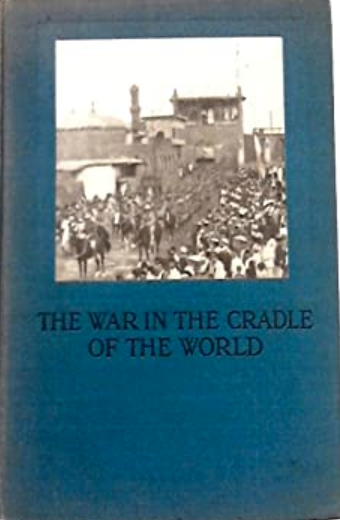
Review The War In The Cradle of The World

Egan, Eleanor Franklin, The War In The Cradle of The World, New York and London: Harper & Brothers Publishers, 1918


Eleanor Franklin Egan was an American journalist who travelled to Mesopotamia to see the British war there during World War I. She left for Japan, sailed across Asia, and then travelled up Mesopotamia to Baghdad. Her The War In The Cradle of the World is more about her trip than the war.

Thursday, August 19, 2021

Review When God Made Hell, The British Invasion of Mesopotamia and the Creation of Iraq, 1914-1921

Townshend, Charles, When God Made Hell, The British Invasion of Mesopotamia and the Creation of Iraq, 1914-1921, London: Faber and Faber Limited, 2010


Charles Townshend wrote a very engaging history with When God Made Hell, The British Invasion of Mesopotamia and the Creation of Iraq, 1914-1921. What started out as a military expedition to protect England’s oil interests in Persia led to an extended campaign to seize as much Ottoman territory as possible in Mesopotamia during World War I. The whole time London never enunciated its goals or strategy and that continued after the war as well. It proved to be a classic example of mission creep with an unintended consequence of the new country of Iraq being created.

Thursday, August 12, 2021

Review Iraq In World War I, From Ottoman Rule to British Conquest

Majd, Mohammad Gholi, Iraq In World War I, From Ottoman Rule to British Conquest, Lanham, Boulder, New York, Toronto, Oxford: University Press of America, Inc., 2006


Iraq In World War I, From Ottoman Rule to British Conquest by Mohammad Gholi Majd is based upon primary sources. Namely U.S. diplomatic cables from Iraq as it was the only foreign delegation to stay in Baghdad during the entire war and the official British history of the Mesopotamian campaign. This turns out to be the major flaw of the book because it consists of one long quote from a document after another. There is very little original writing by Majd, absolutely no analysis and provides nothing from the Ottoman’s side. There’s not even a conclusion. The author also couldn’t say no to any paper that he liked which means there are all kinds of tangents included that could have been cut out. On the good side it does provide reasons why England invaded Mesopotamia and the day to day battles during the war. Those are overshadowed by its faults however.

Wednesday, March 31, 2021

Review The Industrialization Of Iraq, Harvard Middle Eastern Monographs, No. 5

Langley, Kathleen, The Industrialization Of Iraq, Harvard Middle Eastern Monographs, No. 5, Cambridge: Harvard University Press, 1962


The Industrialization of Iraq by Kathleen Langley is an overview of the development of Iraq from the Ottoman era up to the 1958 coup. The author found  no real plan to grow the economy until the 1930s. When one was finally created it was haphazard at best and failed in its goals. Langley’s thesis is that Iraq had potential for growth and the money to do it with its oil profits but only helped the rich and not the public overall.

Thursday, February 18, 2021

Review Enemy On The Euphrates, The Battle For Iraq 1914-1921

Rutledge, Ian, Enemy On The Euphrates, The Battle For Iraq 1914-1921, London: SAQI, 2014


Enemy On The Euphrates, The Battle For Iraq 1914-1921 is a very interesting and easy read on the British colonization of Iraq and the revolt that it inspired. The rebellion was one of the largest the British faced in the 20th Century and almost expelled them. The book is divided into two main parts. The first covers how oil drove the British to conquer the area of the Ottoman Empire that would become Iraq during World War I. That leads to the second half on the 1920 Revolt. The author Ian Rutledge’s thesis was the insurgency was led by religious leaders, landlords and commoners who opposed the British during the war and then led the earliest expression of Iraqi nationalism.

Friday, December 18, 2020

Review Arab War Lords and Iraqi Star Gazers, Second Edition, Gertrude Bell’s The Arab of Mesopotamia

Rich, Paul, Editor, Arab War Lords and Iraqi Star Gazers, Second Edition, Gertrude Bell’s The Arab of Mesopotamia, San Jose, New York, Lincoln, Shanghai: Authors Choice Press, 2001


Arab War Lords and Iraqi Star Gazers is a collection of two pamphlets Gertrude Bell wrote for British troops entering Iraq during World War I. The first was printed in 1916 called The Arab of Mesopotamia and the second came out the next year Asiatic Turkey. The writings were part information guides to the lands and people of the Ottoman Empire and part propaganda justifying why London invaded.

Wednesday, October 28, 2020

Review Iraq and Gertrude Bell’s The Arab of Mesopotamia

Rich, Paul, Editor, Iraq and Gertrude Bell’s The Arab of Mesopotamia, London, Boulder, New York, Toronto, Plymouth, UK: Lexington Books, 2008


Iraq and Gertrude Bell’s The Arab of Mesopotamia is a collection of two pamphlets Gertrude Bell wrote for the British War Office during World War I. The first was The Arab of Mesopotamia written in 1916 while Bell was in Basra. The second was Asiatic Turkey from 1917. They were propaganda pieces to be read by British officers who were coming to govern Iraq after the English conquered it during the war. They provide an overview of some of the people of the Ottoman Empire and a justification for why the English were there. That means she criticizes everything the Ottomans did and praises the British.

Friday, July 10, 2020

Review The Chatham House Version and other Middle-Eastern Studies, New Edition


Kedourie, Elie, The Chatham House Version and other Middle-Eastern Studies, New Edition, Hanover and London: University Press of New England, 1984

Professor Eli Kedourie of the London School of Economics was an iconoclast in Middle East studies. He was born in Baghdad in 1926 and went to university in England. He went on to criticize not only British policy in the Middle East, but western liberals and leftists, Pan-Arabism, and the Arab states. The Chatham House Version and other Middle-Eastern Studies was a collection of journal articles he published in the 1950s and 1960s with some new material added. The thesis of the book was that not only did London make a series of blunders in the region from World War I to its aftermath but that conventional history of the Middle East in England was wrong as well.

Friday, January 10, 2020

Review Understanding Iraq, the Whole Sweep of Iraqi History, from Genghis Khan’s Mongols to the Ottoman Turks to the British Mandate to the American Occupation


Understanding Iraq was one of many book written because of the 2003 invasion. Historian William Polk had decades of experience with that nation and even lived there for a time in the 1950s. The purpose of his book was to try to educate the West about Iraq and draw parallels between the past and present. Polk largely succeeded although there were a few problems along the way.

Review Edmund Ghareeb, The Kurdish Question In Iraq, Syracuse University Press, 1981

   Edmund Ghareeb’s The Kurdish Question In Iraq is a bit of an oddity. On the one hand it takes much of what the Baath gove...