Monday, November 30, 2009

Human Rights Watch: Ninewa’s Minorities Under Pressure From Both Sunni Insurgents and Kurds

In November 2009 Human Rights Watch released a new report detailing the plight of minorities in Ninewa province entitled “On Vulnerable Ground.” The report covers the history of successive governments in Baghdad to Arabize Ninewa by pushing out minorities and Kurds and replacing them with Arabs, and then the ascendancy of Kurds there after the U.S. invasion. They turned around and tried to Kurdicize those same regions to advance their plans to annex the disputed territories there. At the same time, the Sunni Arab insurgency has targeted minorities for being non-believers or cooperators with the Americans. Minorities such as Christians, Shabaks, and Yazidis are therefore in a precarious situation being pressured from all sides to either leave or comply with stronger forces.

Map of Mosul Province

“On Vulnerable Ground” starts with some historical background to Ninewa. Beginning in the 1930s the Iraqi central government started a program to Arabize Ninewa, which has historically been one of the most diverse areas in the country. It is the home to Arabs, Kurds, Christians, Shabaks, and Yazidis, especially in an area known as the Ninewa plains, which are the districts immediately to the east of Mosul. In the 1970s Baghdad stepped up its efforts to move Arabs into Ninewa and push Kurds and minorities out that only got worse under Saddam Hussein. After the Gulf War in 1991 Baghdad tried to pressure Kurds and minorities to register as Arabs, and would not give birth certificates to babies with non-Arab names for instance. They also pressured minorities to join militias and perform other tasks to prove their loyalty or face expulsion. Many Kurds and minorities moved to Kurdistan, which had gotten its autonomy in 1991.
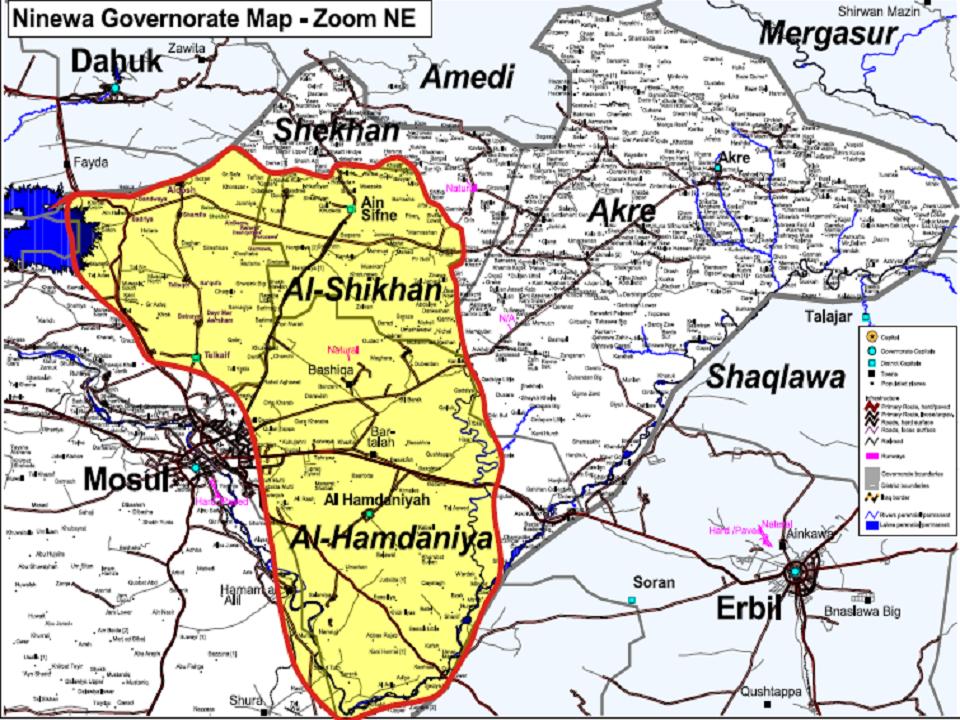
Map of the Ninewa Plain

After the U.S. invasion, the Kurdish peshmerga swept south into Ninewa with U.S. forces. Many Arabs who had moved there under the government’s programs fled before the advance. In the days after the fall of Mosul, the capital of Ninewa, the peshmerga also began kicking out Arab families from towns in the surrounding areas. These factors together increased the ethnic tensions in the province. In all the areas where the Kurds occupied they eventually established their influence through the presence of their peshmerga forces and control of the administration. The divide between Arabs and Kurds intensified after the 2005 provincial elections, when the Sunni Arabs decided to boycott. This allowed the Democratic Patriotic Alliance of Kurdistan, which was made up of the two major Kurdish parties, the Patriotic Union of Kurdistan and the Kurdistan Democratic Party, to win 31 of the 41 council seats in Ninewa.

The ascendancy of the Kurds, and the displacement and loss of power of the Sunni Arabs directly led to the growth of the insurgency in Ninewa. As reported before, Mosul remains the last urban stronghold of the Sunni militants. They in turn, have carried out some of the largest attacks in the Iraq war against Ninewa’s minorities. Christians, Yazidis, and Shabaks have all been singled out for mass casualty bombings, and targeted killings, taking thousands of lives, and forcing many minorities to flee the region. In one spate in October 2008 for example, the Christians of Mosul faced an organized campaign of murder and intimidation to drive them out of the city. 40 were killed, and 12,000 fled Mosul. Arabs and Kurds exchanged blame for the attacks, but Human Rights Watch’s interviews led them to believe that it was definitely the work of Arab insurgents. Some of the largest bombings in Ninewa this year have also been against Yazidis and Shabaks. Sunni militants consider all three groups, Christians, Yazidis, and Shabaks, to be non-believers or collaborators with the Americans.

From 2005 to the present the Kurds also carried out a systematic campaign to co-opt, cajole, threaten, and intimidate Ninewa’s minorities to support the Kurdistan Regional Government’s (KRG) plans to annex the disputed areas in the province. This has followed a two-pronged carrot and stick approach. First, the KRG has spent millions of dollars on minorities to win over their loyalty and create patronage systems. For example, the KRG’s Finance Minister Sarkis Aghajan, a Christian, was ordered by the KRG Prime Minister Nerchivan Barzani to build churches, fund Christian community organizations, and create Christian militia groups. They also used these means to undermine those who opposed the KRG’s plans. Second, the Kurds have used pressure and intimidation. Christians told Human Rights Watch that they were encouraged to sign forms calling for the annexation of Ninewa’s disputed areas by Kurdistan. The KRG also considers Yazidis and Shabaks to be Kurds, and have pressured them to register themselves as such to gain aid. Minority leaders and activists have also been targeted with the Kurds implicated in the attacks. Two Yazidi activists opposed to Kurdish aims were arrested and tortured for six months in 2007. The leader of the Shabak Democratic Gathering was killed by gunmen in July 2008 a few meters from a peshmerga checkpoint who did nothing before, during, or after the attack. Another Shabak politician claimed he was attacked by men wearing Kurdish uniforms before the 2009 provincial elections. Other minorities said they were stopped from attending political rallies by anti-Kurdish groups before the 2009 elections, and were warned that if they didn’t vote for the Kurdish Fraternal List they would lose their homes and jobs. Many of these tactics reminded Human Rights Watch of Saddam’s and earlier Arab government policies. Both the Kurds and minorities were victimized and expelled from Ninewa under the Arabization program. Now the Kurds are repeating many of these same policies to annex the northern regions of Ninewa to Kurdistan.

The 2009 elections turned out to be a major setback for the Kurds’ plans. They lost to the Arab led al-Hadbaa party who took all of the provincial offices, shutting the Kurds out of power, and calling for the withdrawal of the peshmerga. In response, the Kurdish Fraternal list is boycotting the provincial council, have refused to allow Arab officials to carry out their duties in Kurdish controlled areas, and have threatened to break away 16 towns and districts from Ninewa and create their own administration in protest. In June 2009 the KRG made the situation worse when it passed a draft constitution that claimed all of the disputed areas in Ninewa as part of Kurdistan, and said that the peshmerga had the right to operate in Ninewa.

In the end, Human Rights Watch is very worried about the future of minorities in Ninewa province. They are concerned as well, as a Christian leader recently said he is worried about increased attacks on his community in Mosul as Christmas approaches. They are facing the violence of Sunni insurgents, and the forced assimilation and co-option by the Kurds. They are also caught in the middle between the dispute between the central government, the al-Hadbaa provincial government, and the KRG for control of the disputed territories in Ninewa. Human Rights Watch’s findings are also not new. In December 2008 two similar reports were released, one by the United States Commission on International Religious Freedom on Iraqi minorities throughout the country, and another by the Brookings Institution and the University of Bern on minorities and displacement. They both noted the relentless attacks minorities have faced at the hands of insurgents, and the tactics the Kurds have employed against them. Due to these circumstances, Iraq’s minorities have been left with only two real options. First, many have fled becoming displaced or refugees. 20% of Iraq’s refugees for example are believed to be Christians. Second, those that have stayed in Ninewa have tried to align with one of the more powerful actors, whether it be the Kurds, or now the central government and the al-Hadbaa provincial council. None of these provide the protection and rights Ninewa’s minorities deserve, and as long as the divide exists between the KRG and Baghdad their situation is unlikely to get any better.

SOURCES

AK News, “Christians fear escalation of attacks with approach of Christmas,” 11/28/09

Badkhen, Anna, “Kurds evicting Arabs in north Iraq,” San Francisco Chronicle, 4/19/03

Ferris, Elizabeth and Stoltz, Kimberly, “Minorities, Displacement and Iraq’s Future,” Brookings Institution-University of Bern, December 2008

Human Rights Watch, “On Vulnerable Ground,” 11/10/09

United States Commission on International Religious Freedom, "Iraq Report - 2008," December 2008

Sunday, November 29, 2009

Kurdish Lawmaker Sums Up Problems With Iraqi Politics

Parliamentarian Mahmoud Othman, a leader in the Kurdish Alliance, was quoted in the November 28, 2009 New York Times summing up the problems with Iraqi politics. When asked about the possibility that the country would hold elections past the January 31, 2009 deadline set in the constitution he replied, “So what? Nothing in Iraq is very legitimate.” Every major piece of legislation and decision in Iraq is endlessly delayed because of power politics and a zero-sum attitude by law makers. Iraq held its last parliamentary elections on December 15, 2005, but it took four months for Nouri al-Maliki to be named prime minister, and a month after that for him to name his cabinet. The last national elections the country held were for provincial councils. They were originally planned for October 2008, but got delayed until January 2009. The new election law was supposed to be passed by October 15, 2009. There’s talk that it may be confirmed in the beginning of December, but there’s also a possibility that Vice President Tariq al-Hashemi will veto it a second time because the amended version reduces seats for Sunni provinces. Elections are now planned for February or March 2010, one to two months passed the constitutional deadline. Otherman is right than, Iraqi politics does lack legitimacy with its public who see the government as dysfunctional because its unable to provide basic services or make big decisions.

SOURCES

AK News, “Hashemi to take final decision on elections law after Eid,” 11/28/09

Chon, Gina, “Iraqis Miss Target Date on Election,” Wall Street Journal, 10/16/09

Myers, Steven Lee, “Benchmarks in Wartime: As Reliable as Promises,” New York Times, 11/28/09

Special Inspector General for Iraq Reconstruction, “Quarterly Report to the United States Congress,” 10/30/09

Economist Not So Sure About U.S.-Qods Force Meeting Now

In the November 19, 2009 print edition of The Economist there ran a story “Iraq and its neighbours, A regional cockpit,” which was reported here on November 25. The piece claimed that U.S. Ambassador Christopher Hill and commander of American forces in Iraq General Ray Odierno met with the head of the Iranian Revolutionary Guards’ Qods Force General Qassem Suleimani to discuss the U.S. withdrawal in the offices of Iraqi President Jalal Talabani in September 2009. As soon as the story was put up on the magazine’s website it was pulled however. On November 26 they gave an explanation saying that the story was told to them by an Iraqi politician close to Tehran, and confirmed by a senior American official. Just before The Economist printed it however, Gen. Odierno and Ambassador Hill denied the meeting ever happened. The magazine mentioned these, but since then General Odierno and General David Petraeus gave such a strong objection that The Economist reconsidered and withdrew the story from its website. It now says it takes the American officers at their word.

SOURCES

Economist, “Iraq and its neighbours, A regional cockpit,” 11/19/09
- “Were we wrong?” 11/26/09

Former U.S. Economic Adviser Warns Of Impending Jobs Crisis In Iraq

In the November 16, 2009 New York Times, Frank Gunter, the former senior civilian economic advisor to the U.S. military in Iraq warned of an imminent job crisis unless Baghdad liberalized its economy. He wrote that Iraq is facing the dual challenge of a lack of jobs and increasing numbers of people entering the labor market. The July 2009 Special Inspector General for Iraq Reconstruction’s report put unemployment at 17.3% and underemployment at 29.4%, for a combined figure of 46.7%. A January 2009 United Nations study found that young people were hit the hardest with men between 15-29 years of age facing 28% unemployment. They were 57% of the unemployed overall in the country. The cause is that the government is the largest employer in the country, constituting 43% of all jobs and 60% of full time work, and it prefers older workers. This was a major concern for Gunter because 250,000 young people enter the labor market each year, and are discriminated against by the largest employer. Not only that, but the drop in oil prices led to a hiring freeze in 2009.

The other part of the problem is the small size and limitations on the private sector. Outside of farming, there are few jobs available from businesses. It is hard to start an enterprise, get the licenses from the government because of complicated laws, slow bureaucracy, and costs, get credit, and trade internationally. That’s the reason why the World Bank has ranked Iraq 153 out of 183 countries for ease of doing business, placing it at the bottom of the region. This forces many businesses to pay bribes to government officials or participate in the underground economy. Either way, the private sector is not big enough to address the employment demands of the nation.

Faced with these two problems, Gunter warns that by next year Iraq’s unemployment rate will begin climbing rapidly, and this might lead to social unrest. He warns that militants have always taken advantage of poor men offering them cash to carry out attacks. Criminal gangs are also very active in Iraq, and young unemployment people might be easy recruits for them as well. The lack of opportunities will also add to the already high levels of discontent towards the government. Gunter recommends simplifying Iraq’s commercial code so that it is easier to establish businesses. There have been few moves in this direction, other than attempts to attract foreign investment with limited success. Instead Iraq maintains a state-run economy with a slow, inept, and corrupt bureaucracy that is largely unable to meet the needs of its people.

SOURCES

Gunter, Frank, “Liberate Iraq’s Economy,” New York Times, 11/16/09

Inter-Agency Information and Analysis Unit, “Iraq Labour Force Analysis 2003-2008,” United Nations Office for the Coordination of Humanitarian Affairs, January 2009

Special Inspector General for Iraq Reconstruction, “Quarterly Report and Semiannual Report to the United States Congress,” 7/30/09
- “Quarterly Report and Semiannual Report to the United States Congress,” 10/30/09

Friday, November 27, 2009

Parliamentary Seat Allocations At Heart Of Iraqi Election Law Dispute

After Vice President Tariq al-Hashemi vetoed the parliamentary election law on November 18, 2009, the major Shiite and Sunni parties amended it to the detriment of Hashemi and Sunni provinces. The bill says there should be one seat in parliament per 100,000 people in each province. The legislation originally used 2009 numbers based upon the Ministry of Trade’s food ration system. That was going to increase the number of seats in Anbar, Diyala, Ninewa, and Salahaddin, which have the largest amounts of Sunnis in the country, by 24 seats. When the law was amended it switched to using 2005 numbers with a 2.8% increase for population growth. The result was that the Sunni provinces lost a total of 6 seats, while Sulaymaniya in the Kurdistan Regional Government got 3 new seats when before it was going to get none. The change was due to the fact that the Kurdish Alliance in parliament had threatened a boycott of the 2010 elections unless they got more seats. At first, they were only going to get three extra seats between the three provinces of the region. The major Shiite coalitions, the Iraqi National Alliance made up of the Sadrists, the Supreme Islamic Iraqi Council, and smaller parties, and Prime Minister Nouri al-Maliki’s State of Law, also wanted a law passed sooner rather than later, had no interest in increasing seats Sunnis may get, and wanted to punish Hashemi for vetoing the bill.

After the amendment was passed it was expected that Vice President Hashemi would veto the law again. Now there is news of a possible breakthrough, but nothing has been confirmed and parliament is on break until December 8 because of a religious holiday. No matter what, the elections will not happen by January 31, 2010 as the constitution stipulates. A member of the Iraqi Election Commission said they might not occur until February or March 2010. Either way a caretaker government will have to be installed until the election results are finalized, and the major blocs work out a new ruling coalition

Differences In Parliamentary Seat Allocations In Selected Provinces

Provinces

2005 Election Law

Original 2010 Bill

Amended 2010 Bill

Anbar

9

14

13

Diyala

10

13

12

Ninewa

19

31

28

Salahaddin

8

12

11

Sulaymaniya

15

15

18

SOURCES

Bakri, Nada, “Iraq’s parliament passes another election law,” Washington Post, 11/23/09

Ibrahim, Waleed, “Iraqi parliament fails to reach election deal,” Reuters, 11/22/09

Nordland, Rod, “Veto of Iraq’s Election Law Could Force Delay in Vote,” New York Times, 11/19/09

Ramzi, Kholoud, “election faces inevitable postponement,” Niqash, 11/27/09

Visser, Reidar, “Constitutional Disintegration,” Iraq and Gulf Analysis, 11/19/09
- “The IHEC Publishes the Distribution of Governorate and Compensatory Seats,” Iraq and Gulf Analysis, 11/11/09

Former British Diplomat Confirms That U.N. Inspectors Were Means To War With Iraq

On November 24, 2009 England began its third inquiry into the Iraq War, this time headed by John Chilcot. On November 26 Britain’s former ambassador to the United States Christopher Meyer testified. He confirmed what has been reported here before, that the Bush White House had decided upon war before the United Nations weapons inspectors returned to Iraq in November 2002. He told the inquiry, “The U.S. military timetable was already in place before weapons inspectors went in.” Meyer said the original invasion date had been set for January 2003, but was pushed back to March. He believed that the inspectors had no time to complete their work by that date, and instead the U.S. and England turned the process into a means to find evidence of Iraq’s WMD to provide a “smoking gun” to justify the war. Meyer told the inquiry, “It was another way of saying, ‘It’s not that Saddam Hussein has to prove he’s innocent, we’ve now got to bloody well prove he’s guilty.’ And we – Americans and British – have never really recovered from that because of course there was no smoking gun.” England’s former ambassador to the United Nations Sir Jeremy Greenstock agreed that the inspectors never had the time to do their job because the drive for an invasion was so strong in Washington.

Britain’s Prime Minister Tony Blair had been the original impetus to go to the United Nations and have weapons inspectors return to build support for an invasion. On March 12 and 13, 2002 Blair’s political adviser David Manning met with National Security Advisor Condoleeza Rice in Washington where he suggested that inspectors be sent back into Iraq to build a legal base for war, and convince the international community of the U.S. and British’s case against Saddam because it was expected that he would refuse to give them unlimited access to his country. Later, on March 17, Deputy Secretary of Defense Paul Wolfowitz had lunch with Ambassador Meyer, where he suggested that inspections would be a way to trip up Saddam over WMD, and help justify regime change. In April President Bush met with Blair in Texas, where the Prime Minister again emphasized the need to go the U.N. route if the U.S. wanted British support. Bush finally agreed after Secretary of State Colin Powell lobbied him on the same point during dinner on August 5, 2002.

U.N. Resolution 1441 was eventually passed on November 8, 2002 and weapons inspectors entered Iraq shortly afterward. The U.S. and England saw them as a means to provide a justification for overthrowing Saddam however, rather than a way to disarm Iraq. When the inspectors found breaches of 1441 but no “smoking gun” Bush went ahead with the war anyway as planned in March 2003.

For more on the U.N. inspections see:

The U.N. Inspectors Were Right: Iraq Was Not A Threat


Charles Duelfer’s Account Of The End Of The 1990s U.N. Inspections

How The Administration Reversed Itself On Finding Iraq’s WMD

Interview With VP Dick Cheney On Weapons Inspections March 2003

2002 CIA White Paper On Iraq Vs The 2002-2003 U.N. Inspectors

SOURCES

Brown, David, “Invasion lacked legitimacy, Sir Jeremy Greenstock tells Chilcot inquiry,” Times of London, 11/28/09

Manning, David, “SECRET – STRICTLY PERSONAL,” 3/14/02

Marsden, Sam and Cordon, Gavin, “Iraq invasion was of questionable legitimacy, says envoy,” The Independent, 11/27/09

Melkle, James and Sparrow, Andrew, “Iraq war build-up ‘left us scrabbling for smoking gun’ says ex-UK ambassador,” Guardian, 11/26/09

Meyer, Ambassador Christopher, “CONFIDENTIAL AND PERSONAL,” British Embassy, Washington, 3/18/02

Burrough, Bryan, Peretz, Evgenia, Rose, David and Wise, David, “Path To War,” Vanity Fair, May 2004

RTT News, “British Investigation Into Iraq War Begins,” 11/24/09

Sparrow, Andrew, “Iraq inquiry – live,” Guardian, 11/27/09

Sparrow, Andrew and Melkle, James, “Iraq invasion legitimacy was in doubt, Chilcot inquiry told,” Guardian, 11/27/09

Stobart, Janet, “Blair words on Iraq changed after 2002 visit with Bush, Briton testifies,” Los Angeles Times, 11/27/09

Thursday, November 26, 2009

Possible Breakthrough On Election Law Deadlock

The Washington Post reported that there might be a tentative agreement on the Iraqi election law. The Post said that the number of seats up for grabs in Ninewa would be increased to satisfy Sunnis. A spokesman for Vice President Tariq al-Hashemi, who vetoed the election bill, said that he had tentatively agreed to this compromise. After Hashemi rejected the legislation, the major Shiite parties and the Kurdish Alliance amended the law that would give most of the seat increases due to population growth to the Kurds. They had threatened a boycott if that didn’t happen. Those came at the expense of Sunni provinces like Ninewa however, which led the Vice President to threaten a second veto. Hashemi’s okay is the only thing holding up the legislation going into affect as the other members of the Presidential Council, President Jalal Talabani and Vice President Adul Adel Mahdi have already signed off on the amended version. Iraq is in the middle of an Islamic holiday, Id al-Adha, however, so Hashemi may not sign off on it until the celebrations are over.

SOURCES

AK News, “A spokesman for Vice President Hashimi is expected to send written assurances in writing to the ratification of the election law,” 11/26/09

Alsumaria, “Iraq election law amendment in spotlight,” 11/26/09
- “Iraq leaders seek compromise on election law,” 11/26/09
- “Talabani, Adul Mehdi sign amended poll law,” 11/26/09

Aswat al-Iraq, “Provinces’ seats red line – al Hashemi,” 11/26/09
- “Talabani, Shiite VP sign amended election law,” 11/25/09

Al Forat TV, “We have reached a settlement with Hashemite about not canceling of election law again,” 11/26/09

Myers, Steven Lee, “Iraqi Lawmakers Hunt for Election Compromise,” New York Times, 11/26/09

Shadid, Anthony and Bakri, Nada, “Iraqis reach tentative agreement on elections law,” Washington Post, 11/26/09

Wasat, “Hashemi will not invalidate the law of the last elections,” 11/26/09

Maliki Returns To Sectarian Politics

On October 1, 2009 Prime Minister Nouri al-Maliki officially announced his State of Law list that would compete in the 2010 parliamentary elections. Almost every Western report on his coalition mentioned how broad it was, that it was non-sectarian, and how the Prime Minister was running a nationalist campaign. Recently however, Maliki has been emphasizing sectarian politics by warning of the return of Baathists.

On November 12, 2009 for example, Maliki went to a meeting of tribal leaders in Sadr City, Baghdad and said that Iraq’s enemies were trying to undermine the political process during the elections. Three days later he was more specific when he said that Baathists were trying to use the 2010 vote to get back into power, and that he would never let that happen. Then on November 16 at a press conference Maliki said that Baathists would not be allowed to participate in the upcoming elections in any form, and that all talks with them by the government were banned. Maliki has been emphasizing the Baathist threat to Iraq since the August 2009 Baghdad bombings, which he blamed on former regime elements in Syria. In fact, the government aired a new set of video taped confessions on November 22 of three men who claimed they were Baath party members who carried out the October 25, 2009 attacks on Iraq’s Ministry of Justice and Baghdad provincial council offices. In Iraqi politics, whenever Shiite politicians mention Baathists they are talking about the threat of Sunnis returning to power, just as talk about Iranian influence by Sunnis is about Shiite rule.

Maliki’s rhetoric has angered one of his State of Law coalition partners, Sheikh Ali Hatem Sulaiman. He is the head of the Al-Anbar Tribal Council and the Flags of Iraq Party, and was one of the leaders of the Awakening movement there. The sheikh said that those who keep talking about Baathists sound like a broken record, and that Baathists should be able to participate in elections as long as they don’t have any charges against them. He finished by saying that if Baathists were to be truly banned from Iraqi politics, than half of the Sunnis in Anbar would not be able to participate. This is significant because Sheikh Sulaiman was the only notable Sunni politician Maliki was able to draw into his list. He is a minor player however as his party wasn’t able to win a single seat in Anbar in the 2009 elections, and Maliki’s Dawa Party is firmly in the lead of the coalition.

Of more interest is the fact that Ammar al-Hakim, the leader of the Supreme Islamic Iraqi Council and member of the Iraqi National Alliance issued a statement saying that Baathists should be able to take part in Iraqi politics as long as they didn’t have blood on their hands. The Supreme Council has always been one of the most ardent proponents of using the Baathist card against any moves towards reconciliation with Sunnis, and only recently called for the banning of Baathists from the 2010 vote as well. His release was almost certainly a response to Maliki’s comments as the National Alliance is the State of Law’s main challenger.

At the other end of the spectrum, the Sadrists, the other major players in the National Alliance, both attacked Maliki and supported him at the same time. First, a Sadrist parliamentarian said that the authorities faked the November 22 confessions of the alleged bombers. At the same time, Moqtada al-Sadr, echoing the Prime Minister, said that there could never be reconciliation with the Baathists. This shows both that Maliki’s attempt to play sectarian politics with the Baghdad attacks is widely questioned within Iraq, while talking about Baathists still resonates in Shiite politics.

The Prime Minister’s emphasis upon the Baathist threat could be a sign of his foreboding about the coming election. While Maliki is still the most popular politician in Iraq, the August and October 2009 ministry bombings in Baghdad have hurt his claim that he has brought security and stability to the country, so bringing up Baathists is a way for him to defer blame. He also has not been able to bring in any new significant partners into his coalition. Some believe that that his announcements are aimed at his potential rivals, specifically the Iraqi National Movement of former Prime Minister Ilyad Allawi, parliamentarian Saleh al-Mutlaq of the National Dialogue Council, and Vice President Tariq al-Hashemi. Finally, a return to sectarian politics may be a way for him to firm up his base with Shiites, and distract them from more pressing issues like the continued lack of services and corruption in the government.

SOURCES

Ali, Ahmed, “Iraq’s Elections Challenge: A Shifting Political Landscape,” Washington Institute for Near East Policy, 11/20/09

Alsumaria, “Maliki warns of enemies ahead of elections,” 11/12/09

Aswat al-Iraq, “PM warns of Baathists’ infiltration through election,” 11/15/09

Chon, Gina, “Maliki Coalition Tries to Bridge Iraq’s Deep Sectarian Divisions,” Wall Street Journal, 10/2/09

Al-Dulaimy, Mohammed, “Maliki unveils new national, nonsectarian Iraqi party,” McClatchy Newspapers, 10/1/09

Al-Hayat, Elaph, “In Surprise Statement, Al-Hakim Calls for Involving Ba-athists in Iraqi Political Process,” MEMRI Blog, 11/20/09

Karadshesh, Jomana, “Alleged Baath members confess in videos to Iraq attacks,” CNN, 11/23/09

Myers, Steven Lee, “Iraqi Leader Creates Broad Coalition,” New York Times, 10/1/09

Roads To Iraq, “Ba’ath Party and the election – intro,” 11/24/09
- “Ba’ath Party and the election 1,” 11/24/09
- “Disagreement among the “State of Law” and The political-football crisis,” 11/17/09

Al Sabah, “PMi: No talk with Ba’athists,” 11/17/09

Shadid, Anthony, “Maliki Creates Coalition To Compete in Iraqi Vote,” Washington Post, 10/2/09

Wednesday, November 25, 2009

Iraqi Government Sets Up Its Own Youtube Station

The Iraqi government recently launched their own station on Youtube, which can be viewed here: youtube.com/iraqigov

Here's Prime Minister Nouri al-Maliki announcing its start:

Top U.S. Officials Met With Iranian Revolutionary Guards Commander In Sep. 09

In an article entitled “Iraq and its neighbours: A regional cockpit,” the latest issue of The Economist reports that U.S. Ambassador Christopher Hill and commander of Americans forces in Iraq General Ray Odierno met with the head of the Iranian Revolutionary Guards’ Qods Force General Qassem Suleimani in September 2009. Iraq’s President Jalal Talabani facilitated the meeting, which occurred in his offices in Baghdad. Talabani’s Patriotic Union of Kurdistan has not only been one of the staunchest supporters of the U.S. since the 1991 Gulf War, but also has long standing ties with Tehran as it fought on the Iranian side in the Iran-Iraq War in the 1980s, and received support from them afterward.

According to The Economist Hill and Odierno wanted to get assurances from Suleimani that Iranian backed groups would not attack U.S. forces as they withdrew in 2010, and to warn him that Tehran should not interfere in Iraqi affairs after U.S. combat forces were out of the country. The first request should be easy to accomplish if the Qods Force commander wishes since Iranian-backed Special Groups are hardly active in Iraq anymore. In October 2009 for example, there were only six attacks on U.S. forces in southern Iraq, which were likely the work of Shiite militants. Iranian agents are occasionally caught trying to cross into Iraq, and Iranian made weapons are still being found as well. The second part, however, is not going to happen. Iraq is one of Iran’s major foreign policy concerns. As reported before, Tehran wants to make sure that Iraq never becomes a rival again, and that a friendly Shiite government remains in power in Baghdad. In fact, Iran’s military policy is subservient to these larger goals, which is probably why there are so few Special Groups operating right now as Iran has scaled back its support for them whenever important political evens occur in Iraq. Right now that’s the 2010 parliamentary elections. Tehran is very involved in trying to keep the Shiites together for this vote so that they can come out victorious. For example, the speaker of Iran’s parliament Ali Larijani visited Iraq for four days in early-November 2009 where he tried to convince Prime Minister Nouri al-Maliki to join the main Shiite coalition the Iraqi National Alliance. What wasn’t mentioned in The Economist article is what prid pro quo the U.S. officials might have offered General Suleimani to call off his activities in Iraq. Without incentives from the United States there is no reason for Iran to listen as it feels that it has the upper hand with the Americans withdrawing.

Iran’s Revolutionary Guards has been the main way Tehran has tried to influence events in Iraq. In the 1990s the Qods Force was created to carry out the Guards’ foreign policy. In 1998 General Suleimani took command of the Force. It not only funds Shiite parties and militiamen, but is also in charge of trade and smuggling within Iraq.

SOURCES

Alsumaria, “Bombs and missiles seized on Iraqi borders,” 11/16/09

Aswat al-Iraq, “Police arrests 2 Iranians in Khanaqin,” 11/18/09

Badkhen, Anna, “The Iranian factor in Iraq insurgency,” San Francisco Chronicle, 8/21/05

Economist, “A regional cockpit,” 11/19/09

Felter, Joseph and Fishman, Brian, “Iranian Strategy in Iraq, Politics and ‘Other Means,’” Combating Terrorism Center at West Point, 10/13/08

Majid, Kamal, “An Assessment of the conditions in the Kurdish part of Iraq,” Brussels Tribunal.org, 7/23/08

Phillips, James, “Iran’s Hostile Policies in Iraq,” Heritage Foundation, 4/30/07

Roug, Louise and Daragahi, Borzou, “Iraq Edges Closer to Iran, With or Without the US,” Los Angeles Times, 1/16/07

Tuesday, November 24, 2009

Fadhil Sons of Iraq Leader Sentenced To Death

On November 20, 2009 the head of the Sons of Iraq (SOI) in Baghdad’s Fadhil district, Adil al-Mashhadani, was sentenced to death by an Iraqi court. He was charged with the murder of a girl whose mother complained to him about the violence in the neighborhood during the sectarian war. Mashhadani was originally arrested in late March 2009, which set off a day of fighting between Iraqi and U.S. forces, and Mashhadani’s SOI. The SOI leader shows both who the U.S. was willing to work with during the Surge as well as Baghdad’s ambivalent attitude towards the Sons of Iraq program.

In the summer of 2007 General David Petraeus and his top advisers met to discuss a new Sunni policy. It was decided that the U.S. would try to replicate the Anbar Awakening in Baghdad, and other Sunnis areas in central and northern Iraq. In 2005 the Sunni tribes of Anbar had begun to turn on Al Qaeda in Iraq because they no longer perceived them to be allies, but as a threat since the Islamists were attempting to take over the insurgency and impinge on many of the tribes’ businesses. This inspired the Sons of Iraq (SOI) program where American forces began creating ties with insurgents and tribal groups that were willing to fight Al Qaeda.

Fadhil is a small neighborhood in eastern Baghdad near the Tigris River. The area was known for having a very active insurgency in 2006-2007 that was battling Shiite militiamen from Sadr City, which was just to the northeast, and carrying out attacks on the Americans. Adil Mashhadani was a cell leader there. He was a former member of the Republican Guard, and originally joined the fight against the Americans in Fallujah in 2004. In April 2007 Mashhadani’s forces were devastated in a fight with the U.S., followed by Al Qaeda attempting to replace him. Faced with the triple pressure from the Islamists, the Shiites, and the Americans, he decided to switch sides and work with the last. By May the U.S. battalion in Fadhil had organized Mashhadani's men into a SOI unit, and had also been able to work out a deal with the Shiites in the surrounding areas. By June Mashhadani was in firm control, creating his own little fief supported by U.S. troops and reconstruction money. In October Al Qaeda tried to strike back at him with a failed suicide attack. That led to a month’s long battle that expelled the Islamists from the rest of the area. By December 2009 the U.S. got him to reluctantly work with the Iraqi Army and government. This earned Mashhadani the respect of the first two U.S. officers to work with him, who protected him from officials in Baghdad that wanted him arrested for murder.

At the very end of December 2008 things started to change. A new U.S. unit began receiving information about Mashhadani’s men taking part in extortion, rape, and insurgent activity, while it was transferring Fadhil to Iraqi control. This caused tensions with Mashhadani who didn’t want to give up his power. He also complained that hardly any of his men were getting jobs or being paid by the government as promised. That all ended at the end of March when he was arrested by Iraqi Special Forces. His SOI unit, which only numbered about 150 men, was disbanded afterward.

Mashhadani’s detention and the subsequent fighting set off alarm bells in the U.S., but got a much more mixed reaction within Iraq. Many American commentators feared that his arrest would set off a wave of fighting between the government and the SOI since the Prime Minister had never approved of the program since its inception. Sunnis expressed both fear and approval. An SOI commander in Dora, Baghdad for example, was afraid that Iraqi forces would arrest him, while another in Adhamiya said that Mashhadani had been killing people and extorting money and therefore deserved what he got. Sheikh Ahmed Abu Risha of the Anbar Awakening chimed in that Mashhadani had been breaking the law, and called for an end to speculation that his arrest would undermine security in the country. His subsequent death sentence has created the same sort of mixed feelings amongst the SOI.

Adil Mashhadani was the type of man that the U.S. was willing to work with to bring an end to the sectarian war. The question has only been raised by a few like Nibras Kazimi of the Hudson Institute and Talisman Gate blog, but could the U.S. have avoided this whole ordeal if it had decided to crush the entire insurgency rather than attempting to divide and conquer it? After the Samarra bombing in February 2006, which set off the civil war, the Sunnis quickly realized that they were going to lose, as they were outnumbered 3 to 1 by the Shiites. At the same time Al Qaeda was focusing their violence on fellow insurgents who would not follow their lead. The Americans took advantage of this situation to cut a short-term deal with Sunnis like Mashhadani who were willing to turn on the Islamists to save their own skins, which created a long-term problem with the Iraqi government who never approved of the U.S. policy. Instead they could’ve let Mashhadani and Al Qaeda battle it out, and then swept up the remains. The problem for General Petraeus was that would’ve taken longer and led to more fighting at a time when he was under intense domestic pressure in the U.S. to show results as quickly as possible. The Sons of Iraq program appeared to be a way to do that, and the U.S. and Iraq are still facing the consequences as the Americans are trying to ensure the SOI get as many jobs as possible from a government that lacks both the will and capacity to do so.

SOURCES

Alsumaria, “Awakening council ex-leader sentenced to death,” 11/20/09
- “Awakening forces clash with Iraq police,” 3/30/09

Aswat al-Iraq, “Sahwa leader captured in central Baghdad on “terror” charges – spokesman,” 3/28/09

Burns, John and Rubin, Alissa, “U.S. Arming Sunnis in Iraq to Battle Old Qaeda Allies,” New York Times, 6/11/07

Dagher, Sam, “Market bombings: Baghdad locals want security, not Iraqi police,” Christian Science Monitor, 2/4/08

Kazimi, Nibras, “How To Do A “Surge,”” Hudson Institute, 4/2/09

Leland, John, “Iraq Sentences Sunni Leader to Death,” New York Times, 11/20/09

Nordland, Rod, “Rebellious Sunni Council Disarmed After Clashes, Officials in Baghdad Say,” New York Times, 3/31/09

Nordland, Rod and Rubin, Alissa, “Sunni Fighters Say Iraq Didn’t Keep Job Promises,” New York Times, 3/24/09

Parker, Ned and Ahmed, Caesar, “Sons of Iraq movement suffers another blow,” Los Angeles Times, 3/30/09

Raghavan, Sudarsan, “Baghdad Arrest Sets Off Clashes,” Washington Post, 3/29/09

Reuters, “Iraqi forces arrest more U.S.-allied Sunni guards,” 4/4/09

Rosen, Nir, “The big sleep,” The National, 4/24/09

Rubin, Alissa and Cave, Damien, “In a Force for Iraqi Calm, Seeds of Conflict,” New York Times, 12/23/07

Rubin, Alissa and Farrell, Stephen, “Awakening Councils by Region,” New York Times, 12/22/07

Rubin, Alissa and Nordland, Rod, “Troops Arrest an Awakening Council Leader in Iraq, Setting Off Fighting,” New York Times, 3/29/09

Ziezulewicz, Geoff, “Empowered by the U.S., imprisoned by Iraqis,” Stars and Stripes, 9/24/09
- “U.S., Iraqi forces progress cautiously after ‘Sons of Iraq’ arrest,” Stars and Stripes, 4/15/09
- “U.S. troops, Iraqi army work to secure Baghdad district after militia leader’s arrest,” Stars and Stripes, 4/5/09

Monday, November 23, 2009

VP Hashemi Shoots Himself In The Foot With Veto Of Iraqi Election Law

On November 8, 2009 Iraq’s parliament finally passed an election bill after weeks of delay. Ten days later Vice President Tarqi al-Hashemi vetoed it. Hashemi objected to the fact that Iraq’s refugees, the majority of which are Sunnis, would have their votes go towards only eight compensatory seats that would also be shared with smaller parties that didn’t get enough votes at the provincial level, but did well nationally. The Iraqi Election Commission says that there should be one seat in parliament for every 100,000 people, and it’s generally believed that there are at least 2 million Iraqi refugees. The problem was that the Vice President tried to portray his act as a line-item veto, demanding a change in the number of seats set aside for refugees, while claiming that the rest of the bill should not be touched. This is not allowed under Iraqi law however. What his veto did in effect, was open the election bill to the demands of other parties that undermined his own goals.

As reported before, the Kurdish Alliance in parliament objected to the proposed increase in the parliamentary seats from 275 to 323 because the three Kurdish provinces got few to no new seats. Kurdistan Regional Government President Massoud Barzani even went as far as to threaten a Kurdish boycott unless the arrangements were changed. By vetoing the election bill, Hashemi empowered the Kurds to negotiate this very issue.

They aligned with the two major Shiite blocks, the Prime Minister’s State of Law and the Supreme Islamic Iraqi Council, to pass an amendment on November 23 to the election bill. It skips Hashemi’s request for an increase in seats for refugees, by counting their votes as part of the provinces they were originally from, and rearranges the parliamentary seat allocations by province by using older 2005 statistics with a 2.8% increase for recent population growth, rather than 2009 numbers. Using the 2009 figures, Sunni provinces such as Ninewa were due for large increases in seats, but those will now go the Kurds instead. This suits the Shiite parties as well that were not enthusiastic about any extra seats in Sunni provinces.

Vice President Hashemi’s veto has thus backfired. He not only didn’t get the increases he requested for refugees, but the amendment reduces Sunni chances to get a larger say in parliament. When the changes were voted on members of the Iraqi Accordance Front, former Prime Minister Ilyad Allawi’s Iraqi National List, and some Sadrists walked out. This will likely lead to another veto by Hashemi. The head of the Iraqi Election Commission said on November 19 that elections would be delayed because they can’t happen at the end of January 2010 as planned because that would coincide with Shiite religious ceremonies, while the constitution says that voting must be held no later than January 31. What is probably going to happen is that parliament will attempt to overturn Hashemi’s second expected veto, they need a three-fifths vote and the bill will become law, balloting will be held in February, and a caretaker government will have to be announced in the meantime. This all shows that Iraq is barely a country of laws as its politicians rarely if ever meet any deadlines, whether they’re self-imposed or in the constitution.

SOURCES

Arraf, Jane, “Iraq election official: Even if Kurdish boycott averted, January deadline impossible,” Christian Science Monitor, 11/20/09

Bakri, Nada, “Iraq’s parliament approves amended election law,” Washinogton Post, 11/23/09

Ibrahim, Waleed, “Iraqi parliament fails to reach election deal,” Reuters, 11/22/09

Londono, Ernesto, and Mizher, Qais, “Iraqi parliament passes election law after reaching deal on Kirkuk,” Washington Post, 11/9/09

Nordland, Rod, “Veto of Iraq’s Election Law Could Force Delay in Vote,” New York Times, 11/19/09

Roads To Iraq, “What happened today?” 11/23/09

Visser, Reidar, “Constitutional Disintegration,” Iraq And Gulf Analysis, 11/19/09
- “The Hashemi Veto Backfires, Parliament Ups the Ante,” Iraq and Gulf Analysis, 11/23/09

Sunday, November 22, 2009

Iraq’s Displaced Forgotten In Debate Over Election Law

Iraq’s parliament has spent months debating and negotiating over the 2010 election law. While it has discussed several issues such as the status of Kirkuk and voting for overseas Iraqis, nothing has really been said about Iraq’s internally displaced. The result is that many will likely be disenfranchised as happened in the 2009 balloting.

Recently, hundreds of displaced families protested in Diyala against the planned parliamentary vote. They said they would not participate because the voting rules were rigged against them. In the current election bill, Article IV says that displaced families can vote, but only in their original home district they were forced out of, and are ineligible if they transferred their food ration cards to another district. The Iraqi Election Commission has said that around 1 million displaced can vote under these regulations. The latest United Nations figures record around 1.6 million displaced, which means 600,000 people may be disenfranchised.

Another problem is that even those that can vote still have to register, and few have done so. In October 2009 the Iraqi Election Commission reported that only 20,000 displaced voters had signed up by then. The Commission said that it was setting up special teams to try to get more to participate. The same thing occurred in the 2009 provincial elections when the displaced were confused about the voter rules, and few registered. The result was that tens of thousands didn’t get to vote. That led to several protests.

Since there has been no real debate by Iraq’s politicians to correct these problems the same scenario is likely to play out in 2010. Iraq’s displaced are already facing a plethora of problems from findings jobs, housing, to getting services, now a sizeable number are probably going to be shut out of voting for their representatives for a second time.

SOURCES

Fadel, Leila, “Low turnout in Iraq’s election reflects a disillusioned nation,” McClatchy Newspapers, 2/1/09

Naji, Zaineb, “Voter Apathy Among Iraq Displaced,” Institute for War & Peace Reporting, 9/24/08

Niqash, “election law text,” 11/9/09

Radio Free Europe/Radio Liberty, “Iraqi Election Commission Urges Vote Law’s Approval,” 10/7/09

Al Sabah, “Many displaced families in Diyala boycott elections,” 11/17/09

United Nations High Commissioner for Refugees, “Return Update Iraq September 2009,” November 2009

Friday, November 20, 2009

Iraq Moves Down List Of Most Corrupt In The World

Transparency International is a German based organization that tracks corruption across the world. They recently released their 2009 Corruption Index that ranked and compared 180 countries. Since the U.S. invasion in 2003 Iraq has consistently been in the bottom 25 most corrupt nations. In fact, by 2006 it had dropped to the second or third most corrupt in Transparency International’s list. In the latest Index Iraq actually moved down the list for the second year in a row to be tied for the fourth most corrupt country, along with Sudan. Iraq received a score of 1.5 out of 10. Somalia, 1.1, Afghanistan, 1.3, and Myanmar, 1.4, were at the very bottom.

Iraq’s Ranking In Corruption Index 2003-2009
2003 #20
2004 #17
2005 #22
2006 #3
2007 #2
2008 #3
2009 #4

Iraq’s score placed it at the very bottom of nineteen other countries in the Middle East. Qatar, 7.0, the United Arab Emirates, 6.5, and Israel 6.1, had the best scores. Iraq, 1.5, Iran 1.8, and Yemen 2.1, were at the other end of the spectrum.

Transparency International said that nations like Iraq faced severe challenges to establish solid institutions, transparency, and accountability because of instability. That’s apparent each month as there are constant reports about corruption. In November 2009, for example, the Integrity Committee, one of Iraq’s three main anti-corruption agencies, said that it was planning on going after 455 senior officials, including ministers and governors. In October, Prime Minister Nouri al-Maliki’s brother was arrested at the Dubai International Airport trying to smuggle Iraqi antiquities out of the country. In September, the Integrity Committee released a poll from June 2009 of 3,500 Iraqis that found 79% had to pay bribes at government departments, and 20% offered money to officials. Finally, in August, terrorists allegedly paid up to $10,000 to members of the Iraqi security forces to get two truck bombs through checkpoints to attack government ministries in Baghdad.

As Transparency International’s Indexes have shown over the years, corruption remains a pressing problem for Iraq. It eats away at the public’s confidence in the government, costs hundreds of millions of dollars for a country desperate for cash for rebuilding and development, and effects security and services. Baghdad and Washington often talk about addressing this issue, but according to Transparency International there has been little progress.

SOURCES

AK News, “Integrity Committee to sue 455 senior Officials,” 11/9/09

Benraad, Myriam, “Iraq’s Enduring al-Qaeda Challenge,” Washington Institute for Near East Policy, 11/18/09

Inside Iraq, “Officials take bribes, the Government Makes Reports,” McClatchy Newspapers, 9/30/09

Larsa News, “Maliki’s brother arrested in Dubai Airport while trying to smuggle Iraqi Antiquities,” 10/26/09

O’Hanlon, Michael and Campbell, Jason, “Iraq Index,” Brookings Institution, 11/4/09

Transparency International, “Corruption Perceptions Index 2009,” 11/17/09

Thursday, November 19, 2009

Columbia University Charts Sectarian Cleansing of Baghdad

Dr. Michael Izady of Columbia’s School of International and Public Affairs recently gave an interview to the Swiss-based International Relations and Security Network. He presented a series of maps that he put together on Baghdad during Iraq’s civil war. They show the effects of the fighting as the capital went from a mixed Sunni-Shiite city, into a segregated one.

Izady’s first map is from 2003 when the U.S. invasion began. There were majority Sunni and Shiite areas peppered throughout Baghdad. Sadr City in northeast Baghdad was the largest and most well known Shiite area, but there were others such as Amiriya in the west by Baghdad Airport, Ghazaliya in the northwest by Abu Ghraib, and Shula and Kadhimiya in the north. Majority Sunni areas were Hurriya in the north, Washash, Mansur, and Karkh in the central region, Sadiya in the south, and Adhamiya on the eastern bank of the Tigris River. The majority of the capital however was mixed Sunni-Shiite, especially in the central, southern, and northeastern regions.

Baghdad 2003


Green – Shiite majority
Red – Sunni majority
Blue – Christian majority
Yellow – Mixed Sunni-Shiite

The next map skips ahead to 2006. The February bombing of the Shiite shrine at Samarra in Salahaddin province north of Baghdad in that year is credited as beginning of the sectarian war, and Moqtada al-Sadr’s Mahdi Army is largely blamed for carrying out most of the ethnic cleansing. In actuality, in 2005 the Supreme Islamic Iraqi Council’s Badr Brigade militia took over the Interior Ministry under the government of Prime Minister Ibrahim al-Jaafari, and began setting up death squads and carrying attacks on Sunnis. The Supreme Council also began pushing out Sunnis from the security forces, and replacing them with its followers. The activities of the Badr Brigade were exposed in late 2005 when U.S. forces came across a secret detention facility in the capital holding 169 abused prisoners, some of which were tortured. The Interior Minister Bayan Jabr, a Badr Brigade leader, tried to deny the seriousness of the find.

The 2006 map shows the first changes in the sectarian make-up of the city. These can be seen in the outskirts of the city. Sadiya in the south for example, and Hurriya and Washash on the west bank of the Tigris went from Sunni to Shiite majority. The three neighborhoods directly northwest of Sadr City, Hayy Aden, Sahab, and Hayy Sumer went from being mixed to Shiite. In turn, Amiriya in the west went from Shiite to Sunni, along with Ghazaliya above it, and Jihad went from mixed to Sunni to the south. Karkh in central Baghdad, which surrounds the Green Zone, also went from Sunni to mixed.

Baghdad 2006


Green – Shiite majority
Red – Sunni majority
Blue – Christian majority
Yellow – Mixed Sunni-Shiite

The third map covers early 2007. At that time the sectarian war was still going full throttle. For example, the Brookings Institution’s Iraq Index recorded 3,462 killed in November 2006, 2,914 in December, 3,500 in January 2009, 2,700 in February, and 2,400 in March. By that time the segregation of Baghdad was pretty much complete. Adhamiya was the last large Sunni majority neighborhood left in the western half of the capital. Most Sunnis were now concentrated in a strip of western neighborhoods including Kindi, Mansur, Yarmuk, Khadra, Amiriya, and Ghazaliya, along with a few southern district like Dora and Muradiya. Only central Baghdad around the Tigris River had large numbers of mixed areas left with the northwest, northeast, southwest, and southeast all Shiite majority now.

Baghdad Early 2007

Green – Shiite majority
Red – Sunni majority
Blue – Christian majority
Yellow – Mixed Sunni-Shiite

The fourth map is from late 2007. The only real change was along the west bank of the Tigris. There, the southern section of Adhamiya became Shiite, while Resaca and Gaitanis became Sunni majority. During that period, the sectarian fighting was petering out. The Iraq Index counted 1,100 deaths in September 2007; the last time it would record over one thousand deaths in a single month. After that there were 950 killed in October, and 750 in November and December each. The Surge had also led to blast walls being erected around many of the Sunni neighborhoods and the creation of the Sons of Iraq program where the majority of the Sunni insurgency gave up and switched sides to align with the Americans rather than face annihilation at the hands of the Shiite militias, Al Qaeda in Iraq, or the United States. Both of those policies solidified the segregation of Baghdad.

Baghdad Late 2007

Green – Shiite majority
Red – Sunni majority
Blue – Christian majority
Yellow – Mixed Sunni-Shiite

The last map is from mid-2008. There were very few changes by that time. The only noticeable ones were around the Riyad area that went from mixed to Shiite on the western bank of the Tigris across from the Green Zone. By 2008 the sectarian war was over, the insurgency was reduced to largely carrying out terrorist bombings and hit and run attacks, and deaths were dropping.

Baghdad Mid 2008

Green – Shiite majority
Red – Sunni majority
Blue – Christian majority
Yellow – Mixed Sunni-Shiite

Izady believes that the ethnic cleansing of Baghdad by the Shiite militias and the Sons of Iraq movement were the major reasons why the civil war ended. The Badr Brigade and Mahdi Army effectively removed most of the Sunnis to a western strip of the capital, while the Sons of Iraq signaled the collapse of the insurgency. The Surge didn’t fully get underway until mid-2007, and facilitated the reduction of violence and segregation that was already underway. Izady thinks much of the same for Sadr’s August 2007 cease-fire. Again, the fighting was already winding down by then, and Sadr never told his followers to disarm, and many factions had broken away or become Special Groups that were no longer following Sadr’s direction, so there were plenty of militiamen still active. There were just fewer Sunnis to target, and many militia cells turned to exploiting their own Shiite communities instead.

The BBC did a similar set of maps comparing pre-2006 Baghdad to 2007 based upon information from the International Medical Corps. It found a very similar pattern of Shiite expansion in the east and northwest, the vast reduction of mixed neighborhoods, and the concentration of Sunnis in the west. Many other students of the Surge attribute these same factors for the end of the civil war, but just put different emphasis on each point.

The one disputable point that Izady made in his interview with the International Relations and Security Network was when he said he believed that Sunnis were reduced to 12% of Iraq’s population because of the fighting. He said many became refugees in Syria and Jordan. While the exact percentage Sunnis made up of Iraq and Baghdad are disputed, a general number used in sources such as the CIA Factbook is around 30%. How much they made up of Baghdad before the U.S. invasion is an even harder figure to calculate. In the December 2005 national elections however, the Sunni Iraqi Accordance Front and Iraqi National Dialogue Front pulled 22.9% of the vote in the capital, while the Iraqi National List, even though led by a Shiite, former Prime Minister Ilyad Allawi, also draws strongly from Sunnis, got 13.4%. That’s roughly 30% of Baghdad as well. If Izady is to be believed than just over half of the Sunnis fled the country. In 2003 Iraq had a population of around 26 million, if 30% were Sunnis that would be roughly 7.8 million, half of which would be 3.9 million people. The United Nations estimates that there are only 2.5 million refugees however, not all of which are Sunnis. There are other sources that think that Sunnis were only 15-20% of all Iraqis, which would be approximately 3.9million-5.2 million. That would match the refugee numbers much more closely.

Izady’s maps are a valuable resource in charting the changes that Baghdad witnessed after the U.S. invasion. It was and remains the center of power and conflict in the country to this day. The Shiite militias undertook a concerted effort to push Sunnis out of parts of the city beginning in 2005, and largely succeeded as Izady’s graphics show. When the insurgency largely gave up and joined the Sons of Iraq, and the U.S. put up blast walls around many communities, those marked the effective end of the sectarian war. The result is a segregated and Shiite dominated capital, that in a way is symbolic of post-Saddam Iraq as there was displacement across the country, and the Shiite parties are now in firm control of the government, with no real threat from other sects.

SOURCES

BBC, “Baghdad: Mapping the violence,” 2007

CIA, Factbook

Guler, Claudio, “Baghdad Divided,” International Relations and Security Network, 11/9/09

Independent Electoral Commission of Iraq, “Legislation Election of 15 December 2005,” 2006

International Crisis Group, “Shiite Politics In Iraq: The Role Of The Supreme Council,” 11/15/07

Matthews, Dylan and Klein, Ezra, “How Important Was the Surge?” American Prospects, 7/28/08

Murphy, Dan, “New Iraqi leader seeks unity,” Christian Science Monitor, 4/24/06

O’Hanlon, Michael Campbell, Jason, “Iraq Index,” Brookings Institution, 8/20/09

Otterman, Sharon, “IRAQ: The Sunnis,” Council on Foreign Relations, 12/12/03

Wong, Edward, “U.S. Splits With Iraqi Official Over Prisoner Abuse,” New York Times, 11/17/05

Wednesday, November 18, 2009

Problems With Integrating Sons of Iraq Continue

In May 2009 the Iraqi government took full responsibility for the payment of 95,000 Sons of Iraq (SOI). The SOI were put together by the United States when Sunni tribesmen and insurgents felt squeezed by the Shiite militias, Al Qaeda in Iraq, and U.S. forces. The Sunnis were willing to switch sides to forestall their annihilation, and hold on to what they had left. In 2008 Baghdad agreed to take control of the program from the United States, integrating 20% into the security forces, and finding the rest employment with Iraq’s ministries or in the private sector. Since that time, the policy has run into consistent problems. The government has continued with intermittently arresting SOI leaders, there have been problems with paying them, and only around a quarter have found employment.

At the beginning of November 2009, two Sons of Iraq leaders (SOI) were arrested by the security forces. One was the head of the SOI in the Dora neighborhood of Baghdad, and the other was a commander in Baquba in Diyala province. Details on the Diyala arrest were scant, but the authorities said that the SOI leader was arrested for taking part in military operations. The case of Mustafa Kamal Shibeeb of Dora was much better known. In October 2007, Shibeeb led his SOI against Al Qaeda fighters from a rival tribe killing several of them. In 2009 some of the relatives of the dead insurgents went to the police, and got an arrest warrant for Shibeeb. He is also charged with holding and beating 30 suspected insurgents, and killing five of them. Shibeeb was supported not only by the U.S., but a local Iraqi Army unit, in his fight against the authorities. Twice police commandos from the Interior Ministry tried to arrest him in the fall of 2009, and one-time Iraqi soldiers, with the backing of the Americans, blocked them. Shibeeb has also tried to work within the Iraqi justice system by hiring a lawyer, and saying that he would go to court. He has attempted to get the Prime Minister involved as well, by joining one of his Tribal Support Councils. The Baghdad Operations Command, which answers directly to Prime Minister Nouri al-Maliki, ending up ordering a stop to the raids. That didn’t seem to work, as he was ultimately detained in November. Sunni parliamentarians have condemned the arrest, while it’s believed that Interior pursued the case because the victims’ families had tribal connections within the ministry.

This has not been the only time that the government has accepted charges against SOI for killing insurgents. In June 2008 it was reported that the head of the SOI in Amariya, Baghdad was being investigated for killing an Al Qaeda in Iraq leader. In April 2009, an SOI commander in Arab Jabour, a suburb of Baghdad, was arrested for killing Al Qaeda members. SOI members have responded by saying that some of these charges are based upon false information and insurgents who are attempting to undermine them. U.S. officials have told Baghdad to let many of those arrested go, but the government continues detaining them.

Another major problem in the integration of the SOI has been keeping up with their salaries. Since the day that Baghdad agreed to take over the program, they have not always paid the SOI on time. The latest complains came in October 2009, when a unit in Jaweja, southwest of Kirkuk in Tamim, and another in Azamiya, Baghdad said they had not been paid in three months. The U.S. general in charge of military planning in Iraq blamed Iraq’s budget problems for these delays. He said that the government was supposed to make double payments in October to make up for the missed ones. It’s not been reported whether that happened or not.

Finally, finding jobs for the SOI has gone extremely slow. Of the 95,000 SOI fighters that Baghdad took control of this year, only 26% have gotten jobs. The security forces have hired 9,500, 6,800 have gotten jobs in other parts of the government, and 8,800 have gone to work elsewhere. That leaves 69,900 who have not been integrated yet. Out of those, many are simply staying at their posts hoping that the government will come through with their promises. Others have left to find work elsewhere, while still others have probably tried to return to the insurgency out of frustration. It’s unlikely many will take that route as their information is known by the government, which makes it extremely hard for them to operate covertly which is a necessity in any successful guerrilla war, and few have the stomach to return to the fight.

When the Sunni tribes and fighters agreed to join the SOI, they were in effect admitting their defeat. They are now suffering the consequences. Most of them will have to bear with these problems because they have no other choice. Their main benefactors, the Americans, are withdrawing and losing influence. That means they are at the mercy of the Iraqi government, which does have massive bureaucratic and budget problems, but also has shown little enthusiasm for the SOI program since its inception. More stories of arrests and lack of pay are therefore likely.

SOURCES

Ahmed, Caesar, “Prominent member of Awakening movement arrested in Iraq,” Los Angeles Times, 11/10/09

Alsumaria, “Awakening Forces warn of quitting,” 10/8/09

Associated Press, “Budget of Iraqi security forces strained, PM says,” 10/7/09

Aswat al-Iraq, “Sahwa fighters in Haweja demonstrate demanding salaries,” 10/6/09
- “Sahwa official arrested in Diala,” 11/9/09

Parker, Ned, “Awakening leader’s tale illustrates Iraq’s volatility,” Los Angeles Times, 10/18/09
- “The rise and fall of a Sons of Iraq warrior,” Los Angeles Times, 6/29/08

Parker, Ned and Hameed, Saif, “Sunni paramilitary leader released from Iraq jail,” Los Angeles Times, 4/3/09

Rosen, Nir, “An Ugly Peace,” Boston Review, November/December 2008

Rubin, Alissa, “Arrests Deepen Iraqi Sunnis’ Bitterness,” New York Times, 4/12/09

Special Inspector General for Iraq Reconstruction, “Quarterly Report to the United States Congress,” 10/30/09

Tuesday, November 17, 2009

Iraq’s 2010 Election Law Faces New Challenge From Kurdistan

Iraq’s 2010 parliamentary election law was finally passed by the legislature on November 8, 2009. It was then sent to the Presidential Council that consists of President Jalal Talabani, Vice President Adel Abdul Mahdi and Vice President Tarqi al-Hashemi for ratification. It was expected that they would immediately sign the bill into law as it was originally supposed to be done in October. Instead, the legislation has run into more and more problems. As reported before, President Talabani and Vice President Hashemi want the quota for seats given to minorities and refugees increased since that would help their chances in the election. Now Kurdistan Regional Government (KRG) President Massoud Barzani is threatening a Kurdish boycott unless the number of seats up for grabs in each province is changed.

President Barzani recently told the press that the three Kurdish provinces of Dohuk, Irbil, and Sulaymaniya would boycott the 2010 national elections unless more seats are allotted to the region. The number of members in parliament is going to be increased from 275 to 323 next year, and those will be determined by the voting in each of Iraq’s eighteen provinces. The total is based upon numbers derived from the Ministry of Trade’s food ration card system. For every 100,000 people in a province, one seat is to be placed up for election. There are also compensatory and quota seats set aside for minorities, refugees, and smaller parties that do well nationally, but not good enough in the provinces to earn a seat.

Barzani complained that the number of seats increased for several Sunni Arab provinces, but hardly changed at all for the Kurdistan region. For example, Sulaymaniya got no seat increases from 2005 staying at 15, while Dohuk went from 7 to 9, and Irbil went from 13 to 14. In comparison, Ninewa’s seats are going to go from 19 in 2005 to 31 in 2010, and Anbar will go from 9 to 14. In, fact every province, except for Sulaymaniya will see some sort of increase ranging from 1 to 12 seats, with an average of 4.1. According to Norwegian Iraq specialist Reidar Visser, the lack of increases for the KRG reflects the fact that their numbers were believed to be inflated in 2005, while the Sunni areas were not well represented before. The Kurdish Alliance in parliament has gone as far as to threaten a lawsuit against the Trade Ministry, alleging that it is manipulating its numbers.

Parliamentary Seats By Province 2005 vs 2010
Anbar 9 vs 14
Babil 11 vs 16
Baghdad 59 vs 68
Basra 18 vs 24
Dhi Qar 12 vs 18
Diyala 10 vs 13
Dohuk 7 vs 9
Irbil 13 vs 14
Karbala 6 vs 10
Maysan 7 vs 10
Muthanna 5 vs 7
Najaf 8 vs 12
Ninewa 19 vs 31
Qadisiyah 8 vs 11
Salahaddin 8 vs 12
Sulaymaniya 15 vs 15
Tamim 9 vs 12
Wasit 8 vs 11

The Kurdish Alliance and its allies the Supreme Islamic Iraqi Council (SIIC) were the main reasons why the election bill was not passed on time. Their demands over voting in Tamim, the home of Kirkuk, and whether to use an open or closed list system, dragged out the discussion over the legislation for nearly a month after it was due. Now the Kurds are threatening the entire process by mentioning a boycott. They not only want the quota for minorities increased, something they should’ve worked out when the bill was under debate, but now also want the number of seats up for grabs to be redistributed to help Kurdistan. Representation is important in any election and country, but the way the Kurds are dealing with this piece of legislation is not only frustrating the Iraqi public, which is already fed up with their politicians and government for not delivering on issues such as basic services and the passage of laws, but also increasing the growing anti-Kurdish sentiment within the Arab population. The reasons behind the Kurds’ tactics are three-fold. First, after the U.S. invasion, the Kurds were one of the largest and most well organized parties in the country, and were able to translate that into a greater proportion of power than they probably deserved vis a vis the Arab majority. They are therefore use to getting their way. Second, the Kurds, along with all the other large political parties see politics in zero sum terms, which makes it hard for them to compromise on any meaningful issue. Third, with the ascendancy of Prime Minister Nouri al-Maliki and the central government, the Kurds are pushing for as much power as they can get out of fear that Baghdad will once again attempt to take away their rights or subjugate them like what happened under Saddam. All of those factors together, make it extremely difficult to get anything through Iraq’s legislative process, and the 2010 election law is just the latest example.

SOURCES

Agence France Presse, “Iraq’s January vote placed in doubt by presidency,” 11/16/09

AK News, “Kurdish Presidency warn to boycott parliamentary polls,” 11/17/09

Aswat al-Iraq, “KA threatens to sue Trade Ministry,” 11/16/09
- “Kurdistan won’t participate in polls unless allocation mechanism is reconsidered,” 11/17/09

Lucas, Ryan, “Kurdish, Sunni demands may derail Iraqi elections,” Associated Press, 11/17/09

Najm, Hayder, “election law faces new challenges,” Niqash, 11/13/09

Santora, “Kurdish Legislators Threaten Boycott of Iraq Election,” New York Times, 11/17/09

Visser, Reidar, “The IHEC Publishes the Distribution of Governorate and Compensatory Seats,” Iraq and Gulf Analysis, 11/11/09

Monday, November 16, 2009

Iraq’s President and Vice President Want Election Law Revised

In the days after parliament finally passed the 2010 parliamentary election bill, both President Jalal Talabani of the Patriotic Union of Kurdistan (PUK) and Vice President Tariq al-Hashemi, formerly of the Iraqi Sunni Party, and now part of the new Iraqi National Movement, have called for it to be revised. They are both requesting that the number of seats set aside for refugees and minorities be increased.

As the election bill now stands, eight seats are set aside for minorities and eight seats are compensatory seats for refugees and political parties that don’t do well locally in the provinces, but do well nationally. Talabani and Hashemi are both asking that the quota be increased to 48 seats out of 323.

Talabani called for an amendment after the Kurdish parliament requested one. Many of Iraq’s minorities have fled to Kurdistan or live in the disputed territories in northern Iraq, so an increase in the quota would probably help the ruling Kurdish parties like Talabani’s PUK. This is a change for the President as he, and Iraq’s other Vice President Adel Abdul Mahdi, already ratified the bill.

An adviser to Vice President Hashemi said that refugees need more representation since most are Sunnis, which is Hashemi’s constituency. Hashemi’s coalition partner Parliamentarian Saleh al-Mutlaq has called for 30 seats for refugees. The Vice President went on TV saying that he will veto the bill unless it is changed by Tuesday, November 17, 2009.

The ball is now back in parliament’s court to either increase the quota or see whether Hashemi is bluffing about a veto. This is just the latest delay after many, as the law was supposed to be passed in October.

SOURCES

Agence France Presse, “Iraq’s January vote placed in doubt by presidency,” 11/16/09

Alsumaria, “Talabani and Abdul Mehdi ratify election law,” 11/14/09

Aswat al-Iraq, “URGENT/VP says won’t endorse election law come what may,”” 11/15/09

Najm, Hayder, “election law faces new challenges,” Niqash, 11/13/09

Reuters, “Iraq VP Threatens To Veto Vote Law Over Refugees,” 11/15/09

Sunday, November 15, 2009

Number of Displaced Returning Likely To Increase, Will Iraq Be Ready?

The International Organization for Migration (IOM) is the premier relief group working with Iraq’s displaced. They focus upon those who have lost their homes since the February 2006 Samarra bombing that is credited with starting the sectarian war. The IOM’s latest report notes that Iraq’s displaced still face many problems, and that the country’s provinces, especially Baghdad will face an increasing number of returns, which they may not be ready for.

The IOM believes that around 282,251 families, approximately 1.6 mill people, have been displaced since February 2006, with another 250,000 families becoming refugees. The IOM’s numbers mirror closely those of the United Nations High Commissioner for Refugees (UNHCR). They recorded 202,018 families displaced before 2006, equaling 1,212,108 people, and 265,499 families losing their homes afterward, totaling 1,552,003 individuals. (2) Baghdad, Diyala, and Ninewa saw almost 90% of the displacement after the Samarra bombing.

The IOM has recorded about 58,110 post-Samarra families that have gone back so far, amounting to 348,660 people. That’s 10.9% of the families that have lost their homes. Of the returnees 6% were refugees, 3,659 families, and 94% were displaced, 54,451 families. According to the UNHCR’s figures, overall 40% of the displaced have returned since the beginning of the war in 2003. The two heaviest periods of returns were immediately after the invasion when 55,429 came back in 2003 and 291,997 did so in 2004, and then from 2008 to the present. 221,260 people returned in 2008, and 154,850 have from January to September 2009 as well. Like the post-Samarra families, the majority of those coming back have been internally displaced. In total, 703,190 have been internal refugees, compared to 426,156 who arrived from other countries.

The mix of displaced and refugees coming back varies from province to province. In Irbil, 103 families returned, and 100% of them were refugees. Muthanna was very similar with 64 families coming back, 88% of which were from abroad. In comparison Basra has seen 500 families return, 100% of which were displaced. In Ninewa 1,732 families have come back, along with 110,843 to Diyala, 99-98% of which were displaced. Baghdad has seen the most returns, 33,521 families. Of those, 69% came from within Baghdad province, 24% were from other provinces, and 6% were from abroad.

Post-Feb. 2006 Families Returning To Iraq – IOM
Baghdad: 33,521
Diyala: 10,843
Anbar: 5,553
Tamim: 3,873
Ninewa: 1,732
Maysan: 626
Basra: 500
Babil: 306
Karbala: 298
Najaf: 221
Salahaddin: 189
Wasit: 123
Dhi Qar: 108
Irbil: 103
Muthanna: 64
Qadisiyah: 44
Dohuk: 6

The reasons for displacement and return follow some broad trends. First, 58.1% have been displaced for one year or more. The major reasons for leaving their homes were being forced from their property, 23.6%, general violence, 14.3%, and armed conflict, 13.6%. Conversely, improvement in security is the main reason for families coming back. 43.17% said it was better security in their area of origin, 32.48% said it was a combination of better security and difficult conditions where they were, and just 12.98% said it was only problems with where they currently lived. Those difficulties include high rent, poor shelter, and lack of jobs and services. Those going back to Baghdad cite getting their old jobs back, help with transportation, repair to their homes and property, access to services, and wanting to put their kids in school as their main motivations. Of those that have gone back 61% said they feel safe all of the time. Almost half, 49%, said they had good housing conditions, while 34% said they were bad. In Baghdad, Diyala, Tamim, and Anbar, 42.5% said their homes were partially or completely destroyed.

The returnees also face a variety of problems. One is lack of jobs. 44.5% said they were able and employed, compared to 33.5% who said they were able and unemployed, and 22.0% who claimed they were unfit to work. While 98% say they had their ration cards, only 40% said they had regular access to the system, 54% said they had intermittent access, and 6% said they had no access at all. The government is also offering $840 for families that return. Only 44% of returnees have registered for the money however, and of those only 39% have gotten it. Other issues mentioned to the IOM were fuel, 44%, and health care, 42%.

Of those families that are still displaced, the majority say that they want to return. 52.7% said they wanted to go back to their homes, 25.1% said they would integrate where they were, and 19.7% said they would settle somewhere else. The problem the IOM pointed out was if conditions stayed the same or got better than Baghdad, Diyala, and Ninewa provinces could receive a lot more returning families. The question is what will happen then? The government does not have the capacity to deal with all the property claims that arise with large-scale returns. They have not been able to provide for those families that have come back, and have no real policy to deal with them overall. That could start a whole new crisis with thousands of families coming back, but not finding the support and housing they require, and not being able to provide for themselves.

UNHCR Numbers On Displacement And Returns


Displaced 2003-2009
Pre-2006: 202,018 families, 1,212,108 individuals
Post-2006: 265,499 families, 1,552,003 individuals
TOTAL: 467,517 families, 2,764,111 individuals

Returns 2003-2009
2003: 9,237 families, 55,429 individuals
2004: 48,655 families, 291,997 individuals
2005: 25,689 families, 154,155 individuals
2006: 28,355 families, 170,235 individuals
2007: 13,541 families, 81,420 individuals
2008: 39,280 families, 221,260 individuals
Jan.-Sep. 2009: 28,630 families, 154,850 individuals
TOTAL: 193,387 families, 1,129,346, 40% of total displaced

SOURCES

International Organization for Migration, “Assessment of Return to Iraq,” 11/3/09

United Nations High Commissioner for Refugees, “Return Update Iraq September 2009,” November 2009

Friday, November 13, 2009

How Did Kirkuk Become Such A Divisive Issue? A Portrait of The City In 2003

The Pre-War Situation

As recent events have shown, Kirkuk remains one of the outstanding issues in Iraqi politics. Not only does it have a national dynamic between the Kurdistan Regional Government (KRG) and Baghdad, but a local one between Kurds, Arabs, Turkmen, and Christians who live there and are all arguing over who has the right to control it. How did it get that way? A portrait of Kirkuk and Tamim province immediately after the U.S. invasion helps explain at least a part of the story.

In the weeks just before the war began in March 2003 hundreds of Kurds were being driven out of Kirkuk by Saddam’s forces. The goal was to prepare for the American invasion and suppress the Kurds who were expected to help them. This followed a long trend of Baghdad trying to change the demographics of the area. Saddam’s Anfal campaign that started in the 1980s, and his Arabization policy that displaced around 150,000 Kurds, Turkmen, and Assyrian Christians were the most famous examples, but the Iraqi government had been trying to move Arabs into Tamim since at least the 1950s. It’s believed that up to 350,000 Kurds and Turkmen were forced to leave as a result. The population was also changed by the fact that Kirkuk was the hub of the northern oil industry that attracted workers from around the country.

This has led to all kinds of claims to the city by each of the three major ethnicities there. For example, the Kurds say they were and are presently the majority, while the Turkmen point to the 1947 census that showed they were the largest group. A reporter from PBS’ Frontline that entered Kirkuk right after the invasion said that at that time the Kurds were 45% of city, Turkmen 25%, and the remaining 30% were split between Arabs and Christians.

Human Rights Watch warned in late March 2003 that Kirkuk was a disaster waiting to happen. They said unless the U.S. made plans for all of the people that were expected to return to the province after being pushed out by Saddam there would be a crisis. U.S., Turkish, and Iraqi opposition officials actually did meet that month, and said they would set up a committee to deal with northern Iraq, but it never materialized. This was no different from the rest of Iraq, where the U.S. also failed to adequately plan for the post-war situation.

Kirkuk During The U.S. Invasion

As soon as the U.S. war began in March 2003 Iraqi forces began abandoning their positions along the border with Kurdistan. This opened the road to Kirkuk, which the Kurds had promised the Americans they would not enter. The melting away of Saddam’s army was too tempting however, and the Kurdish peshmerga rushed to fill the vacuum. Looting was immediately reported in northern Tamim as the Kurds took out their anger at the Iraqi government. The situation was completely fluid and under Kurdish control, as there were only 2,000 U.S. paratroops in all of northern Iraq, and 50 Green Berets with the frontline peshmerga.

On April 10, the Iraqi forces withdrew from Kirkuk after heavy U.S. bombing, and Kurdish militiamen and civilians moved in. This set off alarm bells in Turkey that was afraid of Kurdish independence. Ankara warned that they would send in their troops if necessary to prevent that from happening, and the Turkish Foreign Minister demanded that observers be sent in at the minimum. He later talked to Secretary of State Colin Powell to get assurances that the Kurds would not be in control of Kirkuk.

Pillaging began in the city as well. There were lines of trucks and cars going back and forth from Irbil and Sulaymaniya to Kirkuk, full of looted goods. While most of the stealing appeared to be happening in Kurdish and government areas, the Turkmen claimed that they were being victimized by the Kurds as well. A day after Kirkuk fell, the Turkmen even held a demonstration against the looting. U.S. soldiers said they were powerless to stop it because they did not have control of the situation, very similar to what happened in other Iraqi cities after the fall of the government. The U.S. commander in Tamim later said that his unit had no plans for dealing with Kirkuk when they went into the country. They were originally tasked with just protecting the oil fields in the province, and were to stay out of the city. They were compelled to break those orders when Kirkuk descended into chaos.

Because of pressure from Washington and Turkey, the Kurdish leadership announced that the peshmerga would withdraw from Kirkuk. At the same time though, Kurdish police from Sulaymaniya were entering the city to assert law and order, and the Patriotic Union of Kurdistan (PUK) was attempting to take over the administration. A contingent from the U.S. 173rd Airborne Brigade also arrived, and Ankara sent in a small group of Turkish Special Forces as observers.

As the looting was being brought under control, there were the first reports of Arabs being expelled from the city and surrounding rural areas. Divas, a middle class neighborhood in Kirkuk that was built for Iraqi army officers was found largely abandoned after Kurds told them they had 24 hours to leave or be shot. On orders from local PUK officials, 2,000 members of the Shamar tribe who had been moved into Tamim in 1973 with the promise of free land by the government were also forced out of four villages. A PUK official in a neighboring town said this was part of his party’s policy to remove all the Arabs that moved into the province under Saddam. Senior PUK leaders denied this claim however.

Most Arabs actually fled before the U.S. invasion even began. According to interviews conducted by Human Rights Watch, the main reasons why they left were to escape the U.S. bombings and fighting, fear of the Kurds’ revenge, and a belief that much of the property they occupied actually belonged to the Kurds. Many relocated to Kirkuk at first, but then moved south. There were already refugee camps full of Arabs just a week after the fall of the city, and those who tried to return to their homes said Kurdish civilians and peshmerga stopped them.

The Turkmen were also singled out. The Kurdistan Democratic Party (KDP) gave an eviction notice to the Iraqi Turkmen Front’s headquarters in Kirkuk on April 13. The party said that the KDP warned them that there would be trouble if they didn’t leave.

Post-War Kirkuk

By May there were sporadic outbursts of violence between the different ethnic groups in Tamim. In that month, around 500 Arabs from the town of Hawija attacked the Kurdish part of Kirkuk, starting 36 hours of fighting. Five people were killed in the process. The cause was Kurdish harassment of some Arabs at a market and a bridge in the city two days beforehand. The Kurdish police also reported that Arabs had killed four Kurds in another neighborhood, and 40 people had been wounded since the fall of the city. American troops were later shot at in Hawija, showing that some elements were also mad at the U.S. for how things were going.

That anger increased when the Americans put together a governing council in Tamim. On May 25, a 300-member assembly of local leaders elected 30 delegates to the council. The Kurds, Turkmen, Arabs, and Christians got six delegates each, plus there were six independent members. That council went on to pick a governor. The day the council was seated the U.S. arrested five Arab members saying that they were Baathists. Two days before American forces arrested two other Arab leaders on the same charges. The Kurds ended up winning the mayor of Kirkuk, and got the majority of seats on the council when the Americans gave them five of the six independent positions.

In August 2003 violence flared up between Turkmen and Kurds. On August 22, Turkmen held a parade for a rebuilt Shiite shrine in the town of Tuz Khumato, south of Kirkuk. They got into an argument with Kurdish residents, who then tried to destroy the shrine with rocket-propelled grenades. The Turkmen rioted, burning down a police station. Eight Turkmen were killed as a result, two by U.S. forces. The Turkmen were mad at the Kurds and the Americans beforehand because they had appointed a Kurdish mayor and chief of police, even though the Turkmen were a majority there. The next day, Turkmen held a protest in Kirkuk that also led to rioting. Three Turkmen were killed, 15-20 demonstrators and police were wounded, and Kurds set about attacking Turkmen statues in the city. There the Turkmen were accusing the Kurds of flooding the city to create a majority to take it over, while Kurdish officials accused the Turkmen of being manipulated by Turkey.

These bursts of violence continued for the rest of the year, with no one willing to back down. On November 20, the PUK headquarters in Kirkuk was bombed and the Islamist Ansar al-Islam was suspected of being responsible. A month later demonstrations and counter-demonstrations by Kurds, Arabs, and Turkmen for and against federalism in Kirkuk led to a shootout on December 31 leaving five dead. U.S. raids were also turning up illegal weapons in all of the major political parties’ offices including those of the KDP, PUK and Turkmen Front, as all sides seemed to be gearing up for a fight.

The Kurdish parties were also trying to create facts on the ground to support their call for Kirkuk to be annexed by Kurdistan. They encouraged people to move back to Kirkuk, and even offered money to each family that did. Once there, these returnees tended to live in tent camps or squatted on government property. By March 2004, there were around 25,000 Kurds living in these conditions. None of them said they’d gotten any money from the Kurdish parties however, and they were desperate to find work, and were relying upon the government food ration system. There were thousands more still in Kurdistan who said they would not go back unless they knew they had housing and jobs. Others said they were simply too poor to make the trip. While many of these people had a legitimate desire to return to Kirkuk, the Kurdish parties were also manipulating them in their attempt to rest control of the city for themselves.

There were Turkmen and Arabs in a very similar situation. Turkmen were also attempting to return to Kirkuk, and were forced to live in tent camps too, as well as Arabs that had fled the city before the invasion. By 2004 the Mahdi Army was organizing Shiite Arabs and Turkmen in the city against the Kurdish claims, and threatening people to not leave.

The Coalition Provisional Authority (CPA) was very worried about the situation. Paul Bremer, the head of the CPA, was so concerned that he talked twice with Kurdish leaders asking them to drop their claims to Kirkuk, but to no avail. In September 2003 for example, the Kurdish President and head of the KDP Massoud Barzani said that all Arabs who had moved to Kirkuk and other Kurdish areas since 1961 had to leave. The CPA was panicking as a result, and did not offer any assistance to any of the Kurds that returned to Tamim, fearing that it would legitimize the Kurdish strategy.

By early 2004 the situation in Kirkuk and Tamim province were quickly deteriorating just as Human Rights Watch had warned about before the opening of hostilities. Reports of Arabs being expelled by Kurds after the fall of Kirkuk didn’t capture the fact that the majority had fled even before the war started. By June 2003 the Kurdish parties had cracked down on many of their members and there were no more stories of displacement. Much more important were the occasional flashes of violence, and the growing dispute over the governance of Kirkuk and Tamim. A year after the invasion, Kirkuk had grown from a local and regional problem to a national one as insurgents and the Mahdi Army were operating in the city, and the CPA was being drawn in. It seems that the divide and conquer strategy of Saddam Hussein was so effective that it continued to play out even after he was disposed. The Kurds, Turkmen, and Arabs were so tied up in their conflicting claims to Kirkuk that cooperation was nearly impossible. The lack of U.S. forces in the north also created a security vacuum that left every group to fend for itself, and the absence of U.S. planning for post-war Iraq allowed the PUK and KDP to become the de facto sovereigns of Kirkuk and many surrounding areas through their police and control of the administration. The subsequent years have only increased these divisions in the city, just as it has become more of an issue in Iraqi politics.

SOURCES

Badkhen, Anna, “Kurds evicting Arabs in north Iraq,” San Francisco Chronicle, 4/19/03

Baker, Luke, “Ancient Rivalries Vie for Dominance of Iraq’s Kirkuk,” Reuters, 2/5/04

BBC, “Kurds flee Iraqi town,” 3/15/03

Bruni, Frank, “A Nation At War: Northern Iraq; Turkey Sending Military Observers to Watch Kurds; U.S. Warns Against Further Moves,” New York Times, 4/11/03

Chivers, C.J., “A Nation At War: In The Field – Kirkuk; Iraqis Abandon Post And Kurds Advance,” New York Times, 3/28/03
- “A Nation At War: In The Field l Northern Iraq; Kirkuk on the Horizon, and a Falcon and Shells Nearby,” New York Times, 4/2/03
- “A Nation At War: Northern Front; Attention Now Shifts to the Role of the Kurds,” New York Times, 4/10/03
- “A Nation At War: Northern Iraq; Paratroopers Find Suspicious Warheads and Rocket Parts in Kirkuk,” New York Times, 4/13/03
- “A Nation At War: The Kurds; Kirkuk’s Swift Collapse Leaves a City in Chaos,” New York Times, 4/11/03

CNN, “U.S. reinforcements arrive in Kirkuk,” 4/10/03

Fleishman, Jeffrey, “Kirkuk Rises to Uneasy Freedom,” Los Angeles Times, 4/12/03

Human Rights Watch, “Claims in Conflict,” 8/2/04
- “Iraq: Impending Inter-Ethnic Violence in Kirkuk,” 3/27/03
- “Iraq: Killings, Expulsions on the Rise in Kirkuk,” 4/14/03

Internal Displacement Monitoring Center, “IDP News Alert: 16 April 2003,” 4/16/03
- “IDP News Alert: 23 April 2003,” 4/23/03

IRIN, “IRAQ: Focus on IDPs in Kirkuk living in poor conditions,” 3/1/04

Kiley, Sam, “IRAQ: The Road to Kirkuk,” Frontline, May 2003

Mite, Valentinas, “Turkomans Say Kirkuk’s Growing Kurdish Population A Threat,” Radio Free Europe/Radio Liberty, 11/13/03

Mufti, Hania, Stover, Eric, “Troubles in Kirkuk,” San Francisco Chronicle, 4/30/03

Oppel, Richard with MacFarquhar, Neil, “After the War: Southern Iraq; 3 British Soldiers Are Killed in Basra Attack,” New York Times, 8/24/03

PBS Frontline, “Interview Col. William Mayville,” Beyond Baghdad, 2/12/04

Rhode, David, “A Nation At War: The North; As Kurds Move Into Kirkuk, Arabs Fear Revenge,” New York Times, 4/11/03

Sachs, Susan, “A Region Inflamed: Attacks; Truck Bomb Kills 5 in a Pro-U.S. Kurdish Stronghold in Northern Iraq,” New York Times, 11/21/03

Travernise, Sabrina, “After The War: The North; Kurds Celebrate Election of Mayor in Kirkuk,” New York Times, 5/29/03
- “After The War: Northern Iraq; U.S. Detains 5 Suspected Baath Loyalists at Kirkuk Elections,” New York Times, 5/25/03
- “Aftereffects: The North; Arabs and Kurds Clash in Kirkuk, and at Least 5 Are Killed,” New York Times, 5/18/03

Tyler, Patrick, “A Nation At War: Combat; Allies Widen Hold on Iraq; Civil Strife on Rise,” New York Times, 4/11/03

Voice of America, “Iraqi Kurds Return to Kirkuk,” 5/29/03

Washington Times, “Insurgents stir up strife in Kirkuk,” 5/17/04

Wong, Edward, “The Struggle for Iraq: Northern Iraq; Back From Exile, Kurds Demand Political Power and Reparations for Seized Property,” New York Times, 1/19/04

Thursday, November 12, 2009

Nir Rosen’s New Take On Iraq – “An Ugly Peace”

In the November/December 2009 issue of the Boston Review, Nir Rosen has a piece called “An Ugly Peace.” In it, Rosen writes about the new status quo in Iraq that was created by the end of the sectarian war and the U.S. Surge, something that he was reluctant to talk about in previous articles. He writes that while Iraq still has plenty of problems such as sectarianism, there are no real challenges to the power of the Iraqi government, and a state of relative stability is beginning to emerge in the country.

Rosen tries to explain how Iraq has come to this new situation. The major reason to him was that the Shiites won the sectarian war. The Mahdi Army, with the implicit and sometimes explicit support of the Iraqi government and security forces were successful in driving large numbers of Sunnis out of central and southern Iraq. Sunni insurgents were also fighting with Al Qaeda in Iraq. By the time the U.S. began the Surge in 2007, many Sunnis were willing to switch sides and work with the Americans for money in the Sons of Iraq (SOI) program to expel the Islamists. U.S. erected blast walls also formalized the new segregation of Iraqi neighborhoods. The success of the Shiites, also led them to turn on each other. The Mahdi Army for example, devolved into several factions, some of which were no better than gangs that preyed on their own communities. In early 2008, Prime Minister Nouri al-Maliki took advantage of this situation by striking against the Sadrists in Basra and Baghdad, resting control of the streets from them. This helped transform him from a sectarian into a nationalist leader at the front of a newly invigorated Iraqi state.

All of this is generally agreed upon by Iraq observers. What’s new is that Rosen is finally writing about it. This has been a slow transformation. In 2008 for example, he wrote about the Sons of Iraq (SOI) program in an article entitled “The Myth of the Surge” in Rolling Stone that emphasized that the Sons of Iraq were insurgents with blood on their hands, and only a stop-gap measure that was actually increasing violence, and putting off the next battle between Sunnis and Shiites. By April 2009 in “The big sleep” for The National, however, he noted that the Sunnis had actually lost the war, and were done for as a military force. He revealed that back in 2006 Sunni insurgent leaders in Jordan and Syria had told him that they were done for now that the sectarian war had started because they could not beat the numerically superior Shiite militias and Shiite controlled government. Maliki’s arrest of an SOI leader in Fadhil that led to two days of fighting, but no further repercussions also showed that the insurgents were not unified enough to resist the power of the government. In fact, the entire SOI program meant that the former insurgents were publicly known, and denied them the anonymity that would allow them to melt back into the public and return to the insurgency.

Another major change in tone could be seen in Rosen’s opinion of the Mahdi Army. In “Songs for the Mahdi Army” for Mother Jones in December 2008 he wrote about how the Sadrists were a state within a state with their militia and social services. They were a force that could not be ignored, and that they were here to stay, even after the government’s crackdown. By the time of “The Ugly Peace” Rosen was talking about their shortcomings. Whereas before he said that the Mahdi Army attacked Sunnis who were Baathists and militants, now he wrote that the Sadrists were responsible for ethnic cleansing of entire Sunni communities. Sadr had also lost control of parts of his movement, some of which had devolved into gangs. This was a far change from previous reports that gave the impression that Sadrists were everywhere in Shiite communities, the security forces, and the government, and all were loyal followers.

Rosen also seems to have come to the conclusion that Iraq is entering a stage of some type of stability. Back in April 2009 he wrote in “The gathering storm” that while there was no more random violence in Baghdad, that shops were open and customers were out on the streets, that Iraq was rebuilding, and that some displaced and refugees were returning he felt a sense of foreboding of things falling apart once the U.S. withdrew. In “An Ugly Peace” he appears to be arguing that the Iraqis can handle security, and that the Iraqi government is strong enough to stand on its own.

The major problem he sees remaining in Iraq is latent sectarianism. That no longer takes the form of fighting out on the streets, but rather in an emerging Shiite culture in the security forces, and government offices. He found that in almost every Iraqi institution and ministry he went to there were posters of Shiite religious figures hanging from the walls, and Shiite music could be heard. He also mentions the continuing refugee and displaced crisis, corruption and Maliki’s move towards authoritarianism as other issues.

This is what Rosen means by his title. There is an ugly peace in Iraq with the Sadrists having lost their standing, the sectarian war is over, but sectarianism remains, and the Sunnis are thoroughly defeated and divided. The Iraqi state and Prime Minister Maliki are asserting their authority, and face no real challengers. These are all major changes in Rosen’s writing who before emphasized that renewed fighting and conflict were always just around the corner. The major problem is that he knew about many of these changes years ago, but didn’t really write about them until now. Having Sunni insurgent leaders saying that they knew they were going to eventually lose back in 2006 was not reported until 2009. The same is true for the Sadrists. Rosen must have known about their fracturing and loss of standing, but chose not to mention it until the end of this year. The real question is what took him so long to change his tune? Was it that he was so caught up in the moment that he didn’t realize the larger transformations occurring, or did his opposition to the U.S. invasion make him emphasize the resistance and chaos in Iraq to make the Americans look bad?

SOURCES

Rosen, Nir, “An Ugly Peace,” Boston Review, November/December 2009
- “The big sleep,” The National, 4/24/09
- “The gathering storm,” The National, 4/10/09
- “The Myth of the Surge,” Rolling Stone, 3/6/08
- “Songs for the Mahdi Army,” Mother Jones, 12/2/08

Wednesday, November 11, 2009

Is The U.S. Committed To Resolving The Kirkuk Controversy In Iraq?

The recent delay of the passage of the 2010 election law showed that Kirkuk remains one of the major unresolved issues in Iraq. There is now talk that the United States will try to deal with the city before it withdraws its troops by the end of 2011.

Joost Hilterman of the International Crisis Group recently wrote a piece in the New York Review of Books where he said that the U.S. Ambassador Christopher Hill and commander of U.S. forces in Iraq General Ray Odierno will attempt to work out a deal over the future of Kirkuk after the Iraqi elections, which are set for January 2010. Odierno is especially worried that Kirkuk could be a flashpoint for renewed violence, this time between Baghdad and the Kurdistan Regional Government. He has successfully pushed the two sides to create a joint command center to coordinate the work of the local Iraqi forces and the Kurdish peshmerga in Kirkuk, but plans to expand that to surrounding areas has stalled because of politically differences. The local Arabs and Turkmen for example, think that the idea will legitimize the presence of the peshmerga, which they hope will someday leave.

U.S. forces have also returned to the streets of Kirkuk to conduct joint patrols, the first since the June 30, 2009 withdrawal from Iraqi cities. The chief of police in Kirkuk publicly said that the Iraqis could do their jobs without assistance, but privately told the BBC that he still calls the Americans for help with operations. This is another step by the U.S. meant to keep a lid on tensions in Kirkuk.

Iraqis desperately need some outside mediation to deal with Kirkuk. Left to their own devices, Iraq’s politicians could go on for months and months debating the issue. It has already been responsible for delaying two election laws, and Article 140 of the Constitution that called for a census and then referendum on the issue has been all but given up on. The United Nations has been trying to work on the issue since early 2007, but to no avail. The U.S. might be the best and last chance to make forward movement on Kirkuk. While their influence with Baghdad is declining, they still have many friends in Kurdistan, and can act as an honest broker since they have taken no position on the city, other than wanting it resolved. It’s definitely something that needs to be kept an eye on in the coming months.

SOURCES

Alsumaria, “Iraq-US joint patrols tour Kirkuk City,” 10/22/09

Gatehouse, Gabriel, “US presence remains in divided Kirkuk,” BBC, 10/20/09

Hilterman, Joost, “Iraq on the Edge,” New York Review of Books,” 11/19/09

International Crisis Group, “Iraq and the Kurds: Trouble Along the Trigger Line,” 7/8/09
- “Oil For Soil: Toward A Grand Bargain On Iraq And The Kurds,” 10/28/08

Tuesday, November 10, 2009

The Changing Face of Violence In Mosul

Mosul remains the second most violent city in Iraq after Baghdad. Almost everyday there are reports of drive by shootings, assassinations, or bombings. Still, there has been a slight decline in casualties since 2007, and a change in the nature of the fighting there.

The problems in Mosul began in 2004. Immediately after the U.S. invasion in 2003 the 101st Airborne Division under the command of General David Petraeus was able to pacify the city by using strong security measures, funding reconstruction projects, and getting all the major parties in the area to join the local council. When his troops left, the city was turned over to Iraqis who were not up to the job. This vacuum allowed insurgents to set up shop in 2004. Mosul became an important way station for Baathists and Al Qaeda in Syria to transfer money, supplies, and foreign fighters into Iraq. By 2005 Al Qaeda was largely in control of the western half of the city, and security deteriorated as a result.

The U.S. responded by asking the Kurdish peshmerga to move into Mosul to help with security. They took up residence in the largely Kurdish western half of the city, while Kurdish army units were deployed in the surrounding areas of Ninewa province. This facilitated the Kurdistan Democratic Party (KDP) taking over the local administration, and after the 2005 elections, they came to control the provincial council as well due to the Sunni Arab boycott. This created ethnic tensions between Arabs and Kurds, and more violence.

By 2008 Mosul had become the last urban bastion of the Iraqi insurgency. During the Surge in 2007 hundreds of militants were forced north to escape the increase in U.S. forces, and moved to Mosul. The ethnic divide there proved a fertile environment, as the insurgents increasingly portrayed themselves as the protectors of the Arabs against the Kurds. Security statistics show the changed environment. In the last three months of 2007 attacks and casualties were actually decreasing. In October 2007 there were an average of 1.51 attacks per day, resulting in 2.87 deaths and 5.83 wounded, compared to just 0.96 attacks per day, 1.58 deaths and 1.25 wounded by December. That averaged out to 1.26 security incidents per day, 2.52 deaths, and 3.73 wounded for the last three months of 2007. By the first half of 2008 that increased to 1.89 security incidents, 2.90 deaths, and 6.92 wounded.

The presence of so many insurgents in Mosul led to several Iraqi and U.S. offensives, with few results. Beginning in February 2008 U.S. forces began setting up combat outposts throughout the city, and erecting blast walls to try to control the movement of insurgents, as Iraqi forces created a Ninewa Operations Command after Prime Minister Nouri al-Maliki promised a “decisive battle” against Al Qaeda in the city in January. Deaths only decreased marginally, while the number of wounded increased dramatically over the next two months. They went from 3.34 deaths per day in February 2008 to 2.76 by April, while the number of wounded went from 2.75 to 7.60 during that same period. The problem was that rather than fighting, the militants instead chose to hide amongst the population, and adopted hit-and-run attacks.

Frustrated, in May Prime Minister Maliki announced Operation Lion’s Roar/Mother of Two Springs, but by August he admitted that it was a failure. Casualties actually increased in the two months after the offensive was launched going from 2.12 deaths per day, and 1.51 wounded in May to 3.58 deaths and 4.48 wounded by July. Following attacks on Christians in the city in October, U.S. and Iraqi forces launched Operation Mother of Two Springs II, and then Operation New Hope in February 2009. In October Operation Ninewa Wall was begun, which is almost exclusively Iraqi. Maliki also increasingly played up tensions with the Kurds, to try to rally the Sunni population of Mosul behind him to some success.

Casualties finally took a noticeable drop beginning in November 2008, but the security operations were not the cause. Rather it was the changing political situation in Mosul and Ninewa overall. In 2008 the al-Hadbaa party was formed to run in the 2009 provincial elections. The party was a coalition of Mosul elites, tribal leaders, and independent Kurds. Most important for the security situation, many Baathists and militants came to support the party as well. At the same time, the nationalist and Baathist factions of the insurgency were able to rest control of Mosul from Al Qaeda who had been losing ground in Iraq since the Anbar tribes turned on them beginning in 2005. These groups in turn, decided to try the political route after they boycotted the 2005 elections. The pending U.S. withdrawal was also a factor as many Sunni Arabs were afraid of greater Shiite domination after the Americans left, so they wanted to try to get positions in the government before that happened. Al-Hadbaa leaders were able to broker a cease-fire with the insurgents as a result, and the party ended up winning control of Ninewa in January 2009. Since then they have been able to forge a marriage of convenience with Maliki as both support a strong central government, and want the Kurdish peshmerga out of Mosul and Ninewa in general.

All of these factors led to a marked change in attacks in Mosul. Before armed clashes and shoot-outs were common in the city, along with all the bombings. Beginning in late 2008 through 2009 however, most attacks were drive by shootings, assassinations, house invasions, and still the bombs. The number of deaths went from 2.63 per day in the second half of 2008 to 1.97 in the first half of 2009, while the average number wounded dropped from 5.48 to 4.49 over the same period. From September to October the number of wounded also saw a noticeable drop.

Even with all of these changes Mosul remains a very dangerous place. Al-Hadbaa’s victory has increased tensions with the Kurdish Fraternal List that are boycotting the provincial council. That on-going ethnic divide provides a continued rationale for violence by some. In October 2009 Mosul still saw 66 attacks, 60 deaths, and 82 wounded. Until the problems between Arabs and Kurds are settled there, it will remain a largely war-torn city, unable to experience the slow return to normality that the rest of the country is beginning to experience.

Monthly Casualties In Mosul – Oct. 2007 to Oct. 2009


Attacks/

Incidents

Avg. # Of

Attacks/

Incidents

Deaths

Avg. #

Of

Deaths

Wounded

Avg. # Of

Wounded

2007


Oct.

47

1.51

89 + 2

Americans

2.87

181 + 2

Americans

5.83

Nov.

39

1.30

94 + 1

American

3.13

124 + 1

American

4.13

Dec.

30

0.96

49 + 3

Americans

1.58

39+

1.25

2008


Jan.

58

1.87

107 + 6

Americans

3.45

385 + 1

American

12.41

Feb.

56

1.93

97 + 1

American

3.34

80

2.75

March

64

2.06

86

2.77

267

8.61

April

67

2.23

83

2.76

228

7.60

May

42

1.35

66

2.12

47 + 3

Americans

1.51

June

58

1.93

89

2.96

253

8.43

July

83

2.67

111

3.58

139

4.48

Aug.

67

2.16

59

1.90

113 + 1

American

3.64

Sep.

80

2.66

82

2.73

140+

4.66

Oct.

92

2.96

112

3.61

188

6.06

Nov.

65

2.16

53

1.76

249

8.30

Dec.

65

2.09

68

2.19

181

5.83

2009


Jan.

52

1.67

56

1.80

56

1.80

Feb.

81

2.89

58

2.00

111

3.96

March

86

2.77

69

2.22

169

5.45

April

79

2.63

53

1.76

191

6.36

May

83

3.06

64

2.06

164

4.70

June

73

2.43

58

1.93

123

4.10

July

73

2.35

79

2.54

169

5.45

Aug.

77

2.48

102

3.29

171

5.51

Sep.

72

2.40

65

2.16

60

2.00

Oct.

66

2.12

60

1.93

82

2.64

Avgs.


4th Qtr

2007

38.66/

month

1.26/day

77.33/

month

2.52/

day

114.66/

month

3.73/day

1st Half 2008

57.5/

month

1.89/day

88.00/

month

2.90/

day

210.00/

month

6.92/day

2nd Half 2008

75.33/

month

2.45/day

80.83/

month

2.63/

day

168.33/

month

5.48/day

1st Half 2009

75.66/

month

2.50/day

59.66/

month

1.97/

day

135.66/

month

4.49/day


SOURCES

ABC News, "Iraqi woman and child killed by US fire," 5/11/08

Abouzeid, Rania, "In Mosul, Iraq's Insurgency Refuses to Be Tamed," Time, 3/18/09

Agence France Presse, "Death toll from bombing in Iraq's Mosul rises to 13," 6/3/08

Associated Press, "Al-Qaida in Iraq front group warns it will retaliate vs. US-Iraqi crackdown," 5/27/08
- "Female bomber kills 3 near bus stop in Iraq," USA Today, 3/19/08
- "Iraq: explosion in apartment kills at least 7, wounds 70," 1/23/08
- "Iraqi police: 18 killed in clashes with al-Qaeda," USA Today, 11/10/07
- "Police: Female suicide bomber kills 3 in Iraq," 2/17/08

Aswat al-Iraq, "2 bombs defused in Mosul," 10/26/09
- "2 civilians killed in Mosul," 10/21/09
- "2 civilians wounded in 2 separate incidents in Mosul," 10/5/09
- "2 cops wounded in Mosul blast," 10/5/09
- "2 killed in separate incidents in Mosul," 10/3/09
- "2 unknown bodies found in Mosul," 10/20/09
- "3 killed, 5 wounded in bombing in Mosul," 10/28/09
- "3 policemen killed, officer wounded in Mosul attack," 10/29/09
- "Blast in Ninewa wounds cement company chief," 10/18/09
- "Bomb wounds 2 in Mosul," 10/6/09
- "Children, mother wounded in Mosul blast," 10/12/09
- "Civilian killed in tribal clashes in Mosul," 10/12/09
- "Civilian wounded in IED blast near Mosul," 10/26/09
- "Contractor gunned down in Mosul," 10/12/09
- "District chief escapes attempt on his life in Mosul," 10/19/09
- "Guard killed in crowded souk in Mosul," 10/23/09
- "Gunmen assassinate tribal affairs office chief in Ninewa," 10/19/09
- "Gunmen storm building in Mosul, kill two civilians," 10/26/09
- "Hand grenade injures 4 in Mosul," 10/31/09
- "IED defused in western Mosul," 10/12/09
- "Iraq army kills gunman in Mosul," 10/19/09
- "Iraqi soldier killed, 2 wounded in Mosul," 10/23/09
- "Police kill gunman in northeastern Mosul," 10/2/09
- "Policeman killed, 3 civilians wounded separately in Mosul," 10/22/09
- "Policeman, gunman killed in Mosul," 10/22/09
- "Policeman survives IED blast near his vehicle," 10/18/09
- "Policeman wounded in Mosul blast," 10/13/09
- "Real-estate office owner killed in Mosul," 10/25/09
- "Sticky bomb defused at official building in Ninewa," 10/28/09
- "Sticky bomb kills, wounds 5 family members," 10/7/09
- "Sticky bomb wounds 5 in Mosul," 10/31/09
- "U.S. forces kill civilian, arrest 4 brothers," 10/27/09
- "Vendor, child killed in northern Mosul," 10/21/09
- "Woman killed, 2 civilians wounded by police mistake fire in Mosul," 10/16/09
- "Woman's head found in Mosul," 10/3/09

Brown, Drewn, "U.S. troops setting down roots in Mosul," Stars and Stripes, 2/23/08

CNN, "Bombings kill 11 in northern Ira," 7/7/08
- "Iraq to host Iran leader for first time since nations warred," 1/24/08

Dagher, Sam, "Fractures in Iraq City as Kurds and Baghdad Vie," New York Times, 10/28/08

Dimov, Marina, "Three members of same family murdered in northern Iraq," Visit Bulgaria, 9/12/08

DPA, "Al-Qaeda suspects, tribal policemen, TV presenter killed in Iraq," 6/17/08
- "At least 10 killed, 15 injured in attacks in Iraq," 2/25/08
- "At least 12 killed in Iraq violence," 3/11/08
- "At least 31 killed in Iraq violence, 100 wounded – 3rd Update," 12/25/07
- "At least 59 killed, 76 wounded in Iraqi violence (1st Lead)," 4/15/08
- "At least five killed, three wounded in Iraqi violence – Summary," 2/3/08
- "Christians, churches attacked in Iraq during celebration," 1/7/08
- "Female students kidnapped, US soldier dies in Iraq," 7/6/08
- "Four Iraqi soldiers killed in clashes in northern Iraq (Extra)," 5/7/08
- "Four killed, three injured in attacks in Mosul," 10/21/09
- "Governor of Iraq's Nineveh escapes assassination attempt – Update," 6/7/08
- "Iraq's Islamic Party leader assassinated in Mosul," 8/7/08
- "Nine killed, nine wounded across Iraq (Roundup)," 10/31/07
- "Plane engines, explosives, and another grave found in Iraq – Summary," 3/9/08
- "Policeman, soldier killed in two incidents in Iraq (Extra)," 8/14/08
- "Three killed, 13 injured in blasts in northern Iraq (2nd Lead)," 4/23/08
- "US troops kill nine suspected al-Qaeda members in Iraq," 2/18/08

Al Dulaimy, Mohammed, "Round-up of Daily Violence in Iraq – Monday 11 February 2008," McClatchy Newspapers, 2/11/08
- "Round-up of Daily Violence in Iraq – Monday 12 May 2008," McClatchy Newspapers, 5/12/08
- "Round-up of Daily Violence in Iraq – Monday 24 May 2008," McClatchy Newspapers, 5/24/08
- "Round-up of Daily Violence in Iraq – Monday October 5 2009," McClatchy Newspapers, 10/5/09
- "Round-up of Daily Violence in Iraq – Saturday October 24, 2009
- "Round-up of Daily Violence in Iraq – Sunday 4 May 2008," McClatchy Newspapers, 5/4/08
- "Round-up of Daily Violence in Iraq – Sunday 23 December 2007," McClatchy Newspapers, 12/23/07
- "Round-up of Daily Violence in Iraq – Tuesday 26 February 2008," McClatchy Newspapers, 2/26/08
- "Round-up of Daily Violence in Iraq – Wednesday 7 May 2008," McClatchy Newspapers, 5/7/08
- "Round-up of Daily Violence in Iraq – Wednesday 10 September 2008," McClatchy Newspapers, 9/10/08

Freeman, Sholnn, "At Least 35 Die As Bombers Hit Wedding Convoy," Washington Post, 5/2/08 - "U.S. Deaths in Iraq War Reach 4,000; Green Zone Is Shelled," Washington Post, 3/24/08

Hamilton, Eric, "The Fight for Mosul," Institute for the Study of War, 4/29/08

Hammoudi, Laith, "Round-up of Daily Violence in Iraq – Monday 8 September 2008," McClatchy Newspapers, 9/8/08
- "Round-up of Daily Violence in Iraq – Monday 26 October 2009," McClatchy Newspapers, 10/26/09
- "Round-up of Daily Violence in Iraq – Thursday 4 September 2008," McClatchy Newspapers, 9/4/08
- "Round-up of Daily Violence in Iraq – Thursday 20 October 2009," McClatchy Newspapers, 10/29/09
- "Round-up of Daily Violence in Iraq – Tuesday 13 October 2009," McClatchy Newspapers, 10/13/09
- "Round-up of Daily Violence in Iraq – Tuesday 22 April 2008," McClatchy Newspapers, 4/22/08
- "Round-up of Daily Violence in Iraq – Tuesday 29 April 2008," McClatchy Newspapers, 4/29/08
- "Round-up of Daily Violence in Iraq – Wednesday 5 March 2008," McClatchy Newspapers, 3/5/08
- "Round-up of Daily Violence in Iraq – Wednesday 13 August 2008," McClatchy Newspapers, 8/13/08
- "Round-up of Daily Violence in Iraq – Wednesday 14 October 2009," McClatchy Newspapers, 10/14/09
- "Round-up of Daily Violence in Iraq – Wednesday 27 August 2008," McClatchy Newspapers, 8/27/08
- "Round-up of Daily Violence in Iraq – Wednesday 27 February 2008," McClatchy Newspapers, 2/27/08

Holden, Michael, "U.S. and Iraqi forces begin al Qaeda action in Mosul," 2/11/08

Hussein, Jenan, "Round-up of Daily Violence in Iraq – Wednesday 28 October 2009," McClatchy Newspapers, 10/28/09

International Crisis Group, "Iraq's New Battlefront: The Struggle Over Ninewa," 9/28/09

Iraq Today, April 2008
- August 2008
- December 2007
- February 2008
- March 2008
- January 2008
- July 2008
- June 2008
- May 2008
- November 2007
- October 2007
- September 2008

Issa, Sahar, "Round-up of Daily Violence in Iraq – Friday 5 September 2008," McClatchy Newspapers, 9/5/08
- "Round-up of Daily Violence in Iraq – Friday 14 March 2008," McClatchy Newspapers, 3/14/08
- "Round-up of Daily Violence in Iraq – Friday 22 August 2008," McClatchy Newspapers, 8/22/08
- "Round-up of Daily Violence in Iraq – Monday 19 October 2009," McClatchy Newspapers, 10/19/09
- "Round-up of Daily Violence in Iraq – Sunday 20 July 2008," McClatchy Newspapers, 7/20/08
- "Round-up of Daily Violence in Iraq – Thursday 1 October 2009," McClatchy Newspapers, 10/1/09
- "Round-up of Daily Violence in Iraq – Thursday 7 February 2008," McClatchy Newspapers, 2/7/08
- "Round-up of Daily Violence in Iraq – Thursday 10 April 2008," McClatchy Newspapers, 4/10/08
- "Round-up of Daily Violence in Iraq – Thursday 17 January 2008," McClatchy Newspapers, 1/17/08
- "Round-up of Daily Violence in Iraq – Thursday 18 September 2008," McClatchy Newspapers, 9/18/08
- "Round-up of Daily Violence in Iraq – Thursday 20 March 2008," McClatchy Newspapers, 3/20/08
- "Round-up of Daily Violence in Iraq – Thursday 24 July 2008," McClatchy Newspapers, 7/24/08
- "Round-up of Daily Violence in Iraq – Wednesday 7 October 2009," McClatchy Newspapers, 10/7/09

Kadhim, Hussein, "Round-up of Daily Violence in Iraq – Monday 9 June 2008," McClatchy Newspapers, 6/9/08
- "Round-up of Daily Violence in Iraq – Monday 14 January 2008," McClatchy Newspapers, 1/14/08
- "Round-up of Daily Violence in Iraq – Monday 29 September 2008," McClatchy Newspapers, 9/29/08
- "Round-up of Daily Violence in Iraq – Thursday 3 October 2007," McClatchy Newspapers, 10/3/07
- "Round-up of Daily Violence in Iraq – Thursday 6 March 2008," McClatchy Newspapers, 3/6/08
- "Round-up of Daily Violence in Iraq – Thursday 11 October 2007," McClatchy Newspapers, 10/11/07
- "Round-up of Daily Violence in Iraq – Tuesday 01 April 2008," McClatchy Newspapers, 4/1/08
- "Round-up of Daily Violence in Iraq – Tuesday 06 May 2008," McClatchy Newspapers, 5/6/08
- "Round-up of Daily Violence in Iraq – Wednesday 23 January 2008," McClatchy Newspapers, 1/23/08
- "Round-up of Daily Violence in Iraq – Wednesday 24 September 2008," McClatchy Newspapers, 9/24/08

KUNA, "Attack in Mosul leads to injury of 17 people," 6/22/08

Mohammed, Mujahid, "Five arrested after Iraq TV crew murder," Agence France Presse, 9/14/08

Multi-National Corps – Iraq, "MNC-I Soldier attacked during military operations (Mosul)," 11/13/07
- "MND-N Soldiers attacked in Ninevah Province (Mosul)," 2/20/08
- "MND-North Soldiers attacked by small-arms fire (Mosul," 1/26/07
- "Task Force Iron Soldiers attacked in Mosul," 10/31/07

Nagpal, Sahil, "Governor of Iraq's Nineveh province survives assassination attempt," DPA, 6/7/08

Oppel, Richard, "Truck Bomb Kills Up to 16 Iraqis in Mosul," 10/17/07

Partlow, Joshua and Tyson, Ann Scott, "Five U.S. Soldiers Are Killed When Convoy Is Hit in Mosul," Washington Post, 1/29/08

PBS Frontline, "Interview Maj. Gen. David Petraeus," Beyond Baghdad, 2/12/04

Press TV, "Car bomb kills woman in Baghdad," 11/8/07

Reuters, "Bombs hit northern Iraq, forces expect more," 8/13/08
- "Car bomb kills 18 people in Iraqi city," 6/26/08
- "FACTBOX-Security developments in Iraq, April 1," 4/1/08
- "FACTBOX-Security developments in Iraq, April 2," 4/2/08
- "FACTBOX-Security developments in Iraq, April 4," 4/4/08
- "FACTBOX-Security developments in Iraq, April 6," 4/6/08
- "FACTBOX-Security developments in Iraq, April 11," 4/11/08
- "FACTBOX-Security developments in Iraq, April 12," 4/12/08
- "FACTBOX-Security developments in Iraq, April 13," 4/13/08
- "FACTBOX-Security developments in Iraq, April 15," 4/15/08
- "FACTBOX-Security developments in Iraq, April 19," 4/19/08
- "FACTBOX-Security developments in Iraq, April 22," 4/22/08
- "FACTBOX-Security developments in Iraq, April 23," 4/23/08
- "FACTBOX-Security developments in Iraq, April 25," 4/25/08
- "FACTBOX-Security developments in Iraq, April 27," 4/27/08
- "FACTBOX-Security developments in Iraq, April 30," 4/30/08
- "FACTBOX-Security developments in Iraq, Aug 4," 8/4/08
- "FACTBOX-Security developments in Iraq, Aug 5," 8/5/08
- "FACTBOX-Security developments in Iraq, Aug 6," 8/6/08
- "FACTBOX-Security developments in Iraq, Aug 8," 8/8/08
- "FACTBOX-Security developments in Iraq, Aug 11," 8/11/08
- "FACTBOX-Security developments in Iraq, Aug 14," 8/14/08
- "FACTBOX-Security developments in Iraq, Aug 15," 8/15/08
- "FACTBOX-Security developments in Iraq, Aug 18," 8/18/08
- "FACTBOX-Security developments in Iraq, Aug 21," 8/21/08
- "FACTBOX-Security developments in Iraq, Aug 23," 8/23/08
- "FACTBOX-Security developments in Iraq, Aug 25," 8/25/08
- "FACTBOX-Security developments in Iraq, Aug 27," 8/27/08
- "FACTBOX-Security developments in Iraq, Aug 28," 8/28/08
- "FACTBOX-Security developments in Iraq, Aug 30," 8/30/08
- "FACTBOX-Security developments in Iraq, Aug 31," 8/31/08
- "FACTBOX-Security developments in Iraq, Dec 25," 12/25/07
- "FACTBOX-Security developments in Iraq, Dec 28," 12/28/07
- "FACTBOX-Security developments in Iraq, Dec 29," 12/29/07
- "FACTBOX-Security developments in Iraq, Dec 30," 12/30/07
- "FACTBOX-Security developments in Iraq, Feb 4," 2/4/08
- "FACTBOX-Security developments in Iraq, Feb 6," 2/6/08
- "FACTBOX-Security developments in Iraq, Feb 7," 2/7/08
- "FACTBOX-Security developments in Iraq, Feb 8," 2/8/08
- "FACTBOX-Security developments in Iraq, Feb 9," 2/9/08
- "FACTBOX-Security developments in Iraq, Feb 11," 2/11/08
- "FACTBOX-Security developments in Iraq, Feb 19," 2/19/08
- "FACTBOX-Security developments in Iraq, Feb 20," 2/20/08
- "FACTBOX-Security developments in Iraq, Feb 24," 2/24/08
- "FACTBOX-Security developments in Iraq, Feb 25," 2/25/08
- "FACTBOX-Security developments in Iraq, Feb 27," 2/27/08
- "FACTBOX-Security developments in Iraq, Feb 28," 2/28/08
- "FACTBOX-Security developments in Iraq, Jan 1," 1/1/08
- "FACTBOX-Security developments in Iraq, Jan 2," 1/2/08
- "FACTBOX-Security developments in Iraq, Jan 7," 1/7/08
- "FACTBOX-Security developments in Iraq, Jan 13," 1/13/08
- "FACTBOX-Security developments in Iraq, Jan 16," 1/16/08
- "FACTBOX-Security developments in Iraq, Jan 17," 1/17/08
- "FACTBOX-Security developments in Iraq, Jan 20," 1/20/08
- "FACTBOX-Security developments in Iraq, Jan 23," 1/23/08
- "FACTBOX-Security developments in Iraq, Jan 30," 1/30/08
- "FACTBOX-Security developments in Iraq, July 1," 7/1/08
- "FACTBOX-Security developments in Iraq, July 3," 7/3/08
- "FACTBOX-Security developments in Iraq, July 5," 7/5/08
- "FACTBOX-Security developments in Iraq, July 7," 7/7/08
- "FACTBOX-Security developments in Iraq, July 8," 7/8/08
- "FACTBOX-Security developments in Iraq, July 9," 7/9/08
- "FACTBOX-Security developments in Iraq, July 11," 7/11/08
- "FACTBOX-Security developments in Iraq, July 12," 7/12/08
- "FACTBOX-Security developments in Iraq, July 13," 7/13/08
- "FACTBOX-Security developments in Iraq, July 14," 7/14/08
- "FACTBOX-Security developments in Iraq, July 15," 7/15/08
- "FACTBOX-Security developments in Iraq, July 16," 7/16/08
- "FACTBOX-Security developments in Iraq, July 18," 7/18/08
- "FACTBOX-Security developments in Iraq, July 19," 7/19/08
- "FACTBOX-Security developments in Iraq, July 20," 7/20/08
- "FACTBOX-Security developments in Iraq, July 21," 7/21/08
- "FACTBOX-Security developments in Iraq, July 22," 7/22/08
- "FACTBOX-Security developments in Iraq, July 24," 7/24/08
- "FACTBOX-Security developments in Iraq, July 25," 7/25/08
- "FACTBOX-Security developments in Iraq, July 28," 7/28/08
- "FACTBOX-Security developments in Iraq, July 31," 7/31/08
- "FACTBOX-Security developments in Iraq, June 2," 6/2/08
- "FACTBOX-Security developments in Iraq, June 8," 6/8/08
- "FACTBOX-Security developments in Iraq, June 9," 6/9/08
- "FACTBOX-Security developments in Iraq, June 14," 6/14/08
- "FACTBOX-Security developments in Iraq, June 16," 6/16/08
- "FACTBOX-Security developments in Iraq, June 17," 6/17/08
- "FACTBOX-Security developments in Iraq, June 19," 6/19/08
- "FACTBOX-Security developments in Iraq, June 22," 6/22/08
- "FACTBOX-Security developments in Iraq, June 24," 6/24/08
- "FACTBOX-Security developments in Iraq, June 29," 6/29/08
- "FACTBOX-Security developments in Iraq, June 30," 6/30/08
- "FACTBOX-Security developments in Iraq, March 4," 3/4/08
- "FACTBOX-Security developments in Iraq, March 10," 3/10/08
- "FACTBOX-Security developments in Iraq, March 12," 3/12/08
- "FACTBOX-Security developments in Iraq, March 16," 3/16/08
- "FACTBOX-Security developments in Iraq, March 17," 3/17/08
- "FACTBOX-Security developments in Iraq, March 18," 3/18/08
- "FACTBOX-Security developments in Iraq, March 19," 3/19/08
- "FACTBOX-Security developments in Iraq, March 21," 3/21/08
- "FACTBOX-Security developments in Iraq, March 25," 3/25/08
- "FACTBOX-Security developments in Iraq, May 2," 5/2/08
- "FACTBOX-Security developments in Iraq, May 4," 5/4/08
- "FACTBOX-Security developments in Iraq, May 5," 5/5/08
- "FACTBOX-Security developments in Iraq, May 6," 5/6/08
- "FACTBOX-Security developments in Iraq, May 9," 5/9/08
- "FACTBOX-Security developments in Iraq, May 13," 5/13/08
- "FACTBOX-Security developments in Iraq, May 20," 5/20/08
- "FACTBOX-Security developments in Iraq, May 22," 5/22/08
- "FACTBOX-Security developments in Iraq, May 24," 5/24/08
- "FACTBOX-Security developments in Iraq, May 26," 5/26/08
- "FACTBOX-Security developments in Iraq, May 29," 5/29/08
- "FACTBOX-Security developments in Iraq, May 30," 5/30/08
- "FACTBOX-Security developments in Iraq, Nov 3," 11/3/07
- "FACTBOX-Security developments in Iraq, Nov 5," 11/5/07
- "FACTBOX-Security developments in Iraq, Nov 6," 11/6/07
- "FACTBOX-Security developments in Iraq, Nov 19," 11/19/07
- "FACTBOX-Security developments in Iraq, Nov 22," 11/22/07
- "FACTBOX-Security developments in Iraq, Nov 23," 11/23/07
- "FACTBOX-Security developments in Iraq, Nov 24," 11/24/07
- "FACTBOX-Security developments in Iraq, Nov 26," 11/26/07
- "FACTBOX-Security developments in Iraq, Nov 27," 11/27/07
- "FACTBOX-Security developments in Iraq, Nov 29," 11/29/07
- "FACTBOX-Security developments in Iraq, Oct 1," 10/1/07
- "FACTBOX-Security developments in Iraq, Oct 2," 10/2/07
- "FACTBOX-Security developments in Iraq, Oct 9," 10/9/07
- "FACTBOX-Security developments in Iraq, Oct 9," 10/9/09
- "FACTBOX-Security developments in Iraq, Oct 11," 10/11/07
- "FACTBOX-Security developments in Iraq, Oct 11," 10/11/09
- "FACTBOX-Security developments in Iraq, Oct 12," 10/12/09
- "FACTBOX-Security developments in Iraq, Oct 14," 10/14/09
- "FACTBOX-Security developments in Iraq, Oct 15," 10/15/07
- "FACTBOX-Security developments in Iraq, Oct 15," 10/15/09
- "FACTBOX-Security developments in Iraq, Oct 16," 10/16/07
- "FACTBOX-Security developments in Iraq, Oct 17," 10/17/09
- "FACTBOX-Security developments in Iraq, Oct 18," 10/18/07
- "FACTBOX-Security developments in Iraq, Oct 18," 10/18/09
- "FACTBOX-Security developments in Iraq, Oct 19," 10/19/09
- "FACTBOX-Security developments in Iraq, Oct 20," 10/20/09
- "FACTBOX-Security developments in Iraq, Oct 21," 10/21/07
- "FACTBOX-Security developments in Iraq, Oct 22," 10/22/07
- "FACTBOX-Security developments in Iraq, Oct 24," 10/24/07
- "FACTBOX-Security developments in Iraq, Oct 26," 10/26/07
- "FACTBOX-Security developments in Iraq, Oct 30," 10/30/07
- "FACTBOX-Security developments in Iraq, Oct 30," 10/30/09
- "FACTBOX-Security developments in Iraq, Sept 1," 9/1/08
- "FACTBOX-Security developments in Iraq, Sept 3," 9/3/08
- "FACTBOX-Security developments in Iraq, Sept 9," 9/8/08
- "FACTBOX-Security developments in Iraq, Sept 9," 9/9/08
- "FACTBOX-Security developments in Iraq, Sept 10," 9/10/08
- "FACTBOX-Security developments in Iraq, Sept 13," 9/13/08
- "FACTBOX-Security developments in Iraq, Sept 17," 9/17/08
- "FACTBOX-Security developments in Iraq, Sept 18," 9/18/08
- "FACTBOX-Security developments in Iraq, Sept 20," 9/20/08
- "FACTBOX-Security developments in Iraq, Sept 21," 9/21/08
- "FACTBOX-Security developments in Iraq, Sept 22," 9/22/08
- "FACTBOX-Security developments in Iraq, Sept 23," 9/23/08
- "FACTBOX-Security developments in Iraq, Sept 25," 9/25/08
- "FACTBOX-Security developments in Iraq, Sept 28," 9/28/08
- "FACTBOX-Security developments in Iraq, Sept 29," 9/29/08
- "FACTBOX-Security developments in Iraq, Sept 30," 9/30/08
- "Iraqi, U.S. soldiers kill 14 gunmen in Mosul raids," 11/9/07
- "Kidnapped Iraq archbishop dead-Catholic news agency," 3/13/08
- "Truck bomb explodes near Iraq's largest dam," 12/17/07

Saeed, Samer, "U.S. troops erect walls in Mosul as inhabitants flee," Azzaman, 2/17/08

Surk, Barbara, "Truck bomb destroys key bridge in western Iraq," Associated Press, 10/17/09

Tait, Paul, "Severed heads and bodies found in Iraq field: police," Reuters, 1/29/08

U.S. Department of Defense, "News Release," 12/28/07

UPI, "Iraq violence claims nine lives," 9/12/08
- "Two soldiers die in Iraq car bomb," 7/19/08

Xinhua, "At least 2 killed in suicide truck bombing in N Iraq," 9/22/08
- "Car bomb hits police patrol in northern Iraq," 1/14/08
- "Car bomb kills policeman in northern Iraq," 9/8/08
- "Gunmen blow up 4 houses in N Iraq, child killed," 6/16/08
- "Gunmen kill provincial council member in N Iraq," 11/6/07
- "Head of provincial council survives bomb attack in N Iraq," 12/9/07
- "Insurgents blow up house of Sunni lawmaker in N Iraq," 9/23/08
- "Iraqi soldiers foil suicide bomb attack in Mosul," 4/29/08
- "Policeman killed in gunfire in northern Ira," 9/20/08
- "Policeman killed in shooting in N Iraq," 11/28/07
- "Seven killed in Iraq suicide car bombing," 9/2/08
- "Suicide car bomb injuring 14 in N Iraq," 6/23/08
- "Three policemen killed in insurgents' attack in Iraq," 1/4/08
- "Two people killed in bomb attack in northern Iraq," 5/24/08
- "Two suicide bombers hit police checkpoint in N Iraq," 11/4/07

Monday, November 9, 2009

New Rumors Of Maliki-Iraqi National Alliance Talks

As the speaker of Iran’s parliament Ali Larijani came to Baghdad for a four-day visit beginning on November 4, 2009, rumors swirled in the Iraqi press that one of his main priorities was to get Prime Minister Nouri al-Maliki to join the major Shiite coalition, the Iraqi National Alliance. Iran was instrumental in putting the list together. Even after the National Alliance was announced in August 2009, talks continued with Maliki’s State of Law List. The sticking points were Maliki’s demand to get 50% of the alliance’s seats and be their only candidate for prime minister. The latest story to emerge of on-going negotiations was from Aswat al-Iraq who reported on November 8, 2009 that the Sadrists, members of the National Alliance, were demanding that the government release all of their followers from jail and death row in order for the State of Law to join. Members of the State of Law in parliament also said that talks were underway. This is all happening after Larijani denied that the point of his trip was to mediate between Maliki and the National Alliance, and Dawa lawmakers said they would not join the list or give into Iranian pressure.

One of Iran’s main priorities is to maintain Shiite power in Iraq. They do not favor one specific group, and have in fact, backed all of the major parties that are rivals with each other. Those divisions actually allow Tehran to maintain its influence as Shiite politicians go to them for assistance and mediation with the others. On the Iraqi side it seems unlikely that Maliki would agree to join the National Alliance. Its two major players, the Sadrists and the Supreme Islamic Iraqi Council have both been opponents of the prime minister in the past, and would like to replace him. On the other hand, the division of the Iraqi parties means that no list is likely to even get a plurality in the 2010 election. If the State of Law were to join with the National Alliance however, they would be assure of at least that many votes, which would give Maliki a greater chance of returning to the leadership. With the Byzantine nature of Iraqi politics, anything is possible.

SOURCES

Aswat al-Iraq, “Sadr says detainees’ release precondition for coalition,” 11/8/09

Al Jazeera, “Iraqi Shias form new alliance,” 8/24/09

Al-Sharq al-Awsat, “Larijani Denies Mediation Role In Iraq,” MEMRI Blog, 11/6/09

Iraq’s Parliament Finally Does Its Job – Passes Election Law

On the night of November 8, 2009, Iraq’s parliament finally passed the 2010 election law. 195 of the 175 members were present, with 141 voting for the bill. As mentioned before, the law was originally supposed to be passed on October 16, but disputes over how to conduct voting in Tamim, home to the disputed city of Kirkuk, and whether to use an open or closed list voting system, delayed the proceedings. From reports, it seems that the legislature was able to break the deadlock when the major parties, including Prime Minister Maliki’s Dawa, the Supreme Islamic Iraqi Council, the Iraqi Islamic Party, and the Sadrists, decided to drop their arguments over Tamim, so that the bill could move forward. U.S. Ambassador Christopher Hill was also seen at the parliament on Sunday desperately trying to bring lawmakers together so that a vote could happen.

The 2010 Election Law is actually a revision of the 2005 legislation with three major changes. First, there will be open instead of closed list voting. This allows the public to choose from individuals, parties or lists, instead of just coalitions. Second, elections in Tamim will be provisional for one year as a committee goes through the voter roles looking for any irregularities. This arises from claims by Arabs and Turkmen in the province that say Kurds have moved in thousands of their people into Kirkuk to shift the demographics in their favor to assure their victory in any vote, and eventually annex it. If the committee finds a difference of 5% or more in the vote, than the election can be invalidated there. To assuage the Kurds, the law says that other provinces can also have their voter roles scrutinized at the request of more than 50 lawmakers. The Kurdish Alliance currently has 53 seats. It also dropped the proposal to give two compensatory seats each to Arabs and Turkmen in Tamim to make up for the expected Kurdish victory there. Third, the number of seats up for grabs will increase from the current 275 to 323. This is based upon statistics from the Ministry of Trade that administers the food ration system, and a requirement that there be one seat in parliament for every 100,000 people.

After that, the bill is pretty much like the 2005 one. Iraqis living overseas will be allowed to vote. There will also be quotas for women, and minorities. Christians will get one seat each in Tamim, Ninewa, Baghdad, Irbil, and Dohuk, Yazidis and Shabaks will get one seat each in Ninewa, and Mandean Christians will get one seat in Baghdad. Women are also supposed to be 25% of the politicians elected to office.

The bill now goes to the Presidential Council for final approval, which is expected shortly. The Election Commission, however, says that because of the delays, Iraq cannot hold balloting on the original date, which was January 16, 2010. Instead they have proposed January 21 as the new deadline.

It was important that the parliament put aside its differences over the future of Kirkuk to get the election bill passed. If they had not, the debate over it could’ve dragged on for months as happened with the provincial election law that was originally planned for October 2008, but got delayed until January 2009, and had the original version vetoed as a result. At the same time, the law is definitely a victory for the Kurds. They got all of their major demands met, and their expected victory in Tamim in 2010 will create more facts on the ground to support their argument that the Kurdistan Regional Government should annex Kirkuk. That will have to wait for another day however as the technical issue of holding elections is finally moving forward.

SOURCES

AK News, “Iraq ends impasse of elections law,” 11/9/09
- “Kirkuk included in Iraqi elections,” 11/9/09

Arraf, Jane, “Iraq passes new election law, smoothing way for January elections,” Christian Science Monitor, 11/8/09

Associated Press, “Election Law Passes In Iraq, Setting Up National Vote,” 11/8/09
- “Iraq Election Panel Seeks Jan. 21 Vote,” 11/9/09

Aswat al-Iraq, “After stormy, wrangling session, election law passed,” 11/8/09

BBC, “Iraq MPs approve election reform,” 11/8/09

Chon, Gina, “Iraq Passes Key Election Law and Prepares for January Vote,” Wall Street Journal, 11/9/09

Chulov, Martin, “Deal on Kirkuk sets stage for Iraqi elections,” Guardian, 11/8/09

CNN, “Iraqi parliament passes key voting law,” 11/8/09

Al Jazeera, “Iraqi MPs pass delayed election law,” 11/9/09

Londono, Ernesto, “Iraqi lawmakers pass election law, paving way for January vote,” Washington Post, 11/8/09

Reuters, “Iraqi lawmakers pass election law,” 11/8/09

Roads To Iraq, “Election law, a first view,” 11/9/09

Strobel, Warren, Issa, Sahar, “Iraqis pass election law crucial to U.S. withdrawal plans,” McClatchy Newspapers, 11/8/09
- “Iraqis set elections for Jan. 23 after weeks of rancor,” McClatchy Newspapers, 11/8/09

Visser, Reidar, “The Election Law Is Passed: Open Lists, Kirkuk Recognised as a Governorate with “Dubious” Registers,” Historiae.org, 11/8/09

Williams, Timothy and Izzi, Sa’ad, “Iraq Passes Crucial Election Law,” New York Times, 11/9/09

Sunday, November 8, 2009

Iranian Parliamentary Speaker’s Visit Raises Questions About Tehran’s Influence In Iraq

The speaker of Iran’s parliament, Ali Larijani is currently on a four-day trip to Baghdad. His visit is raising questions about Iran’s role in the 2010 Iraqi elections, and Tehran’s continued support for militants.

Iran was instrumental in the formation of the main Shiite coalition, the Iraqi National Alliance. As the List was being put together a slew of Iranian officials traveled to Iraq, while Iraqi politicians went to Iran to talk with then leader of the Supreme Islamic Iraqi Council (SIIC) Abdul Aziz al-Hakim, who was residing in a hospital in Tehran. Iranians often joined those meetings. They failed to convince Prime Minister Nouri al-Maliki to join the National Alliance however. As Larijani entered Baghdad, Iraqi and Arab papers were full of reports that he was to put pressure on the Prime Minister to form a single Shiite list. This is highly unlikely as many members of the National Alliance oppose Maliki, and would not support his bid to remain prime minister, which is his top priority. Maliki’s allies in parliament have said that he will not give into Iranian pressure.

The 2010 Iraqi elections were definitely on Larijani’s agenda as he visited many top politicians. On November 6, 2009 he met with the head of the Supreme Council Ammar al-Hakim to discuss the National Alliance. Larijani also had lunch with Vice President Adel Abdul Mahdi of the Supreme Council, who said that despite problems Iran and Iraq had improved their relationship. The speaker of parliament Ilyad al-Samarrai, his two deputies, and other lawmakers were on his agenda as well.

A less friendly encounter happened when Larijani met with Vice President Tariq al-Hashemi of the newly formed Iraqi National Movement. Hashemi said that Iran had lost a lot of support within Iraq because of their interference in the country’s politics and security. Larijani also asked for Hashemi to pardon Iranian agents who had been captured trying to infiltrate into Iraq. The Vice President replied by saying that if Iran released Iraqis it held, than there could be an exchange.

Iran’s support for Shiite militants was on display just as Larijani entered Iraq. On November 4, two members of Hezbollah were captured with weapons in north Baghdad. Iran has used Hezbollah operatives to train and organize Shiite militiamen within Iraq since the U.S. invasion in 2003. On November 6, security forces in Kut, Wasit put up wanted posters for four members of the Iranian Revolutionary Guards Qods Force, who they said were responsible for carrying out attacks on Iraqi forces and civilians. The Qods Force is a branch of Iran’s Revolutionary Guards who were created to run its foreign policy. The Qods Force’s Ramazan Cops was created in the mid-1990s to deal with Iraq. It not only funds Special Groups and training camps, but is also responsible for giving money to Iraqi political parties, and economic aid to the country.

Iran’s main concerns in Iraq are to maintain a friendly Shiite government in Baghdad, make sure that it never becomes a foe to Tehran again, and hinder the U.S. effort there. Those have been seen during Larijani’s visit. He has tried to shore up the main Shiite alliance before the 2010 elections. At the same time, Iranian agents and their Hezbollah allies continue to carry out operations within Iraq to keep the country weak, and make the Americans pay a price for being there. For those reasons, Iran creates very mixed feelings within Iraq. People welcome their economic assistance and tourism, but resent their influence and destabilizing effect.

SOURCES

Alsumaria, “Ali Larijani meets Sayyed Ammar Al Hakim,” 11/6/09

Aswat al-Iraq, “Al-Hashemi disagrees with Larijani on several issues – source,” 11/6/09
- “Al-Hashemi: tension dominates meeting with Larijani,” 11/6/09
- “Security forces seek 4 suspected Iranian group members,” 11/6/09
- “VP says relations with Iran improve despite ‘difficulties,’” 11/6/09

Az-Zaman, “Two Hizbullah Operatives Arrested in Iraq,” MEMRI Blog, 11/4/09

Al-Rafidayn, Al-Sabah, “Iraqi PM Al-Maliki May Succumb to Iranian Pressure to Join Shi’ite Coalition,” MEMRI Blog, 11/4/09

Al-Sharq al-Awsat, “Larijani Denies Mediation Role In Iraq,” MEMRI Blog, 11/6/09

Al-Zaman, Al-Mada, “Larijani Mediates Between Al-Maliki And Al-Hakim,” MEMRI Blog, 11/5/09

Friday, November 6, 2009

Iraq Moves Ahead With Oil Deals

Iraq recently signed a number of new oil deals and has plans to move ahead with several others in the coming weeks. These are part of the Oil Ministry’s plans to open up Iraq’s resources to joint ventures with foreign companies to boost petroleum production to 7 million barrels a day in seven years. This is desperately needed as oil provides almost all of the Iraqi government’s revenue, and Iraq needs billions for development and reconstruction.

On November 5, 2009 the Iraqi Oil Ministry agreed to an initial deal with Exxon Mobile and Royal Dutch Shell for the West Qurna 1 oil field in Basra. It has reserves of 7.4 billion barrels of oil, and was placed up for auction in June 2009. Exxon Mobile and Shell were the top bidders then, but asked for $4 for each extra barrel they produced after production goals were met. The Oil Ministry was only willing to pay $1. In October the two sides agreed to a remuneration fee of $1.90, and the companies said they would increase production from the current level of 280,000 barrels a day to 2.1 million in seven years.

The day before, British Petroleum (BP) and the Chinese National Petroleum Company (CNPC) also finalized their contract for the Rumaila field in Basra. Rumaila has 17.8 billion barrels in reserves, and is Iraq’s largest producer at nearly 1 million barrels a day. BP and CNPC have agreed to boost production to 2.85 million barrels a day in six years, and be paid $2 for every extra barrel produced. BP and CNPC was the only consortium to win a bid in the June round.

On November 2, Eni of Italy, Occidental Petroleum Oil of the U.S., and KOGAS of South Korea signed a preliminary contract for the Zubair field also in Basra. Like Exxon Mobile and Shell, the Eni led consortium were involved in the June auction, but failed to agree to terms with the Oil Ministry until now. Zubair has reserves of 4 billion barrels of oil, and the oil companies have promised to boost production from 195,000 barrels a day to 1.125 million barrels in seven years. There still seems to be some disagreements as Eni said they expected to invest $10 billion, but the Oil Minister said he wanted $35 billion.

The Oil Ministry is also involved in negotiations with a Japanese group consisting of Nippon Oil Corp., Inpex Corp., and JGC Corp. for the Nassiriya field in Dhi Qar. Nassiriya was not part of the June bid round, and has reserves of 5 billion barrels. This deal is for $10 billion and is for engineering and construction work.

Together these contracts, if they come to fruition could almost double Iraq’s oil production. That’s desperately needed as Iraq is almost completely dependent upon petroleum for money. Currently, it has the third largest oil reserves, but is only the 11th largest producer in the world. As reported before, Iraq’s oil production has slowly increased since the 2003 invasion, but has consistently fluctuated up and down and is nowhere near its potential. In September 2009 for example, Iraq produced 2.5 million barrels of oil per day, and exported 1.94 million. That was down from the 2.0 million barrels exported in August. The Oil Ministry’s maneuvers have also been criticized by parliament. The oil and gas committee declared the recent wave of deals as illegal because they were not approved by the legislature, and they want to question the Oil Minister over his poor performance. That is only one small portion of the dispute over Iraq’s most valuable resource. Like so many major issues in Iraq, the country’s politicians have not been able to separate the short-term technical need to boost oil production, from the long-term debate over who has control over contracts and development. That has led to a debilitating set of arguments that have held up major legislation like a new oil law. Those differences could delay these deals from being completed. The companies also have to be aware of local needs, as Iraqis have sabotaged the work of the only other foreign oil corporation working in the Ahdab field in Wasit over lack of jobs and damage to their land. All of these reasons together are why the petroleum industry has been slow to enter the Iraqi market because there are so many uncertainties. At the same time, these preliminary deals are a sign of success for the Oil Ministry, which has seen so many failures in the past. Five oil companies have agreed to their stiff terms after rejecting them in the June bid round. This does create some optimism that Iraq’s petroleum industry will finally begin to get the investment that it needs, but there are still many hurdles ahead.

SOURCES

Alsumaria, “Iraq MPs stress on questioning Oil Minister,” 11/4/09

BBC, “Iraq in third overseas oil deal,” 11/5/09

Dow Jones Newswires, “Iraq Sep Oil Exports -2.7% On Month At 1.956 Million B/D – Ministry,” 10/27/09

EU News Network, “Iraqi Lawmaker Irked Over BP Oil Contract,” 11/4/09

Hafidh, Hassan, “Iraq to Award Oil Field To ExxonMobil, Shell,” Wall Street Journal, 11/4/09

Hoyos, Carola, Warrell, Helen, and Bernard, Steve, “Crude Competition,” Financial Times, 6/30/09

Rasheed, Ahmed, “UPDATE 2-Iraq,Eni-led group sign initial Zubair oil deal,” Reuters, 11/2/09

Reuters, “Q+A-Iraq’s oil contracts, scale and obstacles,” 10/16/09

Williams, Timothy, “Iraq Signs Contract to Develop Oil Field,” New York Times, 11/4/09

Thursday, November 5, 2009

Iraq’s Parliament Misses Another Deadline On New Election Law

October 15, 2009 was the original deadline for Iraq’s parliament to pass a new 2010 election law. As reported before, lawmakers could not agree on how to handle balloting in Tamim province, the home to Kirkuk, or whether to have an open or closed list voting system. Several more deadlines have passed since then, with still no breakthrough threatening to delay the elections.

The Iraqi Election Commission set the last date for action by the parliament as November 5, 2009. They said that if no agreement was made by that time, the balloting could not happen on its set date of January 16, 2010. Not enough lawmakers even showed up on the 5th to hold a discussion. This, despite intense pressure from outside forces to hold a vote. The U.S. Ambassador and the U.N.’s envoy to Iraq have both been sitting in on meetings of the leadership conference in parliament, Vice President Joe Biden called the President of the Kurdish region Massoud Barzani and the speaker of parliament Ilyad al-Samarrai, the Turkish Ambassador to Iraq also talked with Samarrai, and the head of Iran’s parliament also paid a visit to Iraqi lawmakers. That hasn’t helped, as most sessions of the legislature have started with short meetings of the legal committee, who are in charge of putting together the election bill, and then brief sessions of the full parliament who discuss other matters.

Now there is talk of having a vote on the latest proposal put forth by the U.N. on Saturday November 7, 2009. There are conflicting reports about whether this will be a successful day or not. The head of the legal committee and a member of the Kurdish Alliance (KA) both said that the Kurds had agreed to the U.N.’s plan of using the 2009 voter roles for Tamim, but making the elections provisional until a committee could go through those lists for irregularities. A seat for Arabs and Turkmen would also be set-aside in parliament to make up for the predicted victory of the KA in the province. Another member of the KA however, denied any such deal, while the same Kurdish parliamentarian who said there was a breakthrough commented that it was going to be found illegal by the federal court.

The dispute over Kirkuk is not the only issue holding things up. The Supreme Council, the Kurds’ closest allies in the legislature, has also been calling for more dialogue and consensus over the election law. They could be dragging out the process because they favor a closed list voting system, which only allows the public to select from lists, not individual candidates. The Election Commission has said that if no new election bill were passed by the parliament, it would have to revert to the old 2005 law that includes a closed list.

This is all part and parcel of the Iraqi parliament today. Most of the country’s struggles are being fought over in the political arena now, which means the parties tend to see things in zero-sum terms. That makes compromise and coming to terms with others all the harder. Kirkuk is one long-term problem that has consistently stymied the legislative process. It was such an issue that it led to the provincial elections being delayed from October 2008 to January 2009, and caused a veto of the first draft of the law. The struggle for position before the 2010 vote is just as intense as the winners will be able to name the prime minister. Both of those are the reasons why the discussion over the new election bill is being dragged out, and the politicians are failing to meet deadlines. In turn, it’s likely to blowback on them as it increases the negative view the Iraqi public has of its leaders.

SOURCES

AK News, “KA denies reaching agreement on electoral law,” 11/5/09
- “Stalemate of Iraqi national elections,” 11/3/09

Alsumaria, “IHEC: Parliament should enact elections’ law by Thursday,” 11/4/09
- “Kurdish alliance accepts Kirkuk proposal,” 11/5/09

Aswat al-Iraq, “Lawmakers reach agreement on election law, vote on Saturday – MP,” 11/5/09
- “U.S. amb. does not pressure parliament to approve election law – MPs,” 11/3/09

Chon, Gina, “Iraqis Miss Target Date on Election,” Wall Street Journal, 10/16/09

DPA, “Iraqi election law again falters on Kirkuk dispute – Summary,” 11/4/09

Sullivan, Marisa Cochrane, “Iraq’s Parliamentary Election,” Institute for the Study of War, 10/21/09

Visser, Reidar, “A Closed Assembly Will Produce a Closed List,” Iraq And Gulf Analysis, 10/16/09
- “The Neutral, Piecemeal Approach to Kirkuk: How to Unlock the Current Stalemate,” Iraq and Gulf Analysis, 11/4/09
- “They Don’t Give a Damn about Kirkuk … But They Don’t Want to Vote Either?” Iraq and Gulf Analysis, 11/1/09

Wednesday, November 4, 2009

Neo-Baathist-Nationalist Coalition Announced

October 31, 2009 was the deadline to register coalitions for the 2010 parliamentary elections. On that day a new list called the Iraqi National Movement was announced made up of parliamentarian Saleh al-Mutlaq of the National Dialogue Council, former Prime Minister Ilyad Allawi of the Iraqi National List, and Vice President Tariq al-Hashemi. He was the former leader of the Iraqi Islamic Party, but left to form his own Renewal List. Hashemi had been in negotiations with Allawi and Mutlaq since August, and there were talks with Interior Minister Jawad Bolani and his Constitution Party. He chose to join Sheikh Ahmad Abu Risha of Anbar to form the Unity Alliance instead. Allawi was also courted by the major Shiite coalition, the Iraqi National Alliance. Hashemi may be responsible for the Awakening Councils of Diyala joining the Iraqi National Movement as well. The Islamic Party successfully co-opted the Sons of Iraq/Awakening movement in Diyala in 2007-2008, which helped their Iraqi Accordance Front List to come in first place in the 2009 elections there.

The Iraqi National Movement includes both Shiites, Allawi, and Sunnis, Mutlaq and Hashemi, but its main appeal is to Baathists and nationalists. Since the U.S. invasion Mutlaq and Allawi have consistently pushed for the inclusion and rehabilitation of former army officers from Saddam’s time along with Baathists. Hashemi on the other hand has roots with the Muslim Brotherhood, an Islamist group that originated in Egypt, which gave birth to the Iraqi Islamic Party. All three also call for a strong central government, and to limit outside influences, especially from Iran.

Overall, the Iraqi National Movement is a medium sized coalition. In the 2009 provincial elections, Mutlaq and Allawi won 45 seats, accounting for 10.2% of the total. Allawi’s List gained seats in both the largely Sunni west and north, and a spattering across Shiite southern Iraq as well, and became part of the ruling coalitions in Babil, Qadisiyah, and Salahaddin. Mutlaq only gained representation in Sunnis areas, and came in second in Anbar where his party got the head of the council. In comparison, Maliki’s State of Law list won 140 seats, 31.8%, the Supreme Council got 55 seats, 12.5%, the Sadrists 41 seats, 9.3%, and former Prime Minister Ibrahima al-Jaafari 23 seats, 5.2%. Together those last three have formed the new Iraqi National Alliance, and got 119 seats total, 27.0%. The real importance of the Iraqi National Movement will be seen after the election, as no coalition is likely to even come out with a plurality. That will mean a huge amount of back door dealing and negotiations to name a new government, which will likely take months as it did the last two times Iraq went through that process.

Allawi and Mutlaq’s Showing In The 2009 Provincial Elections

Total Provincial Seats: 440

Allawi’s Iraqi National List – Provinces (# of seats)
Anbar (2)
Babil (3)
Baghdad (5)
Basra (2)
Diyala (3)
Qadisiyah (3)
Salahaddin (5)
Wasit (3)
TOTAL: 26, 5.9%

Mutlaq’s Iraqi National Project – Provinces (# of seats)
Anbar (6)
Baghdad (4)
Diyala (6)
Salahaddin (3)
TOTAL: 19, 4.3%

SOURCES

Agence France Presse, “Iraqi VP joins forces with ex-PM to form new bloc,” 10/28/09

Alsumaria, “New Iraq political coalition in the offing,” 8/24/09

Aswat al-Iraq, “Iraq’s Unity Alliance formally announced,” 10/21/09
- “VP announces new list for upcoming parliamentary elections,” 9/12/09

Iraq The Model, “Accord Front Collapses, Sunni Tribes Seek Shiite Allies,” 8/15/09

Al Jazeera, “Iraqi parties form new coalition,” 10/31/09

Roads To Iraq, “The National Movement,” 10/31/09

Visser, Reidar, “Allawi-Mutlak: Consolidation at the Centre of Iraqi Politics,” Ira and Gulf Analysis, 10/27/09

Tuesday, November 3, 2009

October 09 Deaths Continue Up And Down Pattern

Since April 2009 monthly death counts for Iraq have fluctuated up and down. October was no different as it was higher than the previous month. Iraq’s ministries for example, reported 410 deaths in October, compared to 203 in September and 456 in August. They also recorded 1,275 wounded in October, and 711 in September.

Around half of last month’s casualties came from large bombings, most notably the October 25 Baghdad bombings, which killed 155 and wounded 520. In total, there were 22 mass casualty bombings in October resulting in 241 deaths and 887 wounded. In September, there were only 13 leading to 70 deaths and 263 wounded.

Baghdad remains the most violent city in Iraq. There were 53 attacks and incidents last month with 201 deaths and 703 wounded. That was followed by Mosul in Ninewa province with 66 attacks/incidents, 60 deaths and 82 wounded. After those two, Anbar was third with 29 attacks/incidents, 56 deaths, and 175 wounded, and Diyala was fourth with 21 attacks/incidents, 20 deaths, and 46 wounded. Southern Iraq remains the second least violent area with only 21 attacks/incidents overall with 9 deaths and 93 wounded. Babil is still troubled with insurgent and militia activity however. Special Groups are still active in the south as well carrying out six attacks on U.S. bases and patrols. Kurdistan was the least violent area of the country.

Overall, deaths are still down to their lowest levels since the 2003 invasion. According to Iraq’s ministries there were an average of 276.5 deaths in the first six months of 2009 compared to 385.0 in the last six months of 2008. The major reason is that many Sunnis, including insurgents, have decided to get involved in the political process, resulting in a steady decline in the number of attacks across the country since the January 2009 provincial elections.

Iraqi Deaths


Brookings Institution

Iraq Body Count

icasualties

Iraqi Ministries

Associated Press

2008


July

500

584

419

465

510

Aug.

450

592

311

431

475

Sep.

400

535

366

440

503

Oct.

350

528

288

318

446

Nov.

270

473

317

340

360

Dec.

350

522

320

316

393

2009


Jan.

270

276

187

191

242

Feb.

230

343

202

258

288

March

260

416

278

252

335

April

340

484

347

355

371

May

240

332

188

165

225

June

320

488

367

438

447

July

220

395

240

275

309

Aug.

300

593

439

456

425

Sep.

N/A

296

158

203

238

Oct.

N/A

439

320

410

364

Averages


3rd Qtr. 2008

450.0

570.3

365.3

446.3

496.0

4th Qtr.

2008

323.3

507.6

308.3

324.6

379.6

1st Qtr.

2009

253.3

345.0

222.3

233.6

288.3

2nd Qtr. 2009

300.0

434.6

300.6

319.3

347.6

3rd Qtr. 2009

N/A

428.0

279.0

311.3

324.0

Last 6 months of 2008

386.6

539.0

336.8

385.0

447.8

First 6 months of 2009

276.6

389.8

261.0

276.5

317.5


Number of Bombings and Casualty Statistics – April to October 2009

April 2009
Bombings: 21
Deaths: 198 + 32 Iranians
Wounded: 497 + 105 Iranians + 10 Americans

May 2009
Bombings: 9
Deaths: 111
Wounded: 262

June 2009
Bombings: 14
Deaths: 174
Wounded: 517

July 2009
Bombings: 35
Deaths: 180
Wounded: 655

August 2009
Bombings: 44
Deaths: 359
Wounded: 2,252

September 2009
Bombings: 13
Deaths: 70
Wounded: 263

October 2009
Bombings: 22
Deaths: 241
Wounded: 887

Attacks and Casualties By Province October 2008

Baghdad: 53 attacks/incidents
Dead: 201
Wounded: 703

Ninewa: 77 attacks/incidents
Deaths: 75
Wounded: 129

Anbar: 29 attacks/incidents
Deaths: 56
Wounded: 175

Diyala: 21 attacks/incidents
Deaths: 20
Wounded: 46

Tamim: 22 attacks/incidents
Deaths: 9
Wounded: 14

Salahaddin: 6 attacks/incidents
Deaths: 4
Wounded: 25

Southern Iraq: 21 attacks/incidents
Babil: 6
Karbala: 6
Dhi Qar: 5
Wasit: 2
Basra: 1
Qadisiyah: 1
Deaths: 9
Wounded: 93

Special Group attacks in southern Iraq
Mortar attack on U.S. base in Dhi Qar
Rocket attack on U.S. base in Dhi Qar
IED attack on U.S. patrol in Dhi Qar
Attack on U.S. base in Basra
Rocket attack on U.S. base in Kut
2 U.S. vehicles damaged in roadside bombing in Wasit

SOURCES

Al-Anbari, Bassim, “Triple attacks kill 19 in western Iraqi city,” 10/12/09

Agence France Presse, “Iraq death toll falls by half in September: officials,” 10/1/09

Associated Press, “Police: Suicide bomber kills 11 at mosque in Iraq,” 10/16/09
- “Suicide bomb kills 6 at funeral in Iraq,” 10/6/09

Aswat al-Iraq, “2 bombs defused in Mosul,” 10/26/09
- “2 bombs found in Huweija,” 10/7/09
- “2 civilians killed in Mosul,” 10/21/09
- “2 civilians wounded by bomb explosion in Baghdad,” 10/22/09
- “2 civilians wounded in 2 separate incidents in Mosul,” 10/5/09
- “2 civilians wounded in armed attack in Baaquba,” 10/8/09
- “2 civilians wounded in Thi-Qar blasts,” 10/4/09
- “2 civilians wounded, suspect arrested in Khanaqin,” 10/23/09
- “2 cops wounded in Mosul blast,” 10/5/09
- “2 gunmen arrested in Kirkuk while planting bomb,” 10/11/09
- “2 killed in separate incidents in Mosul,” 10/3/09
- “2 missiles land on U.S. base in Kut,” 10/23/09
- “2 policemen wounded in IED blast in Jalawlaa,” 10/28/09
- “2 unknown bodies found in Mosul,” 10/20/09
- “3 civilians wounded in Babel blast,” 10/10/09
- “3 cops killed, wounded in Falluja blast,” 10/17/09
- “3 IEDs defused in Amara,” 10/28/09
- “3 killed, 5 wounded in bombing in Mosul,” 10/28/09
- “3 people injured by sticky bomb in Talafar,”10/30/09
- “3 policemen killed, officer wounded in Mosul attack,” 10/29/09
- “4 cops killed, injured in Babel,” 10/20/09
- “4 cops wounded by IED in Kirkuk,” 10/15/09
- “5 killed, wounded in Falluja blast,’ 10/5/09
- “10 civilians wounded in Babel blast,” 10/4/09
- “Basra airport comes under Katyusha attack,” 10/12/09
- “Blast in Baghdad leaves 6 injuries,” 10/28/09
- “Blast in Falluja leaves no casualties,” 10/27/09
- “Blast in Ninewa wounds cement company chief,” 10/18/09
- “Blast kills 1, wounds 9 north of Hilla,” 10/18/09
- “Blast kills 2, wounds 9 north of Hilla,” 10/18/09
- “Blast kills civilian, injures 3 northeastern Baghdad,” 10/15/09
- “Body found, suspected gunman arrested in Kirkuk,” 10/25/09
- “Body of kidnapped Christian found in Kirkuk,” 10/5/09
- “Bomb explodes in Kirkuk without casualties,” 10/29/09
- “Bomb wounds 2 in Mosul,” 10/6/09
- “Bomber killed in northern Talafar,” 10/29/09
- “Children, mother wounded in Mosul blast,” 10/12/09
- “Civilian body found in eastern Kut,” 10/21/09
- “Civilian killed in Kirkuk,” 10/21/09
- “Civilian killed in tribal clashes in Mosul,” 10/12/09
- “Civilian wounded in Baghdad armed attack,” 10/12/09
- “Civilian wounded in IED blast in Ramadi,” 10/29/09
- “Civilian wounded in IED blast near Mosul,” 10/26/09
- “Contractor gunned down in Mosul,” 10/12/09
- “Cop, civilians injured in Baghdad bombing,” 10/5/09
- “Cop killed by gunmen in Talafar,” 10/1/09
- “Cop wounded in Falluja blast,” 10/11/09
- “Death toll from Baghdad blasts up to 155,” 10/26/09
- “District chief escapes attempt on his life in Mosul,” 10/19/09
- “Guided missiles seized in Basra,” 10/26/09
- “Guard killed in crowded souk in Mosul,” 10/23/09
- “Gunmen assassinate tribal affairs office chief in Ninewa,” 10/19/09
- “Gunmen blow up house of officer in Anbar,” 10/17/09
- “Gunmen storm building in Mosul, kill two civilians,” 10/26/09
- “Gunman kidnap 2 students in Kirkuk,” 10/20/09
- “Gunman killed while trying to plant bomb,” 10/6/09
- “Gunmen kill cop south of Falluja,” 10/21/09
- “Hand grenade injures 4 in Mosul,” 10/31/09
- “IED blast in Kirkuk, no casualties reported,” 10/24/09
- “IED blast kills 2 Iraqi soldiers, wounds 4 in Kirkuk,” 10/13/09
- “IED blast kills 3, wounds 4 in eastern Baghdad,” 10/28/09
- “IED blast near Mosul leaves no casualties,” 10/3/09
- “IED blast targets MNF patrol in Kirkuk,” 10/25/09
- “IED defused in Ramadi,” 10/26/09
- “IED defused in western Mosul,” 10/12/09
- “IED explodes in Nassiriya, no casualties reported,” 10/4/09
- “IED explodes in Talafar,” 10/6/09
- “IED explodes near officer’s house in southern Kirkuk,” 10/5/09
- “IED explodes near police patrol in Kirkuk,” 10/23/09
- “IED hits U.S. convoy in Baghdad,” 10/31/09
- “IED injures 6 in central Baghdad,” 10/1/09
- “Iraq army kills gunman in Mosul,” 10/19/09
- “Iraqi forces clash with smugglers on Syrian borders,” 10/16/09
- “Iraqi soldier killed, 2 wounded in Mosul,” 10/23/09
- “Katyusha rocket lands near Iraqi military post in Diwaniya,” 10/13/09
- “Local official in Falluja assassinated,” 10/23/09
- “Mayor, sons killed, wounded in Diala bombing,” 10/12/09
- “Missile defused in Kirkuk,” 10/9/09
- “Mortars wound civilians in Baghdad,” 10/31/09
- “Police defuse 7 rockets in eastern Wassit,” 10/5/09
- “Police defuse bomb in central Falluja,” 10/12/09
- “Police kill gunman in northeastern Mosul,” 10/2/09
- “Police seize ready-to-launch rockets in Basra,” 10/20/09
- “Policeman killed, 3 civilians wounded separately in Mosul,” 10/22/09
- “Policeman, gunman killed in Mosul,” 10/22/09
- “Policeman survives IED blast near his vehicle,” 10/18/09
- “Policeman wounded in Mosul blast,” 10/13/09
- “Pre. Student kidnapped in Kirkuk,” 10/26/09
- “Real-estate office owner killed in Mosul,” 10/25/09
- “Roadside bomb exploded, another dismantled in Kirkuk,” 10/14/09
- “Rocket lands in south Kirkuk,” 10/29/09
- “Rockets, launching pads seized in Falluja,” 10/6/09
- “Rockets left minor damage at base – U.S. forces in Thi-Qar,” 10/21/09
- “Sahwa official wounded in Diala,” 10/22/09
- “Samarra sahwa official survives attempt on his life,” 10/28/09
- “Sticky bomb defused at official building in Ninewa,” 10/28/09
- “Sticky bomb kills 2 women, injures 12 persons in Babel,” 10/21/09
- “Sticky bomb kills, wounds 5 family members,” 10/7/09
- “Sticky bomb wounds 4 people in Baghdad,” 10/22/09
- “Sticky bomb wounds 5 in Mosul,” 10/31/09
- “Suicide attack leaves 16 casualties in Diala,” 10/13/09
- “Suicide bomber kills 1, wounds 9 in Tikrit,” 10/24/09
- “Suspected bomber kills policeman, guard during interrogation,” 10/31/09
- “Two blasts hit U.S. patrol in Thi-Qar,” 10/14/09
- “Two gunmen killed while planting roadside bomb in Kirkuk,” 10/17/09
- “U.S. base in Nassiriya mortared,” 10/21/09
- “U.S. forces kill civilian, arrest 4 brothers,” 10/27/09
- “U.S. vehicle damaged in explosion in Wassit,” 10/25/09
- “Umm al-Nakhl sahwa chief assassinated,” 10/28/09
- “Unidentified body of woman found west of Makhmour,” 10/24/09
- “Vendor, child killed in northern Mosul,” 10/21/09
- “Woman killed, 2 civilians wounded by police mistake fire in Mosul,” 10/16/09
- “Woman killed, kidnapped person freed in Baghdad,” 10/20/09
- “Woman’s head found in Mosul,” 10/3/09

Bernama, “Civilian Killed, 10 Injured In Bomb Attack In Baghdad Snack Restaurant,” 10/19/09

DPA, “Four killed, three injured in attacks in Mosul,” 10/21/09
- “Four killed, two injured in two separate attacks in Iraq,” 10/1/09
- “Four policemen killed in Iraq,” 10/17/09

Al-Dulaimy, Mohammed, “Round-up of Daily Violence in Iraq – Monday October 5 2009,” McClatchy Newspapers, 10/5/09
- “Round-up of Daily Violence in Iraq – Saturday October 24, 2009
- “Round-up of Daily Violence in Iraq – Sunday October 5, 2009,” McClatchy Newspapers, 10/5/09
- “Round-up of Daily Violence in Iraq – Sunday October 11, 2009,” McClatchy Newspapers, 10/11/09

Hammoudi, Laith, “Round-up of daily Violence in Iraq – Monday 26 October 2009,” McClatchy Newspapers, 10/26/09
- “Round-up of Daily Violence in Iraq – Sunday 18 October 2009,” McClatchy Newspapers, 10/18/09
- “Round-up of Daily Violence in Iraq – Thursday 20 October 2009,” McClatchy Newspapers, 10/29/09
- “Round-up of daily Violence in Iraq – Thursday 29 October 2009,” McClatchy Newspapers, 10/29/09
- “Round-up of daily Violence in Iraq – Tuesday 6 October 2009,” McClatchy Newspapers, 10/6/09
- “Round-up of Daily Violence in Iraq – Tuesday 13 October 2009,” McClatchy Newspapers, 10/13/09
- “Round-up of daily Violence in Iraq – Tuesday 18 October 2009,” McClatchy Newspapers, 10/18/09
- “Round-up of daily Violence in Iraq – Wednesday 14 October 2009,” McClatchy Newspapers, 10/14/09

Hussein, Jenan, “Round-up f daily Violence in Iraq – Tuesday 20 October 2009,” McClatchy Newspapers, 10/20/09
- “Round-up of Daily Violence in Iraq – Wednesday 28 October 2009,” McClatchy Newspapers, 10/28/09

Icasualties.org

Iraq Body Count

Issa, Sahar, “Round-up of Daily Violence in Iraq – Friday 2 October, 2009,” McClatchy Newspapers, 10/2/09
- “Round-up of Daily Violence in Iraq – Friday 9 October, 2009,” McClatchy Newspapers, 10/9/09
- “Round-up of Daily Violence in Iraq – Monday 19 October, 2009,” McClatchy Newspapers, 10/19/09
- “Round-up of Daily Violence in Iraq – Thursday 1 October, 2009,” McClatchy Newspapers, 10/1/09
- “Round-up of Daily Violence in Iraq – Thursday 8 October, 2009,” McClatchy Newspapers, 10/8/09
- “Round-up of Daily Violence in Iraq – Wednesday 7 October 2009,” McClatchy Newspapers, 10/7/09

ITN, “Clear up after Iraq minibus bombing,” 10/7/09

Karim, Ammar, “UN envoy probes Baghdad security as death toll doubles,” Agence France Presse, 11/2/09

Kimball, Jack, “Attacks kill 11, wound over 50 people,” 10/14/09

Leland, John, “Scattering of Attacks in Iraq,” New York Times, 11/1/09

McClatchy Newspapers, “Car bombs explode in Baghdad, killing at least 135 people,” 10/25/09

Multi-National Corps – Iraq, “MND-B, ISF detain five suspects after grenade attack,” 10/12/09

O’Hanlon, Michael Campbell, Jason, “Iraq Index,” 9/22/09

Press TV, “Seven killed in Baghdad mortar attack,” 10/14/09

Reuters, “FACTBOX-Security developments in Iraq, Oct 3,” 10/3/09
- “FACTBOX-Security developments in Iraq, Oct 9,” 10/9/09
- “FACTBOX-Security developments in Iraq, Oct 11,” 10/11/09
- “FACTBOX-Security developments in Iraq, Oct 12,” 10/12/09
- “FACTBOX-Security developments in Iraq, Oct 14,” 10/14/09
- “FACTBOX-Security developments in Iraq, Oct 15,” 10/15/09
- “FACTBOX-Security developments in Iraq, Oct 17,” 10/17/09
- “FACTBOX-Security developments in Iraq, Oct 18,” 10/18/09
- “FACTBOX-Security developments in Iraq, Oct 19,” 10/19/09
- “FACTBOX-Security developments in Iraq, Oct 20,” 10/20/09
- “FACTBOX-Security developments in Iraq, Oct 21,” 10/21/09
- “FACTBOX-Security developments in Iraq, Oct 26,” 10/26/09
- “FACTBOX-Security developments in Iraq, Oct 30,” 10/30/09
- “Iraq oil pipeline to Turkey sabotaged-engineer,” 10/28/09

Salaheddin, Sinan, “Roadside bomb in Baghdad targets Iraqi security forces, kills 1 soldier,” 10/15/09

Santana, Rebecca, “85,000 Iraqis killed in almost 5 years of war,” Associated Press, 10/14/09

Surk, Barbara, “Bombs kill 6 around Iraq,” Associated Press, 10/20/09
- “Half Iraqis killed in October died in one attack,” Associated Press, 11/2/09
- “Truck bomb destroys key bridge in western Iraq,” Associated Press, 10/17/09

UNN, “Iraq: Two explosion, 3 killed & 9 injured,” 10/19/09

Xinhua, “2 killed, 13 wounded in Baghdad bomb attacks,” 10/18/09
- “5 injured in fuel tanker truck bombing outside Baghdad airport,” 10/4/09
- “12 people wounded in bomb explosion in south Baghdad,” 10/21/09
- “At least one killed in suicide car bombing in Diyala,” 10/29/09
- “Bomb explosion kills 3 south of Baghdad,” 10/8/09
- “Civilian killed in Iraq’s Diyala violence,” 10/5/09
- “Insurgent killed, 6 injured in Iraq’s Diyala violence,” 10/12/09
- “Iraqi journalist killed in bomb attack in N Kirkuk,” 10/21/09
- “Iraqi parliament evacuated after bomb discovery: lawmakers,” 10/3/09
- “Seven people wounded in Iraq’s Diyala violence,” 10/22/09
- “Two policemen killed in Baghdad violence,” 10/5/09

Monday, November 2, 2009

Mid-2009 Weekly Security Statistics For Iraq

Despite the recent October 2009 Baghdad bombing, and the previous one in August, attacks in Iraq are at their lowest level since the 2003 invasion. The Special Inspector General for Iraq Reconstruction recorded drops in weekly attacks in eleven of Iraq’s eighteen provinces from May to October 2009. The three governorates in Kurdistan, Dohuk, Irbil, and Sulaymaniya had the least amount of incidents at 0.5 or less for the last six months, followed by the southern provinces of Karbala, Qadisiyah, Najaf, and Muthanna that also saw fewer than one attack per week from August to October. Babil was the one exception in that region, as it had in increase in attacks going from 3.9 in the 2nd quarter of 2009 to 5.1 in the third. Much of that is due to sticky and roadside bombs planted by a mix of Sunni and Shiite militants, and gangs.

The five most violent areas were Diyala, Tamim, Salahaddin, Ninewa, and Baghdad in that order. Out of those however, only Salahaddin saw a very small increase from the second quarter of 2009 to the third, going from 25.2 per week to 25.8. Those provinces along with Anbar however, hold roughly 70% of Iraq’s population. All remain violent because Baghdad is the seat of power, while Diyala, Tamim, Salahaddin, and Ninewa are at the center of the ethnosectarian struggle in the country.

These numbers, along with the fluctuating monthly death counts show that Iraq is a much changed place. Violence is still at unacceptable levels, but the number of attacks and casualties have seen a steady decline over the last two years. Not only that, but the nature of the conflict has drastically changed. Almost all of the incidents consist of bombings, mortar and rocket attacks, and assassinations. There are hardly any armed clashes between militants and the security forces anymore. This is due to the fact that Sunnis are attempting to join the political process, and the Shiite Special Groups and militias are hardly active anymore. This is not captured in the media, which hardly mentions Iraq anymore, and when it does, it’s almost always about violence. That creates a distorted picture of the situation there, and makes Iraq seem like it is in a perpetual state of chaos, when in fact, many there are attempting to return to their normal lives.

Weekly Average Attack Statistics In Iraq – May to October 2009

Province

May-July 09

Aug.-Oct. 09

% Change

Baghdad

74.8

63.1

-16%

Ninewa

65.5

53.1

-19%

Salahaddin

25.2

25.8

+3%

Tamim

20.9

19.8

-5%

Diyala

24.7

17.8

-28%

Anbar

14.9

9.2

-37%

Babil

3.9

5.1

+29%

Basra

5.2

4.1

-21%

Maysan

3.4

2.4

-30%

Dhi Qar

1.6

1.6

0%

Wasit

1.5

1.1

-32%

Qadisiyah

0.4

0.9

+128%

Najaf

1.2

0.4

-70%

Karbala

0.3

0.4

+14%

Muthanna

0.3

0.4

+14%

Irbil

0.2