Showing posts with label al-Hadbaa Party. Show all posts

Wednesday, May 22, 2013

Iraq Announces New Date For Delayed Elections In Anbar And Ninewa Provinces


Iraq recently held provincial elections in twelve of its eighteen provinces. Voting did not take place in Anbar and Ninewa however, because the government had indefinitely postponed them there. Now a date has finally been given for those governorates to have their day at the ballot box in June 2013. Security was the official reason given for the delay, but it was widely believed that Prime Minister Nouri al-Maliki wanted to stop candidates supported by the protest movements there from gaining power. That move has likely backfired as the demonstrations are going on as strong as ever, and security is even worse than before.

Iraq’s government recently said that Ninewa and Anbar would be allowed to vote on June 20, 2013. The cabinet claimed the date came from the Election Commission. That could be true as last month the news was that the two provinces would cast ballots on July 4 instead. The postponement was originally announced on March 19 with security being the rationale. This came after the Anbar provincial council voted to delay the elections a few days beforehand. There definitely was violence going on in those two governorates with 14 candidates haven withdrawn from the city of Mosul for example in Ninewa due to death threats. (1) Al Qaeda in Iraq has consistently been against all elections in the country, and Mosul has always been one of their urban strongholds, so they were likely behind the intimidation there. That being said, overall security was not much different in March than it had been the previous months. The real reason for the delay was probably the protests in major cities such as Ramadi, Fallujah, and Mosul, which started after Baghdad issued arrest warrants for former Finance Minister Rafi Issawi’s bodyguards on terrorism charges. These demonstrations quickly focused upon Sunni victimhood, which they blamed on Prime Minister Maliki. Not wanting to have these forces be institutionalized through winning seats on the provincial councils, the premier pushed through a delay in the balloting in those areas.

The move immediately provoked condemnations by political forces in the two provinces. Speaker Osama Nujafi and his brother the Governor of Ninewa Atheel Nujafi both attacked the delay. A member of their Al-Hadbaa Party and a Christian councilman also said that voting should happen on time. In Anbar, the Iraqi Islamic Party accused Maliki of attempting a coup against the political process, while Sheikh Ahmed Abu Risha a leader of the Awakening Movement and the protests called on the council of ministers to reverse its decision. Anbar Governor Qasim Fahadawi was one of the few voices that supported the delay. (2) He claimed that with the security forces deployed to protect the protest sites there would not be enough soldiers and police to defend the polling areas as well. Speaker Nujafi has become one of the leading critics of the prime minister, and his base is in Ninewa, so it was obvious that he could come out against any postponement of voting there. In Anbar, the criticisms were a bit ironic. Both the Islamic Party and Abu Risha’s Awakening of Iraq and Independents held a large number of seats on the Anbar provincial council, which voted overwhelmingly for a delay. Either those politicians have developed their own base and no longer rely upon their leadership or there was some secret maneuvering behind the scenes to perhaps provoke the central government, and give a rallying point for the protests, which Abu Risha and the Islamic Party are both heavily involved in. Whatever the case, all of these parties are likely to do quite well when the votes are finally cast. Nujafi’s Mutahidun, Uniters, emerged as the leading Sunni vote getter in the provinces that did hold elections in April. Abu Risha and the Islamic Party are likely to come out with a large number of ballots as well. In fact, after the Hawija incident, any hope Maliki might have had to change the political situation with the postponement has now evaporated, and the general public is even angrier than before at the authorities as shown from the huge increase in violence across northern and central Iraq in recent weeks.

Delaying the vote in Anbar and Ninewa was always a very controversial move. The weak institutions in the country meant that there was nothing to challenge Premier Maliki’s decision. With demonstrations growing in those two provinces he didn’t want them to put their voices into action through the ballot box, and was hoping that his allies might be able to gain more support or the protests might have lessoned or been broken up by now. Instead, the situation is even more inflamed. If security was the rationale for the postponement in March, it will be even harder to gain control of the two governorates in June to ensure the security of the polling stations. The prime minister’s plans have thus backfired, and whether the demonstrations end anytime soon or not, they and their political backers will at least be able to place officials into office that will carry on with their spirit if not demands for the next several years.

FOOTNOTES

1. Al Rafidayn, “Electoral Commission: the withdrawal of the 14 candidates for the provincial elections in Mosul after receiving threats,” 3/18/13

2. Alsumaria, “Anbar governor attributed the postponement of the elections for the preoccupation with security forces to protect protesters,” 3/20/13

SOURCES

Agence France Presse, “Iraq delays polls in two provinces for security reasons,” 3/19/13

AIN, “IIP describes postponing local elections in Anbar, Nineveh as disappointing,” 3/20/13

Ali, Ghassan, “Decision to postpone local elections in Anbar and Nineveh,” Radio Free Iraq, 3/19/13

Alsumaria, “Anbar governor attributed the postponement of the elections for the preoccupation with security forces to protect protesters,” 3/20/13
- “Iraq Anbar candidates file lawsuit to challenge elections postponement,” 3/22/13
- “Iraq Anbar unanimously decides to postpone provincial council elections,” 3/13/13

Aswat al-Iraq, “Delay of elections worsens situation, Ninewa officials,” 3/19/13

Haider, Roa, “Mixed reactions to the decision to postpone the elections in Anbar, Nineveh,” Radio Free Iraq, 3/20/13

National Iraqi News Agency, “Ahmed al-Alwani: Salah al-Mutlaq reneged of Iraqiya Slate and playing a suspicious role,” 3/29/13
- “Anbar and Nineveh’s elections on 4, July, council of ministers say,” 4/23/13
- “Araji: Absence of Anbar, Niniveh from participation in provincial councils’ elections unconstitutional,” 3/21/13
- “Cabinet sets June 20 for the provincial elections in Nineveh and Anbar provinces,” 5/20/13
- “Islamic Party: Postponing election a coup against the political process,” 3/19/13
- “MP: Postpone elections in Anbar and Nineveh is to stop a major fraud in the elections,” 3/21/13

Al Rafidayn, “Electoral Commission: the withdrawal of the 14 candidates for the provincial elections in Mosul after receiving threats,” 3/18/13

Shafaq News, “Anbar and Nineveh’s Polls to be Held on May,” 4/2/13
- “IHEC: We haven’t received the letter regarding postponing the ballots,” 3/24/13

Visser, Reidar, “The Postponement of Provincial Elections in Anbar and Nineveh: Initial Reactions,” Iraq and Gulf Analysis, 3/20/13
- “The Question of the Legality of the Delay of the Iraqi Local Elections in Anbar and Nineveh,” Iraq and Gulf Analysis, 3/22/13

Wicken, Stephen, “2013 Iraq Update #9: Issawi resignation presents opportunities to Maliki,” Institute for the Study of War, 3/1/13

Wicken, Stephen and Ali, Ahmed, “2013 Iraq Update #12: Maliki and Sadr Raise Electoral Stakes,” Institute for the Study of War, 3/22/13

Thursday, March 21, 2013

Elections In Iraq’s Anbar and Ninewa Provinces Postponed


Iraq’s cabinet recently announced that it was postponing the April 2013 provincial elections in Anbar and Ninewa for security reasons. This was instantly criticized as a move to undermine the voting process in those two governorates. Both provinces have seen major anti-government demonstrations since December 2012, which have concerned Prime Minister Nouri al-Maliki. At the same time, the councils in Anbar and Ninewa have gone through major divisions. In fact, the former called for a delay in polling before the cabinet’s decision. This maneuver could be the result of these local and national figures trying to keep their opponents at bay for a short period of time.

On March 19, 2013, Iraq’s cabinet said that it was delaying voting in Anbar and Ninewa for up to six months. Security was the reason given for the postponement. Since candidates were announced in January, there have been several assassinations and withdrawals. A candidate in Anbar, and two in Ninewa have been killed since February, and there have been attacks upon others. As a result of this violence, 14 people dropped out in Mosul the capital of Ninewa. Finally, Anbar’s provincial council also placed a formal request with the Iraqi Election Commission to hold off voting there, citing insecurity. Interestingly though the Commission did not make the decision to delay voting, but instead the cabinet did, which is under the control of Prime Minister Nouri al-Maliki. Violence was much worse during the elections in 2005 and 2009, which brings up the questions of whether that was the real motivation behind the decision. The anti-government protests in the two governorates could be a much bigger concern for the prime minister. They could lead to anti-Maliki politicians being elected there, which would further complicate the matter.

The protests in Anbar and Ninewa could be a major reason why elections have been postponed there (Ammon News)

Another major issue was the political divisions within the Anbar and Ninewa councils. In Anbar, seven parties rule, which can be broken up into several different blocks. Sheikh Ahmed Abu Risha’s Awakening of Iraq and Independents holds the most seats. He has been at the forefront of the demonstrations in the province. He, along with Vice President Tariq al-Hashemi’s Alliance of Intellectuals and Tribes, the local offshoot of the Iraqi Islamic Party (IIP), are anti-Maliki. The IIP has condemned the postponement, blaming local elements that are aligned with Baghdad. On the other hand, Jamal al-Karbouli’s National Movement for Development and Reform, Sheikh Hamid Farhan al-Hayes’ Iraq Tribes List, and Governor Qasim Abdi Mohammed Hammadi al-Fahadawi have been supportive of the prime minister. The governor for example said he was for delaying the vote, claiming that the security forces could not protect both the protesters and the polling stations. He thought voting could take place in one to two months. Sheikh Hayes on the other hand, has criticized the protest movement, and said that he was forming a tribal group that would support the central government. Ninewa has seen similar splits. There Governor Atheel al-Nujafi came out against holding up the balloting, while a member of the council supported it. After the 2009 elections, Nujafi’s al-Hadbaa won a majority of seats, and took over the entire provincial government after the Kurdish party boycotted. Since then, al-Hadbaa has split into several different factions, which are going to run against each other. The politicians aligned with Baghdad seem happy with the postponement. With the on-going protests their election chances could be limited. They may hope that in a few months the demonstrations will end. At the minimum, they can hold onto power for a little while longer.

It appears that Maliki and the parties aligned with him in Anbar and Ninewa are the main beneficiaries of the postponement. They are both concerned about the repercussions of the protest movements. At the same time, there’s no telling whether this delay will change the election results once they finally occur. The votes in the two provinces look to be divided amongst a variety of groups, which will simply re-align the current ruling coalitions. The real question is how long will the vote be put off. The cabinet mentioned up to six months, but if that were to be delayed anymore there could be more serious repercussions. High numbers of voters came out in the last governorate elections in 2009 in Anbar and Ninewa after they boycotted in 2005. This included a large number of insurgents, which helped drastically reduce violence in the country overall. Now many Sunnis may be feeling that the election process does not offer them the hope of change. If the voting is delayed for an extended period of time that could be a concrete sign that Baghdad wants to disenfranchise them. That could lead to political apathy or worse an increase in attacks whether through active participation or passive acceptance of militants as an expression of their anger. That means voting needs to occur as quickly as possible in these two governorates, or it could have widespread negative repercussions.

SOURCES

Agence France Presse, “Iraq delays polls in two provinces for security reasons,” 3/19/13

AIN, “IIP describes postponing local elections in Anbar, Nineveh as disappointing,” 3/20/13
- “Urgent….Hakim describes postponing local elections in Anbar, Nineveh as “very serious step,”” 3/20/13

Ali, Ahmed, and Wicken, Stephen, “2013 Iraq Weekly Update #11: Violence Threatens Electoral Campaign,” Institute for the Study of War, 3/15/13

Al-Ali, Daoud, “campaigning begins, uncharismatic candidates break all the rules,” Niqash, 3/7/13

Ali, Ghassan, “Decision to postpone local elections in Anbar and Nineveh,” Radio Free Iraq, 3/19/13

Alsumaria, “Anbar governor attributed the postponement of the elections for the preoccupation with security forces to protect protesters,” 3/20/13
- “Iraq Anbar unanimously decides to postpone provincial council elections,” 3/13/13

Arango, Tim and Gordon, Michael, “Sectarian Strains Pit Some Iraqis Against Their Own Leaders,” New York Times, 3/19/13

Haider, Roa, “Mixed reactions to the decision to postpone the elections in Anbar, Nineveh,” Radio Free Iraq, 3/20/13

National Iraqi News Agency, “BREAKING NEWS Sadrist ministers suspend attending cabinet’s sessions,” 3/19/13
- “Emir of Dulaim Tribes: Maliki postponed elections in Anbar in fear of a new strong Council demands the province’s rights,” 3/19/13
- “Islamic Party: Postponing election a coup against the political process,” 3/19/13
- “Nijaifi denounces postponing elections in Anbar, Niniveh,” 3/19/13

Al Rafidayn, “Electoral Commission: the withdrawal of the 14 candidates for the provincial elections in Mosul after receiving threats,” 3/18/13

Sowell, Kirk, “Inside Iraqi Politics No. 16,” 6/12/11
- “Inside Iraqi Politics No. 40,” 6/20/12

Visser, Reidar, “The Postponement of Provincial Elections in Anbar and Nineveh: Initial Reactions,” Iraq and Gulf Analysis, 3/20/13

Wicken, Stephen, “2013 Iraq Update #10a: Maliki Pursues Issawi – Again,” Institute for the Study of War, 3/13/13

Thursday, June 21, 2012

Exxon Deal With Iraq’s Kurds Gains Powerful New Ally, Ninewa’s Governor, But Will It Backfire On Him?


At the end of 2011, Exxon Mobile threw a monkey wrench into Iraq’s oil plans. In November, it was announced that it had signed a contract with the Kurdistan Regional Government (KRG) to explore for oil and gas. Not only did this defy the wishes of Baghdad to control the country’s energy policy, but half of the blocks that the corporation was going to work on were in disputed territories of northern Iraq upsetting some politicians there as well. One of those early opponents, Governor Atheel Nujafi of Ninewa governorate, has suddenly switched gears, and come out in support of the deal. This may backfire on him, because he could be undermining his own local support.
Gov. Nujafi of Ninewa went from an opponent of the Exxon deal that would involve exploring for oil and gas in the disputed areas of the province to being a supporter (Shafaq News)
Governor Atheel Nujafi of Ninewa recently said that he changed his stance on Exxon’s contract with the Kurds. At first, the governor opposed the deal, because it included two tracts that were in the disputed territories of his province. The disputed areas are parts of Iraq that Saddam Hussein attempted to cleanse of Kurds, and which they now want to annex to Kurdistan. In June, Governor Nujafi gave an interview with Iraq Oil Report where he let it be known that he had reversed course, and now had no objections to Exxon entering the governorate. This was quite a change, because Ninewa sent a delegation to Baghdad to state its opposition to the deal right after it became public in November 2011. Nujafi told Iraq Oil Report that he now believed that Exxon could help relations between Arabs and Kurds in the disputed areas, and that local authorities would not stand in its way as a result. Exxon and Kurdish official met with the governor before his interview, which likely swayed his opinion. His dramatic turnaround led to speculation that Nujafi cut some sort of secret deal with the Kurds. A parliamentarian from the province claimed that Nujafi was willing to give away Ninewa’s disputed areas to the Kurds, while a media adviser to Prime Minister Nouri al-Maliki accused the governor of complicity with the Kurds and Exxon as well. The governor’s decision has caused such controversy, because it seemingly came out of nowhere. Nujafi originally came into office after the 2009 provincial elections where his al-Hadbaa party ran against the Kurdish presence in the governorate, and their attempts to annex the disputed areas. In recent months he has gone through a transformation, convincing the Kurdish Brotherhood List to join the provincial council, which it had boycotted since the 2009 voting. That angered parts of his list that also demanded action against the Exxon deal. Now he took it farther by once again siding with the Kurds after he originally said that Exxon’s presence would be a threat to the province.

Governor Nujafi’s statements came amongst more contradictory news about the progress of the deal. First, in June 2012, Deputy Premier Hussein Shahristani who is in charge of the country’s energy policy claimed that Exxon had promised to stop its operations in Kurdistan until an agreement was reached between Baghdad and the Kurds over petroleum contracts. An official from his office said that Exxon had sent two letters to the Oil Ministry on the issue. At the same time, Maliki’s media adviser Ali Hussein Musawi told the press that Baghdad asked Washington to intervene with Exxon, claiming that its deal with Kurdistan could destabilize the country. Back in December, the premier himself met with Exxon officials while on a trip to Washington asking it to freeze its plans with the Kurds. Then in March and April, the Oil Ministry claimed it received two notices from Exxon that it was stopping its operations in Kurdistan. March was the month the Oil Ministry had set as a deadline for Exxon to explain its position with regards to its contract with the KRG. All of those statements were contradicted by the Kurds and Exxon. The March letter that the company allegedly sent to Baghdad said it would not start work in Kurdistan until the end of 2012, but that was sort of a false promise, because the corporation could not operate in Kurdistan any time earlier. That same month, Exxon CEO Tex Tillerson told the Wall Street Journal that he was committed to working in all parts of Iraq, meaning both in southern and northern Iraq. On April 2, the Kurds’ Natural Resource Minister Asthi Hawrami said that not only was Exxon not stopping its work as the Oil Ministry had claimed, but that he was in daily contact with its executives. The next month, President of Kurdistan Massoud Barzani met with Tillerson in Washington, and he confirmed that the company had no intention of backing out of its contract. Finally, Exxon has set up offices in Irbil, is doing preparatory work there, and in June, there was talk that it had issued a tender for drilling rigs for its new deal. Despite what officials from the central government said, it was obvious that Exxon was committed to their contract with the Kurds. The company was upset with the one that it signed with the Oil Ministry back in 2009, and disliked the conditions it found in southern Iraq. That led it to Kurdistan where the business environment and the deal offered were much better. Although the work is only for exploration, Exxon obviously believed that it could eventually export as well.

Why Governor Nujafi flipped on the Exxon deal still has no clear explanation. Saying that it might help with Arab-Kurd relations in the province makes no sense since so many Arabs in Ninewa are opposed to Kurdish aspirations there. It has also cost him support within his own al-Hadbaa party, which he was already losing over his talks with the Kurds. Some have hypothesized that Nujafi was already on the outs with al-Hadbaa, and therefore moved towards the Kurds to try to win their support so that he could stay in office after the 2013 provincial elections. That doesn’t seem to hold water either as he would have to drop almost everything he ran on in 2009, while keeping part of his al-Hadbaa party loyal to him, and winning over the Kurdish list. That seems a tall order. Another theory is that Nujafi could have seen the writing on the wall that Exxon was going to be entering Ninewa no matter how much Baghdad and local officials complained, and therefore has tried to adapt to the situation as best he could by welcoming them to try to get some benefits. The problem with that is that there are few benefits to be had from oil deals. Petroleum is not labor intensive, and foreign companies and workers usually do all the service work. There’s simply not enough information available at this time to determine whether any of these ideas are true or not. What is for sure is that Exxon is going ahead with its plans, which is going to greatly complicate relations not only within Ninewa, but within Iraq as a whole as it is going to pit all kinds of forces against each other to determine who has control over the country’s natural resources.

SOURCES

Adel, Shaymaa, “Kurds to drill for oil in disputed areas in Iraq’s Mosul,” Azzaman, 6/11/12

Aqrawi, Shamal, “Kurds say Exxon still working in North Iraq,” Reuters, 3/17/12

Bloomberg, “KRG Denies Exxon has ‘Frozen’ Oil Contract,” Iraq Business News, 4/4/12

Hadi, Hemn, “Nineveh governor becomes powerful ally for Kurdistan Region and Exxon Mobile,” AK News, 6/16/12

Hafidh, Hassan, “Iraq Says Exxon Seeks More Time on Kurd Decision,” Wall Street Journal, 3/6/12

Hassan, Rebin, “Kurdistan Parliament committee received Exxon oil deal over a month ago,” AK News, 3/24/12

International Crisis Group, “Iraq And The Kurds: The High-Stakes Hydrocarbons Gambit,” 4/19/12

Al-Jurani, Nabil, “Iraq boosts oil export capacity in Gulf,” Business Week, 4/20/12

Khallat, Khudr, “Nineveh government denies existence of secret deals with Erbil,” AK News, 6/18/12

Lando, Ben, “Kurdistan, Exxon gain key ally in Mosul,” Iraq Oil Report, 6/14/12

Mackey, Peg, “Exxon, Iraq agree on West Qurna oilfield payments,” Reuters, 3/12/12
- “Iraq Kurdistan sees more oil deals with majors soon,” Reuters, 6/19/12

Neuhof, Florian, “Iraq blocks Exxon from next round of licensing,” The National, 2/14/12

Rasheed, Ahmed, “Iraq set to auction new oil, gas blocks,” Reuters, 5/28/12

Rasheed, Ahmed and Mackey, Peg, “Iraq asks Obama to halt Exxon’s Kurdish deal,” Reuters, 6/19/12

Reuters, “Exxon Scouts already in Erbil,” Iraq Business News, 1/26/12
- “Iraq says Exxon Mobil freezes Kurdistan deal,” 3/16/12
- “Iraq sets new condition for Exxon on Kurdistan,” 2/10/12
- “Iraq’s Luaibi says Exxon freezes Kurdish oil deals,” 4/2/12

Al Sumaria, “Shahristani: Exxon Mobil has pledged to freeze its work until a consensus region of Baghdad and Erbil,” 6/20/12

UPI, “Exxon committed to Iraqi Kurdistan,” 4/6/12

Van Heuvelen, Ben, “Crude Awakening,” Foreign Policy, 1/31/12
- “Exxon confirms Kurdistan deals,” Iraq Oil Report, 2/25/12

Monday, April 23, 2012

Kurds End Their Boycott Of Iraq's Ninewa Provincial Council, But Divisions Within Province Likely To Continue


In April 2012, the Kurdish Brotherhood List ended its two year plus boycott of the provincial council in Ninewa, northern Iraq. The list and the ruling Al-Hadbaa party had been at odds since 2008 over the future of the province, positions on the council, and the role of the Kurds. Immediately after the 2009 provincial elections, the Kurds even threatened to split the governorate in two, saying that all of the districts under their control would refuse to cooperate with the council. Now the Kurds have returned, but there are still major differences with Al-Hadbaa, and within the party itself, showing that the province is nowhere near solving all of its problems.
Governor Nujafi of Ninewa succeeded in getting the Kurdish Brotherhood List to end their boycott, and return to the provincial council (Rudaw)
On April 4, 2012, the Kurdish Brotherhood List ended their two-year long boycott of the Ninewa provincial council, and came back to their posts. Ninewa’s Governor Atheel Nujafi took credit for their return. He had been holding talks with them for at least two years. (1) That included meeting with top officials such as the Kurdistan Regional Government (KRG) President Massoud Barzani. The Kurds hold twelve out of 37 seats on the council. In January 2009, Nujafi’s Al-Hadbaa party won a majority in the governorate elections, and then proceeded to take all of the posts in the local government. That led to the Brotherhood List to walk out. The situation got so bad, that the Kurds said that all of the districts that they controlled in the province would no longer cooperate with the council, effectively splitting Ninewa in two. The two lists could not get along, because al-Hadbaa ran on an Arab nationalist agenda that opposed most of the Kurds’ objectives. Those included opposition to Article 140 of the Constitution that is to decide the fate of the disputed territories, demanding that the peshmerga withdraw from the governorate, and that Arabs being held by the Kurds be release. Ninewa includes many areas, which the Kurds wish to annex, because they were at one time either part of Kurdistan before Saddam changed the boundaries or have large Kurdish populations. They are hoping that Article 140 will allow them to add these districts. Until then, they have administrative authority over most of them, and have deployed the peshmerga to protect their interests there. Al-Hadbaa was a direct threat to those goals when it came to power.
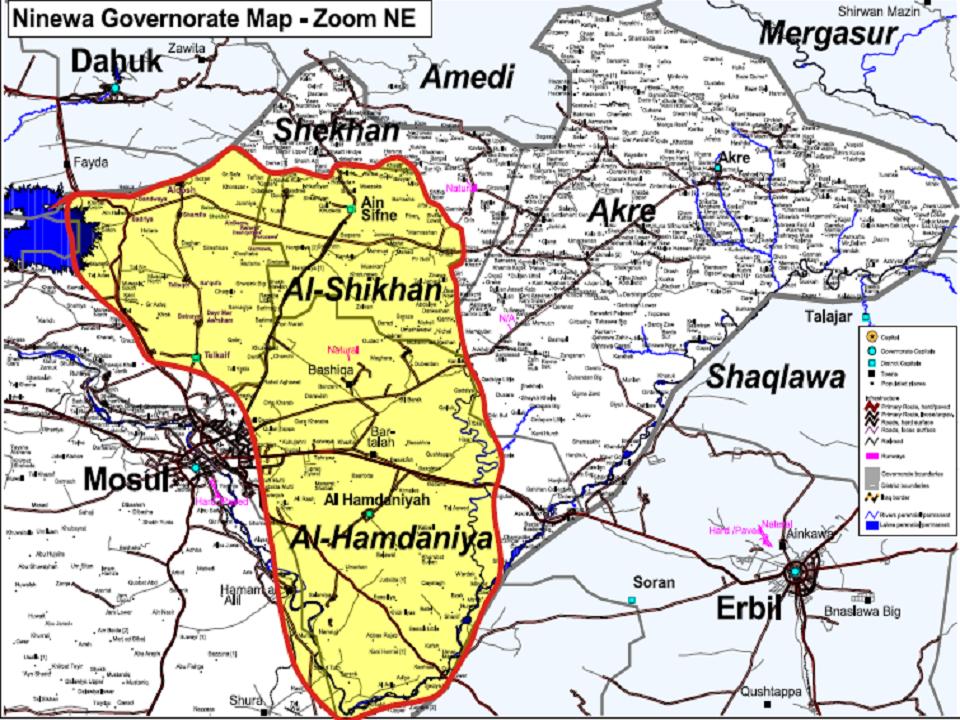
Ninewa province is in northwest Iraq (Wikimedia)
Immediately after the Brotherhood List made their announcement, members of Al-Hadbaa began attacking the event. Some criticized Governor Nujafi for lobbying the Kurds to return, and accused him of cutting a secret deal with them. Some speculated that he wanted to win over the Brotherhood List to ensure himself of a second term in office after the 2013 provincial elections. Sheikh Faisal Abdullah Hameedi Ajeel al-Yaware for instance, of the Justice and Reform Movement within Al-Hadbaa claimed that Nujafi broke his agreement with them when he talked with the Kurds. Members of the Iraqi Islamic Party said that Nujafi acted unilaterally in his negotiations, and did not consult with others. These comments highlighted the internal divisions within Al-Hadbaa. Some factions have been calling for Nujafi to resign. One of the major causes has been his talks with the Kurds. Now that they have come back to the provincial council, these splits within the governor’s party will only come to the fore more. In effect, he has ended their carte blanche rule over the province. 

The differences within Al-Hadbaa were seen in more than just public statements, but in actions as well. On April 11, Al-Hadbaa suspended going to a council meeting, because they claimed the Brotherhood List wanted to make it a secret session. Four days later, six out of the 12 Kurdish councilmembers were stopped at an Army checkpoint north of the provincial capital Mosul, and not allowed to pass. It appeared that some parts of Al-Hadbaa did not want to welcome their council brethren back with open arms. They were determined to make it as difficult as possible to carry on with business as usual.

The rapprochement with the Brotherhood List did not appear possible with the moves that Al-Hadbaa had been making immediately preceding their return. In March 2012, the council voted to freeze Article 140. The local government has absolutely no power over the constitution, but it was a symbolic gesture meant to show their opposition to Kurds annexing any area of the province. The Brotherhood List predictably condemned the move, and demanded that the council be dissolved. Foreshadowing where Governor Nujafi would be heading, he did not approve of the vote, and later said that there were some members of his party that were causing needless problems with the Kurdish list. In late-2011, there was talk that the province would become an autonomous region after Salahaddin said it would wanted to become one. Members of the Kurdistan Democratic Party (KDP) in Baghdad, said that Ninewa could not become its own region without consulting with them first. Again, Governor Nujafi said that the two sides needed to reconcile, compromise, and work with each other, rather than constantly argue. Finally, in July 2011, an official from the KDP said that their peshmerga and Asayesh would not withdraw from the province, quoting security as the reason. As noted before, Al-Hadbaa had asked for the peshmerga to leave as a way to gain greater control of the province, and push back Kurdish hopes of annexing the disputed areas. Altogether, the two parties were continuously bickering with each other for the last year. Neither side could agree upon anything, and were intent on taking actions that would anger the other. It was this deep animosity, which made the Brotherhood’s decision to come back to the council all the more surprising.

Since the 2009 provincial elections, Ninewa has been one of the most deeply divided governorates in Iraq. The Brotherhood List not only left the council, but threatened to break away the sections of the province that they controlled. The disputes between it and Al-Hadbaa continued right up to 2012 with each taking a tit for tat approach to each other. It seemed like both sides were waiting out until the 2013 elections came around, to try to change the status quo. Governor Nujafi was not content with that however, and facing a loss of support within his own party, decided to make a concerted effort over several years to get the Kurds back to their positions. It was a political coup for him to have finally succeeded in April. The problem is that it appears to have increased the internal divisions with his own list, which will likely make governing Ninewa all the more difficult in the future, because now there are factions of Al-Hadbaa that not only do not want to work with the Kurds, but with the governor as well.

FOOTNOTES

1. Radio Free Iraq, “Citizens: fed up with the exchange of accusations between Hadbaa and Nineveh List,” 7/3/11

SOURCES

AIN, “Arab members of Nineveh PC suspend their attendance,” 4/11/12
- “Kurds resume attending Nineveh PC session after three years,” 4/11/12

Ali, David, “Al-Hadbaa and Brotherhood List late Magistrate to refer the dispute to the leaders of Baghdad,” Al Mada, 7/4/11

Aswat al-Iraq, “Hadba’ Bloc’s Crises Threaten Change of Political Map in Ninewa,” 5/20/11

Elias, Saleh, “mosul governor: baghdad’s sectarian policies causing ‘the country to become unstable,’” Niqash, 7/21/11

Fantappie, Maria, “IRAQ: Nouri Maliki attempts to bolster his power by looking to the provinces,” Babylon & Beyond, Los Angeles Times, 7/13/11

Kamal, Adel, “a secret deal? Ninawa council reunites – but critics fear hidden agenda,” Niqash, 4/12/12

Khallat, Khudr, “Six members of Nineveh List banned from entering Mosul,” AK News, 4/15/12

Muhammad, Barzan, “Nineveh Provincial Council Makes Controversial Decision on Article 140,” Rudaw, 3/26/12

National Iraqi News Agency, “Kurdish MPs from Nineveh demand dismantling its PC,” 3/15/12
- “Kurdish official: Peshmirga, Asaish will not withdraw from Nineveh unless residents of disputed areas ask for it,” 7/14/11

Radio Free Iraq, “Citizens: fed up with the exchange of accusations between Hadbaa and Nineveh List,” 7/3/11

Rudaw, “Nineveh Governor Talks Of Warming Ties With Kurdistan,” 1/3/12
- “Salahaddin’s Federalism Declaration Makes Waves,” 11/16/11

Friday, October 1, 2010

Ninewa Unwilling To Hold Census As Long As Kurdish Peshmerga Are Present

Source: U.S. Embassy, Baghdad
Ninewa’s governor Atheel Nujafi told the press that he would block the national census as long as there were Kurdish peshmerga present in his province. Iraq’s Planning Ministry intends on conducting the census on October 24, 2010, and Ninewa is the only governorate that has not prepared for it. Since Nujafi was elected in the January 2009 provincial elections, he and his Al-Hadbaa Party have been calling for all Kurdish forces to withdraw, and be replaced by the Iraqi Army and police. Al-Hadbaa is opposed to Kurdish desires to annex the disputed territories in the province, and believe that the peshmerga are in Ninewa to achieve that goal. Not only that, but after al-Hadbaa took all the positions in the governorate’s council after the 2009 elections, the Kurdish Fraternal List has been boycotting the provincial government, and the peshmerga even refused to allow al-Hadbaa officials from visiting areas under their control. In mid-2010 the United Nations and Iyad Allawi’s Iraqi National Movement began mediating between the parties. The two sides have agreed upon a number of issues such as the budget and distributing government positions, but not security.

If the census were not conducted in Ninewa, the second largest governorate in the country, it would be a major setback. The last time Iraq held a census was in 1997, but it did not include the three provinces in Kurdistan that were not under the administration of Saddam Hussein’s government. They were included in the 1987 census. This year’s census has already been postponed twice before. It was originally planned for 2007, but was cancelled because of the lack of security. The Planning Ministry tried two years later, but political parties were afraid of political manipulation in the disputed territories in Ninewa, Tamim, and Diyala. It’s those same types of objections al-Hadbaa is currently voicing and may hold up this year’s attempt.

SOURCES

Karim, Karzan, “Nineveh governor says no census in his province,” AK News, 9/21/10

Khallat, Khudr, “Kurdish delegation go to Baghdad to discuss census,” AK News, 9/21/10

Sunday, May 23, 2010

Talks Between Al-Hadbaa And Kurds Continue In Ninewa

In the January 2009 provincial elections the al-Hadbaa party emerged victorious in Ninewa province. They took all the positions in the governorate, shutting out the Kurdish led Ninewa Brotherhood List which had previously ruled the province. The Kurds ended up boycotting the provincial council in April 2009, ordered the sixteen districts under their power not to cooperate with al-Hadbaa, denounced the list as Baathists, and barred them from entering any Kurdish area. Besides control of the administration, the two sides have diametrically opposed views for the future of Ninewa. The Kurds for example, want to annex northern portions of the province that are disputed territories, and maintain their peshmerga militia and security forces there.

This year, the United Nations and Iyad Allawi’s Iraqi National Movement have attempted to mediate between al-Hadbaa and the Brotherhood list. In March the two met in Istanbul, Turkey at a conference to discuss provincial governance, and in April the U.N. hosted a meeting as well in Baghdad. The two just began another round of talks this month in Irbil. The Iraqi National Movement has also been pushing the talks as al-Hadbaa is a major player within the list, and Allawi wants them to make concessions in Ninewa in an attempt to win the Kurds over to his side in forming a new government. 

According to press reports, the lists have come to some agreement on outstanding issues. They have found compromises on the budget, appointment and distribution of governmental posts, staffing the bureaucracy, and the release of Arab prisoners held by the Kurds. Two other disputes over the border of Ninewa and security have been given to the central government and the Kurdish Regional Government to work out. A joint committee has also been established to work out the details of each one of these points. 

If al-Hadbaa and the Brotherhood List come to any concrete compromise it would be a major breakthrough for Iraqi politics. The dispute between the two encapsulates the larger Arab-Kurd divide, which is one of the leading problems facing the country. It is a major reason why Mosul, the provincial capital for example remains the most violent city per capita in the nation, and the last urban bastion of the insurgency. If the two lists can work together in Ninewa, it would go a long way to lowering attacks and deaths there and re-unite the divided governorate, as well as lower tensions in northern Iraq.

SOURCES

AK News, “Local consensus government likely in Nineveh: source,” 4/7/10
- “New round of negotiations between Nineveh and Hadbaa in Erbil tomorrow, sources,” 5/13/10
- "New session between sub-committees from "Brotherhood " and "Hadbaa," 5/19/10

Kamal, Adel, “signs of a solution in mosul,” Niqash, 5/13/10

Thursday, April 29, 2010

Human Rights Watch Interviews Former Prisoners At Secret Baghdad Prison

On April 19, 2010 the Los Angeles Times broke the story on a secret prison in western Baghdad at the Muthanna airfield. The facility held 431 prisoners, all of which were Sunnis were who rounded up in Ninewa province in 2009. Human Rights Watch was able to interview 42 former prisoners who were held there. They detailed a series of beatings and abuses that they went through, leading Human Rights Watch to call on the Iraqi government to set up an independent commission to investigate and punish those responsible.

The detainees who were interviewed all had consistent stories and fresh wounds that they said were from their torture. All of them were arrested between September to December 2009 in and around Mosul, the capital of Ninewa, which is the last urban stronghold of the insurgency. They said that the abuse was worse when they were first brought to Muthanna. The interrogations would begin with the prisoners being suspended upside down, and then they would be beat, kicked, whipped, had their nails pulled out, and were burned with either acid or cigarettes. Prisoners that passed out as a result were usually shocked awake with electrodes. The detainees said that the point of the abuse was to get them to sign confessions, but some said the process would continue even after they complied. There were also cases of sodomy using brooms and pistols, younger prisoners being raped, forced oral sex, and having prisoners molest each other.

The next step is to see how the government deals with the issue. Iraq’s Human Rights Ministry has already investigated the Muthanna prison, which led to it being shut down. More than 100 prisoners have been released since then, and the rest have been transferred to jails run by the Ministry of Justice. Three Iraqi army officers have also been detained. Prime Minister Nouri al-Maliki has made two responses since then. On the one hand he has denied knowing anything about the facility, while on the other he’s said that there are no secret prisons in Iraq, and that all of those in Muthanna were detained legally. The government claims that judges issued arrest warrants for everyone rounded up in Ninewa, that they were transferred to Baghdad under court order, and that judges were at Muthanna interviewing the prisoners. At the same time, the prison was run by the Baghdad Brigade, which answers directly to Maliki. Human Rights Watch also found that none of the prisoners had case numbers, and their families were never told where they were. The story is also causing problems with the ruling al-Hadbaa party in Ninewa. They claim that all of the men at Muthanna were the victims of warrant less arrests, and are threatening official protests unless all of those involved are investigated and prosecuted. Like many controversial problems in Iraq, this one is likely never to be fully dealt with. Maliki will say that he’s against torture, while denying any responsibility. A few scapegoats will be found and then everything will move on. Abuse is endemic within Iraq’s prisons and jails, largely because the justice system is based upon confessions. The Muthanna case is just the latest example. Unfortunately it’s unlikely to change anything.

SOURCES

Human Rights Watch, “Iraq: Detainees Describe Torture in Secret Jail,” 4/27/10

Latif, Nizar, “Mosul in revolt over torture claims at ‘al Maliki’s secret jail,’” The National, 4/28/10

Parker, Ned, “Secret prison revealed in Baghdad,” Los Angeles Times, 4/19/10

Friday, April 16, 2010

Ninewa Becomes Playing Field Between Allawi’s Iraqi National Movement And The Kurds

Former Prime Minister Iyad Allawi’s Iraqi National Movement has been actively courting the Kurdish Alliance since the March 2010 elections. As reported before, the Kurds have major questions about some members of Allawi’s list however, such as parliamentarian Osama Nujafi and his brother Atheel Nujafi who is the governor of Ninewa, and the head of the al-Hadbaa party. Allawi has been trying to assuage the fears of the Kurdish leadership by pressing the Nujafis to make concessions in Ninewa province, which has seen a tense standoff between the Kurds and al-Hadbaa since the 2009 provincial elections. Then, al-Hadbaa won a majority of seats and took all the governorate positions, leading to the Kurds to not only boycott the council, but to announce that the 16 administrative districts they controlled would not cooperate with the al-Hadbaa led government either. As part of Allawi’s attempt to mend fences between the two, al-Hadbaa and the Kurdish Ninewa Fraternal List held a United Nations sponsored meeting in early April 2010. 

The conference happened in Baghdad, and was attended by top officials from Baghdad, Kurdistan, and Ninewa. Some of those who were present were Deputy Prime Minister Rafa Issawi, who ran as part of the Iraqi National Movement, Governor Atheel Nujafi, the heads of the Kurdistan Democratic Party (KDP) and Patriotic Union of Kurdistan (PUK) in Ninewa, and the Kurdistan Regional Government (KRG) Interior Minister. The Kurds said they wanted a joint administration in Ninewa that would include them receiving the head of the provincial council, the deputy governor, and dividing the governorate’s budget evenly between the Arab and Kurdish areas. The Kurds also said that the two needed to discuss the presence of the peshmerga in the province, the borders, and annexing the disputed territories there. Despite the positive spin given to the meeting, afterward al-Hadbaa officials said they were pressured by Allawi’s list to attend so that a new national government could be formed. A few days later in mid-April Governor Nujafi said that he had no problems with any of the Kurdish parties that ran in Ninewa in the 2010 vote except for the KDP that won the most parliamentary seats within the Kurdish Alliance. In effect, he was trying to say that he was fine with the Kurds, but just not their leadership. That didn’t seem to work as the other Kurdish parties said they all had a united front within Ninewa.

So far, nothing has come of the U.N. conference or Allawi’s pressure on al-Hadbaa. The Kurds are still boycotting the Ninewa provincial council, there is no power sharing there, and the National Movement and the Kurdish Alliance have come to no agreement over a new government. Despite Allawi being the head of his list, he has only so much influence over the parts of his coalition. The differences between al-Hadbaa and the Kurds run deep, and the two have had several confrontations since the 2009 balloting. Its unclear whether Allawi or the United Nations has enough pull to bring the two sides together, and that may be enough to stop the Kurdish Alliance and the National Movement from finding common ground any time soon.

SOURCES

AK News, “Local consensus government likely in Nineveh: source,” 4/7/10
- “Nujaifi says Hadba issues only KDP in Mosul,” 4/14/10

UN Assistance Mission in Iraq, “SRSG Melkert hosts a meeting between Hadba and Ninewa Fraternal List in Baghdad,” 4/5/10

Monday, March 29, 2010

Kurdish Alliance Lays Out Its Opposition To Allawi’s National Movement

After the new Iraqi parliament is seated they will elect a president with a two-thirds vote who will then tell the leader of the coalition with the most seats to form a new government. Former Prime Minister Iyad Allawi finished first in the March 7 election with 91 seats. He needs to garner 72 more seats to reach a majority of 163 to become the leader of Iraq again, and is in talks with all the major parties to accomplish this. One of them is the Kurdish Alliance, led by the Kurdistan Democratic Party (KDP) and the Patriotic Union of Kurdistan (PUK), who finished with 43 seats. While not a necessity to form a new government, the way the lists are currently divided, they will be an important player. The problem for Allawi is that the Kurdish Alliance has come out against members of his list for being anti-Kurdish.

One major difference between the Kurdish Alliance and Allawi stems from the Kurds’ demands to join a coalition. The Kurds are expecting assurances on Kurdish federalism and sharing of oil revenues, support for Article 140 that lays out rough steps to annex disputed territories such as Kirkuk, and support for President Jalal Talabani to return for a second term as prerequisites for their participation in any new government. Right after the voting ended, the National Movement ran into its first problem when member Vice President Tariq Hashemi said that an Arab should be president in an interview with Al Jazeera. Allawi and Hashemi immediately went to Irbil to meet with Kurdistan Regional Government President Massoud Barzani to smooth over the comments. Recently, Allawi also said that he respected the nomination of Talabani. The presidency is an important symbolic position for the Kurds, to show that they have power in Baghdad. Allawi might have found a solution to this early difference, but he has larger ones to deal with. 

While Allawi is a secular Shiite, most of his list is made up of Sunnis. Two prominent members are parliamentarian Osama Nujafi and his brother Atheel Nujafi who is the governor of Ninewa and the leader of the al-Hadbaa party. They are probably the main reason why the National Movement won 20 out of 31 general seats in the province. In the 2009 elections Al-Hadbaa ran on opposition to Kurdish aspirations to annex disputed regions of the governorate, and to remove them from leadership positions within Ninewa, which they had controlled since 2005. After their victory, the Kurds boycotted the provincial council, set up their own rival administration, and denounced al-Hadbaa as being Baathists. 

The Nujafis inclusion in the National Movement has become a major source of concern for the Kurds. The Kurdish Alliance has said that there are Baathists within Allawi’s list as a result. More and more, Kurdish officials have also said that they would have a problem working with Allawi because of the Nujafis. The leader of the Kurdish Alliance said that they have nothing against Allawi personally, but that members of his list are a threat to the Kurds. Another Kurd said that there were parts of the National Movement that opposed the constitution, meaning Article 140, Kurdish federalism, and denied Saddam’s massacre of Kurds at Halabja. Osama Nujafi has not helped the situation when after the election he said that he would oppose giving the Kurds any concessions over Kirkuk or any other disputed territory. Because al-Hadbaa are such an important part of the National Movement, responsible for up to one fifth of the list’s seats, Allawi would find it almost impossible to compromise with both them and the Kurdish Alliance. The Kurds and the Nujafis have diametrically opposed ideas of the disputed areas, the administration of Ninewa, and al-Hadbaa are considered Baathists in disguise by the Kurdish Alliance. Allawi supporting Talabani for president is a relatively painless move, but making any kind of promises to the Kurds could tear his list apart. 

While anything is possible in Iraqi politics, for now it seems as though there is no common ground to be found between Allawi and the Kurdish Alliance. Allawi was the overwhelming candidate of the Sunnis this election, and the Nujafis played an important role in that victory. That support may now cost him a deal with the Kurds. Already, the Kurds have said that they are closer to Prime Minister Nouri al-Maliki’s State of Law and the Supreme Council-Sadrist led National Alliance. 163 seats in parliament can be achieved without the Kurdish Alliance, but it would be much more difficult. Allawi would have to win over some of the smaller winners in the 2010 election such as the Unity of Iraq and Accordance Front, and more importantly, one or two of the Shiite parties like the Sadrists, Supreme Council, or even Maliki’s State of Law. This is just another sign that forming a new government will be a long and arduous process likely to take months just as it did in 2005.

SOURCES

AK News, “Ayad Allawi & Tariq al-Hashimi in Erbil,” 3/13/10
- “Discords over Kirkuk after Iraq vote,” 3/22/10
- “KA leader rules out nominating al-Hashemi for premiership,” 3/22/10
- “KA: We have reservations on some of Al-Iraqiya members, including Osama Nujafi,” 3/24/10
- “Post of President “crucial point” for Kurds in forging alliances,” 3/10/10

Asrar-Al Sharq, “Mahmoud Othman : presence of difficulty in Kurdistan alliance with Iraqi list,” 3/28/10

Hamad, Qassim Khidhir, “kurdish kingmakes?” Niqash, 3/25/10

Hanna, Michael, Wahid, “How much do they hate Maliki?” Middle East Channel, Foreign Policy, 3/26/10
- “The Race for the Iraqi Presidency,” Middle East Channel, Foreign Policy, 3/11/10

Inside Iraq, “Iraq’s Election results,” McClatchy Newspapers, 3/26/10

Al Iraq News, “Chairman of the Iraqi List: We support the nomination of the Kurdistan Alliance President Talabani for a second term,” 3/27/10

Khabbar, “Sadoun : Kurdistan Alliance close to the two coalitions and has reservations on some members of the Iraq,” 3/28/10

Mahmoud, Mustafa, “Iraq’s divided vote may deepen Kirkuk dispute,” Reuters, 3/23/10

Najm, Hayder, “tight race means a long wait for new pm,” Niqash, 3/24/10

Radio Free Europe/Radio Liberty, “Kurdish Alliance Gives Criteria For Forming A Coalition,” 3/27/10

Radio Nawa, “Kurdish leader describes allied with Allawi as mines, which is fighting Kurds,” 3/28/10

Sowell, Kirk, “Iraq Elections: Maliki’s Path to Re-election,” World Politics Review, 3/16/10

Friday, March 12, 2010

U.S.-Iraqi-Peshmerga Joint Patrols Get Off To Rough Start

In mid-January 2010 joint patrols and checkpoints run by U.S., Iraqi, and Kurdish peshmerga forces were established in Diyala, Tamim, and Ninewa along the border of disputed territories within those provinces such as around the city of Kirkuk. The U.S. commander in Iraq General Ray Odierno originally made the proposal for these operations in August 2009 in an attempt to ease tensions between Baghdad and the Kurdistan Regional Government (KRG). The idea generated widespread opposition amongst Arabs and Turkmen in northern Iraq, but a deal was eventually worked out between the central and regional governments. In mid-February and the beginning of March the operation faced two major setbacks.

First, on February 10, 2010 the U.S. commander in Ninewa set up a joint escort for the governor of the province that led to a confrontation with Kurdish forces. The incident began when a joint force took Governor Atheel al-Nujafi to the Kurdish controlled town of Takleef. There, locals threw rocks and tomatoes at his caravan leading to shots being fired in the air. Iraqi forces with the governor ended up arresting some peshmerga troops, who in turn detained some government soldiers. The standoff eventually ended when all of the prisoners were released, but the affair wasn’t over. Afterward, the governor accused the Kurds of kidnapping. KRG President Massoud Barzani countered by suspending joint patrols, and calling Nujafi a criminal who would be arrested if he ever entered another Kurdish area in Ninewa again. After the January 2009 provincial elections in which Nujafi’s al-Hadbaa party won a majority and took over the local government, the Kurds boycotted and set up their own administration in sixteen districts that they controlled. Takleef was in one of those areas. The U.S. tried to smooth over the situation by saying that it was all a misunderstanding, but the American commander in Ninewa still said that local officials should be able to go anywhere in the governorate. Eventually Barzani okayed the continuation of joint patrols.

The second mishap occurred on March 7, the day of general voting for Iraq’s parliament. A provincial council member in Ninewa who was going to cast his ballot just outside of Mosul was mistakenly fired upon by a joint checkpoint. The council member later died of his wounds in a hospital, while eight others in his entourage were wounded. The incident was labeled a tragic misunderstanding between the two parties.

So far these two incidents have not become a national issue, but if another problem happens the joint patrols could quickly become one. Gen. Odierno envisioned the operation as a way to relieve tensions between Arabs and Kurds, which he considers the main threat to stability in Iraq. He was able to overcome a lot of local opposition to get the program up and running. The two recent events show that they may not be able to accomplish much. That’s especially true in Ninewa where there are two rival administrations, one run by the provincial council and another by the KRG. There it seems the best that the patrols and checkpoints could do is maintain the status quo. At their worst, they could lead to another confrontation that blows up in the face of the Americans.

SOURCES

Arraf, Jane, “Before Iraq election, Arab and Kurd tensions soar in the north,” Christian Science Monitor, 3/1/10

KUNA, “Mosul explosions kill one, injure 20 others,” 3/7/10

Reuters, “FACTBOX-Security developments in Iraq, March 7,” 3/7/10

Tuesday, March 2, 2010

Al-Hadbaa-Change List Alliance In Ninewa For The March Elections?

In 2009 two new parties emerged in northern Iraq. One was the Arab led al-Hadbaa Party in Ninewa that was organized around Iraqi nationalism, economic development of the province, and opposition to Kurdish aspirations to annex disputed areas. It gained support from business elites, tribal sheikhs, Kurds opposed to the ruling Kurdish parties, Turkmen, former Baathists, and nationalist insurgent groups. That helped them win a majority in Ninewa in the January 2009 provincial elections, and take control of the local government. The other group was the Change List, formed by the co-founder of the Patriotic Union of Kurdistan (PUK) Nishurwan Mustafa. Change promised greater transparency in the Kurdistan Regional Government (KRG), an end to corruption, and separating the ruling parties from the government administration and justice system. It won 23% of the vote in the July 2009 Kurdish parliamentary elections, including a majority in the PUK stronghold of Sulaymaniya, drawing upon former PUK members and people disaffected with the ruling Kurdish parties.

Both parties are now running in Ninewa in the March 2010 parliamentary vote, and have discussed an alliance. Al-Hadbaa is competing as part of former Prime Minister Iyad Allawi’s Iraqi National Movement, while the Change List is running alone. They are two of 37 parties involved in the balloting for 31 seats up for grabs in the governorate. At first, a coalition between the two would seem an odd couple since al-Hadbaa is mostly known for its anti-Kurdish stance, but they actually share the same opponents, the PUK and the Kurdistan Democratic Party (KDP). The Change List for example, has complained that the KDP is hindering their campaign in Ninewa, while the KDP-PUK led Ninewa Fraternal List are boycotting the al-Hadbaa led provincial council and have set up their own administration in districts they control in Ninewa. 

Talks have been held between the two lists, but nothing has been confirmed. Al-Hadbaa leaders believe that they can win up to 20 of Ninewa’s 31 seats, while Change expects to win around 3. It would still be a bit of an odd couple if the two did join together, but it could show that al-Hadbaa is opposed to Kurdish designs on Ninewa, rather than Kurds themselves, and that Change will not follow the lead of the PUK and KDP in parliament as many expect. The story is an interesting one, and shows the state of flux Iraqi politics are currently in as new parties are attempting to break the hold of the older, larger, and more powerful lists that have dominated Iraq since the 2003 invasion.

SOURCES

AK News, “Goran List faces obstacles caused by KDP in Mosul,” 2/27/10
- “Hadba expects to win 20 seats in eth March 7 polls,” 2/27/10

Hamad, Qassim Khidhir, “kurdish election lists,” Niqash, 6/30/09

International Crisis Group, “Iraq’s New Battlefront: The Struggle Over Ninewa,” 9/28/09

Niqash, “the hadbaa national list,” 1/28/09

Monday, February 8, 2010

Political Disputes Continue in Ninewa


In the January 2009 provincial elections the new al-Hadbaa party won a majority in Ninewa, and took all the positions in the local government in April. The al-Hadbaa party was made up of Mosul businessmen, tribal leaders, Kurds who opposed the ruling Kurdish parties, Turkmen, and also garnered support from many nationalist insurgent groups and former Baathists. They stood for a strong central government, opposition to Kurdish claims to disputed areas in the province, and called for the Kurdish militia the peshmerga to withdraw. They replaced the Ninewa Fraternal List who was led by the Kurdistan Democratic Party (KDP) and Patriotic Union of Kurdistan (PUK) who had ruled Ninewa since 2005 when Arabs boycotted the local elections. The Fraternal List protested not being included in the new government by announcing that they and 16 districts they controlled would not cooperate with al-Hadbaa, and denouncing the party as Baathists. The Kurds went further by saying that no provincial officials could enter the 16 areas without their permission. This resulted in two dramatic confrontations in May when the governor and provincial police chief were stopped from entering Kurdish controlled areas by the peshmerga. Tensions grew as later in the month people in the Telafar district demanded that they be annexed by Kurdistan, and then in June pro al-Hadbaa tribesmen got into a shootout with peshmerga in the Sinjar district. In August when three large bombings struck minorities the Fraternal List and al-Hadbaa blamed each other rather than insurgents for the attacks.

Things have gotten no better as the March 2010 parliamentary elections are nearing. In January 2010 the governor of Ninewa Atheel al-Nujafi initiated a no confidence vote against the mayor of Sinjar, who turned around and filed a lawsuit against the governor. The Fraternal List condemned the removal of the mayor as well, claiming that al-Hadbaa represented Baathists and their henchmen. At the beginning of February, Governor Nujafi went to the Tel Kaif district where protestors threw fruits and vegetables at his car, while Fraternal List officials said that the governor had gone to the area without their permission. Later in the month Kurdish parties accused al-Hadbaa of trying to shut down their offices in the province before the vote, while Governor Nujafi held a press conference calling on the central government to have the peshmerga removed from Ninewa

The tit for tat between the al-Hadbaa party and the Ninewa Fraternal List does not look like it will be abating anytime soon. Their dispute has resulted in Ninewa province being divided into two separate and rival administrative areas, with no cooperation between them. This is one reason why the province is the most violent per capita in Iraq, because the insurgents have been able to exploit these differences. Several parties in parliament, and the United States and United Nations have tried to mediate between the two, but to no avail. Recently joint U.S.-Iraqi-peshmerga checkpoints have been created in Ninewa, which the Americans hope will build confidence between Arabs and Kurds, but since the Iraqi forces involved are controlled by Baghdad, not the provincial government, they’re unlikely to do anything about the al-Hadbaa-Fraternal List argument. Many hoped that the January 2009 elections would lead to reconciliation in Iraq, as many Sunnis boycotted the last one, but in Ninewa the balloting made the situation worse.

SOURCES

AK News, “Call to resolve conflict between key Kurd and Arab lists in Nineveh,” 2/5/10
- “KRG Spokesman calls for allowing Peshmerga forces to share in security,” 2/7/10
- “Kurdish parties in Nineveh is legal: official,” 2/6/10
- “Nineveh brotherhood renewed fears from Hadba list program,” 2/2/10

Asawt al-Iraq, “Sinjar mayor to sue Ninewa governor,” 1/29/10

International Crisis Group, “Iraq’s New Battlefront: The Struggle Over Ninewa,” 9/28/09

Sunday, January 24, 2010

Joint Iraqi-Peshmerga-U.S. Patrols Begin In Disputed Territories

On January 13, 2010 checkpoints manned by the Iraqi army, Kurdish peshmerga, and U.S. soldiers were set up in Diyala. Similar checkpoints will be created in Ninewa and Tamim later in the month. They are being created in what the U.S. calls the Combined Security Area where Iraqi and peshmerga forces meet, but do not cooperate. These joint operations are meant to help ease tensions between Baghdad and Kurdistan, as well as improve security.

In August 2009 commander of U.S. forces in Iraq General Ray Odierno proposed joint patrols in disputed territories. To Odierno, the patrols would address two important issues. First, the arguments between the Kurds and Arabs in northern Iraq created security gaps that were exploited by insurgents to carry out attacks. Joint patrols were meant to counter this. Second, the Americans have pointed to the Arab-Kurd dispute as the main source of instability in Iraq’s future, and it was hoped that cooperation on the ground would alleviate this problem. While the Kurds immediately embraced the concept, many Arabs and Turkmen rejected it just as fast.

Shortly after Odierno proposed his plan, Arabs and Turkmen began voicing their opposition. On August 23, 2009 for example, the Ninewa provincial council, which is controlled by the Arab led al-Hadbaa party, said they rejected the idea. On September 1, Arabs and Turkmen in the Kirkuk city council also complained. That same month Vice President Tariq al-Hashemi questioned the idea during a meeting with Vice President Joe Biden while he was visiting Iraq, and a few days later 100 Arabs protested against the patrols in Mosul.

Today, Arabs and Turkmen are just as opposed. A Turkmen member of the Tamim provincial council, members of the Arab Group in that province, as well as the al-Hadbaa List in Ninewa all said they were still against the joint patrols in January 2010. Their negative opinion is based upon two issues. First, they want the Iraqi army and police to secure their provinces rather than a mix of U.S., Iraqi, and peshmerga forces. Second, they believe that joint patrols will give legitimacy to the peshmerga being in disputed areas, which many Arabs and Turkmen of the region see as being illegal and a step towards annexation into Kurdistan.

The peshmerga presence and disputed territories in northern Iraq were created as a result of the overthrow of Saddam. In 2003 the peshmerga swept south out of Kurdistan as part of the U.S. invasion. They set up de facto control of areas in Ninewa, Diyala, and Tamim provinces that they claimed were historically Kurdish, and that they wished to annex. When the insurgency began to take off, the U.S. military also asked the Kurds to help with security. The Kurdish forces have been in these areas ever since, and administered them as parts of the Kurdistan Regional Government (KRG) with little to no coordination with Baghdad or Iraqi forces. In 2008, Prime Minister Nouri al-Maliki attempted to assert control of these areas by moving Iraqi forces into Ninewa and Diyala that caused a crisis with the Kurds. This brought the Arab-Kurd dispute to the attention of the U.S. military and policy makers, and led to the joint patrols plan.

Joint patrols will definitely help with security, but the political affects are much more questionable. Northern Iraq is the most violent part of the country, and insurgents have carried out massive bombings and other attacks there to try to play on the differences between Arabs, Kurds, Turkmen, and other minorities that live there. There are swaths of territory in the region that have little military presence because of the disputes between Arabs and Kurds. Joint patrols and checkpoints will hopefully fill these gaps. Since so many local Arabs and Turkmen are opposed to the idea however, the political repercussions may be negligible. They are all afraid that the joint patrols will legitimize Kurdish control of the areas, and in turn allow for their annexation. While they would like better security, they believe the Iraqi security forces should be responsible instead. Joint patrols are likely to be a stopgap measure then, which will help with fighting insurgents, but maintain the political status quo.

SOURCES

AK News, “Arab and Turcomans seek to dissolve joint forces in parliament,” 1/20/10
- “Iraqi MP: Deploying Peshmerga forces in Kirkuk aims to keep it safe,” 1/18/10
- “Joint forces will be deployed in Mosul in coming days,” 1/14/10
- “Kurds accept, Arabs and Turkmen refuse deployment of common forces in Disputed cities,” 1/14/10
- “Kurds welcome Americans Kirkuk proposal,” 8/20/09

Aswat al-Iraq, “Hashemi voices reservations about joint forces presence in Kirkuk, Ninewa,” 9/16/09
- “Peaceful demonstration in Ninewa against joint forces presence,” 9/28/09

Fontaine, Scott, “Milestone: Arab-Kurdish-American checkpoints,” Tribune News, 1/22/10

Knights, Michael, “National Implications of the Kurdish Elections,” Washington Institute for Near East Policy, September 2009

Visser, Reidar, “Maliki’s Northern Headache, and How General Odierno Is Compounding It,” Iraq And Gulf Analysis, 9/9/09

Zuber, Zach, “Three Forces Come Together for Checkpoints,” DVIDS, 1/22/10

Sunday, December 6, 2009

Security Situation In Mosul, November 2009

The security situation in Iraq was a little different in November 2009. Unlike previous months, Baghdad province was not the deadliest place in the country. Rather Ninewa, largely driven by events in the provincial capital Mosul, had the most deaths for the month. Last month Ninewa had 61 attacks resulting in 41 dead and 80 wounded, compared to 59 attacks in Baghdad, 38 deaths, and 165 wounded. Around 90% of the violence in Ninewa occurred in Mosul. There were 55 attacks there in November, resulting in 37 deaths, and 71 wounded. That averaged out to 1.83 attacks per day, 1.23 deaths, and 2.36 wounded. That was the lowest number of attacks since January 2009 when there were 52, and an average of 1.67. 37 was also the lowest number of deaths since at least 2006, if not before.

Mosul is the second most violent city in Iraq after Baghdad. That’s because it is the largest urban stronghold of the insurgency. There are daily reports of assassinations, bombings, and attacks on local officials and security forces. That has begun to change however. Starting in November 2008 attacks and casualties began to see a steady decline. That coincided with the run-up to the January 2009 provincial elections, and the formation of the al-Hadbaa List. The coalition was a collection of Mosul business elites, tribal leaders, and Kurds opposed to the Kurdistan Democratic Party and Patriotic Union of Kurdistan. (3) Al-Hadbaa was eventually able to work out a cease-fire with local insurgents, and got the backing of local Baathists and their fighters, who by 2008 had been able to assume command of the fighting there from Al Qaeda in Iraq. Al-Hadbaa ended up winning the election, which marked a return of Sunni Arabs to politics in Ninewa after they had boycotted the 2005 vote. The greater participation is directly responsible for the reduction of attacks in Mosul. The divide of the city between Arabs and Kurds however, still gives some reason to turn to violence, and the continued security incidents there.

Attack and Casualty Statistics for Mosul – January to November 2009

January 52 Attacks/Incidents, Avg. 1.67/day
56 Deaths, Avg. 1.80/day
56 Wounded, Avg. 1.80/day

February 81 Attacks/Incidents, Avg. 2.89/day
58 Deaths, Avg. 2.00/day
111 Wounded, Avg. 3.96/day

March 86 Attacks/Incidents, Avg. 2.77/day
69 Deaths, Avg. 2.22/day
169 Wounded, Avg. 5.45/day

April 79 Attacks/Incidents, Avg. 2.63/day
53 Deaths, Avg. 1.76/day
191 Wounded, Avg. 6.36/day

May 83 Attacks/Incidents, Avg. 3.06/day
64 Deaths, Avg. 2.06/day
164 Wounded, Avg. 4.70/day

June 73 Attacks/Incidents, Avg. 2.43/day
58 Deaths, Avg. 1.93/day
123 Wounded, Avg. 4.10/day

July 73 Attacks/Incidents, Avg. 2.35/day
79 Deaths, Avg. 2.54/day
169 Wounded, Avg. 5.45/day

August 77 Attacks/Incidents, Avg. 2.48/day
102 Deaths, Avg. 3.29/day
171 Wounded, Avg. 5.51/day

September 72 Attacks/Incidents, Avg. 2.40/day
65 Deaths, Avg. 2.16/day
60 Wounded, Avg. 2.00/day

October 66 Attacks/Incidents, Avg. 2.12/ day
60 Deaths, Avg. 1.93/ day
82 Wounded, Avg. 2.64/ day

November 55 Attacks/Incidents, Avg. 1.83/ day
37 Deaths, Avg. 1.23/ day
71 Wounded, Avg. 2.36/ day

Averages:

4th Quarter 2007: 38.66 Attacks/Incidents/month, Avg. 1.26/day
77.33 deaths/month, Avg. 2.52/day
114.66 wounded/month, Avg. 3.73/day

1st Half 2008: 57.5 Attacks/Incidents/month, Avg. 1.89/day
88.00 deaths/month, Avg. 2.90/day
210.00 wounded/month, Avg. 6.92/day

2nd Half 2008: 75.33 Attacks/Incidents/month, Avg. 2.45/day
80.83 deaths/month, Avg. 2.63/day
168.33 wounded/month, Avg. 5.48/day

1st Half 2009: 75.66 Attacks/Incidents/month, Avg. 2.50/day
59.66 deaths/month, Avg. 1.97/day
135.66 wounded/month, Avg. 4.49/day

For a history of the violence in post-invasion Mosul see:

The Changing Face of Violence In Mosul

SOURCES

Aswat al-Iraq, “2 charred bodies found inside car bomb,” 11/1/09
- “2 civilians killed in Mosul,” 11/19/09
- “2 civilians wounded in cab bomb blast in Mosul,” 11/1/09
- “2 gunmen killed in IED blast they planted,” 11/8/09
- “2 policemen wounded in hand-grenade blast in Mosul,” 11/12/09
- “3 children wounded in Ninewa blast,” 11/15/09
- “3 mortar shells hit central Mosul,” 11/9/09
- “3 soldiers wounded in Mosul blast,” 11/15/09
- “13-year-old Christian boy shot down in Mosul,” 11/13/09
- “Army officer killed in Mosul blast,” 11/23/09
- “Asiacell employee gunned down in Mosul,” 11/2/09
- “Body found, civilian killed, another wounded separately in Mosul,” 11/12/09
- “Bomb kills child, wounds 5 civilians in Mosul,” 11/15/09
- “Car bomb causes slight damage in Mosul,” 11/25/09
- “Child wounded in Mosul blast,” 11/11/09
- “Civilian killed in eastern Mosul,” 11/9/09
- “Civilian killed, son wounded in western Mosul,” 11/16/09
- “Civilian wounded as police detonates IED,” 11/22/09
- “Civilian wounded by Iraqi fire in Mosul,” 11/10/09
- “Cop wounded in Mosul blast,” 11/11/09
- “Employee shot down by gunmen in Mosul,” 11/1/09
- “Gunmen kill employee in Mosul,” 11/22/09
- “Gunmen wound lawman in Mosul,” 11/3/09
- “Gunmen wound policeman in Mosul,” 11/8/09
- “Hand grenade wounds woman in Mosul,” 11/28/09
- “IED injures 2 cops in Mosul,” 11/20/09
- “IED wounds 2 civilians in Mosul,” 11/16/09
- “IED wounds 5 in western Mosul,” 11/6/09
- “Iraqi soldier shot down by gunmen in Mosul,” 11/26/09
- “Judge survives assassination attempt,” 11/17/09
- “Lawyer shot dead by gunmen in Mosul,” 11/1/09
- “Mortar attack on Sunni endowment leaves 3 wounded,” 11/3/09
- “Officer killed, 2 cops wounded by roadside bomb in Mosul,” 11/5/09
- “Policeman killed by gunmen fire in Mosul,” 11/7/09
- “Security element killed in Mosul,” 11/30/09
- “Soldiers wounded in clashes with gunmen,” 11/21/09
- “Teacher gunned down in Mosul,” 11/21/09
- “Thermal bomb kills, injures 2 cops in Mosul,” 11/30/09
- “Thermal bomb leaves child killed, 4 wounded in Mosul,” 11/22/09
- “Thermal bomb wounds civilian in Mosul,” 11/16/09
- “Turkmen politician assassinated in Mosul,” 11/22/09
- “Unidentified body of young man found in Mosul,” 11/13/09
- “Unknown bodies found in Mosul,” 11/4/09

DPA, “Bomb kills three in northern Iraq,” 11/17/09

Hammoudi, Laith, “Round-up of Daily Violence in Iraq – Tuesday 3 November 2009,” 11/3/09
- “Round-up of Daily Violence in Iraq – Tuesday 10 November 2009,” 11/10/09

International Crisis Group, “Iraq’s New Battlefront: The Struggle Over Ninewa,” 9/28/09

Issa, Sahar, “Round-up of Daily Violence in Iraq – Friday 6 November 2009,” McClatchy Newspapers, 11/6/09
- “Round-up of Daily Violence in Iraq – Sunday 8 November 2009,” McClatchy Newspapers, 11/8/09

Reuters, “FACTBOX-Security developments in Iraq, Nov. 9,” 11/9/09
- “FACTBOX-Security developments in Iraq, Nov 26,” 11/26/09

Monday, November 30, 2009

Human Rights Watch: Ninewa’s Minorities Under Pressure From Both Sunni Insurgents and Kurds

In November 2009 Human Rights Watch released a new report detailing the plight of minorities in Ninewa province entitled “On Vulnerable Ground.” The report covers the history of successive governments in Baghdad to Arabize Ninewa by pushing out minorities and Kurds and replacing them with Arabs, and then the ascendancy of Kurds there after the U.S. invasion. They turned around and tried to Kurdicize those same regions to advance their plans to annex the disputed territories there. At the same time, the Sunni Arab insurgency has targeted minorities for being non-believers or cooperators with the Americans. Minorities such as Christians, Shabaks, and Yazidis are therefore in a precarious situation being pressured from all sides to either leave or comply with stronger forces.

Map of Mosul Province

“On Vulnerable Ground” starts with some historical background to Ninewa. Beginning in the 1930s the Iraqi central government started a program to Arabize Ninewa, which has historically been one of the most diverse areas in the country. It is the home to Arabs, Kurds, Christians, Shabaks, and Yazidis, especially in an area known as the Ninewa plains, which are the districts immediately to the east of Mosul. In the 1970s Baghdad stepped up its efforts to move Arabs into Ninewa and push Kurds and minorities out that only got worse under Saddam Hussein. After the Gulf War in 1991 Baghdad tried to pressure Kurds and minorities to register as Arabs, and would not give birth certificates to babies with non-Arab names for instance. They also pressured minorities to join militias and perform other tasks to prove their loyalty or face expulsion. Many Kurds and minorities moved to Kurdistan, which had gotten its autonomy in 1991.

Map of the Ninewa Plain

After the U.S. invasion, the Kurdish peshmerga swept south into Ninewa with U.S. forces. Many Arabs who had moved there under the government’s programs fled before the advance. In the days after the fall of Mosul, the capital of Ninewa, the peshmerga also began kicking out Arab families from towns in the surrounding areas. These factors together increased the ethnic tensions in the province. In all the areas where the Kurds occupied they eventually established their influence through the presence of their peshmerga forces and control of the administration. The divide between Arabs and Kurds intensified after the 2005 provincial elections, when the Sunni Arabs decided to boycott. This allowed the Democratic Patriotic Alliance of Kurdistan, which was made up of the two major Kurdish parties, the Patriotic Union of Kurdistan and the Kurdistan Democratic Party, to win 31 of the 41 council seats in Ninewa.

The ascendancy of the Kurds, and the displacement and loss of power of the Sunni Arabs directly led to the growth of the insurgency in Ninewa. As reported before, Mosul remains the last urban stronghold of the Sunni militants. They in turn, have carried out some of the largest attacks in the Iraq war against Ninewa’s minorities. Christians, Yazidis, and Shabaks have all been singled out for mass casualty bombings, and targeted killings, taking thousands of lives, and forcing many minorities to flee the region. In one spate in October 2008 for example, the Christians of Mosul faced an organized campaign of murder and intimidation to drive them out of the city. 40 were killed, and 12,000 fled Mosul. Arabs and Kurds exchanged blame for the attacks, but Human Rights Watch’s interviews led them to believe that it was definitely the work of Arab insurgents. Some of the largest bombings in Ninewa this year have also been against Yazidis and Shabaks. Sunni militants consider all three groups, Christians, Yazidis, and Shabaks, to be non-believers or collaborators with the Americans.

From 2005 to the present the Kurds also carried out a systematic campaign to co-opt, cajole, threaten, and intimidate Ninewa’s minorities to support the Kurdistan Regional Government’s (KRG) plans to annex the disputed areas in the province. This has followed a two-pronged carrot and stick approach. First, the KRG has spent millions of dollars on minorities to win over their loyalty and create patronage systems. For example, the KRG’s Finance Minister Sarkis Aghajan, a Christian, was ordered by the KRG Prime Minister Nerchivan Barzani to build churches, fund Christian community organizations, and create Christian militia groups. They also used these means to undermine those who opposed the KRG’s plans. Second, the Kurds have used pressure and intimidation. Christians told Human Rights Watch that they were encouraged to sign forms calling for the annexation of Ninewa’s disputed areas by Kurdistan. The KRG also considers Yazidis and Shabaks to be Kurds, and have pressured them to register themselves as such to gain aid. Minority leaders and activists have also been targeted with the Kurds implicated in the attacks. Two Yazidi activists opposed to Kurdish aims were arrested and tortured for six months in 2007. The leader of the Shabak Democratic Gathering was killed by gunmen in July 2008 a few meters from a peshmerga checkpoint who did nothing before, during, or after the attack. Another Shabak politician claimed he was attacked by men wearing Kurdish uniforms before the 2009 provincial elections. Other minorities said they were stopped from attending political rallies by anti-Kurdish groups before the 2009 elections, and were warned that if they didn’t vote for the Kurdish Fraternal List they would lose their homes and jobs. Many of these tactics reminded Human Rights Watch of Saddam’s and earlier Arab government policies. Both the Kurds and minorities were victimized and expelled from Ninewa under the Arabization program. Now the Kurds are repeating many of these same policies to annex the northern regions of Ninewa to Kurdistan.

The 2009 elections turned out to be a major setback for the Kurds’ plans. They lost to the Arab led al-Hadbaa party who took all of the provincial offices, shutting the Kurds out of power, and calling for the withdrawal of the peshmerga. In response, the Kurdish Fraternal list is boycotting the provincial council, have refused to allow Arab officials to carry out their duties in Kurdish controlled areas, and have threatened to break away 16 towns and districts from Ninewa and create their own administration in protest. In June 2009 the KRG made the situation worse when it passed a draft constitution that claimed all of the disputed areas in Ninewa as part of Kurdistan, and said that the peshmerga had the right to operate in Ninewa.

In the end, Human Rights Watch is very worried about the future of minorities in Ninewa province. They are concerned as well, as a Christian leader recently said he is worried about increased attacks on his community in Mosul as Christmas approaches. They are facing the violence of Sunni insurgents, and the forced assimilation and co-option by the Kurds. They are also caught in the middle between the dispute between the central government, the al-Hadbaa provincial government, and the KRG for control of the disputed territories in Ninewa. Human Rights Watch’s findings are also not new. In December 2008 two similar reports were released, one by the United States Commission on International Religious Freedom on Iraqi minorities throughout the country, and another by the Brookings Institution and the University of Bern on minorities and displacement. They both noted the relentless attacks minorities have faced at the hands of insurgents, and the tactics the Kurds have employed against them. Due to these circumstances, Iraq’s minorities have been left with only two real options. First, many have fled becoming displaced or refugees. 20% of Iraq’s refugees for example are believed to be Christians. Second, those that have stayed in Ninewa have tried to align with one of the more powerful actors, whether it be the Kurds, or now the central government and the al-Hadbaa provincial council. None of these provide the protection and rights Ninewa’s minorities deserve, and as long as the divide exists between the KRG and Baghdad their situation is unlikely to get any better.

SOURCES

AK News, “Christians fear escalation of attacks with approach of Christmas,” 11/28/09

Badkhen, Anna, “Kurds evicting Arabs in north Iraq,” San Francisco Chronicle, 4/19/03

Ferris, Elizabeth and Stoltz, Kimberly, “Minorities, Displacement and Iraq’s Future,” Brookings Institution-University of Bern, December 2008

Human Rights Watch, “On Vulnerable Ground,” 11/10/09

United States Commission on International Religious Freedom, "Iraq Report - 2008," December 2008

Review Orit Bashkin, Impossible Exodus, Iraqi Jews In Israel, Stanford University Press, 2017

   In 2015 an Israeli was looking for an Arab to kill in revenge for the deaths of Jews. He stabbed an Iraqi Jew because he l...