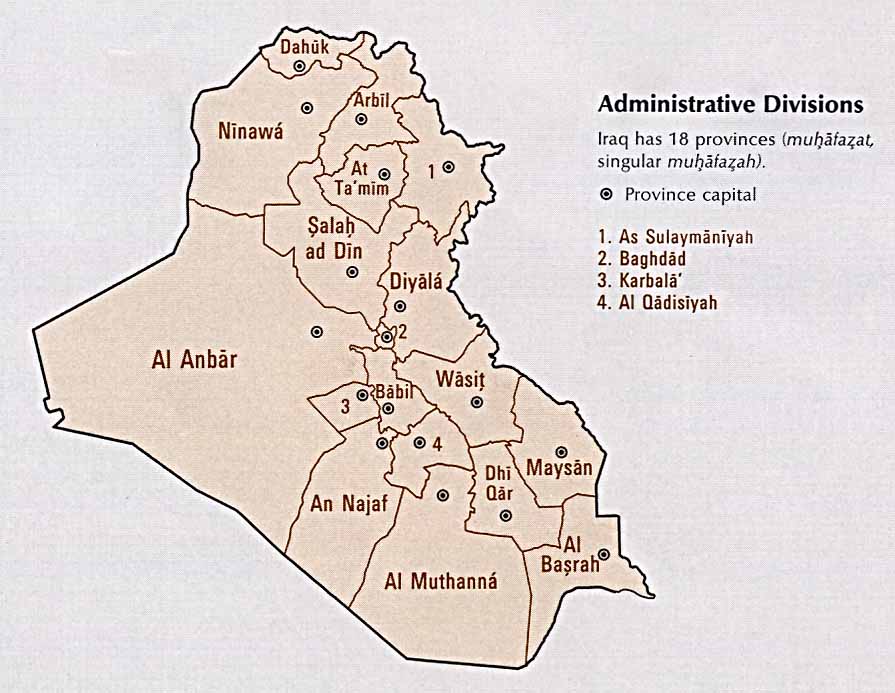
One of the major problems with the Iraqi government is its inability to spend its budget effectively. The country’s eighteen provinces do much worse than the central government in Baghdad. The new Special Inspector General for Iraq Reconstruction’s quarterly report to Congress has the latest numbers on how Iraq’s governorates have done up to October 13, 2009.
Ninewa has spent none of its $236 million budget, probably due to the political disputes between the ruling Al-Hadbaa party and the Kurdish Ninewa Fraternal List, that are boycotting the provincial council. Anbar did the best, spending 70% of its $112 million budget. The new local government there, led by Sheikh Ahmed Abu Risha’s Awakening of Iraq party and Governor Qasim Abed al-Fahadawi, has focused upon developing Anbar and investing in its future.
As reported before, these aggregate numbers show only part of the picture. Almost all of these expenditures are going towards old projects initiated by the previous governments, before the 2009 elections when Iraq was flush with money. Almost every province, has reported a budget deficit this year as a result. Some councils have also not been good at spending their money, such as Maysan that expended 79% its money in 2008, but which went to only 41 of 241 projects. With security improving, Iraqis are increasingly calling for better services, which require that the governorates do a much better job with their finances. A top down, Soviet style management system, a paper based bureaucracy, corruption, and other factors are all reasons why the provinces have not been able to do a better job so far.
Provincial Budgets/% Expended
Anbar $112 mil/70%
Tamim $99 mil/55%
Qadisiyah $86 mil/54%
Dhi Qar $143 mil/48%
Babil $134 mil/41%
Wasit $91 mil/40%
Maysan $80 mil/37%
Baghdad $551 mil/33%
Najaf $93 mil/32%
Karbala $78 mil/29%
Muthanna $56 mil/28%
Basra $201 mil/25%
Diyala $104 mil/23%
Salahaddin $97 mil/17%
Ninewa $236 mil/0%
Kurdistan N/A/N/A
SOURCES
Dagher, Sam, “In Anbar Province, New Leadership, but Old Problems Persist,” New York Times, 9/13/09
Special Inspector General for Iraq Reconstruction, “Quarterly Report to the United States Congress,” 10/30/09
Friday, October 30, 2009


Thursday, October 29, 2009
Kurdish Leadership Attempts To Rally Opposition Behind Kirkuk-Election Law Dispute
As Iraq’s parliament met today, a new election law wasn’t even on the agenda. The Kurdish Alliance boycotted the session denying the legislature the quorum necessary for a discussion. Sunday, November 1, 2009 is the new deadline to hold a vote, but no one is holding their breath.
The most recent breakdown occurred when the Kurdish Alliance objected to the Political Council for National Security’s proposal to use the 2004 voter roles for the balloting in Tamim, the home of Kirkuk. The idea was to use the voter lists that were compiled before large numbers of Kurds moved to the city after the 2003 U.S. invasion. The Kurdish parties claim these people were simply returning to the homes they lost under Saddam, while many Arab and Turkmen residents claim that far more have moved to the province then were expelled, believing it to be a move by Kurdistan to create facts on the ground to legitimize their desire to annex Kirkuk. The Kurdish Alliance demands that Tamim use the 2009 voter roles, and be treated just like any other governorate, with no special qualifications. A Kurdish parliamentarian went as far as threatening a veto by Iraqi President Jalal Talabani of any bill that treats Kirkuk differently.
The two ruling parties in the Kurdistan Regional Government (KRG), the Patriotic Union of Kurdistan (PUK) and the Kurdistan Democratic Party (KDP) are trying to rally the Kurdish opposition behind them over this controversy. All the major Kurdish parties did hold a meeting where they all agreed to have a united stance on Kirkuk and the election law. The PUK and KDP took it a step further saying that since there were still so many disputes with Baghdad that all the Kurds needed to stand together in a united list in the 2010 elections. The two major opposition groups, the Change List and the Kurdistan Islamic Union, however refused to go along, saying that the PUK and KDP would monopolize any gains made by a united front. The ruling parties have been known to use Kirkuk before to rally Kurds behind them, while ignoring their own shortcomings in the KRG. The two parties are known for cronyism, corruption, and clamping down on dissent, all of which led to the Change List winning 25 seats in the Kurdish parliament in the 2009 KRG elections, the most ever for an opposition group. Since then, the ruling parties have been trying to co-opt and intimidate Change and others. The PUK and KDP won a small victory in getting the Change List and the Islamic Union to agree with them on the election law, but they still haven’t been able to bring them under their sway.
SOURCES
Abdul-Zahra, Qassim, “Kurd leader demands control of oil-rich Kirkuk,” Associated Press, 10/27/09
Agence France Presse, “Iraq MPs fail to reach quorum for election law vote,” 10/29/09
Alsumaria, “Kurdistan leader calls for Kirkuk elections,” 10/29/09
Aswat al-Iraq, “Parliament’s agenda without election law,” 10/29/09
Chon, Gina, “Kurds Plan to Boycott Iraqi Vote On Kirkuk,” Wall Street Journal, 10/29/09
Hamad, Qassim Khidhir, “kurds seek unity in struggle with baghdad,” Niqash, 10/29/09
Visser, Reidar, “The IHEC Invents New Problems,” Iraq and Gulf Analysis, 10/29/09
The most recent breakdown occurred when the Kurdish Alliance objected to the Political Council for National Security’s proposal to use the 2004 voter roles for the balloting in Tamim, the home of Kirkuk. The idea was to use the voter lists that were compiled before large numbers of Kurds moved to the city after the 2003 U.S. invasion. The Kurdish parties claim these people were simply returning to the homes they lost under Saddam, while many Arab and Turkmen residents claim that far more have moved to the province then were expelled, believing it to be a move by Kurdistan to create facts on the ground to legitimize their desire to annex Kirkuk. The Kurdish Alliance demands that Tamim use the 2009 voter roles, and be treated just like any other governorate, with no special qualifications. A Kurdish parliamentarian went as far as threatening a veto by Iraqi President Jalal Talabani of any bill that treats Kirkuk differently.
The two ruling parties in the Kurdistan Regional Government (KRG), the Patriotic Union of Kurdistan (PUK) and the Kurdistan Democratic Party (KDP) are trying to rally the Kurdish opposition behind them over this controversy. All the major Kurdish parties did hold a meeting where they all agreed to have a united stance on Kirkuk and the election law. The PUK and KDP took it a step further saying that since there were still so many disputes with Baghdad that all the Kurds needed to stand together in a united list in the 2010 elections. The two major opposition groups, the Change List and the Kurdistan Islamic Union, however refused to go along, saying that the PUK and KDP would monopolize any gains made by a united front. The ruling parties have been known to use Kirkuk before to rally Kurds behind them, while ignoring their own shortcomings in the KRG. The two parties are known for cronyism, corruption, and clamping down on dissent, all of which led to the Change List winning 25 seats in the Kurdish parliament in the 2009 KRG elections, the most ever for an opposition group. Since then, the ruling parties have been trying to co-opt and intimidate Change and others. The PUK and KDP won a small victory in getting the Change List and the Islamic Union to agree with them on the election law, but they still haven’t been able to bring them under their sway.
SOURCES
Abdul-Zahra, Qassim, “Kurd leader demands control of oil-rich Kirkuk,” Associated Press, 10/27/09
Agence France Presse, “Iraq MPs fail to reach quorum for election law vote,” 10/29/09
Alsumaria, “Kurdistan leader calls for Kirkuk elections,” 10/29/09
Aswat al-Iraq, “Parliament’s agenda without election law,” 10/29/09
Chon, Gina, “Kurds Plan to Boycott Iraqi Vote On Kirkuk,” Wall Street Journal, 10/29/09
Hamad, Qassim Khidhir, “kurds seek unity in struggle with baghdad,” Niqash, 10/29/09
Visser, Reidar, “The IHEC Invents New Problems,” Iraq and Gulf Analysis, 10/29/09
Wednesday, October 28, 2009
Iraq’s Continued Attempts To Develop Its Oil Industry
In June 2009, Iraq held its first round of international bidding on its oil fields. Out of six oil and two natural gas fields, only one, Rumaila in Basra tendered a winning bid. The Iraqi Oil Ministry was widely criticized as a result, with many believing they set unrealistic terms for oil companies, and simply expected the country’s large potential to draw in investors. Since then Baghdad has tried to finalize the Rumaila deal and negotiate new ones.
First, in October 2009 the Iraqi cabinet approved the bid for the Rumaila field, made by British Petroleum (BP) and the Chinese National Petroleum Corporation (CNPC). Rumaila currently produces 1 million barrels a day, the largest amount of any field in Iraq. BP-CNPC has agreed to increase production to 2.85 million a day, while getting paid $2 for each extra barrel. This will be done through a joint venture with the state-run South Oil Company holding 25%, BP holding 38%, and CNPC with 37%.
The Oil Ministry has also okayed two new deals for the Nasiriyah field in Dhi Qar, and the Zubayr field in Basra. A Japanese led consortium of Nippon Oil, Inpex, and JGC Corporation won the bid for Nasiriyah, beating out another group headed by Italy’s Eni. Nasiriyah has 4.4 billion barrels in reserves, but only produces 20,000 barrels a day. The Japanese companies have pledged to boost production to 100,000 barrels within 18 months, and to 150,000-200,000 in two years. Eni ended up getting the Zubayr field contract. It currently produces 227,000 barrels a day, and Eni promised to increase that to 1.125 million barrels in six years. Eni originally bid on the field in the June round, but the Oil Ministry turned down their offer.
Iraq desperately needs foreign companies to develop its oil fields. Years of sanctions and wars, have deprived the industry of new equipment, maintenance, and know how. Its infrastructure is also breaking down, and lacks the necessary pipelines, and storage and port facilities to handle any large increase in production. The oil firms are expected to invest in these, as well as training for Iraqis. For its part, the Oil Ministry has also begun to change some of its terms after the first bidding round flopped. It’s been reported that the taxes on foreign corporations have been cut for example, as one positive step. Iraq is also allowing the businesses to own a larger share of the joint ventures, as in the Rumaila deal where Iraq will only have 25%.
Things are far from settled however, with Iraq’s oil. The Oil Minister remains under attack from parliament, members of his own ministry, and the Kurds. Oil exports continue to fluctuate up and down. There are major problems with the Ministry’s accounting and metering systems, as well as corruption. Iraq has also failed to pass a new petroleum law. Because there is so much excess crude and other reserves right now, companies may not be as eager to invest in Iraq as before. All of these factors mean that new oil deals are more important to Iraq than to the oil conglomerates, so the Oil Ministry has to carefully construct its policy to appease both a strong nationalist trend in Iraq that is weary of foreign exploitation, and appeals to those same companies. This is something that the Ministry has been largely incapable of performing so far.
SOURCES
Agence France Presse, “ENI-led group agrees deal for Iraq’s Zubair oilfield,” 10/13/09
Lando, Ben, “Nippon consortium wins Nassiriya,” Iraq Oil Report, 10/20/09
Reuters, “Eni to think twice on Iraq’s Nassiriya field – CEO,” 10/15/09
Salaheddin, Sinan, “Iraqi Cabinet approves BP-led consortium contract to develop Rumaila oil field, spokesman says,” Associated Press, 10/17/09
Webb, Simon, “UPDATE 1-Lower taxes lure big oil Iraq oilfield deals,” Reuters, 10/14/09
Williams, Timothy, “As Iraq Seeks Oil Investors, They See an Uncertain Bet,” New York Times, 10/14/09
First, in October 2009 the Iraqi cabinet approved the bid for the Rumaila field, made by British Petroleum (BP) and the Chinese National Petroleum Corporation (CNPC). Rumaila currently produces 1 million barrels a day, the largest amount of any field in Iraq. BP-CNPC has agreed to increase production to 2.85 million a day, while getting paid $2 for each extra barrel. This will be done through a joint venture with the state-run South Oil Company holding 25%, BP holding 38%, and CNPC with 37%.
The Oil Ministry has also okayed two new deals for the Nasiriyah field in Dhi Qar, and the Zubayr field in Basra. A Japanese led consortium of Nippon Oil, Inpex, and JGC Corporation won the bid for Nasiriyah, beating out another group headed by Italy’s Eni. Nasiriyah has 4.4 billion barrels in reserves, but only produces 20,000 barrels a day. The Japanese companies have pledged to boost production to 100,000 barrels within 18 months, and to 150,000-200,000 in two years. Eni ended up getting the Zubayr field contract. It currently produces 227,000 barrels a day, and Eni promised to increase that to 1.125 million barrels in six years. Eni originally bid on the field in the June round, but the Oil Ministry turned down their offer.
Iraq desperately needs foreign companies to develop its oil fields. Years of sanctions and wars, have deprived the industry of new equipment, maintenance, and know how. Its infrastructure is also breaking down, and lacks the necessary pipelines, and storage and port facilities to handle any large increase in production. The oil firms are expected to invest in these, as well as training for Iraqis. For its part, the Oil Ministry has also begun to change some of its terms after the first bidding round flopped. It’s been reported that the taxes on foreign corporations have been cut for example, as one positive step. Iraq is also allowing the businesses to own a larger share of the joint ventures, as in the Rumaila deal where Iraq will only have 25%.
Things are far from settled however, with Iraq’s oil. The Oil Minister remains under attack from parliament, members of his own ministry, and the Kurds. Oil exports continue to fluctuate up and down. There are major problems with the Ministry’s accounting and metering systems, as well as corruption. Iraq has also failed to pass a new petroleum law. Because there is so much excess crude and other reserves right now, companies may not be as eager to invest in Iraq as before. All of these factors mean that new oil deals are more important to Iraq than to the oil conglomerates, so the Oil Ministry has to carefully construct its policy to appease both a strong nationalist trend in Iraq that is weary of foreign exploitation, and appeals to those same companies. This is something that the Ministry has been largely incapable of performing so far.
SOURCES
Agence France Presse, “ENI-led group agrees deal for Iraq’s Zubair oilfield,” 10/13/09
Lando, Ben, “Nippon consortium wins Nassiriya,” Iraq Oil Report, 10/20/09
Reuters, “Eni to think twice on Iraq’s Nassiriya field – CEO,” 10/15/09
Salaheddin, Sinan, “Iraqi Cabinet approves BP-led consortium contract to develop Rumaila oil field, spokesman says,” Associated Press, 10/17/09
Webb, Simon, “UPDATE 1-Lower taxes lure big oil Iraq oilfield deals,” Reuters, 10/14/09
Williams, Timothy, “As Iraq Seeks Oil Investors, They See an Uncertain Bet,” New York Times, 10/14/09
Tuesday, October 27, 2009
Proposals For 2010 Election Law Go To Parliament
The plans for the 2010 parliamentary election law crafted by the Political Council for National Security are being sent to the legislature today, October 27, 2009. The proposals are for Iraq to use an open list that allows voters to select individual candidates or lists, to use the 2004 election roles, and to divide Tamim province into two voting districts. The first district will be for those that voted in the January 2005 election, and the second will be for those that registered afterward. A source told Alsumaria TV that the major Arab, Kurdish, and Turkmen parties had agreed to these plans. That is especially important if true, because on October 26, a lawmaker from the Kurdish Alliance said that they would boycott any vote on an election law that gave Tamim special status. Now it’s up to parliament to actually hold a vote on the bill. There is still plenty of speculation that some major parties want to delay that for as long as possible, because the Iraqi Election Commission has said that it will impose the old 2005 voter law that included a closed list if the legislature can’t come to a consensus. In a closed list the public can only vote for alliances, and not individuals. That tends to favor the large groupings.
SOURCES
AK News, “Kurds to boycott votes on proposals over Kirkuk status,” 10/26/09
Alsumaria, “Parliament discusses Kirkuk proposal,” 10/27/09
SOURCES
AK News, “Kurds to boycott votes on proposals over Kirkuk status,” 10/26/09
Alsumaria, “Parliament discusses Kirkuk proposal,” 10/27/09
Monday, October 26, 2009
Council Comes Up With Ideas On Iraq Election Law, But What’s Next?
Iraq’s parliament had until October 15, 2009 to pass a new election law for the 2010 parliamentary elections. As reported before, that date came and went with nothing happening. The legislature gave itself another deadline, and that too went nowhere. Eventually the Political Council on National Security was given the task of coming up with a new bill. The Council is made up of the Presidential Council, Prime Minister Nouri al-Maliki and his deputies, the speaker of parliament and his deputies, the chairman of the Supreme Judicial Council, the president of the Kurdistan Regional Government, and members of the major political blocs that have over 10 seats in parliament. They held their first session on October 24. Despite this drawn out process, the Council seems to have made a breakthrough.
The main issue holding up the election law now is how to conduct voting in Tamim province, the home to the disputed city of Kirkuk. The Kurdish leadership says that Tamim should vote as a regular province, since they are the largest group there. It would both increase their representation in parliament, and help with their claims to annex Kirkuk. The Arabs and Turkmen in the province call for quotas to equally divide power amongst themselves and the Kurds, to maintain their position.
The cause of the dispute is the demographic changes that have occurred in the province since 2003. Immediately after the invasion, the Kurds began moving their people into Kirkuk, claiming that they had been forced out under Saddam. That led to fighting between the major communities, and the growth of the insurgency in Tamim. The Arabs and Turkmen say that the number of Kurds that have migrated to the city now far outnumber those that might have been displaced by the former regime.
The Political Council has now come up with three plans for dealing with voting in the province. One plan is to use the old 2004 voter roles that were compiled for the January 2005 elections. A Turkmen politician from Tamim originally proposed this plan in early October 2009. The second idea is for the province to be divided into two districts, one for people that live in Tamim, and the other for those that have just registered. The second group would be used to determine national seats that are given out after the vote to parties that do well nationally, but not enough to gain seats in a specific province. 10-20% of the seats in parliament are given out in this manner. The final proposal is for voting in Tamim to be delayed until the voter roles have been reviewed. All 3 plans avoid treating Tamim as is, which would automatically benefit the Kurds, and increase tensions with the other groups. At the same time, they do not lead to the ethnic division of the province as called for by the Arabs and Turkmen.
The question now is what comes next? Reidar Visser reports that these packages are either to be put together by President Jalal Talabani for parliament to vote on them, or more committees are to be formed to go over each idea. The former would obviously be the quickest way towards ending the delay in a new election law, while the latter will simply drag out the process even more. The Iraqi Election Commission said that they need 90 days to prepare for any balloting, so the more arguments and debates, the less likely Iraq will have elections on schedule, which are set for January 16, 2010. Iraq’s politicians need to think about whether they want to maintain the status quo in Tamim, which might mean having no voting there at all as happened during the 2009 provincials, or whether they want to allow the province to elect representatives. Iraq’s leaders have not been able to separate the need to govern Tamim, with its ultimate fate, so there’s no telling whether these three proposals will solve the election law problem or not.
SOURCES
Alsumaria, “Iraq Council submits 3 proposals over Kirkuk,” 10/26/09
- “Kurdish parties call for elections in Kirkuk,” 10/23/09
AK News, “Arabs, Turkomans seek disfranchise Kurds,” 10/11/09
Aswat al-Iraq, “Political Council for National Security’s meting on election law begins – source,” 10/25/09
- “Turkmen MP calls for using 2004 voters’ records in Kirkuk election,” 10/9/09
- “Urgent/Parliament agrees to send election law to national security council,” 10/21/09
Chon, Gina, “Iraqis Miss Target Date on Election,” Wall Street Journal, 10/16/09
Murphy, Brian, “Trouble for Iraqi elections brewing in oil hub,” Associated Press, 10/1/09
PBS Frontline, “Interview Col. William Mayville,” Beyond Baghdad, 2/12/04
Roads To Iraq, “More deadlocks to come,” 10/21/09
Visser, Reidar, “More Alternatives for Kirkuk Emerge,” Iraq and Gulf Analysis, 10/26/09
The main issue holding up the election law now is how to conduct voting in Tamim province, the home to the disputed city of Kirkuk. The Kurdish leadership says that Tamim should vote as a regular province, since they are the largest group there. It would both increase their representation in parliament, and help with their claims to annex Kirkuk. The Arabs and Turkmen in the province call for quotas to equally divide power amongst themselves and the Kurds, to maintain their position.
The cause of the dispute is the demographic changes that have occurred in the province since 2003. Immediately after the invasion, the Kurds began moving their people into Kirkuk, claiming that they had been forced out under Saddam. That led to fighting between the major communities, and the growth of the insurgency in Tamim. The Arabs and Turkmen say that the number of Kurds that have migrated to the city now far outnumber those that might have been displaced by the former regime.
The Political Council has now come up with three plans for dealing with voting in the province. One plan is to use the old 2004 voter roles that were compiled for the January 2005 elections. A Turkmen politician from Tamim originally proposed this plan in early October 2009. The second idea is for the province to be divided into two districts, one for people that live in Tamim, and the other for those that have just registered. The second group would be used to determine national seats that are given out after the vote to parties that do well nationally, but not enough to gain seats in a specific province. 10-20% of the seats in parliament are given out in this manner. The final proposal is for voting in Tamim to be delayed until the voter roles have been reviewed. All 3 plans avoid treating Tamim as is, which would automatically benefit the Kurds, and increase tensions with the other groups. At the same time, they do not lead to the ethnic division of the province as called for by the Arabs and Turkmen.
The question now is what comes next? Reidar Visser reports that these packages are either to be put together by President Jalal Talabani for parliament to vote on them, or more committees are to be formed to go over each idea. The former would obviously be the quickest way towards ending the delay in a new election law, while the latter will simply drag out the process even more. The Iraqi Election Commission said that they need 90 days to prepare for any balloting, so the more arguments and debates, the less likely Iraq will have elections on schedule, which are set for January 16, 2010. Iraq’s politicians need to think about whether they want to maintain the status quo in Tamim, which might mean having no voting there at all as happened during the 2009 provincials, or whether they want to allow the province to elect representatives. Iraq’s leaders have not been able to separate the need to govern Tamim, with its ultimate fate, so there’s no telling whether these three proposals will solve the election law problem or not.
SOURCES
Alsumaria, “Iraq Council submits 3 proposals over Kirkuk,” 10/26/09
- “Kurdish parties call for elections in Kirkuk,” 10/23/09
AK News, “Arabs, Turkomans seek disfranchise Kurds,” 10/11/09
Aswat al-Iraq, “Political Council for National Security’s meting on election law begins – source,” 10/25/09
- “Turkmen MP calls for using 2004 voters’ records in Kirkuk election,” 10/9/09
- “Urgent/Parliament agrees to send election law to national security council,” 10/21/09
Chon, Gina, “Iraqis Miss Target Date on Election,” Wall Street Journal, 10/16/09
Murphy, Brian, “Trouble for Iraqi elections brewing in oil hub,” Associated Press, 10/1/09
PBS Frontline, “Interview Col. William Mayville,” Beyond Baghdad, 2/12/04
Roads To Iraq, “More deadlocks to come,” 10/21/09
Visser, Reidar, “More Alternatives for Kirkuk Emerge,” Iraq and Gulf Analysis, 10/26/09
Sunday, October 25, 2009
Baghdad Bombing Follows Trend In Violence In Iraq
Today’s devastating bombing on the Justice and Municipalities Ministries, and the Baghdad provincial council building in the capital follows the current trend in Iraqi violence. Since April 2009, the number of deaths has fluctuated up and down each month. According to Iraq’s ministries for example, there were 355 deaths in April, 165 in May, 438 in June, 275 in July, 456 in August, and 203 in September. The other major sources on Iraqi casualties (Iraq Body Count, icasualties, the Brookings Institute, and the Associated Press) all record the same pattern. One could predict then, that October 2009 would see an increase in casualties. Already there have been 214 deaths due to mass casualty bombings this month, 135 from today’s bombing alone. Monthly deaths are still at their lowest levels since the 2003 U.S. invasion.
The ebb and flow of violence shows the relative weakness of militants. They are only able to launch large attacks every other month. This month does show their increasing ability to carry out headline grabbing bombings however, in their attempt to destabilize the government, just as they did in August when they bombed the Finance and Foreign Ministries. That incident along with today’s undermine Prime Minister Nouri al-Maliki’s claim that he has brought security to Iraq, which might hurt his re-election campaign in the 2010 vote.
It’s also important to remember not to track overall security in Iraq based upon such bombings. There is no direct correlation between such attacks and overall security incidents in Iraq or casualties. In June 2009 for instance, there were 14 mass casualty bombings resulting in 174 deaths. For July there were 35 such attacks and 180 casualties, yet June had more deaths overall than July. According to the latest statistics released by the U.S. military, the number of overall security incidents in Iraq has also stayed pretty much steady since March 2009 at just about 200 per week. Overall, casualties in Iraq are still at unacceptable levels, but they are nowhere near as bad as they were during the sectarian war.
SOURCES
Al-Anbari, Bassim, “Triple attacks kill 19 in western Iraqi city,” Associated Press, 10/12/09
Associated Press, “Police: Suicide bomber kills 11 at mosque,” 10/16/09
- “Suicide bomb kills 6 at funeral,” 10/6/09
Aswat al-Iraq, “10 civilians wounded in Babel blast,” 10/4/09
- “Blast kills 1, wounds 9 north of Hilla,” 10/18/09
- “Sticky bomb kills 2 women, injures 12 persons in Babel,” 10/21/09
- “Suicide attack leaves 16 casualties in Diala,” 10/13/09
Bernama, “Civilian Killed, 10 Injured In Bomb Attack In Baghdad Snack Restaurant,” 10/19/09
Cordesman, Anthony, "Recent Trends in the Iraq War: Maps and Graphs," Center for Strategic and International Studies, 10/1/09
DPA, “Four policemen killed in Iraq,” 10/17/09
Hammoudi, Laith, “Round-up of Daily Violence in Iraq – Sunday 18 October 2009,” McClatchy Newspapers, 10/18/09
Issa, Sahar, “Round-up of Daily Violence in Iraq – Thursday 8 October 2009,” McClatchy Newspapers, 10/8/09
ITN, “Clear up after Iraq minibus bombing,” 10/7/09
Kimball, Jack, “Attacks kill 11, wound over 50 people,” Reuters, 10/15/09
McClatchy Newspapers, “Car bombs explode in Baghdad, killing at least 135 people,” 10/25/09
Reuters, “FACTBOX-Security developments in Iraq, Oct 11,” 10/11/09
- “FACTBOX-Security developments in Iraq, Oct 18,” 10/18/09
Shadid, Anthony, “Scores killed, at least 500 wounded in bomb attacks in Baghdad,” 10/25/09
Surk, Barbara, “Bombs kill 6 around Iraq,” Associated Press, 10/20/09
Xinhua, “2 killed, 13 wounded in Baghdad bomb attack,” 10/18/09
- “12 people wounded in bomb explosion in south Baghdad,” 10/21/09
- “Bomb explosion kills 3 south of Baghdad,” 10/8/09
The ebb and flow of violence shows the relative weakness of militants. They are only able to launch large attacks every other month. This month does show their increasing ability to carry out headline grabbing bombings however, in their attempt to destabilize the government, just as they did in August when they bombed the Finance and Foreign Ministries. That incident along with today’s undermine Prime Minister Nouri al-Maliki’s claim that he has brought security to Iraq, which might hurt his re-election campaign in the 2010 vote.
It’s also important to remember not to track overall security in Iraq based upon such bombings. There is no direct correlation between such attacks and overall security incidents in Iraq or casualties. In June 2009 for instance, there were 14 mass casualty bombings resulting in 174 deaths. For July there were 35 such attacks and 180 casualties, yet June had more deaths overall than July. According to the latest statistics released by the U.S. military, the number of overall security incidents in Iraq has also stayed pretty much steady since March 2009 at just about 200 per week. Overall, casualties in Iraq are still at unacceptable levels, but they are nowhere near as bad as they were during the sectarian war.
SOURCES
Al-Anbari, Bassim, “Triple attacks kill 19 in western Iraqi city,” Associated Press, 10/12/09
Associated Press, “Police: Suicide bomber kills 11 at mosque,” 10/16/09
- “Suicide bomb kills 6 at funeral,” 10/6/09
Aswat al-Iraq, “10 civilians wounded in Babel blast,” 10/4/09
- “Blast kills 1, wounds 9 north of Hilla,” 10/18/09
- “Sticky bomb kills 2 women, injures 12 persons in Babel,” 10/21/09
- “Suicide attack leaves 16 casualties in Diala,” 10/13/09
Bernama, “Civilian Killed, 10 Injured In Bomb Attack In Baghdad Snack Restaurant,” 10/19/09
Cordesman, Anthony, "Recent Trends in the Iraq War: Maps and Graphs," Center for Strategic and International Studies, 10/1/09
DPA, “Four policemen killed in Iraq,” 10/17/09
Hammoudi, Laith, “Round-up of Daily Violence in Iraq – Sunday 18 October 2009,” McClatchy Newspapers, 10/18/09
Issa, Sahar, “Round-up of Daily Violence in Iraq – Thursday 8 October 2009,” McClatchy Newspapers, 10/8/09
ITN, “Clear up after Iraq minibus bombing,” 10/7/09
Kimball, Jack, “Attacks kill 11, wound over 50 people,” Reuters, 10/15/09
McClatchy Newspapers, “Car bombs explode in Baghdad, killing at least 135 people,” 10/25/09
Reuters, “FACTBOX-Security developments in Iraq, Oct 11,” 10/11/09
- “FACTBOX-Security developments in Iraq, Oct 18,” 10/18/09
Shadid, Anthony, “Scores killed, at least 500 wounded in bomb attacks in Baghdad,” 10/25/09
Surk, Barbara, “Bombs kill 6 around Iraq,” Associated Press, 10/20/09
Xinhua, “2 killed, 13 wounded in Baghdad bomb attack,” 10/18/09
- “12 people wounded in bomb explosion in south Baghdad,” 10/21/09
- “Bomb explosion kills 3 south of Baghdad,” 10/8/09
Fund For Peace Finds Little Political, Social or Economic Progress In Iraq Despite Security Improvements
The Fund for Peace released its ninth report on Iraq in October 2009 entitled “A Viable Peace?” The group argues that the military gains of the Surge have not translated into sustainable political, economic, or social changes in Iraq that place the country on the road to peace and stability. The Fund believes that there’s still a chance to accomplish this in the future however.
The decline in deaths and violence was the major achievement of the Surge. Deaths are down to the hundreds today each month, when they were in the thousands during the sectarian war of 2006-2007. In January 2007 for example, Iraq Body Count recorded 2,806 deaths. By January 2008 that had dropped to 742, and 275 by January 2009. Despite this steady decline, the Fund does not think that Iraq is stable yet. It cites the United Nations and scholars who count 1,000 violent deaths per year as a sign of civil war, and Iraq still meets that criteria. The Iraq Body Count has found 3,567 deaths from January to September 2009, icasualties has 2,406 deaths, the Iraqi ministries have 2,593, and the Associated Press counts 2,880.
Even with so many casualties can Iraq be said to be moving towards a viable peace? That would mean the causes of violence have been reduced, the country is heading towards stability, and a tipping point has been reached. The Fund says no. It believes that there were positive steps taken during the Surge, but they were not enough. The Fund follows 12 criteria, and found progress in only half of them, with the rest either staying the same or getting worse. The group recorded improvements in external intervention, a state within a state, the criminalization of the state, uneven economic development, refuges/displacement, and demographic pressures due to events such as the impending U.S. withdrawal, Sadr’s cease-fire and the disbanding of the Mahdi Army, the 2009 provincial elections, and the return of refugees. Factors that have not improved are the legacy of vengeance and grievance with the lack of integration of the Sons of Iraq, Arab-Kurd tensions, and Shiite factionalism, human flight with many professionals still being refugees, economic decline with the reduction in oil prices, human rights with abuses by the security forces, deterioration of public services, and factionalized elites.
It also finds some pressing current issues. On the environmental and demographic front there is a three-year long drought, degradation of arable land, and two million refugees. Ninewa also remains unstable, and the status of Kirkuk has not been decided. The 2009 provincial elections also did not include the three governorates of Kurdistan and Tamim, nothing has been done to develop the economy or deal with corruption, and there has been a lack of reconciliation, and passage of some major legislation such as a new oil law.
The report does run into several serious problems. 1st it claims that sectarian tensions have increased since the Surge. That is definitely still an issue, but the political discourse in the country is changing due to Maliki embracing Iraqi nationalism, rather than religious identity, which is being taken up by more and more parties. Second, the Fund has bought into the claim that Prime Minister Nouri al-Maliki is an autocrat. While he has centralized power, he is far from an authoritarian, and isn’t even assured of being re-elected after the 2010 vote. Some of the group’s scores in their twelve criteria are also questionable. For example, the numbers for human flight and displacement/refugees have hardly changed, yet the process of return has begun with improved security. The overall scores are also much the same from when the country was wracked by sectarian war, the government barley functioned, militias and insurgents controlled territory, and Iraq was considered a failed state, to today where there are still large divisions, but the situation is not half as dire as before.
The Fund for Peace however, finishes well with its conclusion. With all of the problems it notes and the mixed picture in its twelve indicators, it believes that Iraq still has too many issues for it to have passed any tipping point yet. It does not think it’s too late though. Instead, it suggests that Baghdad needs to focus upon building institutions, working towards reconciliation, and creating a transparent system of government. Those are the things that the Fund suggests people look at when viewing Iraq, not simply reductions in violence. This redeems the report from its shortcomings in analyzing the difficulties currently besetting Iraq.
SOURCES
Fund for Peace, “A Viable Peace?” October 2009
The decline in deaths and violence was the major achievement of the Surge. Deaths are down to the hundreds today each month, when they were in the thousands during the sectarian war of 2006-2007. In January 2007 for example, Iraq Body Count recorded 2,806 deaths. By January 2008 that had dropped to 742, and 275 by January 2009. Despite this steady decline, the Fund does not think that Iraq is stable yet. It cites the United Nations and scholars who count 1,000 violent deaths per year as a sign of civil war, and Iraq still meets that criteria. The Iraq Body Count has found 3,567 deaths from January to September 2009, icasualties has 2,406 deaths, the Iraqi ministries have 2,593, and the Associated Press counts 2,880.
Even with so many casualties can Iraq be said to be moving towards a viable peace? That would mean the causes of violence have been reduced, the country is heading towards stability, and a tipping point has been reached. The Fund says no. It believes that there were positive steps taken during the Surge, but they were not enough. The Fund follows 12 criteria, and found progress in only half of them, with the rest either staying the same or getting worse. The group recorded improvements in external intervention, a state within a state, the criminalization of the state, uneven economic development, refuges/displacement, and demographic pressures due to events such as the impending U.S. withdrawal, Sadr’s cease-fire and the disbanding of the Mahdi Army, the 2009 provincial elections, and the return of refugees. Factors that have not improved are the legacy of vengeance and grievance with the lack of integration of the Sons of Iraq, Arab-Kurd tensions, and Shiite factionalism, human flight with many professionals still being refugees, economic decline with the reduction in oil prices, human rights with abuses by the security forces, deterioration of public services, and factionalized elites.
It also finds some pressing current issues. On the environmental and demographic front there is a three-year long drought, degradation of arable land, and two million refugees. Ninewa also remains unstable, and the status of Kirkuk has not been decided. The 2009 provincial elections also did not include the three governorates of Kurdistan and Tamim, nothing has been done to develop the economy or deal with corruption, and there has been a lack of reconciliation, and passage of some major legislation such as a new oil law.
The report does run into several serious problems. 1st it claims that sectarian tensions have increased since the Surge. That is definitely still an issue, but the political discourse in the country is changing due to Maliki embracing Iraqi nationalism, rather than religious identity, which is being taken up by more and more parties. Second, the Fund has bought into the claim that Prime Minister Nouri al-Maliki is an autocrat. While he has centralized power, he is far from an authoritarian, and isn’t even assured of being re-elected after the 2010 vote. Some of the group’s scores in their twelve criteria are also questionable. For example, the numbers for human flight and displacement/refugees have hardly changed, yet the process of return has begun with improved security. The overall scores are also much the same from when the country was wracked by sectarian war, the government barley functioned, militias and insurgents controlled territory, and Iraq was considered a failed state, to today where there are still large divisions, but the situation is not half as dire as before.
The Fund for Peace however, finishes well with its conclusion. With all of the problems it notes and the mixed picture in its twelve indicators, it believes that Iraq still has too many issues for it to have passed any tipping point yet. It does not think it’s too late though. Instead, it suggests that Baghdad needs to focus upon building institutions, working towards reconciliation, and creating a transparent system of government. Those are the things that the Fund suggests people look at when viewing Iraq, not simply reductions in violence. This redeems the report from its shortcomings in analyzing the difficulties currently besetting Iraq.
SOURCES
Fund for Peace, “A Viable Peace?” October 2009
Friday, October 23, 2009
The Sadrist Primaries
On October 15, 2009, the Sadrist movement held the very first primary election in Iraq’s post-Saddam era history. While the group hailed it as a step towards democracy, it was more a way to rally and gauge support before the 2010 parliamentary elections.
670 candidates ran for 50 positions. Voting was held in approximately 350 centers in thirteen of Iraq’s eighteen provinces, excluding the three in Kurdistan, Anbar, and Ninewa. Anyone could run as long as they met an age and background requirement. The Sadrists claimed 1.5 million people participated, but the day before a spokesman said that only 250,000 had registered. There were also no voter roles to check the balloting against.
As reported before, the Sadrists had a very mixed showing in the 2009 provincial elections. They did badly in Sadr City and Basra, two of their strongholds, lost control of Maysan province, and received a lower percentage of votes compared to 2005. At the same time, they gained representation across almost four times as many governorates as before, and joined the governing councils in Babil, Dhi Qar, Karbala, got the governorship of Babil, and the head of the council there and in Karbala.
Since then the Sadrists have joined the new Iraqi National Alliance. The List also includes former Prime Minister Ibrahim al-Jaafari’s National Reform Party, and the Sadrists’ archrival the Supreme Islamic Iraqi Council (SIIC). Working with the SIIC was probably due to the influence of Iran, which played a leading role in putting the coalition together, and a realization by Moqtada al-Sadr that he cannot go it alone, like his followers did in 2009. The National Alliance however, lacks any ideological consistently, other than being Shiite, and opposed to Prime Minister Nouri al-Maliki.
The primaries were a preliminary move before the actual 2010 vote. It helped gauge how much support they had, rallied the faithful, and gave their candidates the air of popular support. This is all part of the Sadrists’ new strategy of focusing upon politics and society. Sadr is gambling that by running with the National Alliance, he can gain more seats in parliament, and help put together a new ruling coalition, which would give him control of ministries. In 2006 he withdrew from the government, and lost all of his cabinet positions. It’s unclear how the Alliance will do however, especially since it is a deeply flawed list to begin with. It’s also not clear whether this will be a successful approach overall. Sadr always held large sway with the Shiite street through his anti-establishment militancy, and armed opposition to the U.S. presence. Now he is attempting to give much of that up and rejoin the mainstream, as he tried to do after the 2005 elections. That had mixed results as many of his supporters are opposed to the government, and there’s no telling whether this will do any better.
SOURCES
Faraj, Salam, “Sadrists choose candidates for Iraqi poll,” Agence France Presse, 10/16/09
Hussein, Jenan and Al Dulaimy, Mohammad, “An Iraqi primary election draws crowds but lacks safeguards,” McClatchy Newspapers, 10/16/09
Raghavan, Sudarsan, “Sadr Casts a Shadow Over Bush-Maliki Meeting,” Washington Post, 11/30/06
Sullivan, Marisa Cochrane, “Iraq’s Parliamentary Election,” Institute for the Study of War, 10/21/09
670 candidates ran for 50 positions. Voting was held in approximately 350 centers in thirteen of Iraq’s eighteen provinces, excluding the three in Kurdistan, Anbar, and Ninewa. Anyone could run as long as they met an age and background requirement. The Sadrists claimed 1.5 million people participated, but the day before a spokesman said that only 250,000 had registered. There were also no voter roles to check the balloting against.
As reported before, the Sadrists had a very mixed showing in the 2009 provincial elections. They did badly in Sadr City and Basra, two of their strongholds, lost control of Maysan province, and received a lower percentage of votes compared to 2005. At the same time, they gained representation across almost four times as many governorates as before, and joined the governing councils in Babil, Dhi Qar, Karbala, got the governorship of Babil, and the head of the council there and in Karbala.
Since then the Sadrists have joined the new Iraqi National Alliance. The List also includes former Prime Minister Ibrahim al-Jaafari’s National Reform Party, and the Sadrists’ archrival the Supreme Islamic Iraqi Council (SIIC). Working with the SIIC was probably due to the influence of Iran, which played a leading role in putting the coalition together, and a realization by Moqtada al-Sadr that he cannot go it alone, like his followers did in 2009. The National Alliance however, lacks any ideological consistently, other than being Shiite, and opposed to Prime Minister Nouri al-Maliki.
The primaries were a preliminary move before the actual 2010 vote. It helped gauge how much support they had, rallied the faithful, and gave their candidates the air of popular support. This is all part of the Sadrists’ new strategy of focusing upon politics and society. Sadr is gambling that by running with the National Alliance, he can gain more seats in parliament, and help put together a new ruling coalition, which would give him control of ministries. In 2006 he withdrew from the government, and lost all of his cabinet positions. It’s unclear how the Alliance will do however, especially since it is a deeply flawed list to begin with. It’s also not clear whether this will be a successful approach overall. Sadr always held large sway with the Shiite street through his anti-establishment militancy, and armed opposition to the U.S. presence. Now he is attempting to give much of that up and rejoin the mainstream, as he tried to do after the 2005 elections. That had mixed results as many of his supporters are opposed to the government, and there’s no telling whether this will do any better.
SOURCES
Faraj, Salam, “Sadrists choose candidates for Iraqi poll,” Agence France Presse, 10/16/09
Hussein, Jenan and Al Dulaimy, Mohammad, “An Iraqi primary election draws crowds but lacks safeguards,” McClatchy Newspapers, 10/16/09
Raghavan, Sudarsan, “Sadr Casts a Shadow Over Bush-Maliki Meeting,” Washington Post, 11/30/06
Sullivan, Marisa Cochrane, “Iraq’s Parliamentary Election,” Institute for the Study of War, 10/21/09
Thursday, October 22, 2009
Iraq’s Budget Problems Will Continue Into Next Year
Iraq’s cabinet has passed a new preliminary 2010 budget. It stands at $67.29 billion, an $8.4 billion increase from 2009. Like previous budgets, the overwhelming majority of the spending will go towards operational costs. Of the $67 billion, 73%, $49.17 billion will be for salaries, pensions, etc. That leaves only $17.83 billion for the capital budget that goes towards development and infrastructure. That’s nowhere near what the country needs.
Just like the 2009 budget, it will also have a deficit. Iraq is currently running a $19 billion deficit, and the new budget is expected to be $15 billion short. The cabinet said that it will sell bonds and get loans from the International Monetary Fund (IMF) and World Bank to come up with the difference. That’s unlikely. This year, the Central Bank has only authorized the sale of $3 billion in bonds, and that went to paying for electrical projects with General Electric and Siemens. Baghdad however, is currently negotiating with the IMF for a $5.5 billion loan that will go to the budget. An official from the Central Bank said that he doubted whether the government could meet the IMF’s conditions. Already, Prime Minister Nouri al-Maliki said that he would not go along with cuts in government spending that the international group might ask for if it involved salaries.
The deficit is caused by several factors. For one there’s the expectations for Iraq’s oil industry, which provides almost all of the government’s revenue. The 2010 budget is based upon 2.15 million barrels of oil exports per day and a $60 price. The 2009 budget called for 2 million barrels at $50. It took months for Iraqi crude to reach $50, and Iraq has only achieved 2 million barrels for two months so far in 2009. While Iraq has recently signed some new oil deals, they are not expected to boost production for at least a year.
Another major factor is that the previous provincial and national governments signed dozens and dozens of development deals when the country was flowing in money. This has led almost every province to report a deficit this year.
Iraq has the resources to be a rich country. Years of wars and sanctions however, have left the country with little means to develop its oil industry, and the other sectors in the economy have declined. That makes Iraq increasingly dependent upon petroleum that is in turn, based upon the global economy. Until the rest of the world recovers from the current recession, it’s unlikely that Iraq will make enough to cover it’s basic costs, let alone have the money to invest in its infrastructure and diversify. That means Iraq will continue to run deficits, and will have to incur a new debt in the meantime.
SOURCES
Agence France Presse, “Iraq made ‘good progress’ in IMF loan talks: IMF,” 10/6/09
Dow Jones Newswire, “UPDATE: Iraq Cabinet OKs $67.29B 2010 Budget, To Issue Bonds,” 10/13/09
Reuters, “Iraq PM Says Cannot Cut Public Pay To Suit IMF,” 10/7/09
- “Q+A-Iraq’s oil contracts, scale and obstacles,” 10/16/09
Salaheddin, Sinan, “Iraq Cabinet approves $67 billion budget for 2010,” Associated Press, 10/14/09
Zawya, “Iraq Central Bank Opposes Issuing Treasury Bills To Finance Projects,” 9/27/09
Just like the 2009 budget, it will also have a deficit. Iraq is currently running a $19 billion deficit, and the new budget is expected to be $15 billion short. The cabinet said that it will sell bonds and get loans from the International Monetary Fund (IMF) and World Bank to come up with the difference. That’s unlikely. This year, the Central Bank has only authorized the sale of $3 billion in bonds, and that went to paying for electrical projects with General Electric and Siemens. Baghdad however, is currently negotiating with the IMF for a $5.5 billion loan that will go to the budget. An official from the Central Bank said that he doubted whether the government could meet the IMF’s conditions. Already, Prime Minister Nouri al-Maliki said that he would not go along with cuts in government spending that the international group might ask for if it involved salaries.
The deficit is caused by several factors. For one there’s the expectations for Iraq’s oil industry, which provides almost all of the government’s revenue. The 2010 budget is based upon 2.15 million barrels of oil exports per day and a $60 price. The 2009 budget called for 2 million barrels at $50. It took months for Iraqi crude to reach $50, and Iraq has only achieved 2 million barrels for two months so far in 2009. While Iraq has recently signed some new oil deals, they are not expected to boost production for at least a year.
Another major factor is that the previous provincial and national governments signed dozens and dozens of development deals when the country was flowing in money. This has led almost every province to report a deficit this year.
Iraq has the resources to be a rich country. Years of wars and sanctions however, have left the country with little means to develop its oil industry, and the other sectors in the economy have declined. That makes Iraq increasingly dependent upon petroleum that is in turn, based upon the global economy. Until the rest of the world recovers from the current recession, it’s unlikely that Iraq will make enough to cover it’s basic costs, let alone have the money to invest in its infrastructure and diversify. That means Iraq will continue to run deficits, and will have to incur a new debt in the meantime.
SOURCES
Agence France Presse, “Iraq made ‘good progress’ in IMF loan talks: IMF,” 10/6/09
Dow Jones Newswire, “UPDATE: Iraq Cabinet OKs $67.29B 2010 Budget, To Issue Bonds,” 10/13/09
Reuters, “Iraq PM Says Cannot Cut Public Pay To Suit IMF,” 10/7/09
- “Q+A-Iraq’s oil contracts, scale and obstacles,” 10/16/09
Salaheddin, Sinan, “Iraq Cabinet approves $67 billion budget for 2010,” Associated Press, 10/14/09
Zawya, “Iraq Central Bank Opposes Issuing Treasury Bills To Finance Projects,” 9/27/09
Wednesday, October 21, 2009
The Rising Crime Rate In Iraq
Iraq’s security situation has greatly improved since the height of the sectarian war. Now Iraqis are facing a new danger, rising crime. In fact, the two issues are linked as many blame former insurgents and militiamen for carrying out kidnappings, robberies, etc., as they have no other means to support themselves. Members of the security forces have also been implicated, pointing to the high levels of every day corruption that exists in the country.
Crime in Iraq takes many forms. One that is getting increasing press is kidnapping. Those occurred before, but they had political or sectarian overtones or were done to fund militant groups. Today they are increasingly for pure profit. As a sign of this change, children are becoming a favorite target. There are districts of Baghdad that are plastered with photos of missing kids. The Times of London reported in early October 2009 that the price for a kidnapped child can go as high as $100,000. Many families are said to negotiate with the criminals rather than go to the police.
High-profile robberies are also increasing. The most famous recent case was in July 2009 when members of a Vice President’s security detail held up the Rafidain Bank in Baghdad, stealing $4.8 million and killing 8 people. In August four men with IDs from the Interior Ministry robbed a bank in the capital, and in mid-October thieves held up three jewelry stores in Baghdad as well. In the latter case, 12-15 armed men got out of a minibus and robbed the businesses, while a checkpoint nearby did nothing. Six soldiers and an officer were subsequently arrested for failing to secure the area.
Smuggling is another major issue. This began during Saddam’s time, and has probably increased since then. One reason is because when the U.S. disbanded the Iraqi security forces in 2003 they did away with the border guards, which are only now getting attention. One major item stolen within Iraq and smuggled is oil. A December 2008 audit of the state-run North Oil Company found that 698,000 barrels of oil could be not accounted for, with crime being the major cause. This is another example of a trade that was begun by insurgents to pay for their operations, that is now done increasingly for personnel gain.
There is also a growing sex market for young Iraqi girls. There was a report in Time magazine in March 2009 that said tens of thousands of girls were believed to have been shipped off by criminal gangs to countries like Syria, Jordan, and the United Arab Emirates.
A military spokesman in Baghdad said that former militants and gangs are responsible for 60-70% of the crimes investigated in the capital. With the decline in insurgent, and especially Shiite militia and Special Group activities, and a bad labor market, there is little to do for many young men. That is probably the number one reason for the increase in criminal behavior. Iraq has set up a special task force to go after gangs following a series of jewel robberies in April 2009. On the other hand, the press reports that the authorities have blocked investigations of the sex trade. The high levels of corruption amongst the security forces might also undermine this work. It also shows that while security has improved, law and order has yet to be established in Iraq.
SOURCES
Abouzeid, Rania, “Iraq’s Unspeakable Crime: Mothers Pimping Daughters,” Time, 3/7/09
Bakri, Nada, “Eight Killed In Baghdad Jewel Heists,” Washington Post, 10/15/09
Denselow, James, “The thieves of Baghdad,” Guardian, 10/9/09
Kerbaj, Richard, “Child hostages offer quick way for Iraqi gangsters to make money,” Times of London, 10/7/09
Miller, Deborah, “Iraqis face new threat: brutal violence,” Cleveland Plain Dealer,” 9/21/09
Oppel, Richard, “Iraq’s Insurgency Runs on Stolen Oil Profits,” New York Times, 3/16/08
Williams, Timothy, “As Iraq Seeks Oil Investors, They See an Uncertain Bet,” New York Times, 10/14/09
Crime in Iraq takes many forms. One that is getting increasing press is kidnapping. Those occurred before, but they had political or sectarian overtones or were done to fund militant groups. Today they are increasingly for pure profit. As a sign of this change, children are becoming a favorite target. There are districts of Baghdad that are plastered with photos of missing kids. The Times of London reported in early October 2009 that the price for a kidnapped child can go as high as $100,000. Many families are said to negotiate with the criminals rather than go to the police.
High-profile robberies are also increasing. The most famous recent case was in July 2009 when members of a Vice President’s security detail held up the Rafidain Bank in Baghdad, stealing $4.8 million and killing 8 people. In August four men with IDs from the Interior Ministry robbed a bank in the capital, and in mid-October thieves held up three jewelry stores in Baghdad as well. In the latter case, 12-15 armed men got out of a minibus and robbed the businesses, while a checkpoint nearby did nothing. Six soldiers and an officer were subsequently arrested for failing to secure the area.
Smuggling is another major issue. This began during Saddam’s time, and has probably increased since then. One reason is because when the U.S. disbanded the Iraqi security forces in 2003 they did away with the border guards, which are only now getting attention. One major item stolen within Iraq and smuggled is oil. A December 2008 audit of the state-run North Oil Company found that 698,000 barrels of oil could be not accounted for, with crime being the major cause. This is another example of a trade that was begun by insurgents to pay for their operations, that is now done increasingly for personnel gain.
There is also a growing sex market for young Iraqi girls. There was a report in Time magazine in March 2009 that said tens of thousands of girls were believed to have been shipped off by criminal gangs to countries like Syria, Jordan, and the United Arab Emirates.
A military spokesman in Baghdad said that former militants and gangs are responsible for 60-70% of the crimes investigated in the capital. With the decline in insurgent, and especially Shiite militia and Special Group activities, and a bad labor market, there is little to do for many young men. That is probably the number one reason for the increase in criminal behavior. Iraq has set up a special task force to go after gangs following a series of jewel robberies in April 2009. On the other hand, the press reports that the authorities have blocked investigations of the sex trade. The high levels of corruption amongst the security forces might also undermine this work. It also shows that while security has improved, law and order has yet to be established in Iraq.
SOURCES
Abouzeid, Rania, “Iraq’s Unspeakable Crime: Mothers Pimping Daughters,” Time, 3/7/09
Bakri, Nada, “Eight Killed In Baghdad Jewel Heists,” Washington Post, 10/15/09
Denselow, James, “The thieves of Baghdad,” Guardian, 10/9/09
Kerbaj, Richard, “Child hostages offer quick way for Iraqi gangsters to make money,” Times of London, 10/7/09
Miller, Deborah, “Iraqis face new threat: brutal violence,” Cleveland Plain Dealer,” 9/21/09
Oppel, Richard, “Iraq’s Insurgency Runs on Stolen Oil Profits,” New York Times, 3/16/08
Williams, Timothy, “As Iraq Seeks Oil Investors, They See an Uncertain Bet,” New York Times, 10/14/09
Tuesday, October 20, 2009
Two Provinces Respond To The Drought
Basra in southern Iraq and Irbil in Kurdistan are responding to the drought in different ways. Basra wants to be declared a disaster area and is calling for immediate relief, while Irbil is thinking more long-term and trying to create a water policy.
 According to the United Nations, 46-56% of Irbil’s cropland has been hit by the drought. Many farmers in the north rely upon rain to grow their crops, and that has been down 33-50% from 2007 to 2008. As a result, Irbil’s crop production dropped 80% last year. In response, the Kurdistan Regional Government (KRG) is attempting to create its first water policy. Currently, residents of the region pay $1 for unlimited water use per month, with the rest subsidized by the KRG. A Swedish company was hired to install 100 water meters in one area of Irbil and found that Kurds use more water than many countries. The KRG now plans on installing 100,000 water meters by the end of the year to start regulating water use. This would be a first in the entire country.
 In Basra, not only has its farmland been hit by the drought, but its fresh water supply has as well. 6-25% of the province’s cropland has been affected by the drought. More important is the rising salinity levels, and the incursion of seawater inland. As a result, up to 5,000 villagers have left their land, and the governorate’s director of agriculture warned that farming might be wiped out. The situation is so bad that the local council has asked the province be declared a disaster area. Rather than move to conserve water like Irbil, Basra is in more of a crisis mode and thinking short-term. At the beginning of September 2009, the governor went to Baghdad to talk with Prime Minister Nouri al-Maliki who promised a $20 million project to build water pipes to Basra. That would obviously provide no immediate relief. For that the Ministry of Municipalities and Public Works initiated eight new water purification projects, and the province signed a deal with Iran to deliver 650,000 liters of drinking water every two days. On October 9, the first Iranian shipped docked in Basra’s harbor to deliver the water.
As reported before, Iraq’s drought is reaching disaster levels. Population growth, lack of rain, and no government water policy are the major causes. Iraq’s neighbors are also facing a drought, and they have built dams along many of the major waterways that flow into Iraq. The country’s crops and population have both been affected. Baghdad has still not come up with any real response even though the drought has lasted for two years. That has left the provinces to fend for themselves. Basra is looking short-term, while Irbil is taking the long view. Both approaches need to be considered and coordinated with the central government, but that is simply not happening even though conditions are getting worse.
SOURCES
Alsumaria, “Iran provides Iraq with drinking water,” 10/9/09
- “Will Basra be announced a disaster area?” 9/30/09
Aswat al-Iraq, “8 new water projects in Basra,” 9/26/09
- “Basra governor vows drinking water to all Basra,” 9/6/09
- “Official says Basra’s agriculture may be wiped out,” 8/26/09
Blua, Antoine, “Iraq Tussles With Neighbors Over Water,” Radio Free Europe/Radio Liberty, 9/13/09
Chulov, Martin, “Surge of seawater drives Iraqis from their homes in the south,” Guardian, 9/11/09
- “Water shortage threatens two million people in southern Iraq,” Guardian, 8/26/09
Hamad, Qassim Khidhir, “Kurdish authorities call for water restrictions,” Niqash, 10/8/09
United Nations Office for the Coordination of Humanitarian Affairs, “Iraq Humanitarian Update,” October 2008
Al-Wazzan, Saleem, “salt levels in shatt al-arab threaten environmental disaster,” Niqash, 9/2/09
Zavis, Alexandra, “First violence, now drought threatens Iraq farmers,” Los Angeles Times, 6/26/08
According to the United Nations, 46-56% of Irbil’s cropland has been hit by the drought. Many farmers in the north rely upon rain to grow their crops, and that has been down 33-50% from 2007 to 2008. As a result, Irbil’s crop production dropped 80% last year. In response, the Kurdistan Regional Government (KRG) is attempting to create its first water policy. Currently, residents of the region pay $1 for unlimited water use per month, with the rest subsidized by the KRG. A Swedish company was hired to install 100 water meters in one area of Irbil and found that Kurds use more water than many countries. The KRG now plans on installing 100,000 water meters by the end of the year to start regulating water use. This would be a first in the entire country.In Basra, not only has its farmland been hit by the drought, but its fresh water supply has as well. 6-25% of the province’s cropland has been affected by the drought. More important is the rising salinity levels, and the incursion of seawater inland. As a result, up to 5,000 villagers have left their land, and the governorate’s director of agriculture warned that farming might be wiped out. The situation is so bad that the local council has asked the province be declared a disaster area. Rather than move to conserve water like Irbil, Basra is in more of a crisis mode and thinking short-term. At the beginning of September 2009, the governor went to Baghdad to talk with Prime Minister Nouri al-Maliki who promised a $20 million project to build water pipes to Basra. That would obviously provide no immediate relief. For that the Ministry of Municipalities and Public Works initiated eight new water purification projects, and the province signed a deal with Iran to deliver 650,000 liters of drinking water every two days. On October 9, the first Iranian shipped docked in Basra’s harbor to deliver the water.As reported before, Iraq’s drought is reaching disaster levels. Population growth, lack of rain, and no government water policy are the major causes. Iraq’s neighbors are also facing a drought, and they have built dams along many of the major waterways that flow into Iraq. The country’s crops and population have both been affected. Baghdad has still not come up with any real response even though the drought has lasted for two years. That has left the provinces to fend for themselves. Basra is looking short-term, while Irbil is taking the long view. Both approaches need to be considered and coordinated with the central government, but that is simply not happening even though conditions are getting worse.
SOURCES
Alsumaria, “Iran provides Iraq with drinking water,” 10/9/09
- “Will Basra be announced a disaster area?” 9/30/09
Aswat al-Iraq, “8 new water projects in Basra,” 9/26/09
- “Basra governor vows drinking water to all Basra,” 9/6/09
- “Official says Basra’s agriculture may be wiped out,” 8/26/09
Blua, Antoine, “Iraq Tussles With Neighbors Over Water,” Radio Free Europe/Radio Liberty, 9/13/09
Chulov, Martin, “Surge of seawater drives Iraqis from their homes in the south,” Guardian, 9/11/09
- “Water shortage threatens two million people in southern Iraq,” Guardian, 8/26/09
Hamad, Qassim Khidhir, “Kurdish authorities call for water restrictions,” Niqash, 10/8/09
United Nations Office for the Coordination of Humanitarian Affairs, “Iraq Humanitarian Update,” October 2008
Al-Wazzan, Saleem, “salt levels in shatt al-arab threaten environmental disaster,” Niqash, 9/2/09
Zavis, Alexandra, “First violence, now drought threatens Iraq farmers,” Los Angeles Times, 6/26/08
Monday, October 19, 2009
Almost Half Of Iraqis Live In Slum Conditions
The United Nations Habitat for a Better Future project just released a fact sheet on the housing conditions in Iraq. It found that 40% of Iraqis live in slum conditions.
Iraq is a largely urban nation. 71% of the population lives in cities. Of those, 57% live in slum conditions according to the U.N. Diyala, 86%, Maysan, 82%, and Tamim, 78%, were the worst off, while Irbil, 38%, Sulaymaniya, 42%, and Salahaddin, 46%, had the lowest numbers. The main causes are population growth, overcrowding, internal displacement, and poor housing conditions. The U.N. warns that the situation will only get worse. From 1970 to 2007 Iraq’s population almost tripled in size. By 2030 they predict the country will have around 50 million people due to the large number of young people and high fertility rates. That means more overcrowding in Iraq’s urban centers.
% Of Households Living In Slum Conditions By Province
Irbil 38%
Sulaymaniya 42%
Salahaddin 46%
Dohuk 49%
Karbala 49%
Babil 52%
Baghdad 52%
Basra 54%
Ninewa 56%
Wasit 58%
Dhi Qar 59%
Anbar 59%
Najaf 64%
Muthanna 67%
Qadisiyah 73%
Tamim 78%
Maysan 82%
Diyala 86%
Iraq overall 57%
The U.N. doesn’t believe this situation will be alleviated anytime soon because of a number of issues. Among them are laws limiting private investment, banks that give few personal loans, and a government that is slow to open public land to development. There is legislation, for example, that bars companies from owning land. Strong Iraqi nationalism that opposes foreign corporations, a largely state-run economy, and election year politics all deter Iraqi politicians from changing the laws and regulations. Like so many other things, Iraq is facing a growing problem that needs a response, yet the government is unwilling and unable to meet the challenge.
SOURCES
Abbas, Mohammed, “Iraq aims to allow foreign investors to own land,” Reuters, 5/25/09
Inter-Agency Information and Analysis Unit, “Fact Sheet: Housing & Shelter in Iraq,” UN Habitat for a Better Future, 10/5/09
Ryan, Missy and al-Ansary, Khalid, “Iraq investment still hindered by politics, bureaucracy,” Reuters, 10/7/09
Iraq is a largely urban nation. 71% of the population lives in cities. Of those, 57% live in slum conditions according to the U.N. Diyala, 86%, Maysan, 82%, and Tamim, 78%, were the worst off, while Irbil, 38%, Sulaymaniya, 42%, and Salahaddin, 46%, had the lowest numbers. The main causes are population growth, overcrowding, internal displacement, and poor housing conditions. The U.N. warns that the situation will only get worse. From 1970 to 2007 Iraq’s population almost tripled in size. By 2030 they predict the country will have around 50 million people due to the large number of young people and high fertility rates. That means more overcrowding in Iraq’s urban centers.
% Of Households Living In Slum Conditions By Province
Irbil 38%
Sulaymaniya 42%
Salahaddin 46%
Dohuk 49%
Karbala 49%
Babil 52%
Baghdad 52%
Basra 54%
Ninewa 56%
Wasit 58%
Dhi Qar 59%
Anbar 59%
Najaf 64%
Muthanna 67%
Qadisiyah 73%
Tamim 78%
Maysan 82%
Diyala 86%
Iraq overall 57%
The U.N. doesn’t believe this situation will be alleviated anytime soon because of a number of issues. Among them are laws limiting private investment, banks that give few personal loans, and a government that is slow to open public land to development. There is legislation, for example, that bars companies from owning land. Strong Iraqi nationalism that opposes foreign corporations, a largely state-run economy, and election year politics all deter Iraqi politicians from changing the laws and regulations. Like so many other things, Iraq is facing a growing problem that needs a response, yet the government is unwilling and unable to meet the challenge.
SOURCES
Abbas, Mohammed, “Iraq aims to allow foreign investors to own land,” Reuters, 5/25/09
Inter-Agency Information and Analysis Unit, “Fact Sheet: Housing & Shelter in Iraq,” UN Habitat for a Better Future, 10/5/09
Ryan, Missy and al-Ansary, Khalid, “Iraq investment still hindered by politics, bureaucracy,” Reuters, 10/7/09
Low Level Violence Persists in Anbar
Anbar was once the center of the Sunni insurgency. After the Awakening movement and the Surge however, violence there dropped dramatically. Every time there’s a mass casualty bombing in the province however, there are concerns that militants are making a comeback. The latest incident was an October 11, 2009 attack on the provincial council building in Ramadi, which ended up killing 23, and wounding 65, while members of the National Reconciliation Committee were meeting with local Anbar officials. This led to stories like “Iraq: Insurgency fears rise as bombs kill 19 in Ramadi,” by the Associated Press, “Iraq bombings target reconciliation meeting, killing 26” in the Los Angeles Times, “Triple bombing kills scores in Anbar Province” by the Christian Science Monitor, and “3 Bombings Target Police in Iraq” in the Washington Post, all of which asked whether the attack was a sign that the security situation in Anbar was worsening.
As reported before, trying to read Iraq based upon mass casualty bombings gives a very distorted view of the situation there. A look at security incidents and casualties shows that Anbar has hardly changed in the last year, and violence there has followed national trends.
The last set of comprehensive security statistics released by the U.S. in July 2009 showed that Anbar was the sixth most violent governorate in Iraq out of eighteen. Attacks went through a steady decline there from April 2008 to March 2009, as they did throughout the country, correlating to the January 2009 provincial elections, and the negotiations that took place afterward to form new governments. After that attacks crept back up from April to July 2009. From April 1 to July 1, 2008 for example, there were 275 security incidents recorded by the U.S. military in Anbar, which then dropped to 53 from January 1 to March 20, 2009. From April to July they increased to 92. In comparison, Ninewa province, the home to Mosul, probably the least stable city in the country, had 454 for those same months.
Security Incidents Reported In Anbar Province By U.S. Military
4/1/08-7/1/08: 275
7/1/08-9/30/08: 209
10/1/08-12/31/08: 162
1/1/09-3/20/09: 53
4/1/09-7/21/09: 92
When going through press accounts of casualties, Anbar followed the same trend. There was a dip in January and February 2009 compared to the end of 2008, and then the number of dead and wounded slowly went back up for the rest of 2009. Quarterly averages for example, show that there were an average of 8.66 monthly incidents in Anbar for the last quarter of 2008 resulting in 25.33 deaths per month and 77.66 wounded. That dropped to just 3.66 attacks per month, 8.66 deaths, and 9.66 wounded for the first quarter of 2009. By the 3rd quarter, the number of average monthly attacks had risen dramatically to 20.66, but the resulting deaths, 24.33, and wounded, 84.00, were about the same as the 4th quarter of 2008.
Security Incidents In Anbar October 2008-September 2009
October 08
Attacks/Incidents: 11
Deaths: 11
Wounded: 30
November 08
Attacks/Incidents: 6
Deaths: 20
Wounded: 31 + 2 Americans
December 08
Attacks/Incidents: 9
Deaths: 45
Wounded: 170
January 09
Attacks/Incidents: 3
Deaths: 13
Wounded: 13
February 09
Attacks/Incidents: 3
Deaths: 3
Wounded: 2
March 09
Attacks/Incidents: 5
Deaths: 10
Wounded: 14 + 2 Americans
April 09
Attacks/Incidents: 11
Deaths: 31
Wounded: 64
May 09
Attacks/Incidents: 9
Deaths: 12
Wounded: 11
June 09
Attacks/Incidents: 24
Deaths: 29
Wounded: 53+
July 09
Attacks/Incidents: 22
Deaths: 33
Wounded: 126
August 09
Attacks/Incidents: 23
Deaths: 16
Wounded: 62
September 09
Attacks/Incidents: 17
Deaths: 24
Wounded: 64
Averages
4th Quarter of 2008: 8.66 Attacks/Incidents/month, 25.33 deaths/month, 77.66 wounded/month
1st Quarter of 2009: 3.66 Attacks/Incidents/month, 8.66 deaths/month, 9.66 wounded/month
2nd Quarter of 2009: 14.66 Attacks/Incidents/month, 24.0 deaths/month, 42.66 wounded/month
3rd Quarter of 2009: 20.66 Attacks/Incidents/month, 24.33 deaths/months, 84.00 wounded/month
Violence in Anbar is largely due to two factors. First, there are still Al Qaeda in Iraq and other insurgent and tribal allies active in the province that are attempting to let the Awakening movement, and the Iraqi government know that they are still around. Second, the tribes that aligned themselves with the Americans have broken up into several factions, most of which are extreme rivals with each other. Divisions, feuds, and violence were common occurrences amongst the sheikhs in the past, so there’s no reason to believe that those same dynamics don’t still exist in Anbar today. Together, these two causes are likely to maintain the low level of attacks and casualties currently seen in the governorate.
SOURCES
Associated Press, “Iraq: Insurgency fears rise as bombs kill 19 in Ramadi,” Guardian, 10/11/09
Aswat al-Iraq, “2 cops wounded in Anbar blast,” 8/19/09
- “2 emergency personnel killed in blast near Ramadi,” 9/28/09
- “2 Iraqi soldiers wounded in blast in Falluja,” 8/16/09
- “2 Iraqi soldiers wounded in blast in Falluja,” 8/25/09
- “2 policemen wounded in blast near Anbar,” 9/8/09
- “2 roadside bombs defused, 4 suspects arrested in Falluja,” 8/25/09
- “3 cops injured in IED,” 3/31/09
- “3 policemen wounded in blast near Falluja,” 11/15/08
- “3 soldiers injured in eastern Falluja,” 9/23/09
- “4 killed in attack in Falluja,” 8/16/09
- “6 cops killed, wounded in 2nd Falluja blast,” 12/28/08
- “Blast hits Iraqi army patrol in Falluja,” 8/17/09
- “Car bomb seized in Falluja” 8/25/09
- “Cop killed, 3 wounded in accident in Anbar,” 10/17/08
- “Cop killed, 6 wounded in Falluja suicide bombing,” 12/28/08
- “Falluja blast kills, wounds 7,” 12/24/08
- “Falluja chieftain escapes attempt on his life,” 8/23/09
- “Gunman killed, 2 civilians injured in Ramadi,” 9/3/09
- “Gunman killed in blast in Falluja,” 9/17/09
- “IED defused in central Falluja,” 8/18/09
- “IED defused in Falluja,” 8/13/09
- “IED defused in Falluja without incident,” 10/27/08
- “IED wounds 3 civilians in Falluja,” 9/23/09
- “Police officer killed in Ramadi,” 11/13/08
- “Roadside bomb goes off in western Falluja,” 2/24/09
- “Roadside bomb wounds 3 cops in Falluja,” 8/11/09
- “Sticky bomb injures 2 civilians in Falluja,” 9/23/09
- “Suicide attack kills cop, injures 2 in Falluja,” 3/20/09
- “Tight security in Falluja after blasts,” 12/28/08
- “Toll from Falluja car bombing increases to 23,” 8/3/09
- “Toll of Anbar bombings increases to 8 dead, 22 injured,” 10/11/09
- “U.S. forces shoot mentally handicapped person in Falluja,” 9/16/09
- “URGENT/3 cops wounded in Falluja blast,” 10/18/08
- “Woman killed, 5 civilians injured in Falluja,” 9/16/09
- “Woman killed, 6 wounded in central Anbar,” 8/5/09
BBC, “Falluja car bomb blast ‘kills 13,’” 1/24/09
CNN, “7 prisoners, 6 officers killed in Iraqi jailbreak,” 12/26/08
DPA, “Iraqi tribal leader escapes assassination attempt south of Baghdad,” 3/22/09
Al Dulaimy, Mohammed, “Round-up of Daily Violence in Iraq – Wednesday 16 September, 2009,” McClatchy Newspapers, 9/16/09
- “Round-up of Daily Violence in Iraq – Sunday 16 August, 2009,” McClatchy Newspapers, 8/16/09
Hammoudi, Laith, “Round-up of Daily Violence in Iraq – Friday 14 August, 2009,” McClatchy Newspapers, 8/14/09
- “Round-up of Daily Violence in Iraq – Friday 21 August, 2009,” McClatchy Newspapers, 8/21/09
- “Round-up of Daily Violence in Iraq – Sunday 27 September, 2009,” McClatchy Newspapers, 9/27/09
- “Round-up of Daily Violence in Iraq – Tuesday 28 October, 2008,” McClatchy Newspapers, 10/28/08
Iraq Today, December 2008
- September 2009
Issa, Sahar, “Round-up of Daily Violence in Iraq – Monday 28 September, 2009,” McClatchy Newspapers, 9/28/09
- “Round-up of Daily Violence in Iraq – Saturday 6 December, 2008,” McClatchy Newspapers, 12/6/08
- “Round-up of Daily Violence in Iraq – Saturday 8 November, 2008,” McClatchy Newspapers, 11/8/08
- “Round-up of Daily Violence in Iraq – Wednesday 19 August, 2009,” McClatchy Newspapers, 8/19/09
Issa, Sahar and Kadhim, Hussein, “Round-up of Daily Violence in Iraq – Tuesday 24 March, 2009,” McClatchy Newspapers, 3/24/09
Kadhi, Hussein “Round-up of Daily Violence in Iraq – Thursday 09 October 2008,” McClatchy Newspapers, 10/9/08
Kadhi, Hussein “Round-up of Daily Violence in Iraq – Thursday 19 February 2009,” McClatchy Newspapers, 2/19/09
Kropf, Schuyler, “Mount Pleasant solder killed,” The Post and Courier, 11/7/08
KUNA, “Woman suicide bomber sets off explosives at hospital entrance in Iraq,” 11/9/08
McCary, John, “The Anbar Awakening: An Alliance of Incentives,” Washington Quarterly, January 2009
Al-Mokhtar, Uthman and Bakri, Nada, “3 Bombings Target Police in Iraq,” Washington Post, 10/12/09
Perth Now, “’Imad the killer’ shot dead by cops,” 12/27/08
Press TV, “Car bomber kills 5, wounds 13 in Iraq,” 1/24/09
Reuters, “Double suicide bombing kills 8 in western Iraq,” 11/8/08
- “FACTBOX-Security developments in Iraq, Aug 12,” 8/12/09
- “FACTBOX-Security developments in Iraq, Feb 19,” 2/19/09
- “FACTBOX-Security developments in Iraq, Jan 3,” 1/3/09
- “FACTBOX-Security developments in Iraq, March 20,” 3/20/09
- “FACTBOX-Security developments in Iraq, Nov 3,” 11/3/08
- “FACTBOX-Security developments in Iraq, Nov 13,” 11/13/08
- “FACTBOX-Security developments in Iraq, Oct 17,” 10/17/08
- “FACTBOX-Security developments in Iraq, Oct 18,” 10/18/08
- “FACTBOX-Security developments in Iraq, Oct 25,” 10/25/08
- “FACTBOX-Security developments in Iraq, Oct 26,” 10/26/08
- “FACTBOX-Security developments in Iraq, Oct 29,” 10/29/08
- “FACTBOX-Security developments in Iraq, Sept 3,” 9/3/09
- “FACTBOX-Security developments in Iraq, Sept 28,” 9/28/09
- “Gunmen attack, burn ballot station before Iraq vote,” 1/27/09
Shadid, Anthony, “In Anbar, U.S.-Allied Tribal Chiefs Feel Deep Sense of Abandonment,” Washington Post, 10/3/09
Sly, Liz, “Iraq bombings target reconciliation meeting, killing 26,” Los Angeles Times, 10/12/09
Special Inspector General for Iraq Reconstruction, - "Quarterly Report and Semiannual Report to the United States Congress," 1/30/09
-"Quarterly Report and Semiannual Report to the United States Congress," 7/30/09
- "Quarterly Report to the United States Congress," 10/30/08
- "Quarterly Report to the United States Congress," 4/30/09
Williams, Timothy, “Bombings Outside Iraq Reconciliation Meeting Kill 23,” New York Times, 10/11/09
Xinhua, “Iraqi police foil suicide car bomb attack in W Iraq,” 8/12/09
- “Suicide bomber kills 2 security members in W Iraq,” 8/15/09
- “Up to 15 killed, 147 injured in Fallujah twin suicide attacks,” 12/4/08
Yusuf, Huma, “Triple bombing kills scores in Anbar Province,” Christian Science Monitor, 10/12/09
As reported before, trying to read Iraq based upon mass casualty bombings gives a very distorted view of the situation there. A look at security incidents and casualties shows that Anbar has hardly changed in the last year, and violence there has followed national trends.
The last set of comprehensive security statistics released by the U.S. in July 2009 showed that Anbar was the sixth most violent governorate in Iraq out of eighteen. Attacks went through a steady decline there from April 2008 to March 2009, as they did throughout the country, correlating to the January 2009 provincial elections, and the negotiations that took place afterward to form new governments. After that attacks crept back up from April to July 2009. From April 1 to July 1, 2008 for example, there were 275 security incidents recorded by the U.S. military in Anbar, which then dropped to 53 from January 1 to March 20, 2009. From April to July they increased to 92. In comparison, Ninewa province, the home to Mosul, probably the least stable city in the country, had 454 for those same months.
Security Incidents Reported In Anbar Province By U.S. Military
4/1/08-7/1/08: 275
7/1/08-9/30/08: 209
10/1/08-12/31/08: 162
1/1/09-3/20/09: 53
4/1/09-7/21/09: 92
When going through press accounts of casualties, Anbar followed the same trend. There was a dip in January and February 2009 compared to the end of 2008, and then the number of dead and wounded slowly went back up for the rest of 2009. Quarterly averages for example, show that there were an average of 8.66 monthly incidents in Anbar for the last quarter of 2008 resulting in 25.33 deaths per month and 77.66 wounded. That dropped to just 3.66 attacks per month, 8.66 deaths, and 9.66 wounded for the first quarter of 2009. By the 3rd quarter, the number of average monthly attacks had risen dramatically to 20.66, but the resulting deaths, 24.33, and wounded, 84.00, were about the same as the 4th quarter of 2008.
Security Incidents In Anbar October 2008-September 2009
October 08
Attacks/Incidents: 11
Deaths: 11
Wounded: 30
November 08
Attacks/Incidents: 6
Deaths: 20
Wounded: 31 + 2 Americans
December 08
Attacks/Incidents: 9
Deaths: 45
Wounded: 170
January 09
Attacks/Incidents: 3
Deaths: 13
Wounded: 13
February 09
Attacks/Incidents: 3
Deaths: 3
Wounded: 2
March 09
Attacks/Incidents: 5
Deaths: 10
Wounded: 14 + 2 Americans
April 09
Attacks/Incidents: 11
Deaths: 31
Wounded: 64
May 09
Attacks/Incidents: 9
Deaths: 12
Wounded: 11
June 09
Attacks/Incidents: 24
Deaths: 29
Wounded: 53+
July 09
Attacks/Incidents: 22
Deaths: 33
Wounded: 126
August 09
Attacks/Incidents: 23
Deaths: 16
Wounded: 62
September 09
Attacks/Incidents: 17
Deaths: 24
Wounded: 64
Averages
4th Quarter of 2008: 8.66 Attacks/Incidents/month, 25.33 deaths/month, 77.66 wounded/month
1st Quarter of 2009: 3.66 Attacks/Incidents/month, 8.66 deaths/month, 9.66 wounded/month
2nd Quarter of 2009: 14.66 Attacks/Incidents/month, 24.0 deaths/month, 42.66 wounded/month
3rd Quarter of 2009: 20.66 Attacks/Incidents/month, 24.33 deaths/months, 84.00 wounded/month
Violence in Anbar is largely due to two factors. First, there are still Al Qaeda in Iraq and other insurgent and tribal allies active in the province that are attempting to let the Awakening movement, and the Iraqi government know that they are still around. Second, the tribes that aligned themselves with the Americans have broken up into several factions, most of which are extreme rivals with each other. Divisions, feuds, and violence were common occurrences amongst the sheikhs in the past, so there’s no reason to believe that those same dynamics don’t still exist in Anbar today. Together, these two causes are likely to maintain the low level of attacks and casualties currently seen in the governorate.
SOURCES
Associated Press, “Iraq: Insurgency fears rise as bombs kill 19 in Ramadi,” Guardian, 10/11/09
Aswat al-Iraq, “2 cops wounded in Anbar blast,” 8/19/09
- “2 emergency personnel killed in blast near Ramadi,” 9/28/09
- “2 Iraqi soldiers wounded in blast in Falluja,” 8/16/09
- “2 Iraqi soldiers wounded in blast in Falluja,” 8/25/09
- “2 policemen wounded in blast near Anbar,” 9/8/09
- “2 roadside bombs defused, 4 suspects arrested in Falluja,” 8/25/09
- “3 cops injured in IED,” 3/31/09
- “3 policemen wounded in blast near Falluja,” 11/15/08
- “3 soldiers injured in eastern Falluja,” 9/23/09
- “4 killed in attack in Falluja,” 8/16/09
- “6 cops killed, wounded in 2nd Falluja blast,” 12/28/08
- “Blast hits Iraqi army patrol in Falluja,” 8/17/09
- “Car bomb seized in Falluja” 8/25/09
- “Cop killed, 3 wounded in accident in Anbar,” 10/17/08
- “Cop killed, 6 wounded in Falluja suicide bombing,” 12/28/08
- “Falluja blast kills, wounds 7,” 12/24/08
- “Falluja chieftain escapes attempt on his life,” 8/23/09
- “Gunman killed, 2 civilians injured in Ramadi,” 9/3/09
- “Gunman killed in blast in Falluja,” 9/17/09
- “IED defused in central Falluja,” 8/18/09
- “IED defused in Falluja,” 8/13/09
- “IED defused in Falluja without incident,” 10/27/08
- “IED wounds 3 civilians in Falluja,” 9/23/09
- “Police officer killed in Ramadi,” 11/13/08
- “Roadside bomb goes off in western Falluja,” 2/24/09
- “Roadside bomb wounds 3 cops in Falluja,” 8/11/09
- “Sticky bomb injures 2 civilians in Falluja,” 9/23/09
- “Suicide attack kills cop, injures 2 in Falluja,” 3/20/09
- “Tight security in Falluja after blasts,” 12/28/08
- “Toll from Falluja car bombing increases to 23,” 8/3/09
- “Toll of Anbar bombings increases to 8 dead, 22 injured,” 10/11/09
- “U.S. forces shoot mentally handicapped person in Falluja,” 9/16/09
- “URGENT/3 cops wounded in Falluja blast,” 10/18/08
- “Woman killed, 5 civilians injured in Falluja,” 9/16/09
- “Woman killed, 6 wounded in central Anbar,” 8/5/09
BBC, “Falluja car bomb blast ‘kills 13,’” 1/24/09
CNN, “7 prisoners, 6 officers killed in Iraqi jailbreak,” 12/26/08
DPA, “Iraqi tribal leader escapes assassination attempt south of Baghdad,” 3/22/09
Al Dulaimy, Mohammed, “Round-up of Daily Violence in Iraq – Wednesday 16 September, 2009,” McClatchy Newspapers, 9/16/09
- “Round-up of Daily Violence in Iraq – Sunday 16 August, 2009,” McClatchy Newspapers, 8/16/09
Hammoudi, Laith, “Round-up of Daily Violence in Iraq – Friday 14 August, 2009,” McClatchy Newspapers, 8/14/09
- “Round-up of Daily Violence in Iraq – Friday 21 August, 2009,” McClatchy Newspapers, 8/21/09
- “Round-up of Daily Violence in Iraq – Sunday 27 September, 2009,” McClatchy Newspapers, 9/27/09
- “Round-up of Daily Violence in Iraq – Tuesday 28 October, 2008,” McClatchy Newspapers, 10/28/08
Iraq Today, December 2008
- September 2009
Issa, Sahar, “Round-up of Daily Violence in Iraq – Monday 28 September, 2009,” McClatchy Newspapers, 9/28/09
- “Round-up of Daily Violence in Iraq – Saturday 6 December, 2008,” McClatchy Newspapers, 12/6/08
- “Round-up of Daily Violence in Iraq – Saturday 8 November, 2008,” McClatchy Newspapers, 11/8/08
- “Round-up of Daily Violence in Iraq – Wednesday 19 August, 2009,” McClatchy Newspapers, 8/19/09
Issa, Sahar and Kadhim, Hussein, “Round-up of Daily Violence in Iraq – Tuesday 24 March, 2009,” McClatchy Newspapers, 3/24/09
Kadhi, Hussein “Round-up of Daily Violence in Iraq – Thursday 09 October 2008,” McClatchy Newspapers, 10/9/08
Kadhi, Hussein “Round-up of Daily Violence in Iraq – Thursday 19 February 2009,” McClatchy Newspapers, 2/19/09
Kropf, Schuyler, “Mount Pleasant solder killed,” The Post and Courier, 11/7/08
KUNA, “Woman suicide bomber sets off explosives at hospital entrance in Iraq,” 11/9/08
McCary, John, “The Anbar Awakening: An Alliance of Incentives,” Washington Quarterly, January 2009
Al-Mokhtar, Uthman and Bakri, Nada, “3 Bombings Target Police in Iraq,” Washington Post, 10/12/09
Perth Now, “’Imad the killer’ shot dead by cops,” 12/27/08
Press TV, “Car bomber kills 5, wounds 13 in Iraq,” 1/24/09
Reuters, “Double suicide bombing kills 8 in western Iraq,” 11/8/08
- “FACTBOX-Security developments in Iraq, Aug 12,” 8/12/09
- “FACTBOX-Security developments in Iraq, Feb 19,” 2/19/09
- “FACTBOX-Security developments in Iraq, Jan 3,” 1/3/09
- “FACTBOX-Security developments in Iraq, March 20,” 3/20/09
- “FACTBOX-Security developments in Iraq, Nov 3,” 11/3/08
- “FACTBOX-Security developments in Iraq, Nov 13,” 11/13/08
- “FACTBOX-Security developments in Iraq, Oct 17,” 10/17/08
- “FACTBOX-Security developments in Iraq, Oct 18,” 10/18/08
- “FACTBOX-Security developments in Iraq, Oct 25,” 10/25/08
- “FACTBOX-Security developments in Iraq, Oct 26,” 10/26/08
- “FACTBOX-Security developments in Iraq, Oct 29,” 10/29/08
- “FACTBOX-Security developments in Iraq, Sept 3,” 9/3/09
- “FACTBOX-Security developments in Iraq, Sept 28,” 9/28/09
- “Gunmen attack, burn ballot station before Iraq vote,” 1/27/09
Shadid, Anthony, “In Anbar, U.S.-Allied Tribal Chiefs Feel Deep Sense of Abandonment,” Washington Post, 10/3/09
Sly, Liz, “Iraq bombings target reconciliation meeting, killing 26,” Los Angeles Times, 10/12/09
Special Inspector General for Iraq Reconstruction, - "Quarterly Report and Semiannual Report to the United States Congress," 1/30/09
-"Quarterly Report and Semiannual Report to the United States Congress," 7/30/09
- "Quarterly Report to the United States Congress," 10/30/08
- "Quarterly Report to the United States Congress," 4/30/09
Williams, Timothy, “Bombings Outside Iraq Reconciliation Meeting Kill 23,” New York Times, 10/11/09
Xinhua, “Iraqi police foil suicide car bomb attack in W Iraq,” 8/12/09
- “Suicide bomber kills 2 security members in W Iraq,” 8/15/09
- “Up to 15 killed, 147 injured in Fallujah twin suicide attacks,” 12/4/08
Yusuf, Huma, “Triple bombing kills scores in Anbar Province,” Christian Science Monitor, 10/12/09
Sunday, October 18, 2009
Another Deadline, Another Delay – Parliament Fails To Pass Election Law
Iraq’s parliament has never met a deadline it couldn’t miss. The body had until October 15, 2009 to pass a new election law, but that date came and went with no new legislation. The stated reason for the delay was the inability to decide on how to conduct elections in Tamim, the home to the disputed city of Kirkuk. Another issue is whether to have an open or closed list voting system.
With regards to Kirkuk, the major problem is that the parties can’t separate the need to have voting in the province, with the desire to determine its ultimate status. The Kurds want to annex the city, while the local Arabs and Turkmen want to keep it under the control of the central government or give it special standing. At first, the local Arabs and Turkmen were demanding voting quotas to preserve their position in Tamim, an implicit admission that the Kurds are now the majority there. That idea has apparently been dropped. Now the debate has shifted to who can and cannot vote. The Arabs and Turkmen claim that the Kurdistan Regional Government has changed the demographics of the governorate since the 2003 invasion by moving in thousands of people. The Kurds claim these are simply returnees going back to their homes after Saddam forced them out. The two proposals are to either use the 2004 voter lists that were used in the January 2005 election, or set up a committee to go through existing voter roles to determine who is eligible or not.
The other major sticking point is the voting system, should it be open or closed list. In 2005 Iraq used a closed list system, which allows voters only to vote for coalitions, while the parties pick the actual candidates. In the January 2009 provincial elections, the country switched to an open list where people could pick, a list, a party, or an individual. Most of the major parties supported a closed list until Grand Ayatollah Ali al-Sistani came out for the open system. That led most of the major Arab parties to scramble to publicly proclaim that they too supported the open list, but that might be all for show. The Iraqi Election Commission was supposed to revert to the old 2005 voting system if a new election law wasn’t passed by October 15, so politicians may putting up a public façade of support for the idea, while secretly delaying so that the closed list will be imposed. There are plenty of signs that this might be the case. For example, after the parliament took a long break for Ramadan, they went on another short vacation from October 6 to 13, leaving only two days to resolve the election law. Sessions have only lasted a few hours, and half the politicians haven’t shown up as well.
This is all reminiscent of the debate over the 2009 provincial election law. That vote was originally supposed to occur in October 2008, but arguments over Kirkuk led to the first version of the law to be vetoed by the Presidential Council. An acceptable bill was finally agreed upon, but that delayed the elections until January 2009, and nothing substantive ever happened with Kirkuk. In fact, Tamim has never held provincial elections as a result. Something very similar is likely to occur with the national vote. This will complicate the U.S. withdrawal from Iraq, which is timed to begin in earnest after the election is completed. It will also frustrate Iraqis, who already have a negative opinion of many of their politicians. In a nascent democracy one of the worst things that can happen is to undermine the public’s support for the process, and that continues to happen in Iraq. It’s ironic that disputes over voting are contributing to this.
SOURCES
Chon, Gina, “Iraqis Miss Target Date on Election,” Wall Street Journal, 10/16/09
International Crisis Group, “Iraq and the Kurds: Trouble Along the Trigger Line,” 7/8/09
Knights, Michael, “Critical moments lie ahead in Kurdish-Arab relations in Iraq,” Daily Star, 10/12/09
Visser, Reidar, “A Closed Assembly Will Produce a Closed List,” Iraq And Gulf Analysis, 10/16/09
With regards to Kirkuk, the major problem is that the parties can’t separate the need to have voting in the province, with the desire to determine its ultimate status. The Kurds want to annex the city, while the local Arabs and Turkmen want to keep it under the control of the central government or give it special standing. At first, the local Arabs and Turkmen were demanding voting quotas to preserve their position in Tamim, an implicit admission that the Kurds are now the majority there. That idea has apparently been dropped. Now the debate has shifted to who can and cannot vote. The Arabs and Turkmen claim that the Kurdistan Regional Government has changed the demographics of the governorate since the 2003 invasion by moving in thousands of people. The Kurds claim these are simply returnees going back to their homes after Saddam forced them out. The two proposals are to either use the 2004 voter lists that were used in the January 2005 election, or set up a committee to go through existing voter roles to determine who is eligible or not.
The other major sticking point is the voting system, should it be open or closed list. In 2005 Iraq used a closed list system, which allows voters only to vote for coalitions, while the parties pick the actual candidates. In the January 2009 provincial elections, the country switched to an open list where people could pick, a list, a party, or an individual. Most of the major parties supported a closed list until Grand Ayatollah Ali al-Sistani came out for the open system. That led most of the major Arab parties to scramble to publicly proclaim that they too supported the open list, but that might be all for show. The Iraqi Election Commission was supposed to revert to the old 2005 voting system if a new election law wasn’t passed by October 15, so politicians may putting up a public façade of support for the idea, while secretly delaying so that the closed list will be imposed. There are plenty of signs that this might be the case. For example, after the parliament took a long break for Ramadan, they went on another short vacation from October 6 to 13, leaving only two days to resolve the election law. Sessions have only lasted a few hours, and half the politicians haven’t shown up as well.
This is all reminiscent of the debate over the 2009 provincial election law. That vote was originally supposed to occur in October 2008, but arguments over Kirkuk led to the first version of the law to be vetoed by the Presidential Council. An acceptable bill was finally agreed upon, but that delayed the elections until January 2009, and nothing substantive ever happened with Kirkuk. In fact, Tamim has never held provincial elections as a result. Something very similar is likely to occur with the national vote. This will complicate the U.S. withdrawal from Iraq, which is timed to begin in earnest after the election is completed. It will also frustrate Iraqis, who already have a negative opinion of many of their politicians. In a nascent democracy one of the worst things that can happen is to undermine the public’s support for the process, and that continues to happen in Iraq. It’s ironic that disputes over voting are contributing to this.
SOURCES
Chon, Gina, “Iraqis Miss Target Date on Election,” Wall Street Journal, 10/16/09
International Crisis Group, “Iraq and the Kurds: Trouble Along the Trigger Line,” 7/8/09
Knights, Michael, “Critical moments lie ahead in Kurdish-Arab relations in Iraq,” Daily Star, 10/12/09
Visser, Reidar, “A Closed Assembly Will Produce a Closed List,” Iraq And Gulf Analysis, 10/16/09
Friday, October 16, 2009
Ruling Kurdish Parties Try To Co-Opt And Intimidate Opposition
The Kurdistan Regional Government’s (KRG) July 2009 parliamentary elections were touted as a sea change in Kurdish politics. For the first time, the ruling Kurdistan Democratic Party (KDP) of KRG President Massoud Barzani and the Patriotic Union of Kurdistan (PUK) of Iraqi President Jalal Talabani faced a real challenge from the new Change List headed by the co-founder of the PUK Nishurwan Mustafa. Change ran on greater transparency and democracy. They ended up winning 25 of 111 seats, while the Service and Reform List, a coalition of leftist and Islamist parties, won 13. Since then the KDP and PUK have tried to cajole and bully these new opposition groups.
First, the KDP and PUK have tried to co-opt the Service and Reform List. The list was always a strange mix. On the one hand there were two Islamist groups, the Kurdistan Islamic Union and the Kurdistan Islamic Group, and on the other were the Kurdistan Socialist Democratic Party and the Future Party. The mixture of religious and secular parties always seemed to be a marriage of convenience. The KDP and PUK have tried to play on these divisions by offering ministries in the Kurdish government in return for them joining the ruling coalition. So far, the Kurdistan Socialist Democratic Party and its two seats, and the Future Party with one seat are on the verge of joining the KDP and PUK, and the Kurdistan Islamic Group with four seats are in negotiations to do the same. That leaves only the Kurdistan Islamic Union and the Change List as being committed to being in the opposition. Together they have 31 of 111 seats in the Kurdish assembly.
The PUK and KDP are trying to do something similar for the January 2010 national parliamentary elections. The two parties form the Kurdish Alliance in the legislature, and want all the other Kurdish parties to run as one list in the coming vote. They argue that since there are so many unresolved issues between the KRG and Baghdad, the Kurds need to form a united front. The Change List however, said that they will run separately, but are open to working with the Kurdish Alliance after the balloting in parliament.
At the same time, the PUK and KDP are continuing with their intimidation campaign against the Change List. Before the vote, Change supporters were losing their government jobs, during the election there were all kinds irregularities reported, and afterwards the Change List offices in Irbil were attacked, and their followers got into fights in Sulaymaniya. Since then, the Change List is accusing the ruling parties of firing their members in the peshmerga militia and security forces. Teachers have also said that those who voted for the Change List have been let go or demoted as well.
Kurdistan has been ruled by the PUK and KDP since it got its autonomy from Saddam following the 1991 Gulf War. The administration of the KRG has been noted for cronyism, corruption, tribalism, and a lack of transparency. The 2009 Kurdish elections were widely hailed as a transformative vote since it was the first time that the opposition received a sizeable proportion of the vote. The actions of the ruling parties since then however show that they are still thinking the same way. They are still in control, and want to maintain their position by any means whether by buying off the opposition or threatening them.
SOURCES
AK News, “Kurdish involvement in polls: one list vs. numerous lists,” 10/7/09
Hamad, Qassim Khidhir, “kurdish election lists,” Niqash, 6/30/09
Taha, Yaseen, “kurdish opposition splinters,” Niqash, 10/7/09
Tahir, Wrya Hama, “Kurdish Opposition Say Supporters Targeted in Workplace,” Institute for War & Peace Reporting, 10/2/09
First, the KDP and PUK have tried to co-opt the Service and Reform List. The list was always a strange mix. On the one hand there were two Islamist groups, the Kurdistan Islamic Union and the Kurdistan Islamic Group, and on the other were the Kurdistan Socialist Democratic Party and the Future Party. The mixture of religious and secular parties always seemed to be a marriage of convenience. The KDP and PUK have tried to play on these divisions by offering ministries in the Kurdish government in return for them joining the ruling coalition. So far, the Kurdistan Socialist Democratic Party and its two seats, and the Future Party with one seat are on the verge of joining the KDP and PUK, and the Kurdistan Islamic Group with four seats are in negotiations to do the same. That leaves only the Kurdistan Islamic Union and the Change List as being committed to being in the opposition. Together they have 31 of 111 seats in the Kurdish assembly.
The PUK and KDP are trying to do something similar for the January 2010 national parliamentary elections. The two parties form the Kurdish Alliance in the legislature, and want all the other Kurdish parties to run as one list in the coming vote. They argue that since there are so many unresolved issues between the KRG and Baghdad, the Kurds need to form a united front. The Change List however, said that they will run separately, but are open to working with the Kurdish Alliance after the balloting in parliament.
At the same time, the PUK and KDP are continuing with their intimidation campaign against the Change List. Before the vote, Change supporters were losing their government jobs, during the election there were all kinds irregularities reported, and afterwards the Change List offices in Irbil were attacked, and their followers got into fights in Sulaymaniya. Since then, the Change List is accusing the ruling parties of firing their members in the peshmerga militia and security forces. Teachers have also said that those who voted for the Change List have been let go or demoted as well.
Kurdistan has been ruled by the PUK and KDP since it got its autonomy from Saddam following the 1991 Gulf War. The administration of the KRG has been noted for cronyism, corruption, tribalism, and a lack of transparency. The 2009 Kurdish elections were widely hailed as a transformative vote since it was the first time that the opposition received a sizeable proportion of the vote. The actions of the ruling parties since then however show that they are still thinking the same way. They are still in control, and want to maintain their position by any means whether by buying off the opposition or threatening them.
SOURCES
AK News, “Kurdish involvement in polls: one list vs. numerous lists,” 10/7/09
Hamad, Qassim Khidhir, “kurdish election lists,” Niqash, 6/30/09
Taha, Yaseen, “kurdish opposition splinters,” Niqash, 10/7/09
Tahir, Wrya Hama, “Kurdish Opposition Say Supporters Targeted in Workplace,” Institute for War & Peace Reporting, 10/2/09
Thursday, October 15, 2009
Iraq Ministry Counts 85,000 Dead From 2004-Oct. 2008
Iraq’s Human Rights Ministry recently released a report on the situation in Iraq. Part of it included casualty figures for 2004 to October 2008. The Ministry counted 85,694 civilians and security force members killed, and 147,195 people wounded. Those figures are very close to the two other organizations that have kept count of deaths in Iraq for that time period. The Brookings Institution’s Iraq Index for example, recorded 101,709 deaths from 2004 to October 2008, while Iraq Body Count had 85,903.
There have been other studies on deaths that have used sampling. There was a 2007 World Health Organization and Iraqi government study that reported 151,000 deaths from 2003 to 2005. The Johns Hopkins University and al-Mustansiriya University in Iraq paper published in the medical journal Lancet estimated 601,027 deaths from violence. That study has largely been discredited however, and its members have refused to answer basic questions about their research or share their work with others.
While the actual number of deaths is probably higher than the Human Rights Ministry’s study, it along with other source such as Iraq Body Count, the Iraq Index, and the Associated Press, provide a good starting point for estimating how many have lost their lives during the Iraq War.
Yearly Death Counts
Iraqi Ministry Of Human Rights
2004: 11,313
2005: 15,817
2006: 32,622
2007: 19,155
Jan.-Oct. 2008: 6,787
TOTAL: 85,694
Brookings Institution Iraq Index
2004: 16,804
2005: 20,163
2006: 34,452
2007: 24,550
Jan.-Oct. 2008: 5,740
TOTAL: 101,709
Iraq Body Count
2004: 10,751
2005: 14,832
2006: 27,652
2007: 24,457
Jan.-Oct. 2008: 8,211
TOTAL: 85,694
For an overview of total Iraqi deaths since the 2003 invasion see:
How Many Have Died In Iraq And By What Means?
SOURCES
BBC, “Iraqi death researcher censured,” 2/4/09
Iraq Body Count
Munro, Neil and Cannon, Carl, “Data Bomb,” National Journal, 1/4/08
O’Hanlon, Michael Campbell, Jason, “Iraq Index,” 9/22/09
Salaheddin, Sinan, “Government says 85,000 Iraqis killed in 2004-08,” Associated Press, 10/14/08
There have been other studies on deaths that have used sampling. There was a 2007 World Health Organization and Iraqi government study that reported 151,000 deaths from 2003 to 2005. The Johns Hopkins University and al-Mustansiriya University in Iraq paper published in the medical journal Lancet estimated 601,027 deaths from violence. That study has largely been discredited however, and its members have refused to answer basic questions about their research or share their work with others.
While the actual number of deaths is probably higher than the Human Rights Ministry’s study, it along with other source such as Iraq Body Count, the Iraq Index, and the Associated Press, provide a good starting point for estimating how many have lost their lives during the Iraq War.
Yearly Death Counts
Iraqi Ministry Of Human Rights
2004: 11,313
2005: 15,817
2006: 32,622
2007: 19,155
Jan.-Oct. 2008: 6,787
TOTAL: 85,694
Brookings Institution Iraq Index
2004: 16,804
2005: 20,163
2006: 34,452
2007: 24,550
Jan.-Oct. 2008: 5,740
TOTAL: 101,709
Iraq Body Count
2004: 10,751
2005: 14,832
2006: 27,652
2007: 24,457
Jan.-Oct. 2008: 8,211
TOTAL: 85,694
For an overview of total Iraqi deaths since the 2003 invasion see:
How Many Have Died In Iraq And By What Means?
SOURCES
BBC, “Iraqi death researcher censured,” 2/4/09
Iraq Body Count
Munro, Neil and Cannon, Carl, “Data Bomb,” National Journal, 1/4/08
O’Hanlon, Michael Campbell, Jason, “Iraq Index,” 9/22/09
Salaheddin, Sinan, “Government says 85,000 Iraqis killed in 2004-08,” Associated Press, 10/14/08
Inflation Worries Return For Iraq
The latest statistics for Iraq show that core inflation is creeping back up in the country. Since early 2008 core inflation, that which excludes fuel, electricity, communication, and transport costs, has dropped in Iraq from 15.9% in April to 3.8% in April 2009. Since then however, it has crept back up to 10.8% in August. A United Nations report from that same month warned that food prices were rising sharply in Iraq, while other costs like medicine and rents have also increased.
Overall inflation has not followed the same pattern. In February 2008 it stood at 8.1%, only to drop to -6.3% in June, then rose at the end of the year to 7.6% by October. After that it dropped again to -5.7% in April 2009, and has since gone back up to -0.3% by August.
While of concern, these numbers are nowhere near what inflation was like before. In 2002 it was around 60%. The instability and sectarian violence after the U.S. invasion caused inflation to rise to 65% by 2006. After the Central Bank tightened the money supply, and linked the Iraqi dinar to the U.S. dollar inflation has largely been under control. By 2007 for example, it was down to 12%. Those policies have increased the buying power of the average Iraqi, and any increase in inflation will cut into that.
Iraq’s Inflation/Core Inflation Rate
2008
Jan. 1.3%/10.8%
Feb. 8.1%/13.8%
March 5.6%/12.1%
April 5.5%/15.9%
May 4.6%/14.7%
June -6.3%/12.4%
July -1.4%/13.6%
Aug. -5.2%/12.0%
Sep. 0.3%/12.9%
Oct. 7.6%/13.6%
Nov. 6.7%/12.7%
Dec. 6.8%/11.7%
2009
Jan. 0.6%/9.2%
Feb. 0.2%/7.1%
March -3.1%/8.3%
April -5.7%/3.8%
May-5.6%/4.7%
June 0.7%/8.8%
July -1.5%/7.9%
Aug. -0.3%/10.8%
SOURCES
Department of Defense, “Measuring Stability and Security in Iraq,” March 2008
Inter-Agency Information and Analysis Unit, “Iraq Food Prices Analysis,” August 2009
Reuters, “Iraq inflation rises to 8.11 pct in August,” 9/21/08
Special Inspector General for Iraq Reconstruction, “Quarterly Report and Semiannual Report to the United States Government,” 7/30/07
- “Quarterly Report and Semiannual Report to the United States Congress,” 7/30/09
U.S. Department of State, “Iraq Status Report,” 1/28/09
- “Iraq Status Report,” 6/10/09
- “Iraq Status Report,” 10/7/09
Whitelaw, Kevin, “After The Fall,” U.S. News & World Report, 12/2/02
Overall inflation has not followed the same pattern. In February 2008 it stood at 8.1%, only to drop to -6.3% in June, then rose at the end of the year to 7.6% by October. After that it dropped again to -5.7% in April 2009, and has since gone back up to -0.3% by August.
While of concern, these numbers are nowhere near what inflation was like before. In 2002 it was around 60%. The instability and sectarian violence after the U.S. invasion caused inflation to rise to 65% by 2006. After the Central Bank tightened the money supply, and linked the Iraqi dinar to the U.S. dollar inflation has largely been under control. By 2007 for example, it was down to 12%. Those policies have increased the buying power of the average Iraqi, and any increase in inflation will cut into that.
Iraq’s Inflation/Core Inflation Rate
2008
Jan. 1.3%/10.8%
Feb. 8.1%/13.8%
March 5.6%/12.1%
April 5.5%/15.9%
May 4.6%/14.7%
June -6.3%/12.4%
July -1.4%/13.6%
Aug. -5.2%/12.0%
Sep. 0.3%/12.9%
Oct. 7.6%/13.6%
Nov. 6.7%/12.7%
Dec. 6.8%/11.7%
2009
Jan. 0.6%/9.2%
Feb. 0.2%/7.1%
March -3.1%/8.3%
April -5.7%/3.8%
May-5.6%/4.7%
June 0.7%/8.8%
July -1.5%/7.9%
Aug. -0.3%/10.8%
SOURCES
Department of Defense, “Measuring Stability and Security in Iraq,” March 2008
Inter-Agency Information and Analysis Unit, “Iraq Food Prices Analysis,” August 2009
Reuters, “Iraq inflation rises to 8.11 pct in August,” 9/21/08
Special Inspector General for Iraq Reconstruction, “Quarterly Report and Semiannual Report to the United States Government,” 7/30/07
- “Quarterly Report and Semiannual Report to the United States Congress,” 7/30/09
U.S. Department of State, “Iraq Status Report,” 1/28/09
- “Iraq Status Report,” 6/10/09
- “Iraq Status Report,” 10/7/09
Whitelaw, Kevin, “After The Fall,” U.S. News & World Report, 12/2/02
Wednesday, October 14, 2009
The Islamist Side Of Maliki’s Dawa Party
One of Prime Minister Nouri al-Maliki’s main appeals today in Iraq is his secular stance, something he is running on for the 2010 elections. Despite his Dawa Party’s Islamist roots, Maliki has largely discarded that past history to run on things like security, services, and Iraqi nationalism. However in the last few months, Dawa controlled provincial councils in southern Iraq have begun enforcing Islamic rules.
After the January 2009 provincial elections, Maliki’s State of Law List took control of Basra and Najaf. In August 2009, the Basra council outlawed the sale of alcohol. The deputy governor said that this was legal since the constitution bans violations of Islam. There has also been a push to enforce Islamic dress codes, and gender segregation in public spaces in Basra, some of which the State of Law governor has supported. At the beginning of November, Najaf also outlawed alcohol sales and consumption. The council there said that since the city of Najaf contains a holy shrine, it should not have drinking. These moves highlight the differences between the national and local branches of the State of Law List and Dawa Party. Maliki himself may have dropped religious issues from his rhetoric and policies, but that doesn’t mean his party and followers have. The fact that these laws have been enacted in both Najaf, which is known for its religious history, and Basra, home to Iraq’s second largest city, show that Islamic rules could be imposed anywhere under Maliki’s coalition, and that secularism only goes so deep in current Iraqi politics.
SOURCES
Agence France Presse, “Iraq holy Shiite city of Najaf bans alcohol,” 10/10/09
Haugh, Maj. Timothy, “The Sadr II Movement: An Organizational Fight for Legitimacy within the Iraqi Shi’a Community,” Strategic Insights, May 2005
Lawrence, Quil, “Secular, Religious Blocs Jockey For Position In Iraq,” NPR, 10/8/09
Visser, Reidar, “Ahmad al-Sulayti, or, Maliki’s Basra Problem,” Iraq and Gulf Analysis, 9/7/09
After the January 2009 provincial elections, Maliki’s State of Law List took control of Basra and Najaf. In August 2009, the Basra council outlawed the sale of alcohol. The deputy governor said that this was legal since the constitution bans violations of Islam. There has also been a push to enforce Islamic dress codes, and gender segregation in public spaces in Basra, some of which the State of Law governor has supported. At the beginning of November, Najaf also outlawed alcohol sales and consumption. The council there said that since the city of Najaf contains a holy shrine, it should not have drinking. These moves highlight the differences between the national and local branches of the State of Law List and Dawa Party. Maliki himself may have dropped religious issues from his rhetoric and policies, but that doesn’t mean his party and followers have. The fact that these laws have been enacted in both Najaf, which is known for its religious history, and Basra, home to Iraq’s second largest city, show that Islamic rules could be imposed anywhere under Maliki’s coalition, and that secularism only goes so deep in current Iraqi politics.
SOURCES
Agence France Presse, “Iraq holy Shiite city of Najaf bans alcohol,” 10/10/09
Haugh, Maj. Timothy, “The Sadr II Movement: An Organizational Fight for Legitimacy within the Iraqi Shi’a Community,” Strategic Insights, May 2005
Lawrence, Quil, “Secular, Religious Blocs Jockey For Position In Iraq,” NPR, 10/8/09
Visser, Reidar, “Ahmad al-Sulayti, or, Maliki’s Basra Problem,” Iraq and Gulf Analysis, 9/7/09
Tuesday, October 13, 2009
Iraq’s Oil Exports Continue To Rise And Fall
The October 7, 2009 State Department Iraq Status Report, found that while Iraq’s oil production has continued to increase since the beginning of the year, its exports took a dip over the last two months. 2008 saw the highest average monthly oil production since the U.S. invasion. For that year, Iraq produced an average of 2.41 million barrels per day, and exported 1.84 million barrels. For the first nine months of 2009 Iraq has been pumping less, an average of 2.39 million barrels, but exporting more, 1.91 million barrels. The 2009 budget however called for 2 million barrels a day in foreign sales. That was achieved for only two months, July and August, constituting the most oil exported since 2003. Since that peak, exports have dipped while overall production has continued to rise. In July Iraq produced 2.48 million barrels and exported 2.08 million. The next month it produced the same amount, but exports dropped to 2.0 million barrels. Finally, in September production climbed again to 2.5 million barrels, but foreign sales dropped to 1.95 million barrels.
The results of this uneven output has been a financial pinch for the government. Iraq is currently running a $19 billion budget deficit. Since international oil prices have not recovered from the world recession that means Iraq will continue to have these problems next year as well. Baghdad is already in negotiations with the International Monetary Fund (IMF) for a $5 billion loan to help with its 2010 and 2011 budgets, but the Finance Minister said that it needs $7 billion. The IMF is also calling for cuts in spending. In a speech, Prime Minister Nouri al-Maliki said that the Fund wanted a slash in salaries, something Baghdad was not willing to do. The Iraqi government is the largest employer in Iraq, and Maliki claimed 74% of the budget goes to their wages. Elections are scheduled for January 2010, which is probably why the Prime Minister is weary of reducing pay.
Iraq’s oil industry is wracked by political divisions, lax maintenance, deteriorating infrastructure, and lacks foreign investment. Its production has continually fluctuated up and down as a result, and the government has never met its production goals. At the same time, the other parts of the country’s economy have declined since 2003, leaving Iraq more dependent upon oil than ever before. Until the country overcomes its internal divisions, this situation is unlikely to change, and only a full recovery in the international economy and a spurt in oil prices will provide Iraq any financial relief.
2009 Iraqi Oil Production/Exports in Millions of Barrels Per Day
Jan. 2.15/1.91
Feb. 2.32/1.77
Mar. 2.37/1.81
Apr. 2.37/1.83
May 2.41/1.9
Jun. 2.43/1.96
Jul. 2.48/2.08
Aug. 2.48/2.0
Sep. 2.50/1.94
SOURCES
Agence France Presse, “Iraq made ‘good progress’ in IMF loan talks: IMF,” 10/6/09
Associated Press, “Iraq predicts budget crunch for next year,” 9/29/09
Madhani, Aamer, “Iraq’s economy sputters as oil prices drop,” USA Today, 1/28/09
Reuters, “Iraq PM Says Cannot Cut Public Pay To Suit IMF,” 10/7/09
U.S. Department of State, “Iraq Status Report,” 10/7/09
Zawya, “Iraq Central Bank Opposes Issuing Treasury Bills To Finance Projects,” 9/27/09
The results of this uneven output has been a financial pinch for the government. Iraq is currently running a $19 billion budget deficit. Since international oil prices have not recovered from the world recession that means Iraq will continue to have these problems next year as well. Baghdad is already in negotiations with the International Monetary Fund (IMF) for a $5 billion loan to help with its 2010 and 2011 budgets, but the Finance Minister said that it needs $7 billion. The IMF is also calling for cuts in spending. In a speech, Prime Minister Nouri al-Maliki said that the Fund wanted a slash in salaries, something Baghdad was not willing to do. The Iraqi government is the largest employer in Iraq, and Maliki claimed 74% of the budget goes to their wages. Elections are scheduled for January 2010, which is probably why the Prime Minister is weary of reducing pay.
Iraq’s oil industry is wracked by political divisions, lax maintenance, deteriorating infrastructure, and lacks foreign investment. Its production has continually fluctuated up and down as a result, and the government has never met its production goals. At the same time, the other parts of the country’s economy have declined since 2003, leaving Iraq more dependent upon oil than ever before. Until the country overcomes its internal divisions, this situation is unlikely to change, and only a full recovery in the international economy and a spurt in oil prices will provide Iraq any financial relief.
2009 Iraqi Oil Production/Exports in Millions of Barrels Per Day
Jan. 2.15/1.91
Feb. 2.32/1.77
Mar. 2.37/1.81
Apr. 2.37/1.83
May 2.41/1.9
Jun. 2.43/1.96
Jul. 2.48/2.08
Aug. 2.48/2.0
Sep. 2.50/1.94
SOURCES
Agence France Presse, “Iraq made ‘good progress’ in IMF loan talks: IMF,” 10/6/09
Associated Press, “Iraq predicts budget crunch for next year,” 9/29/09
Madhani, Aamer, “Iraq’s economy sputters as oil prices drop,” USA Today, 1/28/09
Reuters, “Iraq PM Says Cannot Cut Public Pay To Suit IMF,” 10/7/09
U.S. Department of State, “Iraq Status Report,” 10/7/09
Zawya, “Iraq Central Bank Opposes Issuing Treasury Bills To Finance Projects,” 9/27/09
Monday, October 12, 2009
Iraqi National Census Returns
In the summer of 2009 Iraq announced that it would have its first national census since 1987. The date was set for October 24, 2009, but the government was afraid that it would cause tensions in provinces like Tamim and Ninewa where there are disputed territories. In those areas, the make up of the population is a major point of contention. Whoever has the largest numbers has an immediate advantage in its claims for control. This led to a delay in the poll.
Now, in the beginning of October Iraq has announced that it is officially restarting the census. The government has one year to complete the task, and it is starting right where the controversy began, Ninewa and Tamim, as well as the three Kurdish provinces of Dohuk, Irbil, and Sulaymaniya. The main difference between the first census date, and the new one is that it will now finish after the January 2010 parliamentary election. Iraqi politicians worried that the census would cause trouble in the run-up to the vote, and now don’t have to worry about that for the short term. When the results are announced however that could be another story.
SOURCES
Alsumaria, “Iraq prepares for census,” 10/5/09
Reuters, “Citing Tensions, Iraq Abandons Census Plans,” 8/16/09
Now, in the beginning of October Iraq has announced that it is officially restarting the census. The government has one year to complete the task, and it is starting right where the controversy began, Ninewa and Tamim, as well as the three Kurdish provinces of Dohuk, Irbil, and Sulaymaniya. The main difference between the first census date, and the new one is that it will now finish after the January 2010 parliamentary election. Iraqi politicians worried that the census would cause trouble in the run-up to the vote, and now don’t have to worry about that for the short term. When the results are announced however that could be another story.
SOURCES
Alsumaria, “Iraq prepares for census,” 10/5/09
Reuters, “Citing Tensions, Iraq Abandons Census Plans,” 8/16/09
More On Monthly Death Counts In Iraq
The Brookings Institution recently updated their Iraq Index in mid-September 2009. The newest edition includes updated monthly death statistics. At first, Brookings relied upon several sources, including their own analysis of Iraq Body Count's statistics, and the United Nations. Currently, they use U.S. government numbers based upon occasional briefings and reports by the State and Defense Departments. These come in the form of charts, which Brookings then interprets. That's the reason why the numbers are rounded to the nearest tens.
The Iraq Index figures are presented alongside the other major sources on casualties, Iraq Body Count, icasualties.org, the Iraqi Ministries, and the Associated Press. All five sources follow the same general pattern. First, 2009 has not been as deadly as 2008. According to Brookings there were an average of 386.6 deaths per month in the last six months of 2008 compared to 276.6 deaths per month in the first half of this year. If looked at in quarters, Brookings, and the other counts all go up and down over the last five quarters. The Iraq Index shows a decline from an average of 450.0 deaths in the third quarter of 2008, to 323.3 in the fourth quarter, and 253.3 in the first three months of 2009, before deaths go back up to 300.0 in the second quarter. Brookings does not have statistics for September 2009, but the other sources show deaths going down in the third quarter of the year compared to the second.
Iraqi Deaths
Brookings Institution | Iraq Body Count | icasualties | Iraqi Ministries | Associated Press | |
2008 | |||||
July | 500 | 584 | 419 | 465 | 510 |
Aug. | 450 | 592 | 311 | 431 | 475 |
Sep. | 400 | 535 | 366 | 440 | 503 |
Oct. | 350 | 528 | 288 | 318 | 446 |
Nov. | 270 | 473 | 317 | 340 | 360 |
Dec. | 350 | 522 | 320 | 316 | 393 |
2009 | |||||
Jan. | 270 | 276 | 187 | 191 | 242 |
Feb. | 230 | 343 | 202 | 258 | 288 |
March | 260 | 416 | 278 | 252 | 335 |
April | 340 | 484 | 347 | 355 | 371 |
May | 240 | 332 | 188 | 165 | 225 |
June | 320 | 488 | 367 | 438 | 447 |
July | 220 | 395 | 240 | 275 | 309 |
Aug. | 300 | 537 | 439 | 456 | 425 |
Sep. | N/A | 296 | 158 | 203 | 238 |
Averages | |||||
3rd Qtr. 2008 | 450.0 | 570.3 | 365.3 | 446.3 | 496.0 |
4th Qtr. 2008 | 323.3 | 507.6 | 308.3 | 324.6 | 379.6 |
1st Qtr. 2009 | 253.3 | 345.0 | 222.3 | 233.6 | 288.3 |
2nd Qtr. 2009 | 300.0 | 434.6 | 300.6 | 319.3 | 347.6 |
3rd Qtr. 2009 | N/A | 409.3 | 279.0 | 311.3 | 324.0 |
Last 6 months of 2008 | 386.6 | 539.0 | 336.8 | 385.0 | 447.8 |
First 6 months of 2009 | 276.6 | 389.8 | 261.0 | 276.5 | 317.5 |
Associated Press, “Iraq: Key figures since the war began,” 11/3/08
- “Iraq: Key figures since the war began,” 1/2/09
- “Iraq: Key figures since the war began,” 10/1/09
Gamel, Kim, “U.S. monthly toll new low for Iraq,” Associated Press, 8/1/08
O’Hanlon, Michael Campbell, Jason, “Iraq Index,” 9/22/09
Subscribe to:
Posts (Atom)
More Setbacks for Iraq’s Oil Industry
In April Iraq was hoping that it could begin shipping oil through the Strait of Hormuz again. That collapsed in May and so...

-
 Napoleoni, Loretta, Insurgent Iraq, Al Zarqawi and the New Generation , New York: Seven Stories Press, 2005 In Insurgent Iraq autho...
 -
 Dr. Michael Izady of Columbia’s School of International and Public Affairs recently gave an interview to the Swiss-based International Relat...
 -
 Professor Nadje Al-Ali is a professor of gender studies at SOAS, University of London. She has authored several books and articles...