Sunday, December 12, 2010

Is A Coup Likely In Iraq?

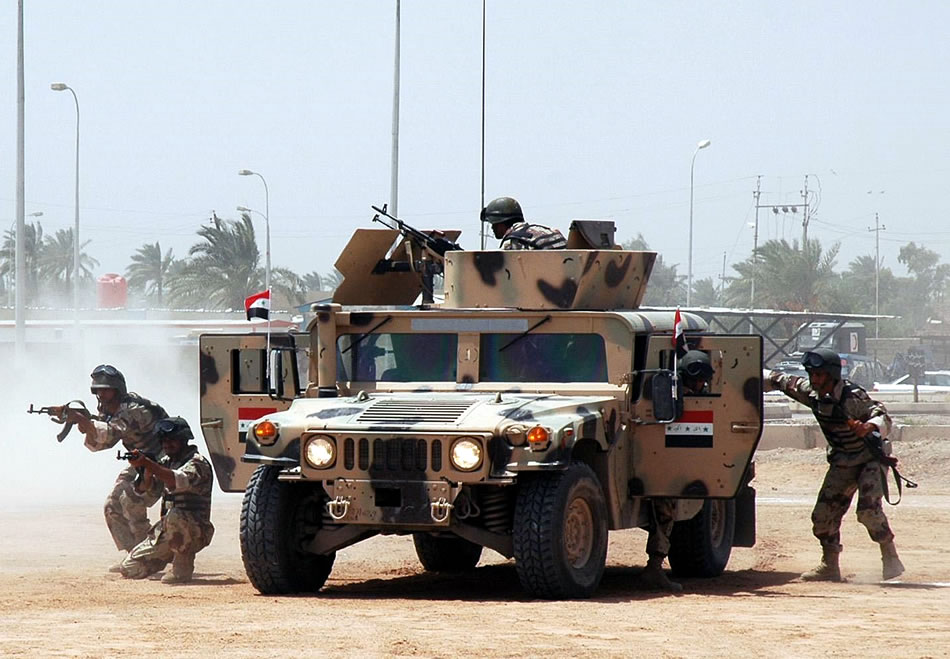
Iraqi soldiers of the 6th Division (Strategy Page)

With Iraq’s on-going political impasse over forming a new government dragging into its ninth month, some have brought up a military coup in Iraq as a possibility. The latest example was an article by United Press International from December 1, 2010 that said a military take over could happen given the country's history of military rulers. What this piece and others fail to understand is the divided nature of Iraq’s armed forces that make a coup highly unlikely.

A coup in Iraq doesn’t appear a possibility anytime soon because the army lacks cohesiveness. That’s due to the way the United States put the Iraqi forces together. From 2003-2008 the Americans focused upon building up the Iraqi army as quickly as possible. Quantity over quality was the main concern. That meant things like loyalties and political parties placing their followers into the forces were largely overlooked. For instance, after the January 2005 elections, the Shiite and Kurdish parties recruited their followers en masse into the army at both the entry and top levels. That’s how 35,000 former Kurdish peshmerga fighters ended up in the army. The peshmerga are directly under the control of the two ruling parties the Kurdistan Democratic Party and the Patriotic Union of Kurdistan. Prime Minister Nouri al-Maliki has also been putting his allies into the command structure. That means if a general ordered a coup, not all the forces may follow due to their ethnicity, sect, and political orientation.

Another problem is the institutional divides. There are currently three Iraqi military bodies. There are the Iraqi army brigades, and independent units and commands. The Iraqi army is divided into 14 divisions that come under the Joint Headquarters and the Ministry of Defense. Independent forces are the 56th Baghdad Brigade, the 1st and 2nd Presidential Brigades, and fifteen independent security battalions. They come under the Office of Commander in Chief, which is part of the prime minister’s office. The U.S. and the premier also created a number of operation commands beginning with the Baghdad Operations Command that answers to Prime Minister Maliki. The Office of Commander in Chief and the Operation Commands also bypass the Ministry of Defense and Interior. As one Iraqi officer told the International Crisis Group, this overlapping and often contradictory command structure means there are too many differences and no general that has enough authority to carry out a coup right now.

A coup in Iraq is mentioned every now and then in articles and reports. Writers point to the political divisions that make the government unable to deal with the country’s long-term problems as a reason why some ambitious general may decide to take matters into his own hands. A commander would have to build up the loyalty of a large and powerful force of units to carry out his plans. That would appear to be a difficult task with so many splits within the army, and lack of a cohesive leadership structure. The Iraqi military is developing and hopefully the increasing nationalism will help overcome some of these divisions. Until then the military does not seem a good vehicle to power. As for those that talk about a coup, many appear to want some kind of answer to the country’s endless difficulties. Iraq, with its history of military rule, makes a coup seem like a possible solution to these issues. If they studied the make-up of the Iraqi army, perhaps they would be dissuaded from this line of argument.

SOURCES

Department of Defense, “Measuring Stability and Security In Iraq June 2010,” 9/7/10

International Crisis Group, “Loose Ends: Iraq’s Security Forces Between U.S. Drawdown And Withdrawal,” 10/26/10

UPI, “Iraq’s Kurds build up their own army,” 12/7/10
- “Splintered Iraqi military ‘poses dangers,’” 12/1/10

Friday, December 10, 2010

Iraqis Weren’t The Only Ones Concerned About Maliki’s Autocratic Ways; Turkey Too

One of the major reasons why it has taken over eight months now to form a new Iraqi government is because most of the country’s major political parties have been weary of Prime Minister Nouri al-Maliki returning for a second term. After he launched his operations against the Sadrists and other Shiite militias in 2008, he increasingly concentrated power in his own hands, and became something of an autocrat. There were plenty of articles written in the West that warned of the premier becoming another Arab strongman. The leaked State Department cables from Wikileaks now show that Iraq’s politicians were not the only ones afraid of Maliki staying in power. Two separate American papers showed that Turkey was apprehensive as well about the prime minister.

The Wikileaks documents recorded two conversations between American and Turkish officials about their opposition to Maliki. One memo was after former U.S. Ambassador to Iraq Christopher Hill met with his Turkish counterpart in Baghdad on January 31, 2010. The Turkish ambassador said that his country had backed Maliki before, but this time they were going to support his opponents in the national elections. Their reason was because they felt Maliki, “Would focus on increasing his own power and would not be cooperative in resolving outstanding issues.” A second document came from current U.S. Ambassador to Iraq James Jeffrey when he was stationed in Turkey in February 2010. He wrote that the Turkish Foreign Minister said that they were dissatisfied with Maliki, and was afraid that he was getting “out of control.” For those reasons Ankara put its weight behind Iyad Allawi and his Iraqi National Movement in the 2010 parliamentary elections. 

Turkey’s bet in the Iraqi balloting failed, but their worries about Maliki may come true. The premier outmaneuvered Iyad Allawi to stay in power. While his National Movement and the Kurds have put forward concrete demands that Maliki must follower in order to maintain their support, there’s no telling whether he will abide by them, and what they will do if he doesn’t. One thing is for sure, the prime minister will continue to try to place his Dawa members in every facet of the Iraqi bureaucracy as he can to try to control the government. That won’t lesson Turkey’s current good relations with Iraq, but it may lead Ankara to re-think their position on certain issues given Maliki’s stance.

SOURCES

Gordon, Michael, “Meddling by Neighbors Adds to Iraq’s Woes,” New York Times, 12/5/10

Jeffrey, James, “U/S Burns’ February 18 Meetings With U/S,” U.S. Embassy, Ankara, 2/25/10

Parker, Ned, “Machiavelli in Mesopotamia,” World Policy Journal, Spring 2009

Xinhua, “Neighbors wrestle for sway over Iraq following U.S. pullout,” 8/17/10

Thursday, December 9, 2010

Iraq’s Oil Exports Little Changed By Work Of Foreign Companies In November 2010

Iraq’s State Marketing Organization announced on December 5, 2010 that the country’s exports barely inched up in November. Last month Iraq exported an average of 1.912 million barrels a day, up from 1.900 million barrels a day in October. Both of those amounts were down from September when the country reached 2.00 million barrels. 

The very modest increase in November was despite international energy companies beginning to work in Iraq. Italy’s Eni for example, said that it had raised oil production at the Zubayr field from 183,000 barrels a day to 201,000 barrels in December. Back in October, Shell claimed output at the Majnoon field had risen to 70,000 barrels a day, up from 45,000 barrels. British Petroleum and China National Petroleum Corporation were also supposed to have boosted production at the Rumaila field by 100,000 barrels during this period. It appears that despite this new work there has been no noticeable change in Iraq’s exports. It may be several more months than before the effect of these foreign corporations are really felt in Iraq.

Iraq Oil Exports Nov. 09 - Nov. 10 (Avg. Million Barrels Per Day)
2009
Nov. 1.92
Dec. 1.91
2010
Jan. 1.92
Feb. 2.05
Mar. 1.84
Apr. 1.80
May 1.88
Jun 1.86
Jul. 1.82
Aug. 1.82
Sep. 2.00
Oct. 1.90
Nov. 1.91

SOURCES

Bureau of Near Eastern Affairs, “Iraq Status Report,” U.S. Department of State, 11/3/10

Cummins, Chip, “Iraq’s Oil Patch Opens the Spigot,” Wall Street Journal, 11/11/10

Davis, Andrew, “Eni, Partners Reaches Key Production Target at Zubair Oil Field in Iraq,” Bloomberg, 12/5/10

Reuters, “Iraq oil exports rise in Nov. to 1.912 mln bpd-SOMO,” 12/5/10

Iraq Has Highest Oil Earnings Of The Year In October 2010

A recent rise in oil prices provided Iraq with its highest monthly earnings of the year in October 2010. Last month Iraqi petroleum sold at $77.10 per barrel, the second highest price of the year. That earned the country $4.5 billion for the month, which surpassed the $4.4 billion Iraq made in January and September. Beforehand prices had dipped from June to August to just over $71 per barrel. Even then, October's profits were not much different from the rest of the year.

This happened despite the country's petroleum industry hitting a plateau since 2008. In that year Iraq produced an average of 2.41 million barrels a day, with exports of 1.84 million barrels a day. In 2009 production was 2.40 million barrels, and exports were at 1.90 million barrels. In the first ten months of 2010 the numbers have hardly changed with an average of 2.36 million barrels in production and 1.88 million barrels of exports. October was no different with 2.35 million barrels a day in production, and 1.89 million barrels in exports. 

The only way that Iraq can significantly increase its revenue is if prices continue to rise or production is ramped up. Petroleum prices are notoriously volatile, and the state of the world economy mitigates against any dramatic changes for the time being. On the other hand, Oil Minister Hussein Shahristani has promised a 4.2% growth in output by the end of the year, and the National Development Plan passed this year predicts 2.30 million barrels of exports in 2011, 2.50 million barrels in 2012, 2.80 million barrels in 2013, and 3.10 million barrels in 2014 because of the deals Baghdad signed with foreign petroleum companies in 2009. Few analysts believe those numbers are possible, but even a modest up tick in production could bring in a sizeable amount of money. Iraq needs to earn as much as possible since it has so many reconstruction needs. Its oil industry will be developed with the help of international firms, but the question is how long will it take, and how great will the increases be. 


Month 
Total Oil Earnings 
Price Per Barrel 
Total Oil Production 
Avg. Monthly Production
(Mil/Bar/Day) 
Avg. Monthly Exports (Mil/Bar/Day) 
Jan. 2010 
$4.4 bil 
$73.97 
59.7 mil bar 
2.46 
1.92 
Feb. 
$4.2 bil 
$73.40 
57.9 mil bar 
2.44 
2.05 
Mar. 
$4.3 bil 
$76.20 
57.1 mil bar 
2.25 
1.84 
Apr. 
$4.2 bil 
$79.66 
53.0 mil bar 
2.38 
1.80 
May 
$4.3 bil 
$73.85 
58.7 mil bar 
2.35 
1.88 
Jun. 
$3.8 bil 
$71.10 
54.7 mil bar 
2.41 
1.86 
Jul. 
$4.0 bil 
$71.21 
56.3 mil bar
2.30 
1.82 
Aug. 
$3.9 bil 
$71.43 
55.4 mil bar 
2.32 
1.82 
Sep. 
$4.4 bil 
$73.07 
60.6 mil bar 
2.35 
2.00 
Oct.  
$4.5 bil 
$77.10 
58.7 mil bar 
2.35 
1.90


SOURCES

Razzouk, Nayla, "Iraq's October Oil Export Revenue Reaches Highest Level in Year," Bloomberg, 11/26/10

Special Inspector General for Iraq Reconstruction, "Quarterly Report to the United States Congress," 10/30/10

Wednesday, December 8, 2010

Iraqi Deaths Continue To Drop In November 2010


The monthly death count figures for Iraq have just been released, and they show another drop in November 2010. Iraq Body Count recorded 298 deaths last month, the exact same amount as October. Icasuaties had 174 deaths, down from 185 in October. Iraq's Ministries reported 171 killed in November, compared to 293 in October. Those sources averaged out to 7.1 deaths per day, down from October's 8.3.

Deaths have been steadily decreased since reaching a yearly high in July. They went from an average of 14.9 deaths per day that month, to 13.8 in August, 7.7 in September, 8.3 in October, and 7.1 in November.

Weekly Attacks In Iraq July-Nov. 2010
(AKE/Iraq Business News)
Currently casualties are divorced from the number of attacks occurring in the country. July and August for example, had the highest casualties of the year. In the latter there were around 220 attacks  resulting in an average of 462.2 deaths, while the former had approximately 360 attacks, but the average number of deaths dropped to 430.6. What was the deciding factor in deaths each month wasn’t the overall number of attacks, or even the mass casualty incidents, but rather the casualties generated in the small, day-to-day operations by militants. In July, 35 were killed on the 7th,  and then 37 more on the 18th in Baghdad by suicide bombers. Then on the 21st a car bomb went off in Abu Sayda, Diyala killing 30. Explosives also struck Shiite pilgrims in Karbala on July 26, causing the loss of 35 people. Altogether, those high profile attacks cost 137 people. In August by contrast, 7-30 were killed by a combination of car and roadside bombs at a market in Kut, Wasit province on the 3rd, 45 died in bombings in Basra on the 7th, 58 army recruits were killed in Baghdad on the 17th by a suicide bomber, 30 more in Kut on the 25th, for a total of 163. July still ended up with more casualties than August even though it had more attacks and deadlier high-profile incidents. That meant more people lost their lives in a smaller number of incidents in July than in August.

Approx. Attacks/Avg. Deaths/High-Profile Attacks/Casualties High-Profile Attacks
July 2010: 220 attacks/462.2 deaths/4 attacks/137 deaths
August 2010: 360 attacks/430.6 deaths/4 attacks/163 deaths 

Overall, casualties have hardly changed since January 2009. For all of last year, there were an average of 10.1 deaths per day. In the eleven months of 2010 there have been an average of 9.7. Unfortunately, attacks are still a daily occurrence in Iraq. On the other hand, both security incidents and deaths are at their lowest level since the 2003 invasion.

Monthly Death Counts

Month Iraq Body Count Icasualties Iraqi Ministries Associated Press 
Avg. # Of Deaths Per Day 
Jan. 10 
259 
135 
196 
177 
6.1 
Feb. 
296 
236 
352 
255 
10.1 
Mar. 
311 
183 
367 
230 
8.7 
Apr. 
380 
259 
328 
321 
10.7
May 
372 
279 
337 
278 
10.3 
June 
353 
176 
284 
294 
9.4 
July 
424 
534 
535 
356 
14.9 
Aug. 
503 
363 
426 
N/A 
13.8 
Sep.  
242 
174 
273 
N/A 
7.7 
Oct. 
298 
185 
293 
N/A 
8.3 
Nov.  
298 
174 
171 
N/A 
7.1 

SOURCES

Agence France Presse, "Iraq monthly toll lowest in a year," 12/1/10

AKE Ltd., "Weekly Security Update for 8th Dec 2010," Iraq Business News, 12/8/10

Icasualties

Iraq Body Count

This Day In Iraqi History - Nov 14 British army ordered to seize Basra vilayet WWI

1914 Sheikh of Islam called for jihad against British and French during WWI Call was repeated in all Sunni mosques in Mosul, Baghdad a...