Friday, February 11, 2011

U.S. Bombing To Soften Up Saddam Started In Mid-2002

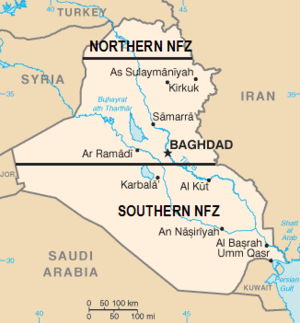
March 2003 was when the U.S. invaded Iraq, but preparatory military operations started several months before. Both England’s Royal Air Force (RAF) and the U.S. Air Force used the no fly zones over southern and northern Iraq as the pretext for a series of large bombing raids to destroy the country’s radar, air defense system, and other targets beginning in mid-2002.

The no fly zones over northern and southern Iraq were created after the 1991 Gulf War and were used to justify the bombing campaign before the 2003 invasion of Iraq (Wikipedia)

Around May 2002 the RAF and U.S. Air Force began doubling their bombings of Iraq. The U.S. and England claimed that they were only responding to Iraqi fire over the two no fly zones, but the American military later admitted that they were taking advantage of the situation to strike Saddam. In December for example, U.S. planes were fired upon over Kurdistan, but then struck southern Iraq in retaliation.

The two countries used twice as many bombs in the second half of 2002 as all of 2001. In September 2002 for instance, the RAF launched a 100 plane raid on Iraq’s western air defense system. Many of these attacks were coordinated with U.S., Australian, Jordanian, and British special forces and commandos, plus CIA officers who were operating within Iraq from August 2002 until the U.S. invasion in March 2003. The raids were aimed at Iraq’s command and control facilities, radar stations, communication centers, and Republican Guard units. 

The attacks picked up when United Nations inspectors returned to Iraq at the end of 2002. In January 2003, when the inspectors released their initial findings to the U.N.’s Security Council that they had found no evidence of weapons of mass destruction or a nuclear program, the U.S. and England were carrying out their heaviest bombing to date. In total, a U.S. Air Force general said that the two countries flew 21,736 sorties against Iraq, dropping 606 bombs on 391 targets from 2002 to March 2003. 

The American Congress authorized the use of force against Iraq on October 16, 2002. Afterward President Bush said, “I have not ordered the use of force. I hope the use of force will not be necessary. Our goal is to fully and finally remove a real threat to world peace and to America. Hopefully this can be done peacefully. Hopefully we can do this without any military action.” What the president stated wasn’t quite true. The White House had actually started an air campaign against Iraq five months before the Congressional vote. Publicly it said that it would work with allies and eventually the U.N. to resolve the conflict. On the other hand, it was moving ahead with military planning, stepping up air sorties, and infiltrating forces into Iraq all of which made the invasion more inevitable. In fact, the U.S. was hoping that the strikes might provoke Saddam Hussein to retaliate, which would provide a justification for war. That didn’t happen, but the administration eventually got what it wanted, and the bombings reduced the number of targets it had to hit when the invasion finally started.

SOURCES

Danner, Mark, “The Secret Way to War,” New York Times Review of Books, 6/9/05

Donnelly, John and Allard, Tom, “Undercover war begins as US forces enter Iraq,” Boston Globe, 1/6/03


Gordon, Michael, "U.S. Air Raids in '02 Prepared for War in Iraq," New York Times, 7/20/03

Gordon, Michael and Risen, James, “Report’s Findings Undercut U.S. Argument,” New York Times, 1/28/03

Loeb, Paul Rogat, “Iraq war started too early,” San Francisco Chronicle, 6/19/05

Loeb, Vernon, “Airstrikes in Southern Iraq “No-Fly” Zone Mount,” Washington Post, 1/15/03

Rangwala, Glen, Hurd, Nathaniel, and Millar, Alistair, “A Case For Concern, Not A Case For War,” Middle East Report Online, 1/28/03

Scahill, Jeremy, “The Other Bomb Drops,” The Nation, 6/1/05

Smith, Michael, “General admits to secret air war,” Times of London, 6/26/05
- “RAF bombing raids tried to goad Saddam into war,” Sunday Times, 5/29/05

Thursday, February 10, 2011

Human Rights Watch Provides More Details About Abuses By Maliki Controlled Security Forces In Iraq

In April 2010 and January 2011, the Los Angeles Times broke two stories about abuse by Iraqi security forces at prisons under the direct control of Prime Minister Nouri al-Maliki. The Times first reported on a secret prison run by the Baghdad Brigade at the Muthanna Airport in Baghdad that held 431 prisoners, all of which were Sunnis from Ninewa. They were first taken to Camp Honor in the Green Zone in Baghdad, and then to the Muthanna facility where some of them were tortured, raped, and went through other abuses. Next, the Times focused upon Camp Honor, which is jointly run by the Baghdad Brigade and the Counter-Terrorism Service, both of which are under the direct control of the premier. After each piece, Human Rights Watch investigated the allegations in more detail. That led to a new report by the organization that provides more details about the workings of what’s been termed “Maliki’s forces,” and the detention facilities they run.

In “Iraq: Secret Jail Uncovered in Baghdad,” Human Rights Watch collected information about three prisons run by the Baghdad Brigade and the Counter-Terrorism Service. The three facilities were all in Baghdad: the Muthanna airport prison, Camp Justice in Kadhimiya, and the Green Zone’s Camp Honor.

The government has tried to deny that any of the three jails were under the control of Maliki. In April 2010 the premier described the Muthanna facility as a transit spot under the jurisdiction of the Defense Ministry. Maliki also claimed that the Justice Ministry would take over Camp Cropper after the Los Angeles Times initially reported on it, while the Deputy Interior Minister denied that the Baghdad Brigade controlled any jails in the country. First, Human Rights Watch found a letter from May 2010 from the Defense Ministry to the Human Rights Ministry saying that it had no connection to Muthanna. Second, a letter was found from August 2010 from the Justice Minister to the Commander of the Armed Forces Office that controls the Baghdad Brigade and the Counter Terrorism Service, and which Maliki heads, asking for permission to move prisoners from Camp Honor. Another classified document from October from the Justice Minister said that the Baghdad Brigade and Counter-Terrorism Service prevented families and lawyers from visiting the camp. All these examples belie the official story that Maliki is not in control of these prisons. Ministries would not be writing to each other saying they had nothing to do with a facility, and having to ask one of the premier’s offices for permission to do anything at them if that was true.

There is also proof that elements of the government were preventing inspections of the camps. In November 2010, 280 prisoners were transferred from Camp Honor to Camp Justice before the former was to be reviewed by an international group. Human Rights Watch obtained a letter from the Justice Minister to the Commander of the Armed Forces dated January 13, 2011 that said that the Baghdad Brigade stopped a prison inspection by the Human Rights Ministry. After the Los Angeles Times article in January, the Justice Ministry claimed that the International Red Cross had gone to Camp Honor. Human Rights Watch contacted the Red Cross, who denied that any such visit had taken place because the government would not agree to their criteria, such as unfettered access to the entire prison and detainees. Sources in the government  told Human Rights Watch that officials had prevented the Human Rights Ministry from doing a check on Camp Honor for more than a year. The fact that authorities were not allowing independent inspections led Human Rights Watch to worry about abuses going on at the facilities controlled by Maliki. Already, the group had documented cases of electric shock, beatings, and rape at the Muthanna airport camp after it was exposed in early 2010. Given that history, and Iraq’s justice system being based upon confessions, it would be no surprise if mistreatment was on going at one or all of the camps.

Iraq was known to be an abusive state during the Saddam era, and it seems that little has changed since then. Shortly after the 2003 invasion, the Coalition began complaining that Iraqi forces were mistreating prisoners. From the Coalition Provisional Authority, to Iyad Allawi’s interim government, to Jaafari’s premiership, to now Maliki’s second term, prisoners have been placed in overcrowded jails, beaten, tortured, etc. Since this treatment has persisted for so long, it can only be described as an institutional problem within Iraq’s armed forces, police, and justice system. With several governments, including the current one, showing no interest in solving this problem, it will not end anytime soon.

SOURCES

Human Rights Watch, “Iraq: Secret Jail Uncovered in Baghdad,” 2/1/11

Parker, Ned, “Alleged abuse at Iraqi detention center prompts oversight concerns,” Los Angeles Times, 1/23/11
- “Secret prison revealed in Baghdad,” Los Angeles Times, 4/19/10

Al Jazeera VIDEO: Egypt Inspires Iraq Protests

Wednesday, February 9, 2011

More Government Jobs On Their Way In Iraq

Iraq’s Planning Ministry said that its strategic anti-poverty campaign announced in January 2011 would include the creation of four million public sector jobs over the next four years. A spokesman for the ministry said that this would be achieved through service projects aimed at jobs for the young. This comes on top of other reports that parliament wants to offer 285,000 new positions in the security forces and ministries this year as well, to fight unemployment. Both point to the continued domination of the economy by the government.

Baghdad claims that unemployment is at 15% and poverty at 30%. The jobless rate comes from 2008. An economic adviser to the government said in September 2010 that it was around 25-27%, while the United Nations has said that poverty is at 22.9%. Underemployment is also estimated at 33%, while many of those involved in farming that are counted as working do not receive wages. No matter what the actual figures are, they all point to a country that has a lot of people struggling to make ends meet.

The Planning Ministry didn’t say where the money will come from for these four million projected jobs, but it is probably funds from oil, which accounts for nearly 90% of government revenue. The government already provides 60% of full time work, and salaries and pensions eat up over 70% of the budget. With oil production expected to increase with the help of international companies, Baghdad is expected to plow some of this money into development projects. It also needs to diversify the economy so that it is not so dependent upon the fluctuations of the petroleum market. Unfortunately, despite the talk of promoting free markets, and new industries, it appears that the authorities are still looking towards the public sector to solve many of the problems facing the country. Iraq may continue to be a neo-socialist economy that becomes even more reliant upon petroleum than ever before as a result.

SOURCES

Dazzayi, Saman, “Iraq’s Planning Ministry promises 4 million jobs in 4 years,” AK News, 2/1/11

Department of Defense, “Measuring Stability and Security in Iraq June 2010,” 9/7/10

The Iraqi Dinar, “The Iraqi government for the first time reveals: Unemployment in Iraq, 27 percent and foreign debt 126 billion dollars?” 9/13/10

Jawayi, Falih, "Iraq to recruit 285,000 people in 2011," AK News, 2/4/11

Special Inspector General for Iraq Reconstruction, “Quarterly Report and Semiannual Report to the United States Congress,” 1/30/11
- “Quarterly Report to the United States Congress,” 10/30/10

Tuesday, February 8, 2011

Iraqi Government Allows Kurdish Oil Exports But Still Disputes Their Contracts

Worker at Tawke field, Kurdistan day exports began (Agence France Presse)
Back in January 2010 Prime Minister Nouri al-Maliki offered to recognize the Kurdish oil contracts, while the Kurdistan Regional Government (KRG) wanted the right to export once again. The talk was linked to the then upcoming parliamentary elections, which happened in March. Thirteen months later, this rhetoric is starting to become reality, but there are still major barriers to overcome. 

On February 3, 2011 the Kurds began exporting again. The Tawke field, which is operated by Norway’s DNO, did a test run that day, pumping some 10,500 barrels. Eventually, the company hopes to return to the 50,000 barrels a day peak mark that it accomplished in the summer of 2009, which was the last time the Kurds were allowed to ship their oil through the national pipeline to Turkey. When the Taq Taq field that is run by Turkey’s Genel Enerji comes on line, the KRG should be able to eventually reach the 100,000 barrels a day quota set in the proposed 2011 budget. That will return the region to exactly the same production level it reached two years ago.

On January 5, Prime Minister Nouri al-Maliki went a step further saying that the central government recognized the Kurds’ oil contracts. The premier gave the rather unbelievable explanation that Baghdad was accepting the Kurdish deals because extracting petroleum from the north was much harder than in the south. Maliki therefore said that the contracts that the KRG signed with foreign companies were necessary. Previously the central government called those transactions illegal, claiming that only the Oil Ministry had the right to sign contracts. The prime minister’s announcement seemingly ended one of the long-standing arguments between the central and regional governments, but then on February 7, Deputy Premier and former Oil Minister Hussein Shahristani claimed that the prime minister was misquoted. Shahristani stated that the Kurdish contracts needed to be amended so that they were like ones offered by Baghdad. In 2009, Iraq held two auctions for oil fields, offering service contracts that paid companies for extra production after they reached a certain quota. The Kurds on the other hand have been signing production sharing deals that give the companies a portion of the profits, and allows them to claim the fields' reserves as part of their holdings. 

Maliki had two reasons for making his statements. First, the premier was fulfilling one of his promises that he made to the Kurds in return for their support for his second term in office. Second, it tied Kurdistan closer to Baghdad. Under the proposed 2011 budget, the Kurds must export 100,000 barrels a day to receive their 17% of the budget. Before, the Kurds received their money no matter what. Two major hang-ups remain however. One is that the status of the Kurdish contracts is still up in the air. Rhetoric usually outpaces reality in Iraq, and the countervailing statements by Maliki and Shahristani about the Kurdish deals was a perfect example. Which comment reflects official Iraqi policy is unclear right now. Second, Baghdad has only agreed to pay the operating costs of DNO and Genel Enerji, not their profits. That issue may prove to be a more immediate problem given that the companies are going to want to reap their full benefits of investing in Kurdistan. If not, there could be another falling out over paying the companies just as happened in 2009, and Kurdish exports could come to an end for a second time.

SOURCES

Ali, Yaser, “KBC: Maliki signs agreement to Kurdish conditions,” AK News, 12/21/10

Aqrawi, Shamal, “UPDATE 1-Iraq starts exporting Kurdish oil – officials,” Reuters, 2/3/11

Carlisle, Tamsin and al Sayegh, Hadeel, “Iraq gives go-ahead to Kurdish oil contracts,” The National, 12/26/10

Ketz, Sammy, “Iraq to respect Kurd profit-sharing oil deals: PM,” Agence France Presse, 2/5/11

Lando, Ben, “No sign of Kurdish oil exports scheduled for February 1 start,” Platts, 2/1/11

Rasheed, Ahmed, “UPDATE 1-Iraq to pay expenses to oil firms in Kurdish region,” Reuters, 1/19/11

Reuters, “Iraq govt wants Kurdish deals amended-Shahristani,” 2/7/11

Monday, February 7, 2011

Protests Return To Iraq Inspired By Events In Tunisia And Egypt

In the last week or so, small demonstrations have spontaneously broken out in several sections of Iraq. A few were in solidarity with the events occurring in Tunisia and Egypt, but all ended up calling on politicians to provide jobs, services, and to fight corruption.These protests are quickly spreading, and could pose a serious challenge to the government as it lacks the will and means to address the public’s complaints.

The first reported incidents were at the very end of January, 2011. On January 30, 200 people gathered in two parts of Baghdad to support the events in Egypt. The next day, there were protests in Husseiniya and outside the Green Zone. At the latter event, participants demanded better services and for the government to not evict squatters from government property. On February 4, 3,000 demonstrated in Diwaniya, Qadisiyah over the lack of jobs and services. That same day there were three more protests in the capital. One was in central Baghdad with around 200 attending who wanted to show solidarity with Egypt and Tunisia. They also condemned the government’s recent closures of liquor stores, and called for better services. Husseiniya saw another protest over electricity, water, and corruption as well. On February 5, police in Najaf broke up people trying to march in support of Egyptians after the governor refused to give them permission. On February 6, 250 were seen in Baghdad’s Bab al-Sham, and 1,000 in Doub al-Sham in Diyala. 100-1,500 went out into the streets of Basra demanding better services, and for the governor and members of the provincial council to resign. Riot police met them, but a small delegation was able to meet with officials to voice their demands for electricity, jobs, and to fight crime and corruption. A similar event took place in Ramadi where people demanded the governor and head of the provincial council to step down over the lack of services, random arrests, unemployment, and corruption. Mosul was also said to be taking part in the civil demonstrations. 

Hamza in Diwaniya has seen the most sustained and violent protests in the country. From February 3 to 5 residents  marched on the local council building. On the first day around 1,000 people gathered in the town, and threw rocks, which led the police to fire shots to disperse the crowd. That ended up wounding three, with four more injured in scuffles with the authorities. Local leaders had to be called out that day to calm the crowd and end the protest. On February 5, the main road to Diwaniya was closed with a roadblock, while others stormed the government building again and a police station. This time people were not only throwing rocks, but Molotov cocktails as well. The police fired again, which reportedly killed one, and injured four others. While the events in the rest of the Middle East obviously had an affect upon Iraqis, the country’s own set of social problems came to the fore in almost all of these situations.

The demonstrators have met with some support from clerics as well. On February 4, several imams during Friday prayers warned politicians that they needed to consider the repercussions of the events going on in the rest of the region. Abdul Mahdi al-Karabani, a representative of Grand Ayatollah Sistani said that there was no social justice in Iraq. A sheikh in Kirkuk warned that protests could spread, while an imam in Kufa, Najaf condemned the police shootings in Hamza. Others talked about the on going poverty and corruption in government. If more mosques join in on these criticisms, it could pose a real quandary for Baghdad as it will be hearing it from both the street, and the religious establishment.

The heat has already reached Prime Minister Nouri al-Maliki. He announced on February 5 that he was cutting his salary in half. He urged other politicians to do the same. He also said that he would not run for a third term, although he later amended that statement, and then offered to raise citizens' ration cards. He later accused  his political rivals for organizing some of the protests. Those token gestures are unlikely to win much praise. Pay for politicians dwarfs those of the average Iraqi, and they get lavish expenses as well for security, cars, their own generators, etc. Maliki also quickly backpedaled on his comment that he would not run again in the next elections, ration cards do not address the core demands of the public, and his attack upon other parties showed that he was trying to defer blame.

This is all very similar to last year when people took to the streets over the lack of electricity. Those started in Basra, but then quickly spread to several other provinces before the Prime Minister ordered them banned. Recently, on January 17, they returned when people blocked the Kirkuk-Baghdad highway in Tamim. Recent polling shows that two-thirds of respondents said that services were the most important issue facing Iraq, and that they felt the supply of electricity, water, etc., had gotten worse. The government was caught off guard by these protests, and could do nothing to alleviate the public’s anger. Maliki and others said it would take several years for example, to increase the nation’s power supply, and even then, officials would later say that demand would continue to outstrip supply. The improved security situation has changed the focus for the average Iraqi away from violence to services. It has also allowed people to feel safe enough to publicly voice their discontent without fear of being attacked by militants.

The problem for Iraq is that Baghdad cannot respond to these demands. The new ruling coalition has been put together, but all of the ministers haven’t even been named, and only four out of 26 parliamentary committees have chairmen. The government was put together to include all of the major parties in a national unity regime. That’s good for looks and dividing up the spoils of power, but not for actually running the country. Trying to be inclusive was made at the cost of competence. That means no immediate improvement in services, and likely more protests unless Maliki tries to ban them again

Pictures Of Protesters, February 6, 2011

Baghdad (Associated Press)
Basra (Reuters)
Basra (Reuters)
Basra (Reuters)
Basra (Reuters)

Basra (Reuters)

Bab al-Sham (Reuters)
SOURCES

Abdul-Kadir, Saad, “Iraqis protest poor public services across country,” Associated Press, 2/6/11

Abdul-Rahman, Mohammed, “KBC allocated second parliamentary committee,” AK News, 2/2/11

Agence France Presse, “Iraq not immune from Arab anger: clerics,” 2/4/11

Alsumaria, "Maliki to compensate for Iraqis ration cards," 2/7/11

Associated Press, “Iraqis seize on Egyptian unrest in protests,” 2/4/11

Aswat al-Iraq, “3,000 persons go to street in Diwaniya to improve services,” 2/4/11
- “Anbar council holds emergency meeting after Ramadi protest, 2/6/11

Faruqi, Anwar, “Iraq’s largest hydropower dam grinds to halt,” Agence France Presse, 1/27/11

Juhi, Bushra, “Electricity-starved Iraqis’ obsession: generators,” Associated Press, 6/26/10

Kami, Aseel, “Iraqis demonstrate over lack of basic services,” Reuters, 2/6/11

Lando, Ben and Ammar, Munaf, "Iraq's Maliki Doesn't Rule Out Third Term," Wall Street Journal, 2/6/11

Latif, Nizar, “Iraqis step up protests in job and food crisis,” The National, 2/6/11

Shadid, Anthony, “Iraq’s Last Patriot,” New York Times, 2/4/11

Sly, Liz, “Iraq’s Maliki says he won’t seek 3rd term, in possible reverberations from Egypt,” Washington Post, 2/5/11

Tawfeeq, Mohammed, “Amid Egypt-inspired unrest, Iraqi prime minister cuts salary in half,” CNN, 2/5/11
- “Protesters in Iraq decry lack of basic services, shortages,” CNN, 2/3/11
Maliki’s Son Gets A New Government Position

The Iraqi press reported that Prime Minister Nouri al-Maliki appointed his son Ahmed al-Maliki to a new position within the government. The younger Maliki will be the assistant to the director of the prime minister’s office. Previously, Ahmed was the head of procurement in that same office. The media said that while there, he built up a huge fortune, and invested in real estate in other countries. It’s also been said that Ahmed has influence over some government agencies due to his father. Since Iraq is one of the most corrupt countries in the world, nepotism and cronyism is rampant. It should be no surprise then, that Maliki, like other politicians, has placed friends and family in prime positions to take advantage of government largesse.

SOURCES

MEMRI Staff, “Divisions among Shi’a Could Prolong Discussion to Form a New Government,” MEMRI Blog, 6/25/10

Wasat Online, “Al-Maliki Appoints Son To Senior Post,” MEMRI Blog, 1/31/11

This Day In Iraqi History - Nov 14 British army ordered to seize Basra vilayet WWI

1914 Sheikh of Islam called for jihad against British and French during WWI Call was repeated in all Sunni mosques in Mosul, Baghdad a...