Showing posts with label U.N. Inspectors. Show all posts

Friday, May 1, 2026

Review Tim Trevan, Saddam’s Secrets: The Hunt For Iraq’s Hidden Weapons, Harper Collins, 1999


Tim Trevan was a British expert in weapons of mass destruction (WMD). In 1992 he joined the United Nations Special Commission (UNSCOM) weapons inspectors in Iraq. His Saddam’s Secrets is one of the better books on the subject. He goes into great detail about all of the jobs the inspectors carried out but focuses upon the biological weapons program which Iraq tried to hide. It’s the coverage of each inspection team that went to Iraq that reveals how Baghdad lied about its program until UNSCOM ended in 1998.

Friday, March 6, 2026

Review David Malone, The International Struggle Over Iraq, Politics in the UN Security Council 1980-2005, Oxford University Press, 2006


The International Struggle Over Iraq is a study by David Malone of the relationship between the United Nations, its permanent members and Iraq from the Iran-Iraq War to the U.S. occupation. The book is up and down in parts but the conclusions are sound. The author argues that from the 1980s-90s the U.N. was increasingly effective in dealing with Iraq because the great powers agreed on using it as a tool in their foreign policy but afterwards the U.S. and U.K. acted increasingly on their own sidelining the organization until it was largely irrelevant although Malone wouldn’t agree with that last point.

Monday, November 10, 2025

Vice President Cheney’s Role In The Iraq War


Almost the entire senior leadership of President Bush’s national security team was for regime change in Iraq. Vice President Dick Cheney was out in front making accusations against Saddam Hussein to justify the invasion. Since he recently passed here is a review of his role in the lead up to the Iraq War.

Friday, August 29, 2025

Review Hans Blix, Disarming Iraq, Pantheon, 2004

Blix, Hans, Disarming Iraq, Pantheon, 2004


President George Bush and Prime Minister Tony Blair justified their invasion of Iraq based upon the threat of Weapons of Mass Destruction. They quoted United Nations weapons inspections in the 1990s which found a vast program to build chemical, biological and nuclear weapons. When inspectors returned to Iraq in 2002 however their work was largely criticized by the U.S. and UK because they didn’t support those countries’ claims against Saddam. Hans Blix was a chief inspector during both regimes and wrote Disarming Iraq to express his perspective on what happened. His book is an argument for the work of the United Nations inspectors and against the actions of both Iraq and the United States.

Thursday, May 23, 2024

Review Unrevealed Milestones in the Iraqi National Nuclear Program 1981-1991

Selbi, Dhafir, Al-Chalabi, Zuhair, Co-authored and edited by Dr. Khadduri, Imad, Unrevealed Milestones in the Iraqi National Nuclear Program 1981-1991, CreateSpace Independent Publishing Platform, 2011


Unrevealed Milestones in the Iraqi National Nuclear Program 1981-1991 was written by three Iraqi scientists who worked on the country’s nuclear program. They were partly inspired by two other scientists who wrote books which the authors believed were full of misinformation aimed at supporting the U.S. claims about WMD. Their intent was to tell their truth of what Iraq did and didn’t do which of course was a huge topic of controversy before and after the 2003 invasion.

Thursday, March 21, 2024

Review The Achilles Trap, Saddam Hussein, The C.I.A., And The Origins Of America’s Invasion Of Iraq

Coll, Steve, The Achilles Trap, Saddam Hussein, The C.I.A., And The Origins Of America’s Invasion Of Iraq, Penguin Press, 2024


Twenty years after the Iraq invasion a comprehensive book including both the US and Iraqi perspectives on what led to the conflict has finally been published. That’s thanks to Steve Coll and his The Achilles Trap, Saddam Hussein, The C.I.A., And The Origins Of America’s Invasion Of Iraq. The author traces U.S.-Iraq relations from the Iran-Iraq War to the 2000s to show how the two countries constantly misread each other leading to false assumptions and the eventual overthrow of Saddam Hussein in 2003.

Wednesday, February 15, 2023

Review The Regime Change Consensus, Iraq In American Politics 1990-2003

Stieb, Joseph, The Regime Change Consensus, Iraq In American Politics 1990-2003, Cambridge, New York, Melbourne, New Deli, Singapore: Cambridge University Press, 2021


The majority of books on the Iraq invasion focus upon the early days of the Bush administration and then how 9/11 changed its perceptions and led to the overthrow of Saddam Hussein. Few have analysis and most just recite the history. Joseph Stieb in The Regime Change Consensus, Iraq In American Politics 1990-2003 is one of those rare releases which focuses upon the ideas that led the conflict with Iraq. It discusses how the first Bush administration created a containment policy around Iraq after the Gulf War and how that broke down in the 1990s so that by the time 9/11 happened the only real debate within the American political establishment was not whether to invade Iraq but how.

Wednesday, December 28, 2022

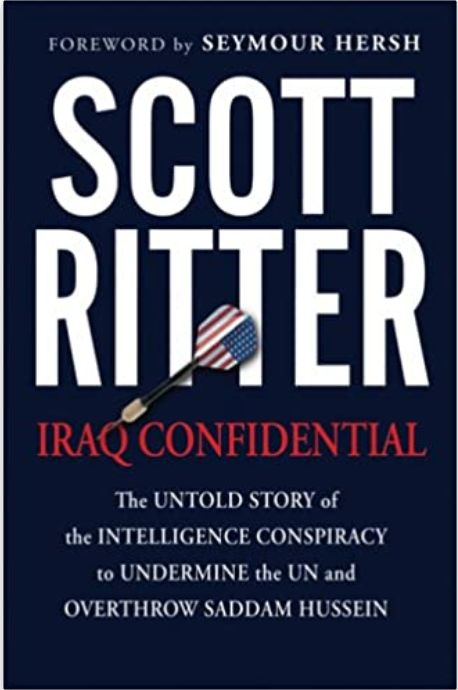
Review Iraq Confidential, The Untold Story of the Intelligence Conspiracy to Undermine the UN and Overthrow Saddam Hussein

Ritter, Scott, Iraq Confidential, The Untold Story of the Intelligence Conspiracy to Undermine the UN and Overthrow Saddam Hussein, New York: Nation Books, 2005


Iraq Confidential, The Untold Story of the Intelligence Conspiracy to Undermine the UN and Overthrow Saddam Hussein was former U.N. inspector Scott Ritter’s second book on his experiences working in Iraq. He claimed the United States undermined the inspection process from the start not supporting it, trying to manipulate it, and ultimately giving up on it. The problem is much of his story contradicts what he wrote in his first book Endgame, Solving The Iraq Crisis. That begs the question of which version is the reader supposed to believe?

Wednesday, November 23, 2022

Review Endgame, Solving The Iraq Crisis

Ritter, Scott, Endgame, Solving The Iraq Crisis, New York: Simon & Schuster, 2002


Endgame, Solving The Iraq Crisis was Scott Ritter venting his frustration with the United Nations weapons inspections in Iraq in the 1990s. Ritter was one of the chief inspectors and believed that the United States gave up on the process and allowed Iraq to hide its weapons of mass destruction. A few years later however he completely flipped around his perspective questioning the Bush administration’s argument to remove Saddam Hussein in 2003.

Friday, November 18, 2022

Review Days Of Fire, Bush and Cheney in the White House

Baker, Peter, Days Of Fire, Bush and Cheney in the White House, New York, London, Toronto, Sydney, Auckland: Doubleday, 2013


Peter Baker wrote Days Of Fire, Bush and Cheney in the White House to refute the idea that Vice President Dick Cheney was the driving force behind President George Bush. Baker argues that the two largely agreed about issues during the first administration but then drifted apart in the second. The Iraq War was an example of their relationship since both individuals wanted to overthrow Saddam Hussein. The author also pointed out how badly the war was handled by the White House.

Thursday, October 20, 2022

Review Hide And Seek, The Search For Truth In Iraq

Duelfer, Charles, Hide And Seek, The Search For Truth In Iraq, New York: Public Affairs, 2009


Charles Duelfer was the deputy head of the United Nations inspectors in the 1990s and then in charge of the Iraq Survey Group which investigated Iraq’s WMD programs after the 2003 invasion. His book Hide And Seek, The Search For Truth In Iraq is about those two experiences plus his work with the CIA in between them. He made three main points. One was that the weapons inspections in the 1990s and 2000s were never going to get to the bottom of things because Iraq would never cooperate with something imposed upon it. The second was that he supported the overthrow of Saddam Hussein but then acknowledged that the Bush administration destroyed Iraq afterward. Third he tried to explain why Iraq wanted WMD and acted like it still had them after they were destroyed. Ultimately his goal was to explain what both the U.S. and Iraqis were thinking during their years of confrontation when almost all books are just about the Americans.

Wednesday, September 14, 2022

How Could The US Get Iraq’s WMD So Wrong?


There is a well known argument that the United States simply lied about the Iraq threat and its weapons programs to justify the war. The presidential and Senate investigations reject that line of thought and so does Charles Duelfer who was the deputy head of the United Nations inspectors in Iraq in the 1990s and then in charge of the Iraq Survey Group which searched for weapons of mass destruction after the 2003 invasion. In his book Hide And Seek he has an example of how U.S. intelligence made assumptions about Iraq which became the basis for all of its reports and assessments about WMD.

Wednesday, April 27, 2022

Chilcot Inquiry Section 4.3 Iraq WMD Assessments, October 2002 to March 2003


In the fall of 2002, the Blair government was concerned about how the return of United Nations inspectors would work out. Prime Minister Tony Blair believed that they would find something and that would justify the war. At the same time London had to deal with the Bush administration which was growing impatient and wanted to go to war sooner rather than later.

Thursday, April 14, 2022

Chilcot Inquiry Section 3.7 Development of UK Strategy and Options, 1 February to 7 March 2003


In the months immediately before the March 2003 invasion of the Iraq the number one priority of Prime Minister Tony Blair’s government was
getting a second United Nations resolution to authorize the use of force against Saddam Hussein. This was despite the fact that the weapons inspectors had found nothing, and France, Russia and others on the U.N. Security Council opposed going to war. Despite that Blair was convinced that he could win the day. He would be proved wrong again and again.

Wednesday, April 13, 2022

Chilcot Inquiry Section 3.6 Development of UK Strategy and Options, November 2002 to January 2003


At the end of 2002 into January 2003 the
Blair administration went through a sea change in its Iraq policy. In the previous period Prime Minister Tony Blair had his one and only victory in the entire Iraq War when he convinced President George Bush to go to the United Nations for a new resolution on weapons inspections. After that however the discussion immediately shifted to invasion.

Tuesday, March 29, 2022

Chilcot Report Section 3.4 Development of UK Iraq Strategy and Options, Late July to 14 September 2002


Section 3.4 of the Chilcot Report focuses upon Prime Minister Tony Blair’s only victory in the lead up to the 2003 invasion of Iraq. That was when he convinced President Bush to go to the United Nations to get resolutions against Iraq that would help build a popular and legal case for war. Even then, there were questions whether this path would be successful.

Monday, March 21, 2022

Chilcot Report Section 3.5 Development of UK Strategy and Options September to November 2002 – Negotiation of Resolution 1441

From September to November 2002 the main issue before the Blair government was how to approach the United Nations and deal with the United States’ opposition to that move. Prime Minister Tony Blair’s only victory so far with the Bush administration was to convince the president to go to the U.N. to get a new resolution on Iraq. Now there were disputes over whether one or two resolutions were needed to go to war. The Blair government was told that two would be necessary, and the problems that would cause with the Americans, but Blair went ahead anyway taking the risk that things would work out.

Tuesday, March 15, 2022

Chilcot Report Volume 2 Section 3.3 Development of UK Iraq Strategy and Options, April to July 2002


Section 3.3 of the Chilcot Report covers the spring-summer of 2002 after Prime Minister Tony Blair told President Bush that the United Kingdom would work with the U.S. against Saddam. England was trying to set out a plan of action that the two countries could follow including going to the United Nations and creating an overall strategy. London believed that if the U.S. was going to war with Iraq, it should take part and that meant it would have a say.

Monday, March 14, 2022

Chilcot Report Section 3.2 Development of UK Iraq Strategy and Options, January to April 2002 – “Axis Of Evil” to Crawford


Section 3.1 of the Chilcot Report covers the British dealing with the aftermath of 9/11 and the Bush administration’s decision to go to war with Iraq. The Blair government naively believed that it could maintain its policy since the 1990s of containing Saddam via sanctions and demanding that U.N. weapons inspectors return. The Prime Minister’s decision to stand by President Bush however meant that he eventually agreed to use force against Iraq if everything else failed. That was England’s first step towards war.

Tuesday, March 1, 2022

Chilcot Report Sec 1.1 UK Iraq Strategy 1990 To 2000

The Chilcot Inquiry was created to explain the decisions that led to England’s participation in the Iraq War. The first section covered the United Kingdom’s strategy towards Iraq from the 1990 Iraqi invasion of Kuwait to 2000. London’s main concern during this period all the way to 2003 was Iraq’s weapons of mass destruction and nuclear programs. British intelligence believed that Iraq was close to getting a nuclear bomb and had a large and active chemical and biological weapons arsenal. After the Gulf War, the UK committed itself to a containment policy that backed United Nations’ inspectors to destroy Iraq’s weapons programs and a no fly zone to deter any further aggression.

This Day In Iraqi History - Sep 9 Sheikh Abu Risha announced the Anbar Salvation Council to fight Al Qaeda in Iraq in Ramadi

871 Zanj slave rebellion returned to Basra city Offered amnesty to residents and then massacred them Survivors hid in city for weeks a...