Showing posts with label Coalition Provisional Authority. Show all posts

Friday, June 26, 2026

Review George Tenet, At the Center of the Storm, My Years at the CIA, Harper Collins, 2007


George Tenet was the director of the Central Intelligence Agency under Presidents Clinton and Bush. He eventually resigned because of the controversy over Iraq’s weapons of mass destruction. His book At The Center of the Storm is very interesting because it shows that he was very sensitive about his time at the Agency with several chapters responding to criticisms of his tenure.

Friday, December 26, 2025

Review Aaron Glantz, How America Lost Iraq, Penguin Books, 2005


Aaron Glantz was a reporter for the San Francisco Bay Area’s Pacifica Radio. He went to Iraq from 2003-05 to report on the conditions of everyday Iraqis. He came away with two main impressions. One was that the Left and Right in America didn’t care about Iraqis at all just their own political agendas. The second was that the U.S. lost Iraq just a year into the occupation because of their misrule.

Friday, December 27, 2024

Review Riverbend, Baghdad Burning, Girl Blog From Iraq, The Feminist Press, 2005

Riverbend, Baghdad Burning, Girl Blog From Iraq, The Feminist Press, 2005


In August 2003 an Iraqi woman going by the name Riverbend started a blog called Baghdad Burning. It became one of the many voices from Iraq that emerged during this time that was quite popular. This book collects her first year of posts. They range from her family life to observations about the deteriorating situation in her country.

Thursday, September 19, 2024

Review Once Upon A Time In Iraq, History of a Modern Tragedy

Bluemel, James and Mansour, Dr Renad, Once Upon A Time In Iraq, History of a Modern Tragedy, BBC Books, 2020


In the introduction to Once Upon A Time In Iraq, History of a Modern Tragedy James Bluemel and Dr. Renad Mansour say they wanted to provide a voice to ordinary Iraqis so they could tell how their lives were impacted by the Iraq War. Few books include Iraqi voices so this seemed like just the type of book that is needed. In reality however the book is a mix of Iraqi and American personalities. Not only that but the first half covers 9/11 to the end of 2003. The middle is about the two battles of Fallujah and the capture, interrogation and execution of Saddam Hussein which diverges from the stated goal of the authors. The last third quickly goes from 2005 when the civil war broke out to 2017 when the Islamic State was defeated. There are definitely good moments but there could’ve been more Iraqis and the authors could’ve spent less time on the early years of the conflict.

Thursday, September 12, 2024

Review Expectation of Valor, Planning For The Iraqi War

Benson, Colonel Kevin, Expectation of Valor, Planning For The Iraqi War, Casemate, 2024


Colonel Kevin Benson who was the chief planner for the 3rd Army wrote Expectation of Valor, Planning For The Iraqi War in response to the conventional wisdom that the U.S. military did not prepare for postwar Iraq in 2003. The author writes that the army did spend time coming up with ideas on how to secure and stabilize the country after the fall of Saddam. However he blames Secretary of Defense Donald Rumsfeld, General Tommy Franks and the Coalition Provisional Authority (CPA) for undermining the work that was done.

Thursday, May 2, 2024

Review Losing The Golden Hour, An Insider’s View of Iraq’s Reconstruction

Stephenson, James, Losing The Golden Hour, An Insider’s View of Iraq’s Reconstruction, Potomac Books, Inc., 2007


The “Golden Hour” is the time after a war has ended when rebuilding and reforms can be carried out in a country before the public turns against them. James Stephenson was the United States Agency for International Development (USAID) chief in Iraq from 2004-2005. In his Losing The Golden Hour, An Insider’s View of Iraq’s Reconstruction he argues that America failed to rebuild Iraq because of lack of planning, experience and bickering.

Thursday, March 14, 2024

Review Mugged By Reality, The Liberation of Iraq and the Failure of Good Intentions

Agresto, John, Mugged By Reality, The Liberation of Iraq and the Failure of Good Intentions, New York: Encounter Books, 2007


John Agresto worked for the Coalition Provisional Authority from 2003-2004 as the advisor to the Ministry of Higher Education. The book covers two themes. The main one is the author giving a neoconservative argument for why he supported the Iraq War. The second is what were the root causes for the failure of the U.S. occupation sprinkled with anecdotes about the people he met in Iraq. The book is about how the author struggled to hold onto his ideas as they were confronted by the occupation. Some of his criticisms are poignant but too many times he rambles on and contradicts himself.

Thursday, February 1, 2024

Review Lessons Of The Iraqi De-Ba’athification Program For Iraq’s Future And The Arab Revolutions

Terrill, W. Andrew, Lessons Of The Iraqi De-Ba’athification Program For Iraq’s Future And The Arab Revolutions, Carlisle: Strategic Studies Institute, 2012


In Lessons Of The Iraqi De-Ba’athification Program For Iraq’s Future And The Arab Revolutions W. Andrew Terrill lays out how deBaathification was a disaster for the United States and Iraq. He argues it was based upon the wrong assumptions, was not necessary, helped lead to the insurgency, inflamed sectarianism, and devastated the Iraqi government.

Thursday, January 11, 2024

Review U.S. Policy In Post-Saddam Iraq

Eisenstadt, Michael and Mathewson, Eric, Editors, U.S. Policy In Post-Saddam Iraq, Washington, DC: Washington Institute for Near East Policy, 2003


Before the 2003 invasion of Iraq the Washington Institute for Near East Policy realized the United States could learn a lot from the British time in the country starting in World War I. The Institute collected together a group of Iraq experts and had them write about the United Kingdom’s experience and then make suggestions for the Bush administration. The authors provided a good history and there were plenty of lessons for the U.S. to learn. As we all know the White House thought it had all the answers and carried out a costly and highly flawed occupation as a result.

Wednesday, January 25, 2023

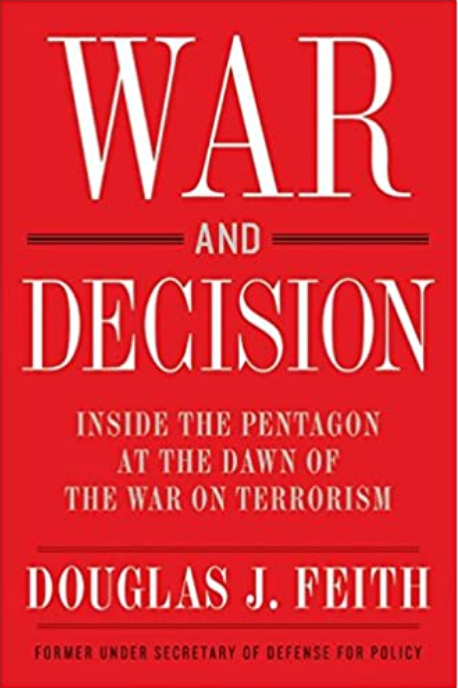
Review War and Decision, Inside The Pentagon At The Dawn Of The War On Terrorism

Feith, Douglas, War and Decision, Inside The Pentagon At The Dawn Of The War On Terrorism, New York: Harper Collins, 2008


Douglas Feith was the Undersecretary of Defense for Policy in the Bush administration. War and Decision, Inside The Pentagon At The Dawn Of The War On Terrorism is his attempt to answer the critics of the decision to invade Iraq in 2003. His problem was that he tried to make this argument using what was known in 2008 when the justifications for war had been disproven. He twists and turns events and omits others to try to say that Saddam Hussein was a threat to the United States while blaming the State Department, the Central Intelligence Agency and Paul Bremer for everything that went wrong. War and Decision is an amazing example of verbal gymnastics but ironically exposes many of the problems with the Iraq War.

Wednesday, December 21, 2022

Review The Clausewitz Delusion, How the American Army Screwed Up the Wars in Iraq and Afghanistan (A Way Forward)

Melton, Stephen, The Clausewitz Delusion, How the American Army Screwed Up the Wars in Iraq and Afghanistan (A Way Forward), Minneapolis: Zenith Press, 2009


In The Clausewitz Delusion, How the American Army Screwed Up the Wars in Iraq and Afghanistan (A Way Forward) the U.S. Army Staff College’s Stephen Melton argues that the U.S. military’s doctrine led it to fail in its most recent conflicts. The author believed that America threw away decades worth of history fighting offensive wars and subsequent occupations that started in colonial times for a defensive approach during the Cold War and planned for short imperial battles after embracing Carl von Clausewitz after Vietnam. That left the U.S. unprepared for wars like Afghanistan and Iraq.

Friday, November 18, 2022

Review Days Of Fire, Bush and Cheney in the White House

Baker, Peter, Days Of Fire, Bush and Cheney in the White House, New York, London, Toronto, Sydney, Auckland: Doubleday, 2013


Peter Baker wrote Days Of Fire, Bush and Cheney in the White House to refute the idea that Vice President Dick Cheney was the driving force behind President George Bush. Baker argues that the two largely agreed about issues during the first administration but then drifted apart in the second. The Iraq War was an example of their relationship since both individuals wanted to overthrow Saddam Hussein. The author also pointed out how badly the war was handled by the White House.

Thursday, October 27, 2022

Review From Dictatorship to Democracy: An Insider’s Account of the Iraqi Opposition to Saddam

Al-Bayati, Hamid, From Dictatorship to Democracy: An Insider’s Account of the Iraqi Opposition to Saddam, Philadelphia Oxford: University of Pennsylvania Press, 2011


Hamid al-Bayati was the London representative of the Supreme Council for the Islamic Revolution in Iraq (SCIRI). His From Dictatorship to Democracy: An Insider’s Account of the Iraqi Opposition to Saddam is about what SCIRI did from the 1990s to the start of the U.S. occupation of Iraq. The book is one of omission because what he doesn’t say is sometimes more important than what he does. His main concern was to portray SCIRI in a good light as an organization that pushed for a democratic Iraq while he never mentions important facts like it was created and funded by Iran. On the other hand he does cover what the Iraqi opposition was doing during the 1990s and 2000s which is a story rarely told.

Friday, October 7, 2022

Review The Strongest Tribe, War, Politics, and the Endgame in Iraq

West, Bing, The Strongest Tribe, War, Politics, and the Endgame in Iraq, New York: Random House, 2008


Bing West was one of the pre-eminent military writers on the Iraq War. A former Marine West travelled to Iraq constantly to discuss with American troops what they were going through. The Strongest Tribe, War, Politics, and the Endgame in Iraq is about how the U.S. came from the brink of defeat in Iraq and then was finally able to turn around the military situation with the Surge. His main focus is upon U.S. leadership which was severely lacking during most of the war starting with President Bush.

Friday, September 30, 2022

Review The Prince of the Marshes, And Other Occupational Hazards Of A Year In Iraq

Stewart, Rory, The Prince of the Marshes, And Other Occupational Hazards Of A Year In Iraq, Orlando, Austin, New York, San Diego, Toronto, London: Harcourt Inc, 2006


Rory Stewart was a British Coalition Provisional Authority (CPA) official in Maysan and Dhi Qar provinces in southern Iraq. He was tasked with setting up local governments and starting construction projects. His book The Prince of the Marshes, And Other Occupation Hazards Of A Year In Iraq documents all the problems he faced trying to achieve those two goals. That included a CPA administration in Baghdad that didn’t care about the governorates, dozens of competing parties, sheikhs and tribes, and an uprising by the followers of Moqtada al-Sadr. His firsthand experience goes with others from this period who believed America made a hollow promise that it came to Iraq to create a democracy and rebuild the country.

Thursday, September 22, 2022

Review No End In Sight, Iraq’s Descent Into Chaos

Ferguson, Charles, No End In Sight, Iraq’s Descent Into Chaos, New York: Public Affairs, 2008


No End In Sight, Iraq’s Descent Into Chaos is an expansion of a documentary about the Iraq war that Charles Ferguson made. It consists of over a dozen interviews the author did with former U.S. officials, journalists, Iraqis and more. It is a condemnation of the U.S. invasion and occupation of Iraq. He blames President Bush, Secretary of Defense Donald Rumsfeld, Coalition Provisional Authority head Paul Bremer for everything that went wrong. Most of the book is very informative and convincing but the last third gets a bit meandering as it loses focuses and goes into all kinds of topics such as withdrawing from Iraq, Iran’s role, what might have happened in Iraq and more.

Wednesday, September 21, 2022

Chilcot Inquiry Section 9.1 March to 22 May 2003


The British were caught off guard by the post-war situation in Iraq. That’s because the Blair government had made so few plans for what it was to do the day after the invasion ended. There were mixed ideas about who would run Iraq, the security situation and deBaathification.

Wednesday, December 22, 2021

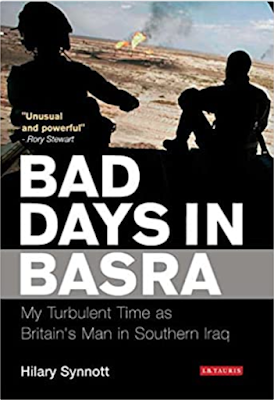
Review Bad Days In Basra, My Turbulent Time as Britain’s Man in Southern Iraq

Synnott, Hilary, Bad Days In Basra, My Turbulent Time as Britain’s Man in Southern Iraq, London, New York: I.B. Tauris, 2008


Hilary Synnott was the head of the Coalition Provisional Authority South (CPA-South) from 2003-2004 responsible for southern Iraq. He thought the job would be daunting when he took it and found it almost impossible when he got there. He said that the CPA failed because the U.S. and England never adequately planned for the post-war situation and never provided the resources necessary to make it successful. On top of that, CPA head Paul Bremer told Synnott he only cared about Baghdad and neglected the rest of the country. Bad Days In Basra, My Turbulent Time as Britain’s Man in Southern Iraq is the tale of Synnott’s experiences with the Coalition.

Wednesday, December 15, 2021

Review Blood Money, Wasted Billions, Lost Lives, and Corporate Greed in Iraq

Miller, T. Christian, Blood Money, Wasted Billions, Lost Lives, and Corporate Greed in Iraq, New York, Boston, London: Little, Brown and Company, 2006


Blood Money, Wasted Billions, Lost Lives, and Corporate Greed in Iraq is about the failed reconstruction project by the United States after the 2003 invasion that deposed Saddam Hussein. Author T. Christian Miller goes through the planning, the different sectors of the country that the Americans tried to rebuild, the private contractors that flocked to profit from the war, and the effect this had on the people of Iraq. The author argues that the U.S. never had solid leadership, kept changing its plans and the result was a total failure.

Thursday, November 11, 2021

Review Night Draws Near, Iraq’s People In The Shadow Of America’s War

Shadid, Anthony, Night Draws Near, Iraq’s People In The Shadow Of America’s War, New York: Picador, 2006


Anthony Shadid was a reporter for the Washington Post who went to Iraq before, during and after the 2003 invasion. He was Arab and spoke the language which gave him far greater access to the average Iraqi than most Western journalists. That was what Night Draws Near, Iraq’s People In The Shadow Of America’s War focuses upon, average Iraqis and their feelings about the events that swept over their country. As he wrote, the fall of Saddam Hussein wasn’t a finale as the White House believed but the start of a new period in Iraqi history marked by dramatic changes, war and lots of suffering.

This Day In Iraqi History - Sep 9 Sheikh Abu Risha announced the Anbar Salvation Council to fight Al Qaeda in Iraq in Ramadi

871 Zanj slave rebellion returned to Basra city Offered amnesty to residents and then massacred them Survivors hid in city for weeks a...