Showing posts with label Reconstruction. Show all posts

Thursday, May 2, 2024

Review Losing The Golden Hour, An Insider’s View of Iraq’s Reconstruction

Stephenson, James, Losing The Golden Hour, An Insider’s View of Iraq’s Reconstruction, Potomac Books, Inc., 2007


The “Golden Hour” is the time after a war has ended when rebuilding and reforms can be carried out in a country before the public turns against them. James Stephenson was the United States Agency for International Development (USAID) chief in Iraq from 2004-2005. In his Losing The Golden Hour, An Insider’s View of Iraq’s Reconstruction he argues that America failed to rebuild Iraq because of lack of planning, experience and bickering.

Thursday, November 16, 2023

Review Fighting for Fallujah, A New Dawn for Iraq

Ballard, John, Fighting for Fallujah, A New Dawn for Iraq, Westport, London: Praeger Security International, 2006


Fighting for Fallujah, a New Dawn for Iraq is a military history of the two battles for the Iraqi city by John Ballard. It covers how Fallujah became a center of resistance to the U.S. occupation, then the American attempt to pacify it and concludes with the rebuilding effort. It is heavy on details about the U.S. military units involved. The author veers off course sometimes but it is still a good blow by blow account of the struggle for Fallujah.

Thursday, January 19, 2023

Review We Meant Well, How I Helped Lose the Battle for the Hearts and Minds of the Iraqi People

Van Buren, Peter, We Meant Well, How I Helped Lose the Battle for the Hearts and Minds of the Iraqi People, New York: Metropolitan Books, 2011


Martin van Buren was a State Department official who was sent to Iraq for one year to head an embedded Provincial Reconstruction Team (ePRT) in 2009. His book We Meant Well, How I Helped Lose the Battle for the Hearts and Minds of the Iraqi People reads like a travel journal. The highlight of the book is his description of how ridiculous the U.S. rebuilding effort was. That’s overshadowed by van Buren’s cynicism and immaturity which dominates his writing.

Tuesday, February 15, 2022

Iraq’s Sinjar Dist May Forever Be Changed As Few Yazidis Have Returned

(Wikipedia)
There have recently been two humanitarian reports on the situation in Ninewa’s Sinjar district. One looked at a subdistrict and found a severe lack of rebuilding. The second noted that the increase in Turkish air strikes on the area was another detriment to people returning. It found that only 30% of Yazidis have returned as a result.

Wednesday, December 22, 2021

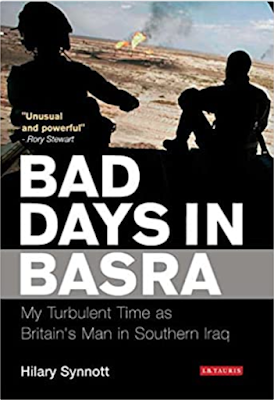
Review Bad Days In Basra, My Turbulent Time as Britain’s Man in Southern Iraq

Synnott, Hilary, Bad Days In Basra, My Turbulent Time as Britain’s Man in Southern Iraq, London, New York: I.B. Tauris, 2008


Hilary Synnott was the head of the Coalition Provisional Authority South (CPA-South) from 2003-2004 responsible for southern Iraq. He thought the job would be daunting when he took it and found it almost impossible when he got there. He said that the CPA failed because the U.S. and England never adequately planned for the post-war situation and never provided the resources necessary to make it successful. On top of that, CPA head Paul Bremer told Synnott he only cared about Baghdad and neglected the rest of the country. Bad Days In Basra, My Turbulent Time as Britain’s Man in Southern Iraq is the tale of Synnott’s experiences with the Coalition.

Wednesday, December 15, 2021

Review Blood Money, Wasted Billions, Lost Lives, and Corporate Greed in Iraq

Miller, T. Christian, Blood Money, Wasted Billions, Lost Lives, and Corporate Greed in Iraq, New York, Boston, London: Little, Brown and Company, 2006


Blood Money, Wasted Billions, Lost Lives, and Corporate Greed in Iraq is about the failed reconstruction project by the United States after the 2003 invasion that deposed Saddam Hussein. Author T. Christian Miller goes through the planning, the different sectors of the country that the Americans tried to rebuild, the private contractors that flocked to profit from the war, and the effect this had on the people of Iraq. The author argues that the U.S. never had solid leadership, kept changing its plans and the result was a total failure.

Thursday, September 16, 2021

Review Fallujah Awakens, Marines, Sheikhs, and the Battle Against Al Qaeda

Ardolino, Bill, Fallujah Awakens, Marines, Sheikhs, and the Battle Against Al Qaeda, Annapolis: Naval Institute Press, 2013


Fallujah Awakens, Marines, Sheikhs, and the Battle Against Al Qaeda is Bill Ardolino’s tale of how the Marines forged an alliance with sheikhs from the Albu Issa tribe in the Fallujah peninsula south of the city to battle the Islamic State of Iraq (ISI) in 2007. The area was a base for ISI and split the Albu Issa literally in half. A few sheikhs were tired of the insurgents taking over their territory and asked the Americans for help. The story is about how ISI alienated members of the Albu Issa while the Marines tried new tactics which turned around the security situation.

Wednesday, December 16, 2020

Review Imperial Life In The Emerald City, Inside Iraq’s Green Zone

Chandrasekaran, Rajiv, Imperial Life In The Emerald City, Inside Iraq’s Green Zone, New York: Vintage Books, 2006


Imperial Life In The Emerald City, Inside Iraq’s Green Zone by Washington Post journalist Rajiv Chandrasekaran is a critique of the American effort to rebuild Iraq under the Office of Reconstruction and Humanitarian Assistance (ORHA) and the Coalition Provisional Authority (CPA) in the first year of the American occupation. The U.S. wanted to create a democracy and free market in Iraq that would be a model for the rest of the Middle East but its dreams crashed on the rocks of reality. It’s ideas were too big, its resources too little, and its planning poor and often times haphazard.

Wednesday, December 9, 2020

Review Liberate And Leave, Fatal Flaws In The Early Strategy For Postwar Iraq

Eberly, Don, Liberate And Leave, Fatal Flaws In The Early Strategy For Postwar Iraq, Minneapolis: Zenith Press, 2009


Liberate And Leave, Fatal Flaws In The Early Strategy For Postwar Iraq is about Don Eberly’s time working for the Office for Reconstruction and Humanitarian Assistance (ORHA) and the Coalition Provisional Authority (CPA). The book is mostly his personal recollections of his time in Iraq during the early U.S. occupation. It’s a bit rambling, but his main points were that the U.S. had no plan to rebuild Iraq, and he also questioned whether the Americans could create a democracy in Iraq given its history under Saddam Hussein.

Wednesday, July 22, 2020

Review Hard Lessons, The Iraq Reconstruction Experience


Bowen, Stuart, Hard Lessons, The Iraq Reconstruction Experience, Washington D.C.: U.S. Government Printing Office, 2009

Stuart Bowen was the Special Inspector General for Iraq Reconstruction from 2004-13. His job was to assess the American rebuilding effort in Iraq. In a series of reports he documented the huge failure the United States suffered in Iraq. Much of that history was put together in Hard Lessons, The Iraq Reconstruction Experience that covers the period from 2001 to 2008. At the heart of the matter was the U.S. attempting the largest rebuilding effort in its history in the middle of a war with no unified plan which was a recipe for disaster.

Tuesday, April 7, 2020

Displaced Returns Become A Trickle In Iraq In 2020

(International Organization for Migration)
Almost two and half years after Iraq’s victory over the Islamic State and the returns of those displaced (IDPs) during the war is almost over. While 4.6 million people have gone back to their home areas there are still 1.3 million IDPs. Over 500,000 of those that have gone back are living in severe conditions as well. This repeats Iraq’s previous experience when during the civil war approximately one million had to settle in new areas after the fighting was over.  

Tuesday, August 13, 2019

IMF Warns Iraq It Needs To Change Its Priorities But Baghdad Unresponsive


The International Monetary Fund released a report on Iraq’s budget and economy in July 2019. It repeated warnings it has been making for the last several years. Namely that Iraq needed to changed its spending, focus upon investment, reform its economy, and fight corruption. This message has been delivered to Iraq by the IMF, the World Bank, and the United States for years, and yet there has been no change. That’s because Iraq’s elites benefit from the way the system currently works.

Thursday, August 1, 2019

Postwar Situation In West Mosul - Many Unresolved Issues

Old City West Mosul (Al Jazeera)


The International Organization for Migration (IOM) is the main group working with Iraq’s displaced population (IDPs). In June 2019 it released the results of survey work it did in West Mosul, the most war damaged area in Iraq. It talked with people that stayed in the city during the Islamic State occupation, those the fled and have now returned, and those that are still displaced. The IOM found that there are still major unresolved issues for the district including a lack of rebuilding, services, schools and jobs, along with distrust and resentment.

Thursday, July 18, 2019

Postwar Situation In Fallujah Rebuilding Mostly Done Economy And Services Not Recovered

(REACH)

There is very little information coming out about Iraq’s postwar areas. The Iraqi media says little and the western press even less. NGOs are the only organizations putting out reports on these places. REACH released an assessment of Anbar’s Fallujah district. It found that almost all the displaced have returned, war damaged was mostly repaired, but there is a lack of services and jobs which is hindering the revival of the economy.

Wednesday, July 10, 2019

Lack Of A Rebuilding Plan Undermines Iraq’s Call For More Help


West Mosul 2 years after the end of the war vs the Islamic State (Al Jazeera)

At the end of June Prime Minister Adil Mahdi and Ninewa Governor Mansour al-Marid both called for more international help to rebuild the country. At a meeting with a delegation from the United Nations’ Security Council the premier said that the international community should be helping Iraq more with reconstruction. That same day Governor Marid stated that the world was responsible for what happened to Mosul during the war against the Islamic State so it should provide more aid and investment. This came after the Trade Ministry announced a conference including 120 companies and 11 countries such as Germany, India, Iran, Saudi Arabia, Egypt and others to try to garner money for putting post-conflict areas back together.

Wednesday, May 22, 2019

Difficult Situations In Postwar Areas Of Iraq

As of March 2019 4,188,780 displaced (IDPs) Iraqis had returned home. That is a priority of the government, but it has no rebuilding or reconciliation policy to help these people. The International Organization for Migration (IOM) did a survey of the areas people are going back to. It surveyed 1,547 locations across eight provinces in February 2019. The situation in home areas is important because the more difficulties there the less likely IDPs are to go back.
(IOM)

Tuesday, May 21, 2019

Postwar Business Situation In Mosul

(Mosul Eye)

Mosul was one of the most heavily damaged cities in Iraq after it was liberated in 2017. The business sector is trying to revive itself but facing major difficulties. That includes the aftermath of the fighting, spotty services, high costs, the lack of credit, and trying to rebuild markets.

Tuesday, May 14, 2019

Postwar Business Environment In Fallujah

(Combating Terrorism Center)

The International Organization for Migration did a survey at the end of 2018 into the economic situation in Fallujah. It found that a high number of businesses were destroyed and looted during the time the city was under Islamic State control and the period it was liberated. In the aftermath firms are still facing difficulties like in many other post conflict areas of Iraq.

Tuesday, April 16, 2019

Glimpse At Some Of The Liberated Areas Of Iraq


Aid groups are really the only ones consistently reporting on the liberated areas of Iraq. Many of these places are rural and the government isn’t even that present. The United Nations’ Migration Agency, Returns Working Group, and Social Inquiry released a paper on the displaced returning home that contained information on the Ramadi district in Anbar, Sadiya and Jalawla in Diyala, Abbasi in Kirkuk, west Mosul, Sinjar, and Tal Afar in Ninewa, and Baiji and Tuz Kharmato in Salahaddin. All were considered hotspots due to local tensions, the lack of housing and services, and other issues they are encountering since they were freed from the Islamic State.

Monday, April 8, 2019

Revised Review Nights in the Pink Motel, An American Strategist’s Pursuit of Peace in Iraq


Revised Review Earle, Robert, Nights in the Pink Motel, An American Strategist’s Pursuit of Peace in Iraq, Annapolis: Naval Institute Press, 2008

Robert Earle was a veteran State Department official who was in retirement writing books when he was called back into service by John Negroponte who was just appointed the U.S. Ambassador to Iraq in the summer of 2004. Negroponte wanted Earle to be his “thinker.” His book Nights in the Pink Motel is divided into four sections. Three of those focus upon Earle writing strategy papers for Negroponte and U.S. commander in Iraq General George Casey. The middle section is when Earle got a blood clot in Baghdad, which forced him leave Iraq, and head to Germany for medical treatment. Earle writes in an easy and informal style, and the book reads like a journal rather than a formal account of events. The main take away from The Pink Motel was that the U.S. dug itself into a hole the first year in Iraq, and even when it tried to come up with a strategy to pull itself out, it fell short.

This Day In Iraqi History - Sep 9 Sheikh Abu Risha announced the Anbar Salvation Council to fight Al Qaeda in Iraq in Ramadi

871 Zanj slave rebellion returned to Basra city Offered amnesty to residents and then massacred them Survivors hid in city for weeks a...