Showing posts with label Surge. Show all posts

Friday, February 13, 2026

Review Roger Petersen, Death, Dominance, and State-Building, The US in Iraq and the Future of American Military Intervention, Oxford University Press, 2024


Death, Dominance, and State-Building, The US in Iraq and the Future of American Military Intervention is a very detailed argument by MIT Professor Roger Petersen that America’s counterinsurgency and nation building strategies failed in Iraq. His point is that the U.S. was able to temporarily bring down violence during the Surge but failed to maintain the peace nor build a functioning Iraqi state.

Friday, July 25, 2025

Review James Baker III and Hamilton, Lee, The Iraq Study Group Report, The Way Forward – A New Approach, Vintage Books, 2006

Baker, James, III and Hamilton, Lee, The Iraq Study Group Report, The Way Forward – A New Approach, Vintage Books, 2006


By 2006 the American political establishment finally realized that things were not going right in Iraq. Violence was going up and neither the Iraqis nor the U.S. seemed like they had any answers. That led to several strategy reviews including the independent Iraq Study Group whose main findings are contained within this book. Ironically rather than coming up with a course adjustment the group actually advocated for maintaining the status quo showing that many of the elites didn’t know what the actual policy was in Iraq.

Friday, June 20, 2025

Review Kelly Kennedy, They Fought for Each Other: The Triumph and Tragedy of the Hardest Hit Unit in Iraq, St. Martin’s Griffin, 2011

Kennedy, Kelly, They Fought for Each Other: The Triumph and Tragedy of the Hardest Hit Unit in Iraq, St. Martin’s Griffin, 2011


On June 21, 2007, reporter Kelly Kennedy witnessed the worst attack upon Charlie Company of the 26th Infantry Regiment when an IED killed several soldiers during its deployment to the Adhamiya district of Baghdad. Kennedy bonded with the unit afterwards and felt their pain. This experience led her to write They Fought for Each Other: The Triumph and Tragedy of the Hardest Hit Unit in Iraq which discusses not only their time in Iraq but the trauma they faced afterwards.

Friday, March 14, 2025

Review Timothy Andrews Sayle, Engel, Jeffrey, Brands, Hal and Inboden, William, Edited by, The Last Card, Inside George W. Bush’s Decision To Surge In Iraq, Cornell University Press, 2019

Sayle, Timothy Andrews, Engel, Jeffrey, Brands, Hal and Inboden, William, Edited by, The Last Card, Inside George W. Bush’s Decision To Surge In Iraq, Cornell University Press, 2019


The Last Card, Inside George W. Bush’s Decision To Surge In Iraq provides the most comprehensive view of how the Bush administration decided to order the Surge in 2007. It consists of two halves. The first is interviews with 28 members of the White House starting with President Bush himself along with Vice President Dick Cheney, Secretary of State Condoleezza Rice, and various members of the National Security Council, State Department, and Pentagon. The second part is a series of articles by academics trying to evaluate the decision making process and giving some views of whether the Surge worked or not. It’s those firsthand accounts of most of the major players within the government that makes this a must read for those interested in the Surge.

Tuesday, November 19, 2024

US Army In The Iraq War Volume 2 Chapter 13 Toward The Defeat Of AQI, August 2009-July 2010


Chapter 13 in the U.S. Army’s second volume on the Iraq war covers the end of 2009 to the start of 2010. The Islamic State of Iraq reached a nadir during that period losing most of its leadership and manpower. Prime Minister Nuri al-Maliki continued to be an incompetent war time leader while plotting to hold onto power after he lost an election. That meant Iraq couldn’t take advantage of the decline of the insurgency.

Monday, July 22, 2024

US Army In The Iraq War Volume 2 Ch 6 “The Darkness Has Become Pitch Black”


Chapter 6 of the U.S. Army’s second volume on the Iraq War is about the ups and downs during the heart of the Surge in the mid to late-2007. Continued U.S. operations were degrading the insurgency leading to a dramatic drop in violence. Part of that success was due to the continued expansion of the Sunni Sahwa which the government rejected. On the other hand PM Maliki’s administration remained plagued by problems while still relying upon militias. In the middle of all that the Iraqi ruling parties continued their machinations against each other.

Thursday, June 27, 2024

Review The U.S. Army In The Iraq War Volume 2, Surge And Withdrawal 2007-2011

Rayburn, Colonel Joel, Sobchak, Colonel Frank, Editors, The U.S. Army In The Iraq War Volume 2, Surge And Withdrawal 2007-2011, Strategic Studies institute and U.S. Army War College Press, 2019


The second volume of the U.S. Army’s official history of the Iraq War covers the Surge of 2007 to the Americans returning to Iraq after the fall of Mosul in 2014. Three things stand out. First was how dysfunctional the Bush administration was when it rolled out its new strategy in 2007. The second is the details provided on how Prime Minister Nouri al-Maliki hallowed out the Iraqi Security Forces so he could take control of them which helped lead to the resurgence of the insurgency. Last, it touches on how paranoid Maliki was. The sheer length of the book at over 600 pages and its density makes it one for Iraq researchers more than the general public.

Wednesday, June 26, 2024

US Army In The Iraq War Volume 2 Ch 5 “The Surge Of Operations”


Chapter 5 of the second volume of the U.S. army’s history of the Iraq War focuses upon the summer of 2007. The Americans expanded their operations from Baghdad into neighboring Diyala while there were still differences over the new strategy. Part of that effort to turn tribes and insurgents against the Islamic State of Iraq ran into continued opposition from Prime Minister Nuri al-Maliki. On the other hand, Iranian backed militias were fighting each other for control of southern Iraq.

Tuesday, June 25, 2024

US Army In The Iraq War Volume 2 Ch 4 “The Awakening Gathers Momentum”


Chapter 4 of the second volume in the U.S. army’s history of the Iraq War is about how the Anbar Awakening expanded in the province. That eventually led to other tribes and insurgent groups to turn against the Islamic State of Iraq across central Iraq in what became known as the sahwa.

Wednesday, June 19, 2024

US Army In The Iraq War Volume 2 Ch 3 “The New Way Forward, February 2007-April 2007”


The third chapter of the U.S. army’s history of the Iraq War covers the start of the Surge in February 2007. There were two main issues. First, there were still differences over the new strategy. Second, the Americans looked to the Iraqi government to be a partner but it was an actor in the civil war trying to establish Shiite supremacy over Baghdad.

Tuesday, June 18, 2024

US Army In The Iraq War Volume 2 Ch 2 “The Eve Of The Surge, December 2006-February 2007”


Chapter 2 of the U.S. Army’s second volume on the Iraq War covers the period after President Bush decided to surge troops into Iraq but before it was actually implemented. It showed more dysfunction within the U.S. government, while inside Iraq the warring factions were preparing for a final confrontation.

Tuesday, June 4, 2024

US Army In The Iraq War Volume 2 Ch 1 “Strategy In Crisis, October-December 2006


The second volume of the U.S. Army’s official history of the Iraqi War starts off with President Bush trying to come up with a new Iraq strategy. He’d been disengaged from the war and finally realized in 2006 that things were not going well. It took an extended period of time to formulate a new approach which highlighted the continued dysfunction within the White House over a conflict which was supposed to be a defining moment in the administration.

Friday, October 7, 2022

Review The Strongest Tribe, War, Politics, and the Endgame in Iraq

West, Bing, The Strongest Tribe, War, Politics, and the Endgame in Iraq, New York: Random House, 2008


Bing West was one of the pre-eminent military writers on the Iraq War. A former Marine West travelled to Iraq constantly to discuss with American troops what they were going through. The Strongest Tribe, War, Politics, and the Endgame in Iraq is about how the U.S. came from the brink of defeat in Iraq and then was finally able to turn around the military situation with the Surge. His main focus is upon U.S. leadership which was severely lacking during most of the war starting with President Bush.

Thursday, September 8, 2022

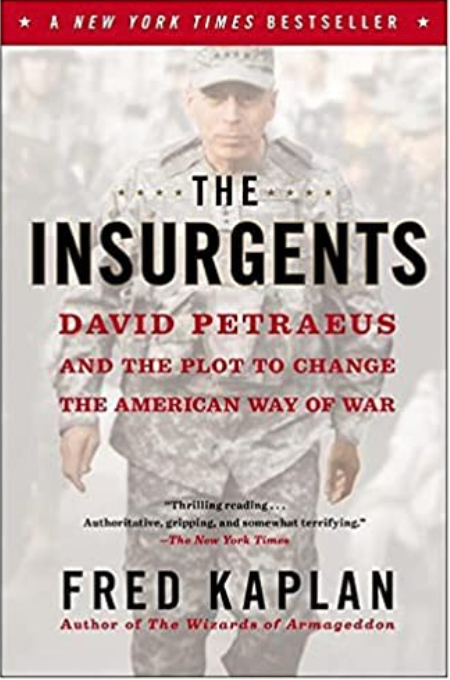
Review The Insurgents, David Petraeus And The Plot To Change The American Way Of War

Kaplan, Fred, The Insurgents, David Petraeus And The Plot To Change The American Way Of War, New York: Simon & Schuster, 2013


Journalist Fred Kaplan had a good idea behind writing The Insurgents, David Petraeus And The Plot To Change The American Way. He wanted to explain how a small group of U.S. army officers, academics and think tankers tried to incorporate counterinsurgency into military doctrine to save the failing wars in Iraq and Afghanistan. He goes into the ideas they shared, the books they read, the papers they wrote and their role in the two conflicts. Most of the book is about Iraq with only the last few chapters switching to Afghanistan under the Obama administration. Kaplan believed that counterinsurgency was institutionalized within the U.S. army, but the book has one gaping hole, an assessment of whether the new strategy worked or not.

Thursday, September 1, 2022

Review Tell Me How This Ends, General David Petraeus And the Search For A Way Out Of Iraq

Robinson, Linda, Tell Me How This Ends, General David Petraeus And the Search For A Way Out Of Iraq, New York: Public Affairs, 2008


Tell Me How This Ends, General David Petraeus And The Search For A Way Out Of Iraq by Linda Robinson is about the 2007 U.S. Surge when General David Petraeus and Ambassador Ryan Croker attempted to use new techniques to break the cycle of violence in Iraq and bring about national reconciliation. Half of the book follows a great man in history narrative as Robinson focuses upon Petraeus as the right man at the right time to bring about change. The other part covers the politics of the war both in Washington and Baghdad. The author notes the dramatic reduction in violence the Surge brought about but then couldn’t tell whether that would lead to the necessary political transformations in Iraq because her work was published before the Surge ended.

Friday, February 25, 2022

Review Overreach, Delusions of Regime Change In Iraq

MacDonald, Michael, Overreach, Delusions of Regime Change In Iraq, Cambridge, London: Harvard University Press, 2014


Overreach, Delusions of Regime Change In Iraq by Michael MacDonald might be the best explanation for why the United States invaded Iraq in 2003. It doesn’t focus upon the details of the Bush administration such as when the president said this or that but rather goes through the ideological and philosophical beliefs that led to America’s overthrow of Saddam Hussein. MacDonald argues that not only the White House but a large number of Republicans and Democrats in Congress and foreign policy experts agreed that overthrowing the regime would be easy. That was because the elite believed in American exceptionalism meaning that the U.S. was good for the world and that its values were universal and therefore Iraqis would want the same thing as Washington, a liberal democracy and a capitalist economy if only they were freed from Saddam. MacDonald not only goes through international relations theory but philosophy as well to explain these underlying assumptions behind the Iraq War.

Wednesday, January 19, 2022

Review The Gamble, General David Petraeus And The American Military Adventure In Iraq, 2006-2008

Ricks, Thomas, The Gamble, General David Petraeus And The American Military Adventure In Iraq, 2006-2008, New York: Penguin Press, 2009


The Gamble, General David Petraeus And The American Military Adventure In Iraq, 2006-2008 was journalist Tom Ricks second book about Iraq. His first, Fiasco was one of the best discussing how the U.S. military went wrong in Iraq after the 2003 invasion. The Gamble focused on how it tried to fix things with the 2007 Surge. Ricks looked at several individuals responsible for the new strategy namely Generals Jack Keane, David Petraeus and Raymond Odierno. It’s an interesting read because it argues that the U.S. succeeded tactically in bringing down the horrific violence in Iraq but did not provide the political change it hoped for that would ensure long term stability.

Wednesday, July 15, 2020

Review The Death of the Mehdi Army, The Rise, Fall, and Revival of Iraq’s Most Powerful Militia


Nicholas Krohley was a member of a U.S. Army Human Terrain Team working in east Baghdad during the Surge. This was part of the military’s attempt to understand the socio-cultural dynamics of the areas it was operating in Iraq. He was in the capital when the U.S. and Iraqi forces challenged Moqtada al-Sadr and his Mahdi Army in its home turf of Sadr City and the surrounding area. The Death of the Mehdi Army attempts to tie in the history of east Baghdad and the rise of the Sadr movement to explain how its militia collapsed in 2008.

Friday, June 26, 2020

Review Surge, My Journey with General David Petraeus and the Remaking of the Iraq War


Mansoor, Peter, Surge, My Journey with General David Petraeus and the Remaking of the Iraq War, New Haven and London: Yale University Press, 2013

Peter Mansoor wanted to write an insider’s view of The Surge. He was more than qualified as he was the executive officer to General David Petraeus the commander of the new American strategy. The result was Surge, My Journey with General David Petraeus and the Remaking of the Iraq War. It gets off to a slow start as there is too much on American personnel, organization, etc. It picks up when the Surge actually starts. Mansoor’s thesis is that the Surge came at the right time and wouldn’t have worked earlier because the conditions were not right.

Friday, May 29, 2020

Review Duty, Memoirs Of A Secretary At War

Gates, Robert, Duty, Memoirs Of A Secretary At War, New York: Alfred A. Knopf, 2014

Robert Gates had a long history in U.S. government service. His last position was Secretary of Defense, which he held at the end of the Bush administration into the first term of President Obama. His memoir of that time Duty, Memoirs Of A Secretary At War covers the bureaucratic wars he went through, the difficulties he had with the military, and various challenges the United States faced, most importantly the wars in Iraq and Afghanistan. His most major incites come from the handling of those two conflicts. He found that the Pentagon and military were not committed to either one believing that they were aberrations, and he found American politics corrosive to running both.

This Day In Iraqi History - Sep 9 Sheikh Abu Risha announced the Anbar Salvation Council to fight Al Qaeda in Iraq in Ramadi

871 Zanj slave rebellion returned to Basra city Offered amnesty to residents and then massacred them Survivors hid in city for weeks a...