Monday, January 6, 2014

Violence In Iraq’s Anbar Highlights Divided Tribes There

 
As fighting continues in Iraq’s western Anbar province, the various tribes there have found themselves in a precarious situation. Some have aligned themselves with the central government against insurgents, some are opposed to both the federal forces and the militants, while still others have joined the gunmen. Anbar was always a very divisive place in part because of the deep-seated tribal rivalries. Those are all being exasperated by the current rebellion in the governorate.

Anbar’s various sheikhs are taking sides in the brewing conflict in their governorate. The two brothers Sheikh Mohammed al-Hayes and Sheikh Hamid al-Hayes were aligned with Baghdad before the fighting started. The Hayes brothers were opponents of the Anbar protests and accused the Ramadi site of harboring the murders of Mohammed’s son in December 2013. When the prime minister began threatening to shut down the demonstrations the Hayes’ were enthusiastic supporters. On December 27 for example, Mohammed al-Hayes met with delegations from the Albu Diab, Albu Jaber, Albu Ali al-Jassim, Albu Fahd, Albu Shaban, and Albu Hamza tribes, and they pledged to support the central government, while Hayes called for Maliki to burn down the protest camps. Then when the Ramadi site was closed Hamid al-Hayes called for all the rest to be shut down as well saying they were connected to terrorism. When fighting broke out, he wanted the army to be sent to Anbar’s cities to secure them from the Islamic State of Iraq and The Levant (ISIS). Sheikh Ahmed Abu Risha is another tribal leader who has been moving towards Baghdad in recent months. In January he said that the people of Anbar should fight the Islamic State. His men have created joint patrols with SWAT forces in Ramadi, and claimed to have killed 62 ISIS fighters. Sheikh Wisam Hardan is a third local leader who has thrown in his lot with Baghdad. All three of these sheikhs have different reasons for working with the central government. Some wanted the money that came along with cooperating with the prime minister, which could then be used in their patronage networks to maintain their followers. Some wanted to use their ties with Maliki against their rivals in Anbar. Others were concerned about the rise of the Islamic State and the increasing violence in the province, because they fought them during the Awakening, knew about their past crimes, and could be targeted by the Islamists in the future.

A second group of sheikhs is holding a middle position. They want the insurgents and especially ISIS out of their areas, but are just as opposed to the federal government. They have been cooperating with the local police, but refuse to do so with the army, Federal Police or SWAT. Sheikh Majid Sulaiman called on other sheikhs to take up arms against the Islamic State, and said they would protect local police stations. A member of the Anbar Tribes Council Sheikh Naji al-Dulaimi stated that he supported the local police, and opposed the armed groups trying to take over the province. The Albu Bali tribe worked with police to retake some stations in the Jazeera area outside of Ramadi that had been taken over by insurgents. The Albu Ghanim arrested three Islamic State fighters in Ramadi as well. Two unknown tribes have come to the aid of the police in Haditha. These tribes want to maintain their local power bases, and see both the militants and Prime Minister Maliki as threats. Many Anbaris feel that the Shiite led government is sectarian and only interested in oppressing Sunnis. The federal security forces are seen as an extension of the premier, and are therefore rejected. The insurgents are considered just as dangerous, because if they gain a foothold they will try to take away the tribesmen as fighters, charge taxes, and in the case of the Islamic State impose its harsh form of Islam, and kill anyone that opposes it. Almost all of the Anbar sheikhs were involved with the Awakening and remember the excesses the Islamic State’s predecessor, Al Qaeda in Iraq perpetrated in the province, and don’t want to see it return.

A third collection of sheikhs has joined the militants. The Albu Alwan tribe has supposedly split in half. One part has fought both the Islamic State and SWAT forces. The other is working with security forces to fight the insurgents. While ISIS is constantly mentioned as being in control of Fallujah and moving into Anbar in general, most of the fighters seen in the governorate’s cities are not aligned with them. Some are tribesmen who have taken up arms, because of their opposition to Baghdad. They see the security forces conducting mass raids and carrying away dozens and dozens of people without warrants as part of a sectarian campaign by the Shiite led government against Sunnis. That led some to the protest movement, and they were angry when Maliki shut down the Ramadi site. In general, they do not see a way to have their demands met by legitimate means, and are now taking up the gun instead.

The sheikhs in Anbar now find themselves in the middle of a conflict between the insurgents and the government. Depending upon their position vis-à-vis Baghdad some have supported the central government, some have joined the insurgency, and others want both the militants and the federal forces out of Anbar. This is similar to what happened before following the U.S. invasion. Like then, some tribes decided to join the insurgency, and some were opposed to it. They were eventually all brought together under the Anbar Awakening, but then split apart in 2007 over how to enter politics. The sheikhs have been divided ever since then, and that’s what’s behind the various positions they are taking on the current fighting. That will make it all the harder for Baghdad to secure the province, because its forces can cause just as much conflict as end it. The tribes may not have the manpower, and definitely don’t have the firepower to take on the militants by themselves either. A positive result could be that more of them see a common enemy in the insurgency and decided to take some kind of assistance from Baghdad. The worse case is that Anbar descends into increasing violence and the sheikh’s rivalries fuel the fighting. Their short sightedness will be one of the biggest barriers to overcome to turn things around in the province.

SOURCES

AIN, “Hayis : Ramadi needs IA forces to clear it from terrorists,” 1/1/14
- “ISF, Anbar tribes pledge to eliminate all terrorists,” 1/5/14
- “Urgent….4 tribes announce supporting ISF in Anbar,” 1/1/14

Ali, Ahmed, “Iraq Update #42: Al-Qaeda in Iraq Patrols Fallujah; Aims for Ramadi, Mosul, Baghdad,” Institute for the Study of War, 1/5/14

Jawad, Haider Ali, “Anbar..Maliki issued an amnesty for wanted..And half of the Albu Alwan tribe organized into Awakening..Al Qaeda seized money from banks,” Buratha News 1/5/14

Lewis, Jessica, “Iraq Update #41: Showdown in Anbar,” Institute for the Study of War, 1/2/14

Al-Mada, “Hayes: Ramadi sit-in square has become the headquarters for Al Qaeda and we will participate in clearing it of its most wanted,” 12/27/13

National Iraqi News Agency, “Amir of Dulaim clans tribes to stand with security forces to fight Qaeda and ISIL,” 1/2/13
-  “Anbar Tribes Council: Tribes support local police, do not allow assaulting official institutions,” 1/1/14
- “Anbar tribes regain /9/ police stations which was dominated by terrorists yesterday,” 1/2/14

New Sabah, “Anbar Council: army needs to enter,” 1/4/14

Radio Nawa, “Hayes: ending the sit-in squares is essential,” 12/31/13

Shafaq News, “Hardan: We refuse to work with Abu Risha,” 1/5/14

REUTERS VIDEO: Air Strikes Target Suspected Sunni Militants in Iraq

AL JAZEERA VIDEO: Iraq Violence Maliki Under Fire As Bombings Continue


REUTERS VIDEO: Violence Rages In Iraq


CARNEGIE ENDOWMENT VIDEO: Paul Salem On Iraq's Foreign Policy

Thursday, January 2, 2014

Aftermath of Shutting Down Ramadi Protest Site In Iraq

 
On December 30, 2013, Iraq’s Prime Minister Nouri al-Maliki in conjunction with Anbar Governor Ahmed Diab took down the protest site in Ramadi. The province was already inflamed by the arrest of Parliamentarian Ahmed Alwani two day before from the Iraqi Islamic Party who was one of the leaders of the demonstrations. Immediately fighting broke out in Ramadi and Fallujah, which has continued to the present time. This has brought the internal divisions within Anbar to the forefront with different groups and individuals coming out for and against Baghdad in this conflict. In the bigger picture, the premier’s actions have probably succeeded in turning a large part of Anbar opinion towards armed struggle, which will undermine Iraq’s already precarious security situation.

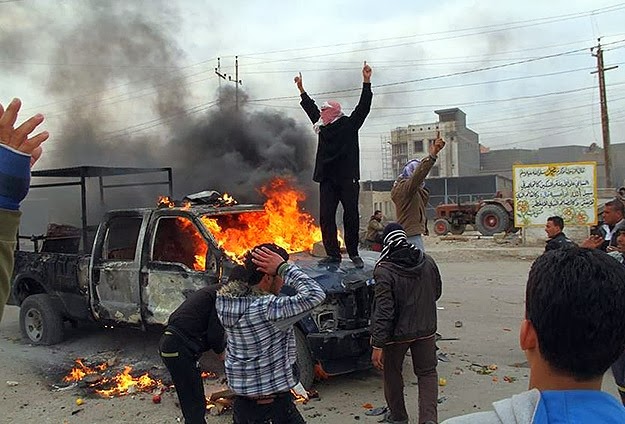
The decision to close the Ramadi sit-ins immediately led to violence across Anbar. As soon as local police took down the site, gunmen appeared in the streets of Ramadi and Fallujah who eventually began attacking the security forces. Some mosques in Ramadi were heard calling for jihad according to Azhar Shallal of Agence France Presse.  Several police cars were seized in Ramadi and burned by gunmen. There were also clashes reported in Hit. The fighting continued into December 31. A police station was taken over in Ramadi, the 8th Army Brigade base outside of Ramadi was hit by several rockets, while two other military camps were overrun by fighters in Haditha and Baghdadi. By January 1st it appeared militants had gained sway over large parts of Fallujah, Ramadi, with fighting spreading to Kharma. Previously, Al Qaeda in Iraq (AQI) had been trying to re-establish itself in the province. It was setting up supply bases and training camps in the desert and border regions, while its main operations were in the major cities. Other smaller insurgent groups were still active as well. Now with this decision to take down the protest site, Maliki has given impetus to a whole new group of young men to take up arms against the government. The prime minister was in negotiations with the Anbar authorities and tribes to peacefully end the demonstrations by offering a number of concessions over prisoners and development. Both sides were interested in ending the sit-ins, as they were concerned about the re-birth of the insurgency. Then the leadership of the 7th Division in Anbar was killed in a trap by AQI in the middle of December. This led to a upswing in nationalist sentiment across a large segment of society and the political class. The premier on the other hand used the opportunity to force the matter with the protesters. First he ordered a raid to arrest Parliamentarian Ahmed Alwani from the Iraqi Islamic Party who had an arrest warrant out for him for his inflammatory remarks about Shiites and the insurgency at the protests, and then cut a deal with Anbar Governor Diab to take down the Ramadi site. That enraged large segments of the province and led to the current fighting there. That’s given the insurgency a fresh breath of life, and in turn Al Qaeda can be counted on to take advantage of the situation as well.

Anbar officials are divided about how to deal with this deteriorating situation. On the one hand there are those that have aligned themselves with Baghdad. Those include the governor who has called for the Army to be sent into Ramadi to restore order. He also made comments about Al Qaeda having members amongst the demonstrators, something repeated by Maliki, and wanted the activists to go home until after the 2014 parliamentary elections. Sheikh Mohammed al-Hayes called for the premier to burn down the protest sites, and held a meeting on December 27 with the Albu Diab, Albu Jaber, Albu Ali al-Jassim, Albu Fahd, Albu Shaban, and Albu Hamza tribes, which issued a statement supporting the central government. His brother Sheikh Hamid al-Hayes of the Anbar Salvation Council said that all the protest sites should be closed on December 31 saying they were connected to terrorists. The two were threatening force against the Ramadi site previously blaming the death of Mohammed’s son on gunmen who fled into the camp afterward. On the other hand the head of the Anbar provincial council Sabah Kahout al-Halbusi disagreed with the governor’s calling for the military to protect the province, saying that the local police and tribes could do the job. The same comment was made by Sheikh Naji al-Dulaimi of the Anbar Tribes Council. Anbar has deep political and tribal divisions, which were being brought to the fore by recent events. Several groups including Governor Diab, the provincial council, both Hayes’, Sheikh Ahmed Abu Risha and others were trying to find compromise with Baghdad beforehand. They were worried about the re-birth of Al Qaeda in the province, wanted to get on with governing Anbar after the 2013 elections, and also could gain money and power from things like development projects if they cooperated with the central government. On the other hand, the Iraqi Islamic Party, other sheikhs, and much of the clerical establishment in the government were pushing for maintaining the demonstrations, and were largely unwilling to listen to what Maliki had to offer. Now that the cities in Anbar are revolting those differences are being emphasized even more.

Maliki could not have picked a worse time to come down on the protesters, and now he is suffering the consequences. Major cities in Anbar are in open rebellion. This will provide a great recruiting tool for the insurgency and Al Qaeda. At the same time, any hope the premier might have had of cutting a deal to end the remaining protests in Fallujah, Diyala, Kirkuk, Ninewa, and Salahaddin are now out the window. Within Anbar the local council, which just took power in 2013 will find themselves running an ungovernable province, and more divisions will likely emerge over how to deal with Baghdad. The tribes too will face increasing dissent as well, and the clerical establishment, which was another important ally of the demonstrators may find their influence slipping away if more and more young men turn to the gun rather than protesting. Overall, the prime minister has made a mess of things, and helped the vary militants he was trying to defeat.
Smoke emerging from Ramadi (AIN)
Blocking the highway to Syria and Jordan outside of Fallujah (AP)
Lighting tires on fire on highway outside of Fallujah (AP)
Burning police station outside of Fallujah (AP)
Police vehicle in Ramadi set ablaze (Reuters)
Police truck taken over by gunmen in Ramadi (Reuters)
Another police truck burned in Ramadi (World Bulletin)
A funeral for a person killed in the fighting in Ramadi (AFP)
Taking away the dead from the fighting in Ramadi (AFP)
Police truck burning in Ramadi (AFP)
Gunmen walking through the streets of Ramadi (Reuters)

SOURCES

Abdulrazaq, Hawar, “Exiled Iraqi VP officially resigns from his post,” Bas News, 12/31/13

AIN, “Breaking news … MPs of Motahidon Alliance submit their resignation protesting Anbar events,” 12/30/13
- “Gunmen control police station central Ramadi,” 12/31/13
- “IA Brigade moves from Basra to Anbar, says official,” 1/1/14
- “Urgent….4 tribes announce supporting ISF in Anbar,” 1/1/14

Agence France Presse, “44 Iraq MPs resign after protest camp cleared,” 12/30/13
- “Iraq militants free prisoners, burn police stations,” 1/1/14

Dunlop, W.G., “Iraq army to quit tense cities after protest camp cleared,” Agence France Presse, 12/31/13

Al Forat, “Anbar Governor calls to deploy military forces inside Ramadi to combat terrorists,” 1/1/14
- “Fallujah Police Headquarters, Mayor Office detonated by terrorists,” 1/1/14
- “Maliki orders concerned ministries to provide necessary services to Anbar,” 12/31/13

Ghaziny, Yasir, “Deadly Clashes Between Iraqi Forces and Tribal Fighters in Anbar,” New York Times, 12/30/13

Al-Mada, “Management Anbar: Daash infiltrate into the cities of the province and will pursue them,” 12/31/13

Al Masalah, “Suleiman escaped from Anbar to “Erbil,” 12/31/13

National Iraqi News Agency, “Anbar Tribes Council: Tribes support local police, do not allow assaulting official institutions,” 1/1/14
- “Armed clashes erupt again in east of Fallujah,” 12/31/13
- “Armed clashes resumed east of Fallujah,” 1/1/14
- “An Army HQ subjected to Katyusha rocket attacks north of Ramadi,” 12/31/13
- “BREAKING NEWS Anbar Governor says that Alwani will be released within hours,” 12/29/13
- “BREAKING NEWS Ramadi sit-in organizers agree to take off protest tents, authorizing the Governor do it,” 12/29/13
- “Chairman of Anbar Council rejects the Governor’s call for the Army return to cities,” 1/1/14
- “Clashes renewed in Ramadi,” 1/1/14
- “Jamal Karbouli accuse Anbar governor of colluding to break up the sit-in,” 12/30/13
- “Mosques in Falluja call for pursuing who set on fire security centers, official building,” 1/1/14
- “Sadoun Dulaimi leaves Anbar for Baghdad with tribal chiefs’s demands,” 12/29/13
- “Security source: Armed groups overrun military compounds in Hadeetha,” 12/31/13
- “Security source: Military units did not withdraw from Ramadi, clashes,” 12/31/13
- “Urgent..Maliki directs to act quickly to compensate what Anbar province lost of services because of the activities of terrorist groups,” 12/31/13

Radio Nawa, “Hayes: ending the sit-in squares is essential,” 12/31/13

Rudaw, “Sunnis Announce resignations, Calls for Resistance After Anbar Crackdown,” 12/30/13

Salaheddin, Sinan, “Iraqi police dismantle Sunni protest in west,” Associated Press, 12/30/13

Shafaq News, “Iraqi ministers boycott cabinet sessions in protest against Anbar events,” 12/31/13
- “Maliki: Al-Qaeda has lost its safe haven in the sit-in square,” 12/30/13

Shallal, Azhar, “Clashes kill 10 as Iraq forces clear Sunni protest camp,” Agence France Presse, 12/30/13

This Day In Iraqi History - Nov 14 British army ordered to seize Basra vilayet WWI

1914 Sheikh of Islam called for jihad against British and French during WWI Call was repeated in all Sunni mosques in Mosul, Baghdad a...