In January 2011, the Ministry of Migration and Displacement announced that it had formulated a master plan to deal with Iraq’s displaced and refugees in one year. The United Nations High Commissioner for Refugees (UNHCR) praised the idea, saying that it hoped that it would be the beginning of the end of Iraq’s refugee problem. By February however, when details of the 2011 budget were published, the Ministry had to reverse course saying that it would not be receiving enough money to fully implement its program.
In February, the Deputy Minister of Migration and Displacement told the press that the 2011 budget would not provide enough money to complete its plans to deal with the country’s displaced and refugees. The Deputy Minister said that his agency needed $416-$500 million this fiscal year, but it would only be getting $250 million.
Just the month before, the same official laid out the Ministry’s plans. He stated that the government was going to solve the refugee issue within a year. The plan would include three options for the displaced. One would be to return them to their homes, another was to have them integrate into the communities they currently reside in, and the third was to relocate others to another area. The Ministry was coordinating these actions with the UNHCR. In order to implement the program, the government would secure areas where the displaced wanted to go back to, provide short-term loans for housing, give them back their old jobs, and provide services. The Ministry already created Return Assistance Centers in Baghdad, which has the largest refugee and displaced population. These facilities offer $850 for six-months for returnees to rent a new place. The government also renewed its efforts to try to get refugees to come back, by offering Iraqis in Egypt and Yemen free plane rides home, and $250 each. Because the Ministry is only getting half of what it expected, it will only be able to implement a fraction of what it wanted to do this year.
The plan might have been too ambitious to begin with. A former Minister of Migration and Displacement told Radio Free Europe/Radio Liberty that the Ministry’s plans were not coordinated with other ministries. Areas where refugees and displaced want to go back to are supposed to be secured by the Iraqi security forces for example, but this has not been discussed with the Interior Ministry. The Ministry of Migration’s program would also involve working with several other government agencies to provide housing and services, but this too has not been worked out. The problem with the Iraqi government is that the ministries are divided between the various political blocs in the ruling coalition, with many run like personal fiefs of their ministers. There is little to no dialogue between them as a result. Without an integrated plan, refugees and the displaced cannot be dealt with, and this was true even before the 2011 budget was announced.
SOURCES
Healy, Jack and Schmidt, Michael, “Iraq Tells Refugees in Egypt and Yemen: We’ll Pay You to Return,” New York Times, 2/10/11
IRIN, “IRAQ: Funding shortfall hits plans for IDPs, returnees,” 2/28/11
Radio Free Europe/Radio Liberty, “Iraq Drafts Plan To Help IDPs, Refugees,” 1/26/11
Thursday, March 10, 2011


Wednesday, March 9, 2011
Why Didn’t The Iraqi Air Force Fight During The 2003 Invasion?
During the March 2003 U.S. invasion, the Iraqi Air Force did not show up. Saddam Hussein had 267 planes and helicopters at his disposal, but not a single one even left the ground during the war. Afterward, several dozen were found buried near air bases. The U.S. military claimed that the Iraqis were afraid to fly because of the Coalition’s air superiority. In fact, Baghdad was following a strategy shaped by the Iran-Iraq and Gulf wars.
Saddam believed that 2003 would be a limited conflict like 1991, where he would remain in power. According to captured documents found after the war, Saddam’s main priorities were: 1) a coup or a Shiite uprising, 2) regional threats from Iran and Israel, and finally 3) the Coalition in that order. He therefore wanted to preserve his forces to fight another day against the much more important internal threats and Tehran. This was the same strategy he took in previous wars.
In the Iran-Iraq War, Baghdad failed to destroy the Iranian air force on the ground in the opening attacks. Iraq then formulated a strategy of sending its air craft to friendly neighboring states where they could not be hit by Iran. That worked to preserve much of the air force during the war.
During the Gulf conflict, Iraq followed a similar plan. First, it tried to hide many of its planes by dispersing them throughout the country. When that didn’t work, it decided to send aircraft to the only nation that the Coalition would not hit, Iran. 173 fighters, bombers, and transports were flown to Iran as a result. The problem was, after the war, Tehran did not return the planes, and Iraq lost a sizeable piece of its air force.
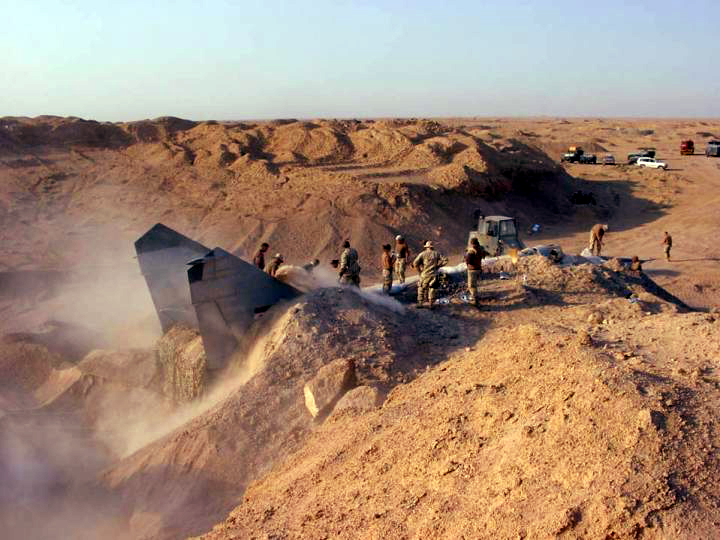
The Gulf War shaped Saddam’s perceptions of the 2003 invasion. He believed there would be a massive air campaign, southern Iraq might be taken, but the U.S. would not enter Baghdad, and he would remain in office. Following this view, Iraq wanted to preserve its air force from what it thought would be a short conflict. That led it to hide its planes amongst trees, place destroyed aircraft on airfields as decoys, bury several dozen planes in the sand, and not fly a single sortie. After the war, U.S. forces looking for WMD dug up 24 Iraqi planes including MiG-25 fighters and Su-25 fighter-bombers in a western Baghdad air base.


Rather than being afraid to fight in 2003 as the Americans initially speculated, Iraq was simply following the same pattern it had set nearly twenty years before. Ever since the Iran-Iraq War, Baghdad had tried to protect its air force from its enemies by hiding them, either within the country, or in neighboring states during conflicts. Because Saddam did not see the U.S.-led coalition in 2003 as a real threat to his power, he did not want to waste his planes during the invasion, and chose to bury and camouflage them instead. That was the real lesson from the episode, in that it revealed Saddam’s flawed perceptions of the war that would unseat him.
SOURCES
Associated Press, “Iraqi Warplanes Found Buried in Desert,” 8/1/03
Global Security, “Iraqi Air Force Equipment – Introduction,” 1/22/05
Haulman, Daniel, “What Happened to the Iraqi Air Force?” Air Force Historical Research Agency, 11/5/09
Smith, Charles, “Iraqi ‘Mach 3’ MiG Buried in Sand,” Newsmax, 8/6/03
Woodsa, Kevin, Stout, Mark, “Saddam’s Perceptions and Misperceptions: The Case of ‘Desert Storm,’” Journal of Strategic Studies, February 2010
Saddam believed that 2003 would be a limited conflict like 1991, where he would remain in power. According to captured documents found after the war, Saddam’s main priorities were: 1) a coup or a Shiite uprising, 2) regional threats from Iran and Israel, and finally 3) the Coalition in that order. He therefore wanted to preserve his forces to fight another day against the much more important internal threats and Tehran. This was the same strategy he took in previous wars.
In the Iran-Iraq War, Baghdad failed to destroy the Iranian air force on the ground in the opening attacks. Iraq then formulated a strategy of sending its air craft to friendly neighboring states where they could not be hit by Iran. That worked to preserve much of the air force during the war.
During the Gulf conflict, Iraq followed a similar plan. First, it tried to hide many of its planes by dispersing them throughout the country. When that didn’t work, it decided to send aircraft to the only nation that the Coalition would not hit, Iran. 173 fighters, bombers, and transports were flown to Iran as a result. The problem was, after the war, Tehran did not return the planes, and Iraq lost a sizeable piece of its air force.
The Gulf War shaped Saddam’s perceptions of the 2003 invasion. He believed there would be a massive air campaign, southern Iraq might be taken, but the U.S. would not enter Baghdad, and he would remain in office. Following this view, Iraq wanted to preserve its air force from what it thought would be a short conflict. That led it to hide its planes amongst trees, place destroyed aircraft on airfields as decoys, bury several dozen planes in the sand, and not fly a single sortie. After the war, U.S. forces looking for WMD dug up 24 Iraqi planes including MiG-25 fighters and Su-25 fighter-bombers in a western Baghdad air base.
MiG-25 found July 2003 in western Baghdad (U.S. Air Force)


Rather than being afraid to fight in 2003 as the Americans initially speculated, Iraq was simply following the same pattern it had set nearly twenty years before. Ever since the Iran-Iraq War, Baghdad had tried to protect its air force from its enemies by hiding them, either within the country, or in neighboring states during conflicts. Because Saddam did not see the U.S.-led coalition in 2003 as a real threat to his power, he did not want to waste his planes during the invasion, and chose to bury and camouflage them instead. That was the real lesson from the episode, in that it revealed Saddam’s flawed perceptions of the war that would unseat him.
SOURCES
Associated Press, “Iraqi Warplanes Found Buried in Desert,” 8/1/03
Global Security, “Iraqi Air Force Equipment – Introduction,” 1/22/05
Haulman, Daniel, “What Happened to the Iraqi Air Force?” Air Force Historical Research Agency, 11/5/09
Smith, Charles, “Iraqi ‘Mach 3’ MiG Buried in Sand,” Newsmax, 8/6/03
Woodsa, Kevin, Stout, Mark, “Saddam’s Perceptions and Misperceptions: The Case of ‘Desert Storm,’” Journal of Strategic Studies, February 2010
Tuesday, March 8, 2011
Sons Of Iraq Were Mismanaged By Americans And Neglected By Baghdad
In 2007 during the Surge, the Americans decided to create the Sons of Iraq (SOI) program. The U.S. spent over $300 million on the effort, which was billed as splitting the insurgents from the population. In the time that the Americans ran the program, they never took the time to really pay attention to how many SOI there were, how many were on duty at any given time, what they did, or whether the effort was really successful or not. At the end of 2008, the SOI started transitioning to Iraqi government control. Baghdad said that it would give all of them jobs in the security forces or other ministries. Instead, it ended up paying them late, and then froze hiring them. The government has promised to restart the process, but there are open questions about whether this will happen or not. The entire history of the Sons of Iraq shows that it was initially mismanaged by the Americans, and then neglected by the Iraqi government.
In June 2007, the U.S. military command authorized the use of the Commander’s Emergency Response Program (CERP) to fund the SOI program. The U.S. would end up spending around $370 million on the SOI from 2007-2009. The SOI grew out of the Anbar Awakening, when nationalist insurgents and tribes decided to break with Al Qaeda in Iraq. The U.S. would eventually sign 779 individual SOI agreements covering at its peak, 104,000 fighters in nine provinces across Iraq.
Growth Of The Sons Of Iraq
2007
June 12,000
July 24,000
August 27,000
September 29,000
October 40,000
November 57,000
December 68,000
2008
January 73,000
February 82,000
March 92,000
April 104,000
May 105,000
June 104,000
July 102,000
August 99,000
September 99,000
October 95,000
November 93,000
December 91,000
2009
January 91,000
February 91,000
The U.S. claimed that the SOI was a smashing success, but only had anecdotal evidence to prove it. The Americans said that the SOI provided intelligence, found weapons caches, acted as a force multiplier to support U.S. and Iraqi forces, denied insurgents fighters, and sometimes cooperated with Iraqi forces in security operations. There were plenty of stories by American soldiers about this work, but none of it was ever documented. In fact, despite the U.S. leadership constantly talking about the program, it never developed a master plan on how to execute or manage the SOI. In turn, commanders in the field paid very little attention to the details of how the SOI worked. The Special Inspector General for Iraq (SIGIR) reconstruction for example, reviewed 98 of the 779 SOI contracts, and found 97 of them had no documentation of what the SOI were doing. There was also a lack of daily status reports, attendance records, and papers on what the SOI’s activities were supposed to be. In only two of the 98 files did the U.S. confirm the number of SOI they were working with. American commanders told SIGIR that they did monitor the SOI, but never wrote any of it down. Still, there were questions about how thorough a job they did of it. The SIGIR in turn, said it could not determine the overall success of the program because of the utter lack of information about the SOI’s work. The military did its own classified study of the SOI, and came to the same conclusion.
The U.S. also exercised weak financial control over the payments to the SOI. In the 98 case files examined by SIGIR, it found that payments were often to an SOI leader rather than directly to each fighter. Once a contract was signed with a commander, the Americans tended to provide the same amount of money each month based upon how many armed men he claimed to have under his control. In southern Iraq for instance, the Multi-National Division South approved $331,200 to pay 345 SOI for four months. It made a payment of $82,800 each month for that time period. That would mean that every single SOI was on duty every day for one-third of the year. There was no verification of this however, as all the cash was delivered to one SOI commander. Finally, the U.S. also usually did not keep receipts, vouchers, or any kind of cash controls on the money they gave to the SOI. The U.S. said this was necessary because it would take too much time to individually pay members, plus the security situation did not allow for better control. At the same time, this meant that the Americans never had a way to verify whether SOI received their money or not, rarely took the time to check to see how many SOI there actually were and how many were at work at any given moment, or whether any cash given out for supplies and equipment was actually spent on what it was supposed to be for. In one case, the U.S. gave $121,800 to an SOI unit to buy seven trucks, another time $56,036 was paid for vests, radios, ladders, air conditioners, generators, and spot lights. There were no documents on whether those items were ever bought however. The money was simply handed out with little to no oversight. U.S. soldiers also said that it was a common practice for SOI commanders to keep a share of their men’s payments. Overall, the SIGIR found that the CERP had little monitoring since it was created in 2003. The SOI was but one example of how the U.S. dolled out large sums of cash to Iraqis in the hopes that it would do some good, and help with the counterinsurgency effort, but did little to see whether this was money well spent.
When the Americans began turning over the SOI to Baghdad, it ran into a whole new set of problems. In 2008, the Iraqi government promised to provide 20% of the SOI jobs with the security forces, and 80% with other ministries by the end of 2009. The U.S. and Iraq started by registering all of the SOI. That came to 95,120. One issue that arose was that some SOI commanders had hired more men then they were allotted in their contracts. In northern Iraq there were three SOI leaders who hired 198 more fighters than they were supposed to. When faced with these cases, Prime Minister Nouri al-Maliki’s regime refused to pay them. Instead, the U.S. had to, costing $163,803 in February 2009. Next, the government would not pay SOI commanders, but only registered SOI fighters individually on a set day. Most of those payments were late. From October 2008 to December 2010, the 198 SOI units were only paid on time 41.9% of the time. In Babil, Wasit, Anbar, and Qadisiyah the Iraqi government was simply not ready to pay the SOI initially. Again, the U.S. stepped in to cover Baghdad’s shortcomings, paying the SOI for one month in Babil, Wasit, and Anbar, and paying for four additional months in Qadisiyah. This caused much frustration amongst the SOI, many of which did not trust the government to begin with. The U.S. military began receiving reports that the SOI were walking off their jobs in Anbar and Tamim in June 2010 as a result. There are also a few anecdotal stories that some SOI have returned to the insurgency, but SOI commanders have denied them. Towards the very end of 2010 however, Baghdad began rectifying some of its earlier shortcomings with 75% of SOI units being paid on time from September to December 2010.
An even bigger dilemma was the type and number of jobs that were offered to the SOI. So far, only 39,224 have found employment in the government. That’s only 42% of the total. When broken down by province, 73.9% of the 30,476 SOI in Baghdad have been hired, followed by 14.7% in Salahaddin and 5.3% in Diyala. In Ninewa, Tamim, Wasit, Qadisiyah, Babil, and Anbar none of the 24,239 SOI there have been integrated. Not only that, but since November 2009, all hiring was halted due to the March 2010 parliamentary elections. Baghdad wanted them to help with securing the balloting, and then promised to restart integrating them afterward, but nothing has happened. The U.S. claims that the process is being held up over security concerns while a new ruling coalition is being put together. There are also reports that the jobs being offered are menial such as janitors, drivers, and guards. A December 2009 study found that most SOI respondents were dissatisfied with their new jobs.
In 2011, the government is supposed to do better. It has drafted a new transition plan. First, it will get SOI into the security forces such as the police and protection facilities force. The U.S. has also suggested that SOI be taken into the pipeline and electricity police that have manpower shortages. In the meantime, the 2011 budget includes $300 for each SOI, with that money being transferred to the ministry that hires an SOI.
The Sons of Iraq was a major piece of the American counterinsurgency effort in Iraq in 2007. It used CERP funds that weren’t structured properly for such a program as it had major problems with its accountability, management, and high-level direction from its inception. Individual ground commanders were tasked with creating and paying SOI units, and exercised very little control over them. Since many times SOI leaders were given bulk payments without any record keeping, U.S. officers didn’t seem to really care what the SOI were actually doing. The lack of documents also means that there is no way to quantify whether the SOI were really successful or not. The U.S. military still claims that the SOI were one of the major reasons why violence declined in Iraq after the Surge, but since the program covered nine provinces with Sunnis, Shiites, nationalists, Baathists, etc. other factors were probably at work, such as jobs, for why so many men joined the units. The integration of the SOI continues to be an issue as well. Payments to the SOI have become more routine, but when the government begins re-hiring SOI, how many are offered jobs, and whether they are positions the fighters want are all up in the air. American influence is declining in Iraq, so it can’t be sure that Baghdad will fully transition the SOI to ministries. The main problem with the Iraqi government has always been the fact that the SOI was an American creation, and so many officials all the way up to the prime minister do not trust the fighters. That lack of trust is shared with the SOI. The ultimate fate of the Sons of Iraq therefore, is still up in the air.
SOURCES
Roug, Louise and Boudreaux, Richard, “Deadly Rift Grows Among Insurgents,” Los Angeles Times, 1/29/06
Special Inspector General for Iraq Reconstruction, “Sons of Iraq Program: Results Are Uncertain and Financial Controls Were Weak,” 1/28/11
In June 2007, the U.S. military command authorized the use of the Commander’s Emergency Response Program (CERP) to fund the SOI program. The U.S. would end up spending around $370 million on the SOI from 2007-2009. The SOI grew out of the Anbar Awakening, when nationalist insurgents and tribes decided to break with Al Qaeda in Iraq. The U.S. would eventually sign 779 individual SOI agreements covering at its peak, 104,000 fighters in nine provinces across Iraq.
Growth Of The Sons Of Iraq
2007
June 12,000
July 24,000
August 27,000
September 29,000
October 40,000
November 57,000
December 68,000
2008
January 73,000
February 82,000
March 92,000
April 104,000
May 105,000
June 104,000
July 102,000
August 99,000
September 99,000
October 95,000
November 93,000
December 91,000
2009
January 91,000
February 91,000
The U.S. claimed that the SOI was a smashing success, but only had anecdotal evidence to prove it. The Americans said that the SOI provided intelligence, found weapons caches, acted as a force multiplier to support U.S. and Iraqi forces, denied insurgents fighters, and sometimes cooperated with Iraqi forces in security operations. There were plenty of stories by American soldiers about this work, but none of it was ever documented. In fact, despite the U.S. leadership constantly talking about the program, it never developed a master plan on how to execute or manage the SOI. In turn, commanders in the field paid very little attention to the details of how the SOI worked. The Special Inspector General for Iraq (SIGIR) reconstruction for example, reviewed 98 of the 779 SOI contracts, and found 97 of them had no documentation of what the SOI were doing. There was also a lack of daily status reports, attendance records, and papers on what the SOI’s activities were supposed to be. In only two of the 98 files did the U.S. confirm the number of SOI they were working with. American commanders told SIGIR that they did monitor the SOI, but never wrote any of it down. Still, there were questions about how thorough a job they did of it. The SIGIR in turn, said it could not determine the overall success of the program because of the utter lack of information about the SOI’s work. The military did its own classified study of the SOI, and came to the same conclusion.
The U.S. also exercised weak financial control over the payments to the SOI. In the 98 case files examined by SIGIR, it found that payments were often to an SOI leader rather than directly to each fighter. Once a contract was signed with a commander, the Americans tended to provide the same amount of money each month based upon how many armed men he claimed to have under his control. In southern Iraq for instance, the Multi-National Division South approved $331,200 to pay 345 SOI for four months. It made a payment of $82,800 each month for that time period. That would mean that every single SOI was on duty every day for one-third of the year. There was no verification of this however, as all the cash was delivered to one SOI commander. Finally, the U.S. also usually did not keep receipts, vouchers, or any kind of cash controls on the money they gave to the SOI. The U.S. said this was necessary because it would take too much time to individually pay members, plus the security situation did not allow for better control. At the same time, this meant that the Americans never had a way to verify whether SOI received their money or not, rarely took the time to check to see how many SOI there actually were and how many were at work at any given moment, or whether any cash given out for supplies and equipment was actually spent on what it was supposed to be for. In one case, the U.S. gave $121,800 to an SOI unit to buy seven trucks, another time $56,036 was paid for vests, radios, ladders, air conditioners, generators, and spot lights. There were no documents on whether those items were ever bought however. The money was simply handed out with little to no oversight. U.S. soldiers also said that it was a common practice for SOI commanders to keep a share of their men’s payments. Overall, the SIGIR found that the CERP had little monitoring since it was created in 2003. The SOI was but one example of how the U.S. dolled out large sums of cash to Iraqis in the hopes that it would do some good, and help with the counterinsurgency effort, but did little to see whether this was money well spent.
Map Of SOI To Be Transitioned To Government Control By Province April 2009
 |
| (Special Inspector General for Iraq Reconstruction) Click on image for larger view |
% Of SOI Paid On Time By Iraqi Government Oct. 08-Dec. 10
 |
| (Special Inspector General for Iraq Reconstruction) Click on image for larger view |
Number of SOI Transferred To Government Control Oct. 08-Dec. 10
 |
| (Special Inspector General for Iraq Reconstruction) Click on image for larger view |
In 2011, the government is supposed to do better. It has drafted a new transition plan. First, it will get SOI into the security forces such as the police and protection facilities force. The U.S. has also suggested that SOI be taken into the pipeline and electricity police that have manpower shortages. In the meantime, the 2011 budget includes $300 for each SOI, with that money being transferred to the ministry that hires an SOI.
The Sons of Iraq was a major piece of the American counterinsurgency effort in Iraq in 2007. It used CERP funds that weren’t structured properly for such a program as it had major problems with its accountability, management, and high-level direction from its inception. Individual ground commanders were tasked with creating and paying SOI units, and exercised very little control over them. Since many times SOI leaders were given bulk payments without any record keeping, U.S. officers didn’t seem to really care what the SOI were actually doing. The lack of documents also means that there is no way to quantify whether the SOI were really successful or not. The U.S. military still claims that the SOI were one of the major reasons why violence declined in Iraq after the Surge, but since the program covered nine provinces with Sunnis, Shiites, nationalists, Baathists, etc. other factors were probably at work, such as jobs, for why so many men joined the units. The integration of the SOI continues to be an issue as well. Payments to the SOI have become more routine, but when the government begins re-hiring SOI, how many are offered jobs, and whether they are positions the fighters want are all up in the air. American influence is declining in Iraq, so it can’t be sure that Baghdad will fully transition the SOI to ministries. The main problem with the Iraqi government has always been the fact that the SOI was an American creation, and so many officials all the way up to the prime minister do not trust the fighters. That lack of trust is shared with the SOI. The ultimate fate of the Sons of Iraq therefore, is still up in the air.
SOURCES
Roug, Louise and Boudreaux, Richard, “Deadly Rift Grows Among Insurgents,” Los Angeles Times, 1/29/06
Special Inspector General for Iraq Reconstruction, “Sons of Iraq Program: Results Are Uncertain and Financial Controls Were Weak,” 1/28/11
Subscribe to:
Posts (Atom)
This Day In Iraqi History - Nov 14 British army ordered to seize Basra vilayet WWI
1914 Sheikh of Islam called for jihad against British and French during WWI Call was repeated in all Sunni mosques in Mosul, Baghdad a...

-
 Napoleoni, Loretta, Insurgent Iraq, Al Zarqawi and the New Generation , New York: Seven Stories Press, 2005 In Insurgent Iraq autho...
-
 Dr. Michael Izady of Columbia’s School of International and Public Affairs recently gave an interview to the Swiss-based International Relat...
-
 Professor Nadje Al-Ali is a professor of gender studies at SOAS, University of London. She has authored several books and articles...