Friday, December 24, 2010

Were The Sadrists Promised Southern Governorships In Return For Supporting Maliki?

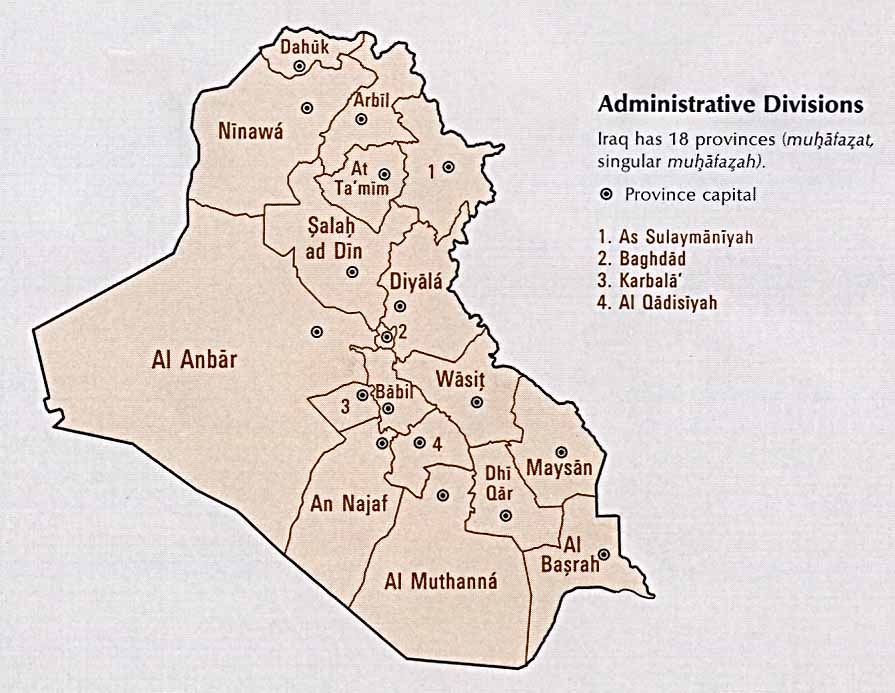
Did Maliki offer the Sadrisrts Maysan, Babil, Qadisiyah, and Dhi Qar in return for staying in power? (Univ. of Texas)

It’s been reported that part of the deal cut between the Sadrists and Prime Minister Nouri al-Maliki to assure him of a second term was that the latter would receive control of one to four southern governorships. In November 2010 for example, there were stories that the Sadrists were offered the top posts in Maysan, Babil, Qadisiyah, and Dhi Qar. 

That didn’t sit well with some of the current officeholders. The State of Law governor of Maysan for one, Muhammad al-Sudani, rejected any deal cut between the premier and the Sadrists for his position. Sudani however, was recently appointed the new Minister of Human Rights on December 21, which could provide a means for the Sadr Trend to assume power there. They currently hold seven seats out of 27 on the provincial council.

Another issue is that governors are to be appointed by the local government, not Baghdad. That didn’t stop Maliki from inserting himself into the controversy over replacing the governor in Salahaddin. There, the provincial council decided to dismiss the new governor in September 2009 over fraud charges, five months after he took office. The premier however, decided that he was going to name his replacement, and sent troops to the provincial headquarters until the local politicians gave in to his will. It took seven months to resolve the dispute with a compromise between the two sides. 

The events in Salahaddin show that with weak institutions, those with power can manipulate the system in Iraq. That doesn’t bode well if the rumors of a Sadrist-Maliki deal for southern governors is true. The premier could try to push through his choices in those provinces, all of which are controlled by State of Law coalitions. On the other hand, he could renege on his promises as he’s done with others in the past. Either way it is a story that needs to be followed in the coming days.

SOURCES

Associated Press, “Sadrists expect big role in new Iraq government,” 12/1/10

Healy, Jack, “Cleric’s Anti-U.S. Forces Poised for Gains in Iraq,” New York Times, 12/19/10

Sowell, Kirk, “Politics, Political Risk & Political Economy,” Inside Iraqi Politics, 11/22/10

Visser, Reidar, “Nujayfi, Talabani and Maliki – Plus Lots of Hot Air,” Iraq and Gulf Analysis, 11/11/10
- “Parliament Approves the Second Maliki Government,” Historiae, 12/21/10

Thursday, December 23, 2010

Another Fallout Between Sadrists And League Of The Righteous

As predicted, soon after the Sadr Trend announced that it was trying to reconcile with the breakaway Special Group, the League of the Righteous, a blow-up occurred between the two. On December 8, 2010, a member of the Sadrist movement told the press that they were going to send a delegation to meet with leaders of the League in an attempt to bring them back into the fold, get them to reject violence, and join the political process. Ten days later, the League asked to bury two of its fighters in a Sadrist cemetery in Najaf. When they said no, a firefight broke out, but with no reported casualties. Afterward, the two sides released statements attacking each other. Moqtada al-Sadr said that the government needed to stop trespassers into the Najaf cemetery, called the League corrupt, and accused them of trying to discredit him in the eyes of his followers. He went on to say that the League should be banned from joining politics because they had used violence to kill Iraqis. A spokesman for the League stated that they would not give up their weapons as long as the U.S. occupied Iraq, thus rejecting the Sadrists' overture. 

Sadr has held talks off and on with the League since 2008, with little to show for it. In December 2009 for example, Sadr issued a communiqué calling on the League to rejoin his movement. That same month however, the two groups held competing processions during a religious ceremony and taunted each other. Nothing came of the negotiations.

Every time an attempt is made to bring the two sides back together, they end up denouncing each other. This month’s events follow that pattern. The two sides apparently have little love for each other, especially at the grassroots level. Yet two years of failure has not ended the efforts at reconciliation. As in the past, after this latest spat, the Sadrists will try again. That’s because since 2004 various groups have broken off from the movement, which have weakened Sadr’s control of the street and violence, which were his main paths to power. Now, the Trend wants to consolidate its position as the main opponents to the U.S. presence in Iraq, as well as being the leading Shiite party after the March 2010 elections. If they can bring the League back into the fold, it will be another step in achieving those goals. Given their recent history however, that may be easier said than done.

SOURCES

AK News, “Attempt to incorporate al-Haq group in political process,” 12/8/10

Alsumaria, “Sadr rebukes Asaib Ahel al Haq,” 12/18/10

Daragahi, Borzou, “Muqtada Sadr’s Mahdi Army militiamen slowly resurface,” Los Angeles Times, 6/28/10

Roads To Iraq, “Al-Sadr’s election campaign, questioning Maliki is the next political crisis,” 12/9/09

Zahra, Hassan Abdul, “Iraq’s Sadr in war of words with splinter group,” Agence France Presse, 12/18/10

Wednesday, December 22, 2010

Partial Iraqi Cabinet Approved By Parliament (REVISED)

On December 21, 2010 Prime Minister Nouri al-Maliki walked into parliament, rattled off the names of 29 minister nominees, who were then elected by a hand vote by lawmakers. The group then posed for pictures, and the event was over. In those few minutes Iraq took its first step towards having a new acting government.

13 of the 42 ministries still don’t have heads. These include some of the most hotly contested positions such as Defense, Interior, National Security, and Electricity. Maliki is running the security ministries, while newly elected officials are in charge of the rest. The premier has promised to fill all of the posts before the December 25 deadline to form a new government. This was similar to Maliki’s first coalition announced in 2006 when the security ministries were also not filled until almost a month after the initial cabinet was put together.

Despite the Prime Minister’s calls for qualified and competent nominees for each ministry, his new cabinet was cobbled together in just a few hours before they were announced publicly. Maliki later said he didn’t even know anything about some of the officials.

The positions in the new government were distributed by the size of each winning list. The State of Law-Sadrist led Iraqi National Coalition walked away with the most positions as they were the largest bloc. It received the premiership, deputy premier for energy, deputy speaker of parliament, and 21 ministries, seven of which are temporary. Within the list, Maliki’s State of Law got 13 offices, five of which are temporary, the Sadrists received seven posts, two of which are temporary, Fadhila two, and the Supreme Islamic Iraqi Council and Hezbollah Iraq won one each. Iyad Allawi’s Iraqi National Movement was next with eleven, followed by nine for the Kurdish Coalition, three of which are temporary, two for the Centrist Alliance, and one for the Assyrian Democratic Movement, a Christian party. Allawi is also going to head the new National Council for Strategic Policy, but it has to be created by new legislation passed by parliament.

Along with ministries, the major Kurdish parties also walked away from the day with a promise by Maliki to fulfill their 19 demands. The prime minister signed onto the 19-points just before the cabinet was made public. The list includes implementation of Article 140 that will determine the future of Kirkuk and other disputed areas and resolving the Kurds’ oil deals. Later the Kurdish Coalition claimed that Maliki pledged to follow through with Article 140 within two years. The previous two administrations made the same deal with the Kurds, but never followed through. Whether Maliki will this time around is one of the most important decisions he will be making because it involves such divisive topics that it could derail his entire government.

On the other hand, the Kurdish opposition group the Change List, ended up leaving the new government. They demanded two service ministries and a deputy premiership, but were only offered one. Disappointed, they decided to go into the opposition instead, claiming that the Iraqi National Coalition tried to marginalize them, while the Kurdish Coalition was pressuring them to rejoin their list. This marked the first time a winning party in post-2003 Iraq has not wanted to partake in the spoils of power.

Overall, Maliki’s new ruling coalition is a mixed bag. Unlike his 2006 government, Allawi, Sunni, and nationalist parties, will have a much larger role this time around. At the same time, there are so many entities involved that they had to create new positions just to satisfy all of them. The major blocs also come with competing agendas over Iraq’s major issues such as oil, federalism, security, and the disputed territories. That will mean the new government will act much like the last one with deadlock, indecision, and procrastination on the problems that beset the country. That may also allow the premier to continue to consolidate his hold on power as he did last time. The near future in Iraq, may look a lot like the recent past.

New Iraqi Government

Top Posts

  • Prime Minister Nouri al-Maliki, Dawa, State of Law, Iraqi National Coalition, and acting Minister of Defense, Interior, and National Security
  • President Jalal al-Talabani, Patriotic Union of Kurdistan, Kurdish Coalition
  • Speaker of Parliament Osama Nujafi, Iraqi National List, Iraqi National Movement

Deputies

  • Deputy Premier Saleh al-Mutlaq, Iraqi National Dialogue Front, Iraqi National Movement
  • Deputy Premier Roj Nouri Shaways, Kurdistan Democratic Party, Kurdish Coalition, and acting Minister of Trade
  • Deputy Premier for Energy Hussein al-Shahristani, State of Law, Iraqi National Coalition, and acting Minister of Electricity
  • Deputy Speaker of Parliament Qusay Abdul Wahab Suhail, Sadr, Iraqi National Coalition 
  • Deputy Speaker of Parliament Aref Tayfour, Kurdistan Democratic Party, Kurdish Coalition

Cabinet

  • Minister of Agriculture, Izz al-Din al-Dawla, Iraqi National List, Iraqi National Movement
  • Minister of Communication Muhammad Tawfaq Allawi, Iraqi National List, Iraqi National Movement
  • Minister of Culture Sadoun Dulaimi, Unity of Iraq, Centrist Alliance
  • Minister of Education Muhammad Tamim, Iraqi National Dialogue Front, Iraqi National Movement
  • Minister of Environment Sargon Sliwa Lazar, Assyrian Democratic Movement
  • Minister of Finance Rafi Issawi, National Future Gathering, Iraqi National Movement
  • Minister of Foreign Affairs Hoshyar Zebari, Kurdistan Democratic Party, Kurdish Coalition, and acting Minister for Women Affairs
  • Minister of Health Muhammad Amin, Patriotic Union of Kurdistan, Kurdish Coalition
  • Minister of Higher Education Ali al-Adeeb, State of Law, Iraqi National Coalition, and Acting Minister of National Reconciliation
  • Minister of Housing Muhammad Darraji, Sadr, Iraqi National Coalition, and acting Minister of Public Works
  • Minister of Human Rights Muhammad Shaia’a Sudani, State of Law, Iraqi National Coalition 
  • Minister of Immigration and Displacement Dindar Shafiqq, Kurdistan Islamic Union, Kurdish Coalition, and acting Minister of Civil Society
  • Minister of Industry Ahmad Nasser al-Dali Karbuli, Renewal List, Iraqi National Movement
  • Minister of Justice Hasan Shammari, Fadhila, Iraqi National Coalition
  • Minister of Labor Nassar Rubaie, Sadr, Iraqi National Coalition, and acting Minister Of Planning
  • Minister of Oil Abdul Karim Luaibi, State of Law, Iraqi National Coalition
  • Minister of Science and Technology Abdul Karim al-Samarraie, Renewal List, Iraqi National Movement
  • Minister of Sports Jasim Muhammad Jaffar, State of Law, Iraqi National Coalition
  • Minister of State Salah Muzahim Darwish, Iraqi National Dialogue Front, Iraqi National Movement
  • Minister of State Abdul al-Mahdi al-Mutayri, Sadr, Iraqi National Coalition
  • Minister of State Salah Jabouri, Iraqi National Dialogue Front, Iraqi National Movement
  • Minister of State Hassan al-Sari, Hezbollah Iraq, Iraqi National Coalition
  • Minister of State Bushra Hussain Saleh, Fadhila, Iraqi National Coalition 
  • Minister of State for Foreign Affairs Ali al-Sajri, Unity of Iraq, Centrist Alliance
  • Minister of State for Government Spokesmanship Ali al-Dabbagh, State of Law, Iraqi National Coalition
  • Minister of State for Parliamentary Affairs Safi al-Din al-Safi, State of Law, Iraqi National Coalition
  • Minister of State for Provincial Affairs Turan Matthaw Hassan, Iraqi Turkmen Front, Iraqi National Movement 
  • Minister of State for Tribal Affairs Jamal Batikh, Iraqi National Movement
  • Minister of Tourism Lewaa Smisam, Sadr, Iraqi National Coalition
  • Minister of Transportation Hadi al-Ameri, Badr Organization/Supreme Islamic Iraqi Council, Iraqi National Coalition

Positions By List

  • Iraqi National Coalition: Prime Minister, Deputy Premier for Energy, Deputy Speaker of Parliament, Ministries of Defense (temp), Education, Electricity (temp), Housing, Human Rights, Interior (temp), Justice, Labor, National Reconciliation (temp), National Security (temp), Oil, Planning (temp), Public Works (temp), Sports, State x3, State for Foreign Affairs, State for Government Spokesmanship, State for Parliamentary Affairs, Tourism, Transportation - 21 ministries total, 7 temporary
  1. State of Law: Prime Minister, Deputy Premier for Energy, Ministries of Defense (temp), Education, Electricity (temp), Human Rights, Interior (temp), National Reconciliation (temp), National Security (temp), Oil, Sports, State for Government Spokesmanship, State for Parliamentary Affairs - 11 ministries total, 5 temporary
  2. Sadrists: Deputy Speaker of Parliament, Ministries of Housing, Labor, Planning (temp), Public Works (temp), State, Tourism - 6 ministries total, 2 temporary
  3. Fadhila: Ministries of Justice, State - 2 ministries total
  4. Hezbollah Iraq: Ministry of State - 1 ministry total
  5. Supreme Islamic Iraqi Council: Ministry of Transportation - 1 ministry total
  • Iraqi National Movement: Speaker of Parliament, Deputy Premier, Ministries of Agriculture, Communication, Education, Finance, Industry, Science and Technology, State x2, State for Provincial Affairs, State for Tribal Affairs - 10 ministries total
  1. Iraqi National List: Speaker of Parliament, Ministries of Agriculture, Communication - 2 ministries total
  2. Iraqi National Dialogue Front: Deputy Premier, Ministries of Education, State x2 - 3 ministries total
  3. National Future Gathering: Ministry of Finance - 1 ministry total
  4. Renewal List: Ministries of Industry, Science and Technology - 2 ministries total
  5. Iraqi Turkmen Front: Minister of State for Provincial Affairs - 1 ministry total
  • Kurdish Coalition: President, Deputy Premier, Deputy Speaker of Parliament, Ministries of Civil Society (temp), Foreign Affairs, Health, Immigration and Displacement, Trade (temp), Women Affairs (temp) - 6 ministries total, 3 temporary
  1. Kurdistan Democratic Party: Deputy Premier, Deputy Speaker of Parliament, Ministries of Foreign Affairs, Trade (temp), Women Affairs (temp) - 3 ministries total, 2 temporary
  2. Patriotic Union of Kurdistan: President, Ministry of Health - 1 ministry total
  3. Kurdistan Islamic Union: Ministries of Civil Society (temp), Immigration and Displacement - 2 ministries total, 1 temporary
  • Centrist Alliance: Ministry of Culture, Minister of State for Foreign Affairs - 2 ministries total
  • Assyrian Democratic Movement: Ministry of Environment - 1 ministry total

SOURCES

Agence France Presse, “A lone woman in Iraq’s new cabinet,” 12/21/10

Alaadin, Ranj, “#Iraq names cabinet – finally,” Ranj Alaaldin Blog, 12/21/10

Ali, Yaser, "KBC: Maliki signs agreement to Kurdish conditions," AK News, 12/21/10

Ali, Saman, "Maliki signed to implement article 140 in two years," AK News, 12/21/10

Ashur TV, “Ashur t.v. Interview with Mr. Sargon Lazar, of Foreign the Assyrian Democratic Movement,”  Christians Of Iraq, 2/29/08

Aswat al-Iraq, “Nejeifi named parl. Speaker, Suhail and Tayfour deputies,” 11/11/10
- “The new cabinet line-up announced by al-Maliki,” 12/21/10
- "North Iraq Kurdistan's "Change" Bloc withdraws from new cabinet," 12/21/10

BBC, “Iraqi parliamentary approves new government,” 12/21/10

Chulov, Martin, "Iraq names cabinet after nine-month power struggle," Guardian, 12/21/10

Healy, Jack, "Cleric's Anti-U.S. Forces Poised for Gains in Iraq," New York Times, 12/19/10

Ibrahim, Haider, “No minister assigned without my consent says Maliki,” AK News, 11/27/10

Katzman, Kenneth, "Iraq: Politics, Elections, and Benchmarks," Congressional Research Service, 4/22/09
- "Iraq: Reconciliation and Benchmarks," Congressional Research Service, 5/12/08

Kazmi, Haider, "Maliki spoke frankly and undermine his confidence: I am not convinced I do not know anything about some ministers," Al-Aalem, 12/21/10

Long, Austin, “Why Anbar voted for Allawi,” Foreign Policy, 4/5/10

Omaima, Younis, “Iraqiya got 9 ministries and the Sadrists 8, and 6 for the Kurds, and only 4 of the State of Law,” Al-Aalem, 12/21/10

Surk, Barbara and Abdul-Zahra, Qassim, "Iraq finally has a new government," Associated Press, 12/21/10

Visser, Reidar, “Change Inside Iraqiyya?” Iraq And Gulf Analysis, 11/14/10
- “Parliament Approves the Second Maliki Government,” Historiae, 12/21/10

Wikipedia, “Rafi al-Issawi”
Tuesday, December 21, 2010

Supreme Islamic Iraqi Council Finally Comes Out For Maliki

On December 16, 2010 it was reported that Ammar Hakim, the head of the Supreme Islamic Iraqi Council (SIIC), had finally come out in favor of Prime Minister Nouri al-Maliki’s second term. Hakim made his announcement in a speech in Baghdad marking the beginning of the celebration for the Imam Hussein Bin Ali. The Supreme Council was the last major party to support the premier, marking their decline in Iraq’s political system.

The SIIC followed a bewildering, and ultimately self-defeating path before and after the March 2010 election. The party’s problems began with the 2009 provincial balloting. The Supreme Council faced a devastating series of losses, going from controlling most of the south and Baghdad to only Muthanna. That was a foreshadowing of its showing in 2010, as the SIIC was seen as being sectarian, too close to Iran, and having mismanaged the governorates. They didn’t seem to learn their lesson however as they joined the Iraqi National Alliance along with the Sadrists in August 2009, which was pushed by Iran to unite all of the Shiite parties. Within days the leader of the SIIC Abdul Aziz al-Hakim passed away, leaving a power vacuum, as his son Ammar took charge of the organization. The National Alliance failed to convince Prime Minister Maliki to run with them. The Supreme Council then decided to back the Accountability and Justice Commission’s banning of dozens of members of Iyad Allawi’s Iraqi National Movement for alleged ties to the Baath Party. After the voting in Mach 2010, the National Alliance and Maliki’s State of Law joined together into the National Coalition. Hakim felt threatened however because Maliki and the Sadrists had all done better than the SIIC in the balloting, and it had become a minor party as a result. That led Hakim to become one of the strongest opponents to Maliki, then reverse course and try to align with Allawi, but nominate its own candidate for prime minister, Vice President Adel Abdul Mahdi, in September 2010. Since Allawi was set on becoming Iraq’s leader this was a non-starter for Hakim. To make things worse, when Sadr came out for Maliki on October 1, the Badr Organization did so as well, effectively splitting the SIIC in two. When Allawi finally gave in, and agreed to Massoud Barzani’s power sharing agreement in November that kept Maliki in power, the Supreme Council was left out in the cold.

Hakim and his party lucked out because the new Iraqi regime will be a national unity government. That means all of the major parties will be included, even the SIIC. Now that the discussion has shifted from who will be Iraq’s next leader to controlling ministries, the Supreme Council has finally come around and backed the premier to try to partake in the spoils. It’s likely to only get 2-3ministries, reflecting its decline.

The SIIC went from one of the leading parties in the country, and being a backbone of the Jaafari and Maliki governments, to now being a medium sized organization that was unable to shape any of the major negotiations over the new ruling coalition. It is now an afterthought when posts are being distributed, and its decision to support the prime minister hardly gained any attention. This means some of the party’s ideas such as federalism and a Shiite autonomous region in the south are likely dead. On the other hand, exile and anti-Saddam opposition lists like the SIIC still run Iraq, occasionally wielding sectarian issues to stay in office. The party is not going to disappear, and still holds 20 seats in the new parliament, but its fall from grace hopefully means that more nationalist and domestic lists are coming to the fore, which would be a major development in Iraq’s politics.

SOURCES

Aswat al-Iraq, “Hakim pledges support for PM Maliki’s govt.,” 12/16/10

Al Jazeera, “Iraqi Shias form new alliance,” 8/24/09

Ramzi, Kholoud, “after months of negotiations, maliki holds on to power,” Niqash, 12/15/10

Serwer, Daniel and Parker, Sam, “Maliki’s Iraq between Two Elections,” United States Institute of Peace, May 2009

Monday, December 20, 2010

More Experts Question Iraq's Oil Production Goals


After signing a number of petroleum deals with international corporations in 2009 and 2010 the Iraqi Oil Ministry plans a massive increase in production. Oil Minister Hussein Shahristani has promised 12 million barrels a day, up from the current 2.5 million barrels by 2017. Few experts and oil executives believe this is possible however within that time frame.

Since 2009 Iraq’s Oil Ministry has consistently talked about a boost in output. In September 2010 Minister Shahristani predicted a 4.2% increase by the end of 2010. After that the country was to reach 4 million barrels a day in 2013, and finally 12 million by 2017.

No experts interviewed in the press believe those benchmarks are possible. At the end of October 2010 Reuters conducted a survey of ten banks, analysts, and universities. They believed that 2.8 million barrels by 2011 and 4.6 million by 2015 were more realistic. The Economist Intelligence Unit had the highest mark of 6.02 million barrels by 2016. In mid-November the International Energy Agency predicted 6.5 million barrels, but not until 2030. Finally, at the end of November an adviser to Prime Minister Nouri al-Maliki said that the country would only reach 8 million barrels by 2017. All of those questioned had the same reasons for their skepticism; Iraq lacks security, political stability, infrastructure, and leadership to manage such a large increase. One oil consultant said that Iraq’s planned investment in drilling exceeded the country’s capabilities. Another said Iraq needs roads, bridges, airports, and a steady water supply, not just improving its oil industry. Iraq is moving ahead with plans to expand its ports, pipelines, and other parts of the petroleum supply chain, but there are always questions about whether the country has enough financing, and can finish any of the work on time and competently.

With foreign help Iraq’s oil production will undoubtedly go up. It’s just a question of how much and how fast. Despite Oil Minister Shahristani’s prediction of immediate results following the signing of petroleum contracts with international companies, there has not been any noticeable increase as of November 2011. The nation’s current pipelines and port can’t handle any large up tick as well until they are expanded. Experts seem to agree that 5-6 million barrels a day in 5-10 years would be a much more realistic mark. Iraq wants to return to the international oil market in a big way, and be a leader in OPEC like it used to be before twenty years of wars and sanctions devastated its industry. Unfortunately, those lost years will be hard to make up, and even if Iraq produces half of what it wants to it will probably not be a game changer any time soon.


Predictions Of Iraq's Future Oil Production (Avg. Millions/Barrels/Day)

RespondentEnd 2011 2012 2013 2014 2015 2016 2017 
Oil Ministry 4.0 12.0 
Former Oil Minister Chalabi 6.0 
PM Maliki Adviser 8.0 
Deutsche Bank 2.85 3.0 3.3 3.8 4.4
Dunia Frontier Consultants 2.5 3.0 3.5 4.0 5.5 
Iraq Energy Institute 2.75 3.1 3.8 4.2 
JBC Energy 2.85 3.3 3.9 4.9 
Economist Intelligence Unit 2.65 2.87 3.14 3.49 4.21 6.02 
Eurasia Consultants 2.8 3.3 3.8 4.8 
London School of Economics 3.2 3.8 4.3 4.5 4.5 
Neftex Petroleum Consultants 3.0 3.9 4.0 4.2 4.4 
Oil Company (Unnamed) 2.7 3.0 3.8 4.5 5.5 
Consultancy (Unnamed) 3.0 3.0 3.5 4.0 4.0 5.0 
Averages 2.83 3.22 3.92 3.99 4.64 5.17 10.0 


SOURCES

Lewis, Barbara and El Gamal, Rania, “POLL-Iraq oil output seen edging up, not yet game-changer,” Reuters, 10/28/10

Pamuk, Humeyra, “Iraqi oil output plans overambitious – executives,” Reuters, 10/13/10

Razzouk, Nayla, “Iraq’s October Oil Export Revenue Reaches Highest Level in Year,” Bloomberg, 11/26/10

Reuters, “UPDATE 2-Iraq oil output may hit 8 million bpd by 2017,” 11/29/10

UPI, “IEA says Iraq’s oil boost plan a fizzle,” 11/4/10

Sunday, December 19, 2010

Turkey Doing Business In Iraq

Since the sectarian civil war ended in Iraq in 2007, Baghdad has actively been seeking foreign investment and better trade agreements to rebuild the country. One of those success stories is Turkey.

The Turkish presence in Iraq is large and growing. Recently, an economic adviser to the government said that there were more Turkish companies in Iraq than from any other country. In Kurdistan alone, 60% of the foreign businesses there, roughly 730, were from Turkey. In 2009 the two countries conducted $9 billion worth of trade. That was up from almost $0 before 2003. By 2007 that had grown to $3.7 billion, then $6 billion in 2008. Turkey also has $8 billion invested in Iraq. Most Turkish businesses are involved in construction, electricity, and commerce.

There are a few complaints about the Turkish economic presence in Iraq. In Kurdistan for example, many of the Turkish firms are contractors dealing with trade. There, the Investment Board has said that most of the Turkish companies are not investing enough, and are only there for short-term profits. Kurdish businesses are pushing the regional government to make Turkey form more joint ventures as a result. Another major issue is that Turks tend to employ Turks, instead of Iraqis. They’re said to do so for ease of operation and because Turks have more experience. Again, in Kurdistan, locals are demanding that the Turks hire more locals.

Turkey has become a major player in Iraq’s economy. Outside of oil, they have more business with Iraq than any other country. Hundreds of Turkish companies have set up shop in Iraq. There is some debate about how much they actually contribute to the country however. Nonetheless, Baghdad has been eager to sign agreements with Ankara, and see the relationship between the two grow even more. That will only increase the amount of trade and investment between them. Both sides are attempting to benefit from this situation. Ankara sees its growing economic ties as a means to gain influence in Iraq, especially with the Kurds, who they shunned before 2003. Baghdad wants foreign businesses to come to the country to help revive the economy after years of sanctions and wars. While Turkey appears to have the upper hand for now, hopefully when Iraq recovers it will be able to set more equal terms.

SOURCES

Agence France Presse, “Iraq-Turkey trade up 50 percent in past year,” 4/10/10

AK News, “Investment in Kurdistan reached almost $14 billion in five years,” 8/6/10
- “Turkish companies asset in Kurdistan over US$ 621 million,” 7/21/10

Aswat al-Iraq, “Turkish and French Companies Most Active in Iraq,” Iraq Business News, 12/4/10

Kimball, Jack and Aqrawi, Shamal, “Iraqi Kurdistan attracts $12 bln over 3-1/2 yrs-board,” Reuters, 2/15/10

Nordland, Rod, “Rebuilding Its Economy, Iraq Shuns U.S. Businesses,” New York Times, 11/13/09

Special Inspector General for Iraq Reconstruction, “Quarterly Report to the United States Congress,” 10/30/10

Friday, December 17, 2010

Baghdad Government Cracking Down On Alcohol Sales

Recently, the local government of Baghdad has tried to crackdown on alcohol sales. At the end of November 2010 Iraqi police entered a café in the capital frequented by members of the Iraqi Writers Union, and forced the owner to sign a paper saying that his establishment was a nightclub so that it could be shut down. The authorities were using an old Saddam era law from the 1990s that banned the sale of alcohol in hotels and restaurants by all except Christians to non-Musims. Afterward, writers and poets of the Union organized a protest claiming that the government was using laws that it had condemned before, and trying to impose a religious state based upon Iran’s. A few days later there were counter demonstrations by the Sadrists calling for all liquor to be banned in the country. 

Back in August 2009, Dawa led provincial councils started banning alcohol in the capital, Basra, Najaf, and Wasit. (1) That led to the closing of several liquor stores that had just re-opened after government crackdowns on Shiite militias in 2008. Dawa is Prime Minister Nouri al-Maliki’s party.

Even though the premier has run on a secular platform in the 2009 and 2010 elections, there are still religious elements of his party, and it may be trying to appeal to likeminded Iraqis. The Sadrists for example, were key to securing Maliki’s nomination for a second term in office. Starting another anti-liquor campaign could be aimed at winning points with them as they have come out in support of the bans.

Sadrists protesting for banning alcohol in Baghdad

(MEMRI Blog)

Writers and poets protesting crackdown on liquor sales in Baghdad

(MEMRI Blog)

(Jewish Policy Center)

FOOTNOTES

1. Al-Wazzan, Saleem, “booze ban in basra,” 3/23/10

SOURCES

Agence France Presse, “Iraqi writers protest against club closure and alcohol ban,” 12/3/10

Al-Jader, May, “Iraqi Writers Union outraged by social club closure,” AK News, 11/29/10

Al-Rafidayn, Al Arabiya, Al-Mada, Al-Sharq Al-Awsat, “The Crisis of Closing Down Baghdad Night Clubs Escalates,” MEMRI Blog, 12/9/10

Reuters, “Supporters of Shi’ite cleric MOqtada al-Sadr,” 12/10/10

Al-Wazzan, Saleem, “booze ban in basra,” 3/23/10

This Day In Iraqi History - Nov 14 British army ordered to seize Basra vilayet WWI

1914 Sheikh of Islam called for jihad against British and French during WWI Call was repeated in all Sunni mosques in Mosul, Baghdad a...